News from LabRulezLCMS Library - Week 37, 2024

Photo: LabRulezLCMS Library
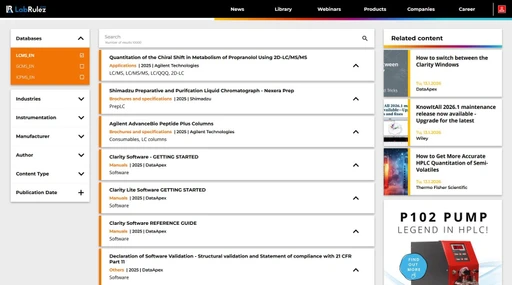
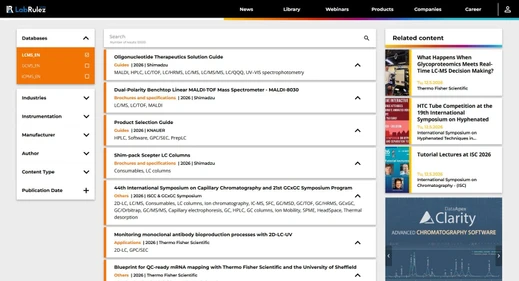
Our Library never stops expanding. What are the most recent contributions to LabRulezLCMS Library in the week of 9th September 2024? Check out new documents from the field of liquid phase, especially HPLC and LC/MS techniques!
👉 SEARCH THE LARGEST REPOSITORY OF DOCUMENTS ABOUT LCMS AND RELATED TECHNIQUES
👉 Need info about different analytical techniques? Peek into LabRulezGCMS or LabRulezICPMS libraries.
This week we bring to you applications, technical notes, posters and other documents by Agilent Technologies, Shimadzu, Thermo Fisher Scientific, Waters Corporation, and Metrohm!
1. Metrohm: Installation instruction: MVA-25 – 884 Professional VA fully automated for the determination of antioxidants with auto-matic sample preparation
- Technical note
The «MVA-25» is a fully automated system for the determination of antioxidants in lubricants, including automatic sample preparation. The only manual operation needed is to pipette the reference oil or the in-service oil sample into a vial and place it on the rack of the sample changer. All other steps of the analysis procedure are carried out automatically.
Important features:
- Automatic sample preparation.
- Addition of electrolyte into the sample vial.
- Mixing of reference oil or in-service oil sample with sand and electrolyte.
- Calibration and determination of a series of samples.
- Automatic addition of electrolyte into the measuring vessel for the blank determination.
- Automatic transfer of the extraction solution fromthe sample changer to the measuring vessel.
- Automatic calculation of the calibration curve fora reference oil or the remaining antioxidant content for an in-service oil sample.
- Automatic rinsing of transfer tubing and measuring vessel.
- Applications:
- Determination of aromatic amine type antioxidants based on ASTM D6971 [1].
- Determination of hindered phenol type antioxidants based on ASTM D6810 [2].
- Combination of ASTM D6971 and ASTM D6810 into one determination requiring only one sample preparation procedure per sample
2. Waters Corporation: Employing ballistic gradients, vacuum jacketed columns and prototype benchtop multi reflecting time-of-flight (MRT) to increase lipidomic throughput whilst maintaining highly confident identifications
- Poster / ASMS
INTRODUCTION:
One common theme between all omics applications is the ever-increasing size of patient cohorts, driven by the need for identification of novel disease biomarkers and an increase in the power of the studies. However, as these studies scale to thousands of patient samples throughput becomes the limiting factor.
One such possible method is to decrease separation time using methods such as Rapid Microbore Metabolic Profilling (RAMMP) that scale down column dimensions and chromatographic separation time 1. However, this does come at the cost of peak capacity and feature detection.
One way to maintain narrow peak widths is to move the column significantly closer to the MS source, and in combination with a vacuum jacket to mitigate frictional heating and temperature differentials, vacuum jacketed columns (VJC) can significantly increase peak capacity and narrow peak widths (Figure 1) 2.
Reliable identification of lipids in short analysis times requires high resolution mass spectrometers capable of fast scanning without loss of resolution. Multi reflecting time of flight utilises gridless mirrors to prevent ion loss while increasing flight length, and therefore, mass resolution. The benchtop Xevo MRT Mass Spectrometer is capable of scanning at 100Hz while maintaining a mass resolution of 100,000 full width half maximal (FWHM), necessary for sufficiently profiling ever decreasing peak widths (Figure 2).
As such, vacuum jacketed columns and the Xevo MRT MS were applied to the analysis of the lipidome of healthy controls and patients with different cancers and compared with conventional chromatography.
3. Thermo Fisher Scientific: HPLC Hacks: 9 Easy Ways To Modernize Your Methods
- Guide
Adopting modern analytical technology can help your lab boost productivity, reduce costs, and lower environmental impacts by using fewer chemicals. This list provides top considerations to help you get started.
Lab operation
- Make a list of any recurring issues causing preventable instrument downtime Use a Fishbone diagram to find the root cause of each issue and see what solutions you need to overcome the problem.
- Identify which methods you need to modernize that are draining your productivity and budget Modernizing older methods can help increase your lab’s productivity and lower your carbon footprint.
- See what changes to your method are allowable without needing revalidation Ways to modernize your method include changing column particle size, length, and inner diameter for isocratic and gradient methods. Consult your regulatory guidelines (like USP 621) to learn more.
HPLC instrument
- Make sure your instrument can handle a wider range of backpressures Moving to smaller column particles and inner diameters can improve method efficiency, speed, and sensitivity at the cost of higher backpressures. Ensure your instrument can meet the pressure demands of your new method.
- Consider upgrading to a dual-channel instrument to maximize your throughput and bench space Dual-channel LC systems have two flow paths in a single system, allowing you to run two analyses simultaneously.
- Adjust fittings and tubing to match your new flow rates and column dimensions The impact of extra column and dead volumes on resolution becomes more pronounced as your flow rates and column volumes decrease.
CDS software and automation
- Use an instrument and software combo with built-in tools to simplify method transfer Leverage tools to simplify your method transfer to newer LC hardware, like custom injection programs, adjustable gradient delay volumes, and dual-column heating modes.
- Simplify sequence creation and instrument operation with eWorkflows Different instrument conditions, injection sequences, and techniques for calculating results can create complexity for operators. Adopting software with customizable templates helps you get accurate results quicker and more efficiently.
- Set-up automated system suitability testing to prevent wasted samples from failed runs Take advantage of automated system suitability testing and intelligent run control to set up in-run pass/fail limits and define sample re-injection criteria, eliminating errors and sample waste.
4. Shimadzu: Quantitation of Extractable Per- and Polyfluorinated Alkyl Substances (PFAS) in Consumer Products on the Shimadzu Triple Quadrupole Mass Spectrometer LCMS-8060NX
- Application
User Benefits
- A newly developed and cost-effective full workflow for the analysis of extractable PFAS in consumer products without the need of labor-intensive solid phase extraction.
- Meet or exceed the proposed reporting limits of the new ASTM method for 46 PFAS and 25 surrogates using the highly sensitive Shimadzu LCMS-8060NX.
- Reduce pressure failures with the new Shimadzu Nexcol PFAS Delay column (backpressure tolerance of 15,000 psi) while minimizing PFAS background levels.
Introduction
Per-and Polyfluorinated alkyl substances (PFAS) are a broad class of thousands of chemicals with a varied global definition that include carbon-fluorine bonds. Since the carbon-fluorine bond is the strongest in organic chemistry, PFAS was manufactured for desirable water-resistant, oil-resistant, and heatresistant properties. Since the 1940’s, industries have integrated PFAS in products such as food packaging, textiles, and household products due to their unique properties. However, a characteristic of PFAS of concern is their slow breakdown rate, leading to potential accumulation in people, animals, and the environment. Studies have shown widespread exposure to PFAS among the United States population.1 In response to growing concerns regarding consumer exposure to PFAS, many states have initiated bans of PFAS uses in various consumer products and food packaging materials.2 These bans have led to a need for analytical testing to determine the amount of PFAS in consumer products, however, the lack of standardized methods presents challenges in ensuring reliability and reproducibility between labs.
5. Agilent Technologies: Simplified Analysis Workflow – Determination of Vitamins B1, B2, B3, B5, and B6 in Infant Formula
- Application
Abstract
This study developed and validated an efficient workflow for analyzing vitamins B1, B2, B3, B5, and B6 in infant formula. The workflow employed a straightforward sample preparation protocol, using trichloroacetic acid (TCA) for protein precipitation. For enhanced detection sensitivity, the analysis was performed using the Agilent 1260 Infinity II Prime LC system, equipped with a 60 mm Agilent InfinityLab Max-Light cartridge cell in the diode array detector (DAD). The developed methods demonstrated robustness and reliability in quantifying B vitamins in infant formula, ensuring accurate nutritional labeling and compliance with regulatory standards.
Conclusion
This study successfully developed and validated an efficient workflow for quantifying B vitamins in infant formula. The workflow uses a simple and straightforward sample preparation protocol to precipitate proteins in the formula. Despite its simplicity, the study demonstrated excellent linearity, repeatability, and recovery, providing reliable measurements of vitamins B1, B2, B3, B5, and B6. The use of the Agilent 1260 Infinity II Prime LC system, paired with a 60 mm Agilent InfinityLab Max-Light cartridge cell in the DAD, significantly enhanced detection sensitivity.