News from LabRulezLCMS Library - Week 3, 2025
LabRulez: News from LabRulezLCMS Library - Week 3, 2025
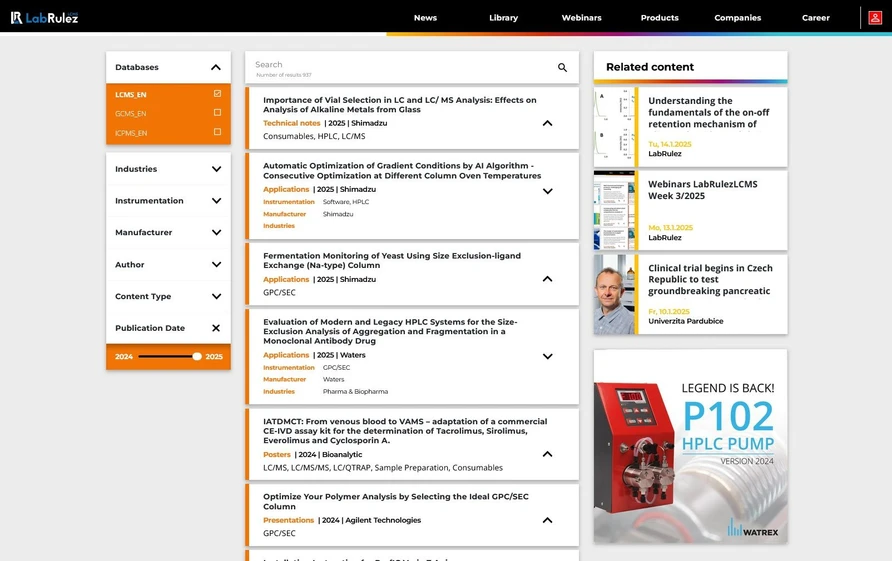
Our Library never stops expanding. What are the most recent contributions to LabRulezLCMS Library in the week of 13th January 2025? Check out new documents from the field of liquid phase, especially HPLC and LC/MS techniques!
👉 SEARCH THE LARGEST REPOSITORY OF DOCUMENTS ABOUT LCMS AND RELATED TECHNIQUES
👉 Need info about different analytical techniques? Peek into LabRulezGCMS or LabRulezICPMS libraries.
This week we bring you applications by Thermo Fisher Scientific, Shimadzu, a presentation by Agilent Technologies, a manual by Metrohm, and a poster from ASMS by Waters Corporation!
1. Thermo Fisher Scientific: High-resolution DIA proteomics workflow for single-cell samples on the Orbitrap Astral mass spectrometer
- Technical note
- Full PDF for download
Assess proteome coverage and sample throughput performance for single-cell samples using a library-free and library-based data-independent acquisition (DIA) method on the Thermo Scientific™ Orbitrap™ Astral™ mass spectrometer.
Introduction
In recent years, there has been a shift to analyzing smaller sample quantities, driven by the interest in profiling the proteome of individual cells. This increased focus on LC-MS analysis of limited sample amounts, e.g., single cells, requires the highest possible sensitivity. At the same time, throughput and chromatographic performance must be preserved to generate sufficiently high-quality data from large data sets to draw meaningful conclusions. This trend toward analyzing smaller sample quantities reflects the need to understand the heterogeneous nature of biology through the dissection of complex systems into their individual parts or, specifically, individual cells. Traditional proteomics approaches read out the average of a sample while single-cell proteomics provides insights into the exact nature of each of the components in such samples.
The Orbitrap Astral mass spectrometer delivers a new standard for single-cell samples with deeper proteome coverage and faster throughput. It enables these capabilities through the synchronized acquisition of high-resolution and high-dynamic range full scan spectra with the Thermo Scientific™ Orbitrap™ mass analyzer and high speed and sensitivity MS/MS spectra with the Thermo Scientific™ Astral™ mass analyzer. The Thermo Scientific™ Vanquish™ Neo UHPLC system delivers maximum performance in terms of precise, low flow rates and gradient formation, as well as low injection volumes—an important benefit for single-cell proteomics and limited sample amounts.
The Thermo Scientific™ μPAC™ Neo HPLC columns with novel micro-pillar array deliver highly reproducible chromatographic separation and increased sensitivity with maximum resolution.
The Thermo Scientific™ FAIMS Pro Duo interface enhances sensitivity by removing background signals.
In this technical note, we present a single-cell proteomics workflow (Figure 1). To first evaluate sensitivity and quantitative precision and accuracy and linearity of the workflow, a dilution series from 5 ng to 50 pg of the Thermo Scientific™ Pierce™ HeLa protein digest standard was analyzed.
2. Shimadzu: Automatic Optimization of Gradient Conditions by AI Algorithm - Consecutive Optimization at Different Column Oven Temperatures
- Technical note
- Full PDF for download
User Benefits
- The AI algorithm of LabSolutions MD can automatically optimize gradient conditions to greatly reduce labor of LC method development.
- Gradient conditions are automatically optimized at different column oven temperatures consecutively.
- Automatic optimization of gradient conditions can be applied not only to new method development, but also to existing method to efficiently improve resolution.
Introduction
In the typical LC method development, the process begins with “preparation” which includes mobile phase preparation, column installation, and creation of analysis schedules, then the analysis is started. After that, the acquired data is analyzed and “preparation” for the subsequent analysis is carried out, followed by starting the next analysis again. The method development progresses by repeating these processes, but in addition to the significant time required to repeatedly create analysis schedules, expertise in chromatography is necessary to explore optimal conditions based on data analysis. In other words, typical method development requires “human intervention”. Therefore, eliminating human involvement and automating such method development processes would be desirable to improve labor efficiency. This article introduces an approach for automatically optimizing gradient conditions at different column oven temperatures consecutively, identifying the combination of temperature and gradient conditions that meet the resolution criteria.
Conclusion
Automatic optimization of gradient conditions using AI algorithm of LabSolutions MD was applied to a model sample (mixture of seven compounds of small molecule) at different column oven temperatures. As a result, the temperature and gradient conditions that met the resolution criteria were successfully explored. In method development, human intervention, such as analysis batch creation and data analysis, is required to optimize gradient conditions. LabSolutions MD can provide significant labor savings in this area. For more information on LabSolutions MD, please refer to the Technical Report “Efficient Method Development Based on Analytical Quality by Design with LabSolutions MD Software (C190-E284)”.
3. Agilent Technologies: Optimize Your Polymer Analysis by Selecting the Ideal GPC/SEC Column
- Presentation
- Full PDF for download
- Recorded webinar
- GPC/SEC Separation Mechanism
- Conventional GPC/SEC Workflow
- Considerations for GPC/SEC Column Selection (Key questions to ask)
- What polymer are you analysing?
- Which solvent (or solvents) is your polymer soluble in?
- What is the expected molecular weight range of your polymer?
- What is the requirement for your analysis or what would you like to improve about your existing GPC/SEC separation?
- Resolution is important
- Reproducibility of sample chromatography and results
- Speed of analysis or sample throughput is something to improve on
- Further considerations
- Know the properties of the sample
- Be familiar with the properties of the columns being considered
- It is important to balance polarities for the sample, solvent, and column packing
- Common Column Chemistries for GPC/SEC
- Agilent Magic Triangles
- Column Selection: Porosity
- Individual Pore Versus MultiPorous Particle
- Column Selection: Particle size
- Columns for Low Polarity Organic Eluents
- Columns for Medium Polarity Organic Eluents
- Columns for High Temperature GPC/SEC
- Columns for Fluorinated Organic Eluents
- Columns for Aqueous Eluents: Neutral or weak Anions
- Columns for Aqueous Eluents: Polycations and Strong Polyanions
- Column Selection: Additional Considerations
- Columns in Series
- Wrongly Coupled Columns
- Combination of Individual Pore Size Columns
- Column Selection and Importance of Solvent Choice
- Solvent Selection
- Successful Solvent Choice
- Eluent Modification in Organic GPC
- Common Questions Around GPC/SEC Standards
- Agilent Polymer Calibration Standard Offerings
- Well Characterized Polymer Standards
- Easivial Certificate of Analysis
- Common Questions Around SEC Standards
- Installation and Care of Your Column
- Before Your Analysis
- Column Selection – Additional considerations
- System Tubing
- Your GPC/SEC Toolbox
4. Metrohm: Installation Instruction for ProfIC Vario 7 Cation
- Manual
- Full PDF for download
The ProfIC Vario 7 Cation is a Professional IC Vario system with Inline Dilution and Inline Dialysis for the fully automatic determination of cations in high concentrations in matrices containing emulsions. This system enables users to dilute the sample and eliminate droplets of fat or organic solvents or particles prior to the analysis.
5. Waters Corporation: IMPROVED TISSUE HOMOGENIZATION AND SPE-BASED SAMPLE PREPARATIONS FOR THE QUANTITATIVE LC-MS ANALYSIS OF OLIGONUCLEOTIDE THERAPEUTICS
- Poster/ASMS
- Full PDF for download
Efficient extraction of drug analytes is a critical aspect of drug metabolism and pharmacokinetics (DMPK) studies. This has long applied to small molecules and still applies to the bioanalysis of oligonucleotides. Oligonucleotide drugs and their metabolites must be quantified within both biofluids and tissue samples. The newest of oligonucleotide drugs are both extensively modified and conjugated. These modified residues and conjugate moieties can complicate extraction recovery and reproducibility. In this work, we report several key insights on how to achieve improved extractions. Protocols for solvent-assisted proteinase K sample pre-treatments are investigated using a weak anion exchange (WAX) microplate-based solid phase extraction (SPE) device. Direct injection LC-MS quantitation is demonstrated for all three antisense oligonucleotides (ASOs).
CONCLUSIONS
- Selective extraction and elution of ASO oligonucleotides is feasible from multiple tissue types.
- Extracted ASOs are amenable for either full scan mode analysis on benchtop small footprint TOF MS or MRM analysis by Triple Quad MS
- Reproducible and repeatable data were collected even without the application of an internal standard
- One novel aspect of the SPE eluate is that no further sample preparation is required for subsequent LC-MS analysis saving time and avoiding sample losses during drying and reconstitution
- Eluted nucleic acid components can be readily analyzed by regular ion-pairing reversed phase chromatography and UV/MS-based detection and quantitation
- This robust tissue extraction protocols for improved LC-MS based bioanalysis of ASO drugs was repeatable and highly reproducible across multiple batches of SPE sorbent, providing confidence in the suitability of the optimized protocols