LCMS
More information
WebinarsAbout usContact usTerms of use
LabRulez s.r.o. All rights reserved. Content available under a CC BY-SA 4.0 Attribution-ShareAlike
Author
LabRulez
LabRulez
Everything from the world of analytical chemistry in one place. We connect people in solving their problems. At Labrulez you will find all the necessary information easily, quickly and clearly. Stop searching and start finding.
Tags
Scientific article
Science and research
LinkedIn Logo

Remote Deep-Ultraviolet Laser Ablation in Connection with Electrospray Ionization–Atmospheric Pressure Chemical Ionization (rDUVLAESCI): A Novel Dual Ionization Source for Molecular Mass Spectrometry
Tu, 18.2.2025
| Original article from: Anal. Chem. 2025, 97, 4, 2062–2069
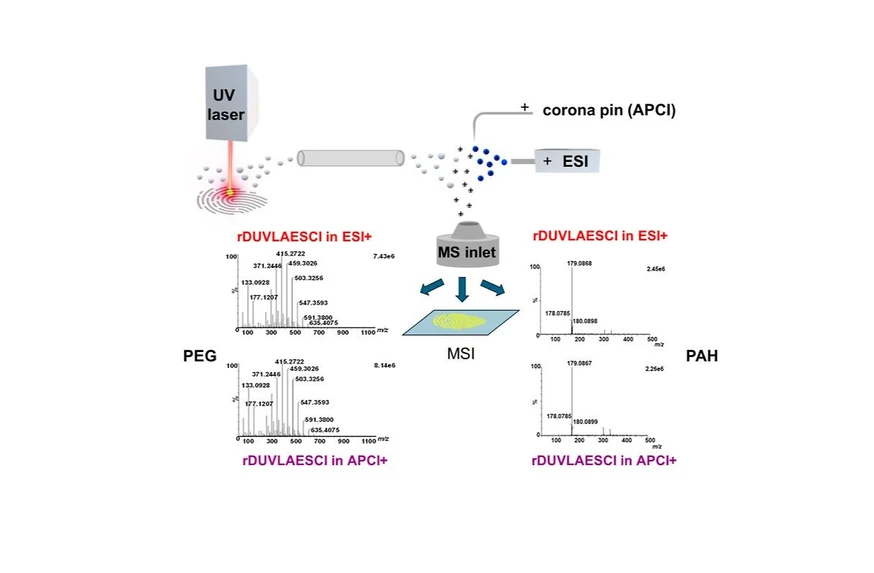
This study introduces a novel remote deep-UV laser ablation dual-ionization source for molecular mass spectrometry and imaging with enhanced spatial resolution.
<p>Anal. Chem. 2025, 97, 4, 2062–2069: Remote Deep-Ultraviolet Laser Ablation in Connection with Electrospray Ionization–Atmospheric Pressure Chemical Ionization (rDUVLAESCI): A Novel Dual Ionization Source for Molecular Mass Spectrometry</p>

Anal. Chem. 2025, 97, 4, 2062–2069: Remote Deep-Ultraviolet Laser Ablation in Connection with Electrospray Ionization–Atmospheric Pressure Chemical Ionization (rDUVLAESCI): A Novel Dual Ionization Source for Molecular Mass Spectrometry

The study presents a remote deep ultraviolet laser ablation inlet connected to a dual electrospray ionization–atmospheric pressure chemical ionization (rDUVLAESCI) source for molecular mass spectrometry. This system enables simultaneous spatial acquisition of MS data for diverse organic molecules, offering improved detection of both polar and nonpolar compounds. With a deep 193 nm UV laser, the system allows precise sampling from dried spots, supporting molecular MS imaging (MSI) at resolutions down to 3 μm. 

The rDUVLAESCI dual source provides complementary ionization modes, achieving high analyte sensitivity across a broad molecular range. Demonstrations include mapping psychoactive substances on latent fingerprints, linking chemical and biometric data for enhanced forensic analysis.

The original article

Remote Deep-Ultraviolet Laser Ablation in Connection with Electrospray Ionization–Atmospheric Pressure Chemical Ionization (rDUVLAESCI): A Novel Dual Ionization Source for Molecular Mass Spectrometry

Barbora Papoušková, Petr Fryčák, Filip Gregar, Karel Lemr, and Tomáš Pluháček

Anal. Chem. 2025, 97, 4, 2062–2069

https://doi.org/10.1021/acs.analchem.4c04392

licensed under CC-BY 4.0

Ambient mass spectrometry (MS) has become a powerful tool for analyzing a wide variety of molecules under native conditions. (1) One of the most advanced ambient techniques is represented by laser ablation/desorption followed by the post-ionization of desorbed neutral particles by anionization source, namely, electrospray ionization (ESI), atmospheric pressure chemical ionization (APCI), and atmospheric pressure photoionization (APPI). (2) During the last two decades, considerable efforts have been devoted to the development of advanced laser ablation electrospray ionization (LAESI) source designs. Lasers with wavelengths ranging from the deep UV (DUV) to the far IR have been successfully coupled with ESI, APCI, APPI, and low-temperature plasma ionization (LTP) to ionize various molecules with significantly different polarity and molecular weight. (2−4)

In addition, UV and DUV laser ablation have attracted attention for their ability to focus the laser beam to small spots (low μm scale) and for the efficient absorption of short wavelengths by a wide range of molecules or sample surfaces, respectively. The efficient desorption/ablation of minute samples within a single laser pulse without any extensive analyte fragmentation (5−7) has allowed the DUV-LAESI/APPI/LTP MS analysis/visualization of intact small molecules, metabolites, (8−12) lipids, (5,10,12) dyes/inks, (9) or even proteins (13−17) in various matrices ranging from model wet or dried spots (8,11,13,14,16) and banknotes (9) to biological tissue sections. (5,7,10,12,14,15,17) To the best of our knowledge, there has been no publication describing universal ion source design simultaneously acquiring DUVLAESI and DUVLAAPCI signals within a single analytical run with a variable laser spot size at the μm scale for direct analysis as well as for imaging purposes.

This study is aimed at the development and characterization of a novel dual rDUVLAESCI ion source that facilitates simultaneous electrospray and chemical ionization. Its applicability covers comprehensive direct analysis as well as MS imaging of a plethora of organic molecules. The source features a new custom-built interface and enables the automatic acquisition of rDUVLAESCI (ESI and APCI modes) data in a single analytical run. The simultaneous dual-mode acquisition facilitates new possibilities for the straightforward analysis of complex samples containing analytes of widely varying polarity. Analytes ranging from polar organic molecules to aromatic hydrocarbons were effectively ionized. Moreover, the proposed design with a remote laser ablation chamber provides an excellent lateral resolution of 3–160 μm and analytical performance allowing the analysis of minute samples. MSI of the traces of new psychoactive substances (naphyrone, butylone, cathinone, and flephedrone) visualized latent fingerprints linking illicit drug abuse with the identification of individuals.

Experimental

rDUVLAESCI Ion Source Setup

The full description of the developed rDUVLAESCI simultaneous dual acquisition source is presented in the Supporting Information. Briefly, an Analyte G2 remote UV laser ablation unit (Photon Machines, USA) with a 193 nm excimer nanosecond laser was connected to a Synapt G2-S hybrid Q-TOF mass spectrometer (Waters Corporation, UK) via a proprietary interface designed for the commercially available ESCI Multimode ionization source (Figure 1). The optimized parameters for rDUVLAESCI–MS and rDUVLAESCI–MSI automated data acquisition within a single analytical run are summarized in the Supporting Information. The mass spectra collected from the spot analyses were evaluated using MassLynx 4.1 software (Waters Corporation, UK). Extracted time-resolved data from imaging experiments were visualized using the ILAPS software originally developed for laser ablation data reduction and imaging applications. (18)

Anal. Chem. 2025, 97, 4, 2062–2069 - Figure 1. The rDUVLAESCI interface is mounted in the Waters ESCI Multimode ionization source. The cloud of ablated material is transported orthogonally toward the MS inlet into the ESI/APCI sourceAnal. Chem. 2025, 97, 4, 2062–2069 - Figure 1. The rDUVLAESCI interface is mounted in the Waters ESCI Multimode ionization source. The cloud of ablated material is transported orthogonally toward the MS inlet into the ESI/APCI source

Preparation of Standards for Spot Analysis

A set of reference analytes differing in polarity and molecular weight was used to characterize the ionization properties. For each analyte, the stock standard solution of 1 mg mL–1 was prepared in either heptane (anthracene), isopropanol (butylone, cathinone, flephedrone, naphyrone, ethyl stearate, squalene, stearic acid, and PEG 600), acetone (stearyl stearate), or methanol (palmitic acid), based on solubility. A 2 μL aliquot was pipetted onto the microscopic slide and left to dry at laboratory temperature to create a spot with an average diameter of 14 mm.

Preparation of Latent Fingerprints with Traces of New Psychoactive Substances

The two model latent fingerprints with trace amounts of new psychoactive substances were prepared to demonstrate the applicability of rDUVLAESCI–MS in molecular MSI. The following 5-step procedure was used to prepare minute volume samples: application of 50 μL of butylone and naphyrone (1 mg mL–1) on the microscopic slide (2.5 × 5 cm); spreading over the desired area; the complete drying of the slide at laboratory temperature; touching the microscope glass surface with a thumb; and a collection of latent fingerprints by printing on a new clean microscope glass. The second latent fingerprint sample with flephedrone and cathinone was prepared by using the same procedure with two donors placing their thumbs on the same microscopic slide to create partially overlapping fingerprints. The prepared latent fingerprints were subjected to MSI of endogenous and exogenous analytes using rDUVLAESCI–MSI. Personal identification was based on comparing characteristic dactyloscopic features of the drug and sebum-based 2D maps with the reference fingerprint visualized by a metallic dactyloscopic powder (bronze).

Results and Discussion

Visualization of New Psychoactive Substances on Latent Fingerprints Followed by Personal Identification

The rDUVLAESCI–MSI was probed on latent fingerprints collected from donors after direct contact with either dried flephedrone and cathinone or naphyrone and butylone. The simultaneous rDUVLAESCI–MSI acquisition allowed us to visualize the spatial distribution of new psychoactive substances adhered to papillary lines (Figure 6), even in the case of the partially overlapped latent fingerprints (Figure 7). The proper optimization of the laser frequency (20 Hz), helium gas flow rate (0.65 L min–1), and synchronization with MS scanning frequency (acquisition of 2 spectra per pixel) enables the reconstruction of the 2D images showing reliable and non-affected papillary line patterns with negligible carryover (no sebum-related signal detected between papillary lines). Therefore, the sebum-related compounds and the new psychoactive substances (wet fingerprint) highlighted the characteristic papillary line profile that is essential for direct forensic personal identification. The reconstruction of the papillary line pattern was based on detecting the sebum constituents, namely, squalene, cholesterol, waxes, etc. (Figures 5 and 7).
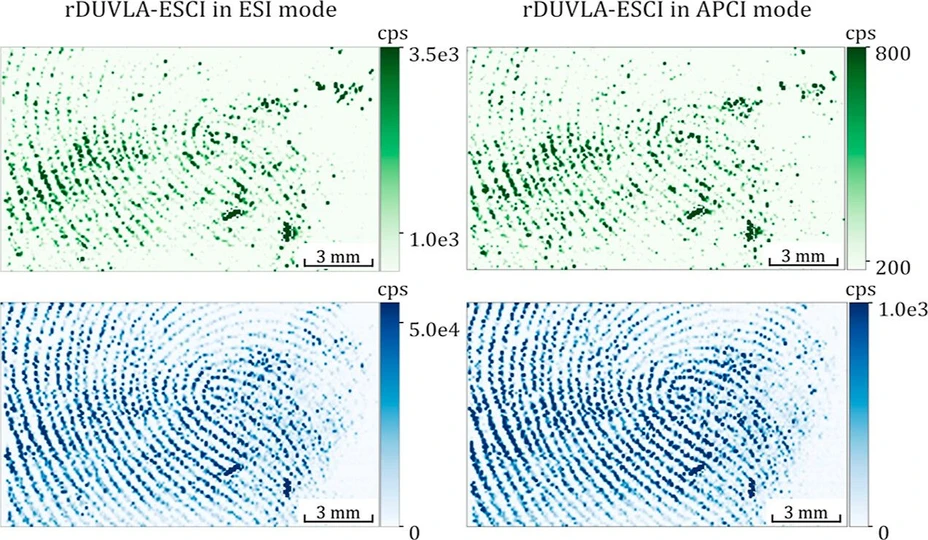
Anal. Chem. 2025, 97, 4, 2062–2069 - Figure 6. Molecular MSI of butylone and naphyrone adhered to a latent fingerprint collected from the male and female donors. rDUVLAESCI–MSI 2D images for butylone (top) and naphyrone (bottom).Anal. Chem. 2025, 97, 4, 2062–2069 - Figure 6. Molecular MSI of butylone and naphyrone adhered to a latent fingerprint collected from the male and female donors. rDUVLAESCI–MSI 2D images for butylone (top) and naphyrone (bottom).

The palmitoyl oleate image revealed an overlapped papillary pattern of two donors, who underwent the standard forensic fingerprint matching approach. The comparison of the characteristic dactyloscopic features provided positive matching with a visualized reference fingerprint (at least ten dactyloscopic markers are required for personal identification in Czechia and Slovakia). Even in the case of the overlapped fingerprint belonging to the donors who came into contact with flephedrone, personal identification was achieved (Figure 7). More than 15 characteristic features of overlapped fingerprints were detected. The simultaneous rDUVLAESCI–MSI renders the link between molecular features and biometric information.
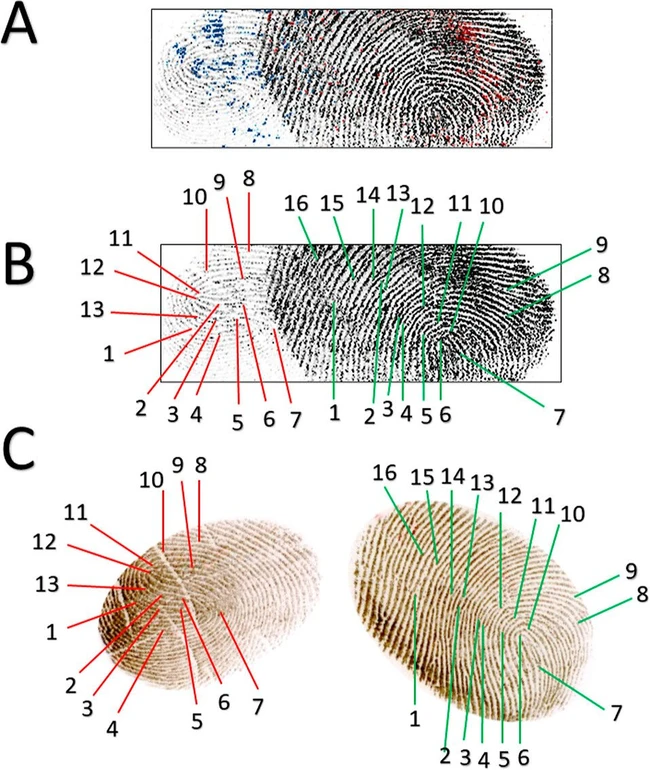
Anal. Chem. 2025, 97, 4, 2062–2069 - Figure 7. Dactyloscopic identification of the male and female donor visualizing constituents of fingerprints. 2D image: (A) co-reregistration of the cathinone and flephedrone with the fingerprint pattern; (B) palmitoyl oleate overlapped image of both persons, the thicker latent fingerprint was collected for the female donor; and (C) reference fingerprints visualized using a standard dactyloscopic approach. The positive dactyloscopic markers confirmed personal identification for both new psychoactive substances containing fingerprint donors.Anal. Chem. 2025, 97, 4, 2062–2069 - Figure 7. Dactyloscopic identification of the male and female donor visualizing constituents of fingerprints. 2D image: (A) co-reregistration of the cathinone and flephedrone with the fingerprint pattern; (B) palmitoyl oleate overlapped image of both persons, the thicker latent fingerprint was collected for the female donor; and (C) reference fingerprints visualized using a standard dactyloscopic approach. The positive dactyloscopic markers confirmed personal identification for both new psychoactive substances containing fingerprint donors.

Conclusions

Our work has introduced a novel comprehensive ambient technique for complex analysis. The simultaneous acquisition of rDUVLAESCI mass spectra within a single analytical run enables the analysis of various molecules differing significantly in their polarity. The technique opens a new window in comprehensive molecular MS either for dried spot samples or for visualization of the spatial distribution of analytes. The fully automated rDUVLAESCI–MSI provided a reliable image of the molecular distribution with a variable spatial resolution in the range from 160 to 3 μm. 2D images visualizing new psychoactive substances on latent fingerprints were used for direct personal identification, even in the case of overlapping fingerprints. The successful dactyloscopic identification confirms the image quality robustness for forensic applications.

LabRulez
LinkedIn Logo
 

Related content

Overcoming Strong Solvent Effects in the Analysis of Vepdegestrant

Applications
| 2026 | Agilent Technologies
Instrumentation
HPLC
Manufacturer
Agilent Technologies
Industries
Pharma & Biopharma

Identification of Double Bond Positions and Relative Acyl Chain Positions in Egg Yolk Phosphatidylcholines Using OAD-TOF System

Applications
| 2026 | Shimadzu
Instrumentation
LC/MS, LC/MS/MS, LC/TOF, LC/HRMS
Manufacturer
Shimadzu
Industries
Food & Agriculture

High Molecular-Weight Polysaccharide Characterization by SEC-MALS Using GTxResolve™ 1000 and 2000 Å SEC Columns

Applications
| 2026 | Waters
Instrumentation
GPC/SEC, Consumables, LC columns
Manufacturer
Waters
Industries
Pharma & Biopharma, Food & Agriculture

Development and Optimization for a Comprehensive LC/MS/MS Method for the Detection of 74 PFAS Compounds

Applications
| 2026 | Agilent Technologies
Instrumentation
LC/MS, LC/MS/MS, LC/QQQ
Manufacturer
Agilent Technologies
Industries
Food & Agriculture

PFAS in Biota: Risk Context & Robust Analytical Solutions

Others
| 2026 | ALS Europe
Instrumentation
Laboratory analysis, LC/MS, LC/MS/MS
Manufacturer
Industries
Environmental
 

Related articles

JUNIOR STAR Grants at UCT Prague: Two talented women from abroad driving innovation in science
Article | Scientists

JUNIOR STAR Grants at UCT Prague: Two talented women from abroad driving innovation in science

Two outstanding early-career researchers at UCT Prague, Filipa Oliveira and Stella Gonsales, received prestigious GAČR JUNIOR STAR grants for innovative research in materials science and sustainable chemistry.
UCT Prague
tag
share
more
Research from IOCB Prague reveals a previously unknown mechanism of genetic transcription
Article | Science and research

Research from IOCB Prague reveals a previously unknown mechanism of genetic transcription

Scientists at IOCB Prague reveal a previously unknown mechanism that initiates gene transcription. Using cryo-EM, they uncover how alarmone molecules enable RNA synthesis under stress.
Institute of Organic Chemistry and Biochemistry of the Czech Academy of Sciences
tag
share
more
Food Adulteration and How It Is Revealed by Analytical Chemistry
Article | Food

Food Adulteration and How It Is Revealed by Analytical Chemistry

Food adulteration threatens quality and consumer trust. Discover how HPLC and modern chromatographic systems from Watrex Praha help identify oil, honey, and wine adulteration with high confidence.
Watrex Praha
tag
share
more
Affinity, Gel Filtration, Size Exclusion Chromatography: Repurposing Kinase Inhibitors for Malaria
Interview | Video

Affinity, Gel Filtration, Size Exclusion Chromatography: Repurposing Kinase Inhibitors for Malaria

This podcast explores how chromatography (FPLC/SEC) and mass spectrometry support malaria drug discovery, from protein purification and QC to interaction studies and complex sample preparation.
Organomation
tag
share
more
 

Related content

Overcoming Strong Solvent Effects in the Analysis of Vepdegestrant

Applications
| 2026 | Agilent Technologies
Instrumentation
HPLC
Manufacturer
Agilent Technologies
Industries
Pharma & Biopharma

Identification of Double Bond Positions and Relative Acyl Chain Positions in Egg Yolk Phosphatidylcholines Using OAD-TOF System

Applications
| 2026 | Shimadzu
Instrumentation
LC/MS, LC/MS/MS, LC/TOF, LC/HRMS
Manufacturer
Shimadzu
Industries
Food & Agriculture

High Molecular-Weight Polysaccharide Characterization by SEC-MALS Using GTxResolve™ 1000 and 2000 Å SEC Columns

Applications
| 2026 | Waters
Instrumentation
GPC/SEC, Consumables, LC columns
Manufacturer
Waters
Industries
Pharma & Biopharma, Food & Agriculture

Development and Optimization for a Comprehensive LC/MS/MS Method for the Detection of 74 PFAS Compounds

Applications
| 2026 | Agilent Technologies
Instrumentation
LC/MS, LC/MS/MS, LC/QQQ
Manufacturer
Agilent Technologies
Industries
Food & Agriculture

PFAS in Biota: Risk Context & Robust Analytical Solutions

Others
| 2026 | ALS Europe
Instrumentation
Laboratory analysis, LC/MS, LC/MS/MS
Manufacturer
Industries
Environmental
 

Related articles

JUNIOR STAR Grants at UCT Prague: Two talented women from abroad driving innovation in science
Article | Scientists

JUNIOR STAR Grants at UCT Prague: Two talented women from abroad driving innovation in science

Two outstanding early-career researchers at UCT Prague, Filipa Oliveira and Stella Gonsales, received prestigious GAČR JUNIOR STAR grants for innovative research in materials science and sustainable chemistry.
UCT Prague
tag
share
more
Research from IOCB Prague reveals a previously unknown mechanism of genetic transcription
Article | Science and research

Research from IOCB Prague reveals a previously unknown mechanism of genetic transcription

Scientists at IOCB Prague reveal a previously unknown mechanism that initiates gene transcription. Using cryo-EM, they uncover how alarmone molecules enable RNA synthesis under stress.
Institute of Organic Chemistry and Biochemistry of the Czech Academy of Sciences
tag
share
more
Food Adulteration and How It Is Revealed by Analytical Chemistry
Article | Food

Food Adulteration and How It Is Revealed by Analytical Chemistry

Food adulteration threatens quality and consumer trust. Discover how HPLC and modern chromatographic systems from Watrex Praha help identify oil, honey, and wine adulteration with high confidence.
Watrex Praha
tag
share
more
Affinity, Gel Filtration, Size Exclusion Chromatography: Repurposing Kinase Inhibitors for Malaria
Interview | Video

Affinity, Gel Filtration, Size Exclusion Chromatography: Repurposing Kinase Inhibitors for Malaria

This podcast explores how chromatography (FPLC/SEC) and mass spectrometry support malaria drug discovery, from protein purification and QC to interaction studies and complex sample preparation.
Organomation
tag
share
more
 

Related content

Overcoming Strong Solvent Effects in the Analysis of Vepdegestrant

Applications
| 2026 | Agilent Technologies
Instrumentation
HPLC
Manufacturer
Agilent Technologies
Industries
Pharma & Biopharma

Identification of Double Bond Positions and Relative Acyl Chain Positions in Egg Yolk Phosphatidylcholines Using OAD-TOF System

Applications
| 2026 | Shimadzu
Instrumentation
LC/MS, LC/MS/MS, LC/TOF, LC/HRMS
Manufacturer
Shimadzu
Industries
Food & Agriculture

High Molecular-Weight Polysaccharide Characterization by SEC-MALS Using GTxResolve™ 1000 and 2000 Å SEC Columns

Applications
| 2026 | Waters
Instrumentation
GPC/SEC, Consumables, LC columns
Manufacturer
Waters
Industries
Pharma & Biopharma, Food & Agriculture

Development and Optimization for a Comprehensive LC/MS/MS Method for the Detection of 74 PFAS Compounds

Applications
| 2026 | Agilent Technologies
Instrumentation
LC/MS, LC/MS/MS, LC/QQQ
Manufacturer
Agilent Technologies
Industries
Food & Agriculture

PFAS in Biota: Risk Context & Robust Analytical Solutions

Others
| 2026 | ALS Europe
Instrumentation
Laboratory analysis, LC/MS, LC/MS/MS
Manufacturer
Industries
Environmental
 

Related articles

JUNIOR STAR Grants at UCT Prague: Two talented women from abroad driving innovation in science
Article | Scientists

JUNIOR STAR Grants at UCT Prague: Two talented women from abroad driving innovation in science

Two outstanding early-career researchers at UCT Prague, Filipa Oliveira and Stella Gonsales, received prestigious GAČR JUNIOR STAR grants for innovative research in materials science and sustainable chemistry.
UCT Prague
tag
share
more
Research from IOCB Prague reveals a previously unknown mechanism of genetic transcription
Article | Science and research

Research from IOCB Prague reveals a previously unknown mechanism of genetic transcription

Scientists at IOCB Prague reveal a previously unknown mechanism that initiates gene transcription. Using cryo-EM, they uncover how alarmone molecules enable RNA synthesis under stress.
Institute of Organic Chemistry and Biochemistry of the Czech Academy of Sciences
tag
share
more
Food Adulteration and How It Is Revealed by Analytical Chemistry
Article | Food

Food Adulteration and How It Is Revealed by Analytical Chemistry

Food adulteration threatens quality and consumer trust. Discover how HPLC and modern chromatographic systems from Watrex Praha help identify oil, honey, and wine adulteration with high confidence.
Watrex Praha
tag
share
more
Affinity, Gel Filtration, Size Exclusion Chromatography: Repurposing Kinase Inhibitors for Malaria
Interview | Video

Affinity, Gel Filtration, Size Exclusion Chromatography: Repurposing Kinase Inhibitors for Malaria

This podcast explores how chromatography (FPLC/SEC) and mass spectrometry support malaria drug discovery, from protein purification and QC to interaction studies and complex sample preparation.
Organomation
tag
share
more
 

Related content

Overcoming Strong Solvent Effects in the Analysis of Vepdegestrant

Applications
| 2026 | Agilent Technologies
Instrumentation
HPLC
Manufacturer
Agilent Technologies
Industries
Pharma & Biopharma

Identification of Double Bond Positions and Relative Acyl Chain Positions in Egg Yolk Phosphatidylcholines Using OAD-TOF System

Applications
| 2026 | Shimadzu
Instrumentation
LC/MS, LC/MS/MS, LC/TOF, LC/HRMS
Manufacturer
Shimadzu
Industries
Food & Agriculture

High Molecular-Weight Polysaccharide Characterization by SEC-MALS Using GTxResolve™ 1000 and 2000 Å SEC Columns

Applications
| 2026 | Waters
Instrumentation
GPC/SEC, Consumables, LC columns
Manufacturer
Waters
Industries
Pharma & Biopharma, Food & Agriculture

Development and Optimization for a Comprehensive LC/MS/MS Method for the Detection of 74 PFAS Compounds

Applications
| 2026 | Agilent Technologies
Instrumentation
LC/MS, LC/MS/MS, LC/QQQ
Manufacturer
Agilent Technologies
Industries
Food & Agriculture

PFAS in Biota: Risk Context & Robust Analytical Solutions

Others
| 2026 | ALS Europe
Instrumentation
Laboratory analysis, LC/MS, LC/MS/MS
Manufacturer
Industries
Environmental
 

Related articles

JUNIOR STAR Grants at UCT Prague: Two talented women from abroad driving innovation in science
Article | Scientists

JUNIOR STAR Grants at UCT Prague: Two talented women from abroad driving innovation in science

Two outstanding early-career researchers at UCT Prague, Filipa Oliveira and Stella Gonsales, received prestigious GAČR JUNIOR STAR grants for innovative research in materials science and sustainable chemistry.
UCT Prague
tag
share
more
Research from IOCB Prague reveals a previously unknown mechanism of genetic transcription
Article | Science and research

Research from IOCB Prague reveals a previously unknown mechanism of genetic transcription

Scientists at IOCB Prague reveal a previously unknown mechanism that initiates gene transcription. Using cryo-EM, they uncover how alarmone molecules enable RNA synthesis under stress.
Institute of Organic Chemistry and Biochemistry of the Czech Academy of Sciences
tag
share
more
Food Adulteration and How It Is Revealed by Analytical Chemistry
Article | Food

Food Adulteration and How It Is Revealed by Analytical Chemistry

Food adulteration threatens quality and consumer trust. Discover how HPLC and modern chromatographic systems from Watrex Praha help identify oil, honey, and wine adulteration with high confidence.
Watrex Praha
tag
share
more
Affinity, Gel Filtration, Size Exclusion Chromatography: Repurposing Kinase Inhibitors for Malaria
Interview | Video

Affinity, Gel Filtration, Size Exclusion Chromatography: Repurposing Kinase Inhibitors for Malaria

This podcast explores how chromatography (FPLC/SEC) and mass spectrometry support malaria drug discovery, from protein purification and QC to interaction studies and complex sample preparation.
Organomation
tag
share
more
Other projects
GCMS
ICPMS
Follow us
More information
WebinarsAbout usContact usTerms of use
LabRulez s.r.o. All rights reserved. Content available under a CC BY-SA 4.0 Attribution-ShareAlike