News from LabRulezLCMS Library - Week 8, 2025
LabRulez: News from LabRulezLCMS Library - Week 8, 2025
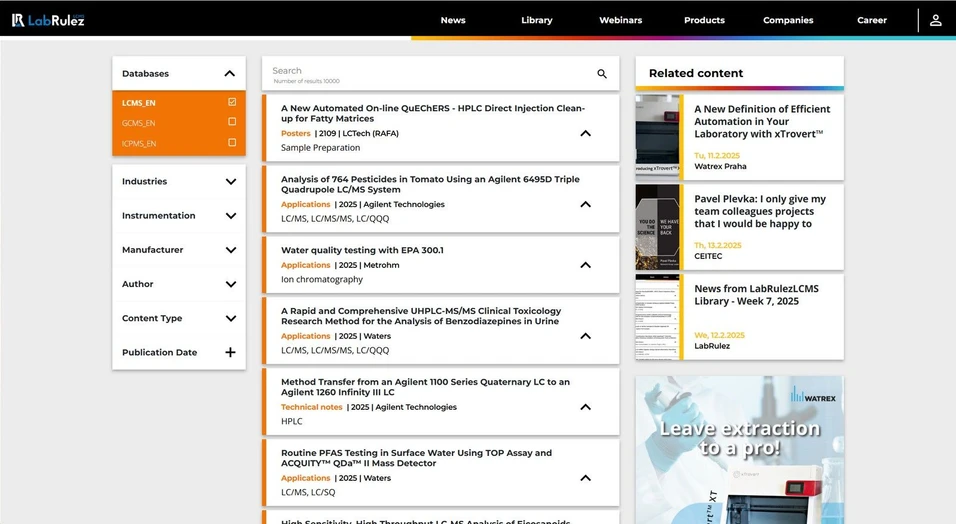
Our Library never stops expanding. What are the most recent contributions to LabRulezLCMS Library in the week of 17th February 2025? Check out new documents from the field of liquid phase, especially HPLC and LC/MS techniques!
👉 SEARCH THE LARGEST REPOSITORY OF DOCUMENTS ABOUT LCMS AND RELATED TECHNIQUES
👉 Need info about different analytical techniques? Peek into LabRulezGCMS or LabRulezICPMS libraries.
This week we bring you application notes by Agilent Technologies, Metrohm, Knauer, Shimadzu, Thermo Fisher Scientific and Waters Corporation!
1. Agilent Technologies: A Study of Method Limit of Quantitation for 30 PFAS in Food
Using Captiva EMR PFAS food passthrough cleanup by LC/MS/MS detection
- Application note
- Full PDF for download
This application note presents a study for the method limit of quantitation (LOQ) determination for 30 per- and polyfluoroalkyl substances (PFAS) targets in foods using a newly developed method of QuEChERS extraction followed by Agilent Captiva EMR PFAS Food cartridge passthrough cleanup, then LC/MS/MS detection. The LOQspiking was determined as the lowest validated spiking level in food matrices, with acceptable method accuracy and repeatability results. The LOQcal was calculated based on the standard deviation of LOQspiking-A following the procedure published in 40 CFR Appendix B to Part 136.1 Both LOQspiking-A and LOQcal-A from this method were compared against the required LOQAOACr from the AOAC SMPR 2023.003 guideline.2 The LOQcal-A results from this method were also compared to LOQcal-F from the U.S. Food and Drug Administration (FDA) method3, which uses the same calculation method to determine method LOQcal. The results showed that the newly developed method provided acceptable LOQs meeting the AOAC SMPR guideline requirements. The new method LOQcal-A results were lower than the LOQcal-F from the FDA method for foods in the same category.
Conclusion
A case study on the method limits of quantitation was conducted for the validated Agilent method for 30 PFAS in food. Method LOQspiking-A, MDLA, and LOQcal-A were summarized for 30 PFAS targets in all 15 food matrices.
Both method LOQspiking-A and LOQcal-A were compared to the LOQ levels required by the AOAC SMPR 2023.003 guideline and EU regulation; all met the accepted criteria, with few exceptions due to the significant positive detection of
target in food matrices. Method LOQcal-A results were then compared between the Agilent and FDA C-010.03 methods, demonstrating a much lower method LOQcal achieved by the Agilent method, which is attributed to the simplified method, higher matrix removal efficiency, and reduced matrix effect.
2. Metrohm: Ohmic iR drop
Part 3 – Measurement with EIS
- Application note
- Full PDF for download
This Application Note introduces the third and final tool that is available to researchers—electrochemical impedance spectroscopy (EIS).
As mentioned in Part 2, although it is technically possible to estimate the ohmic drop, most of the time real systems are more complicated. As a consequence, the ohmic drop must be determined experimentally. There are three main experimental techniques for determining the iR drop:
- Current interrupt
- Positive feedback
- Electrochemical impedance spectroscopy (EIS)
Within the Metrohm Autolab range of products, all modular and compact instruments equipped with a FRA32M module, as well as VIONIC powered by
INTELLO, are able to perform EIS measurements across a wide frequency range. Of the three experimental techniques listed above, EIS is considered the most
accurate method, making it the recommended choice. It is important to exercise caution when using the other two methods, as their incorrect usage can sometimes result in data misinterpretation or even damage to the setup. Therefore, in the subsequent discussion, we will primarily focus on measuring the iR drop through EIS. More information regarding the current interrupt and
positive feedback methods can be found in Application Notes AN-EC-003 and AN-EC-004.
3. Knauer: Increased sample loading capacity for online SPE-HPLC analysis of PAHs in water
- Application note
- Full PDF for download
Polycyclic aromatic hydrocarbons (PAHs) are environmental pollutants and are
widespread across the globe mainly due to long-term anthropogenic sources
of pollution. Due to their high mutagenic and carcinogenic potential a sensitive
determination is mandatory. The used system configuration makes it possible to
switch between direct injection via autosampler and injection with an auxiliary pump (feed pump) without changing/replumbing the system. The use of autosampler injection or injection via feed pump enables the user to inject a broad variety of different volumes from µl to ml scale.
Conclusion
The used system configuration makes it possible to switch between direct injection via autosampler and injection with an auxiliary pump (feed pump) without changing/replumbing the system. The use of autosampler injection or injection via feed pump enables the user to inject a broad variety of different volumes from µl to ml scale. It was shown that the recovery of the SPE injection was in range from 80 %–120 % and all calibrations showed excellent linearity. The approach of injecting 1800 µl via the auxiliary feed pump has enhanced the detection limits. As seen in Tab. 6, the LOD was improved in a range from 50–90 %, still using a relatively low injection volume. Loading higher volumes on the SPE can lead to a further enhancement of the method sensitivity. Although, only six PAHs were investigated in detail, the method can also be used for the determination of all 16 PAHs according to EPA method 610.
4. Shimadzu: Rapid Screening of Illegally Added Drugs in Health Food Product by DPiMS-8060
- Application note
- Full PDF for download
User Benefits
- Based on PESI ionization technology, the simplified pretreatment and micro sampling are suitable for precious samples and reduce mass spectrometry contamination.
- With a peak collection rate of up to 3 peaks per second, high-sensitivity rapid screening of 98 drugs (196 MRM channels) can be completed within 2.0 minutes.
Health food refersto food with specific health functions. Criminals usually add illegal additives that can produce effects similar to prescription drugs in health foods, enhance the efficacy of health products, and make huge profits. It is necessary to establish a rapid detection method for illegal additivesin health food. In this Application News , a rapid analytical method for the determination of several illegally added drugs (β-receptor agonists, weight loss drugs, antihypertensive drugs, lipidlowering drugs, aphrodisiacs, antianxiety drugs) in health food was established using a probe electrospray ionization (PESI) mass spectrometer DPiMS-8060 (Fig.1). The Principle behind the PESI Method was shown in Fig.2. This method can complete rapid qualitative screening of 98 illegally added drugs within 2.0 minutes. The sensitivity and precision of the method were evaluated, and the detection limits were 0.02-10 ng/mL; The
detection precision RSDs of all drugs were within 10%; Using commercially available oral liquids for a matrix spiked test, the target substances can be detected in the spiked samples. This method is fast, accurate, and highly sensitive, suitable for rapid qualitative screening of illegally added drugsin health food.
Conclusion
This Application News establishes a qualitative screening method for the rapid determination of 98 illegally added drugs in health food within 2.0 minutes using the probe electrospray ionization (PESI) mass spectrometer DPiMS-8060. In contrast, The LC-MS/MS method requires several times the analysis time
of this method to complete. This method saves a lot of sample processing and detection time, can significantly shorten the analysis cycle, and is particularly suitable for rapid screening of compounds.
5. Thermo Fisher Scientific: Screening of PFAS compounds in wastewater using adsorbable organic fluorine with combustion ion chromatography (CIC)
Results from U.S. EPA draft Method 1621 collaboration study
- Application note
- Full PDF for download
Per- and polyfluoroalkyl substances (PFAS) is the collective name for synthetic fluorinated compounds. A screening method, such as combustion ion chromatography (CIC), can be used to assess the total extent of PFAS contamination by determining organic fluorine in various matrices, including wastewater. In Application Note 002748, the results from Thermo Fisher Scientific’s IC application lab in Sunnyvale, California, as part of the multilaboratory validation study of EPA draft Method 1621, are presented alongside techniques needed for successful analyses.
Equipment
- Thermo Scientific™ Dionex™ RFIC microbore system
- Compatible combustion-absorption system with offline
adsorption unit - Thermo Scientific™ Chromeleon™ Data System (CDS) software
Conclusion
The method outlined in AN002748 demonstrates that CIC is an excellent tool to measure AOF and screen for PFAS in wastewater. The method is sensitive, with method blanks of 1 ng/mL and method detection limits (MDLs) of 2.5 ng/mL, and accurate, with recoveries of 80–120%. Together, these data highlight the
power of CIC in eliminating the sample matrix and measuring only adsorbable fluorine content in samples, successfully achieving the goals outlined in EPA draft Method 1621.
6. Waters Corporation: Routine PFAS Testing in Surface Water
Using TOP Assay and ACQUITY™ QDa™ II Mass Detector
- Application note
- Full PDF for download
Per- and polyfluoroalkyl substances (PFAS) have increasingly become a major environmental and public health concern due to their toxic properties and tendency to bioaccumulate in living organisms. Global widespread use of PFAS over many decades has meant that these compounds have become common and persistent environmental pollutants. Traditional testing methods are often challenged to capture the full extent of PFAS pollution; performing a total oxidizable precursors (TOP) Assay analysis allows for the assessment of perfluoroalkyl acid (PFAA) precursors in a given sample, by monitoring perfluoroalkyl carboxylic acid (PFCA) concentrations before and after sample oxidation. Eight surface water river samples were collected downstream from wastewater treatment plants across the northwest of England and analysed using the ACQUITY QDa II Mass Detector. Results demonstrated a marked increase in summed PFCA content in all surface water samples analysed, underlining the utility of such techniques to support and supplement existing PFAS testing methodologies.
Benefits
- TOP Assay offers a means of assessing the burden of perfluoroalkyl acids (PFAAs) as well as their precursors in a single method, offering a complementary testing approach that can be used to analyse surface water samples
- Utilising the ACQUITY QDa II Mass Detector for this analysis offers a cost effective, user-friendly, and reliable means of sample triage, using LC-MS and nominal mass information to support and compliment more sophisticated traditional testing methodologies
Conclusion
Quantifiable increases in at least three of the six monitored PFCA compounds were observed in all surface water river samples examined in this workflow. This suggests a large presence of PFAA precursors or other unknown PFAS compounds within the samples, that otherwise may not have been fully captured, warranting further investigation. Large concentrations of PFBA were observed post-oxidation across most samples, suggesting that perfluoro-butyl precursors are the main type of PFAS precursors in the local rivers assessed.
- By comparing PFCA concentrations before and after oxidation, the TOP Assay can reveal the extent of “hidden” PFAA precursors that traditional PFAS workflows may not fully capture, therefore enhancing a laboratory’s detection capabilities
- All eight surface water river samples tested showed a significant increase in total PFCA content following oxidation, with levels ranging from 63 to 2711 ng/L (ppt). This indicates a high degree of precursor contamination that legacy analysis may have overlooked
- The ACQUITY QDa II Mass Detector is well-suited to this workflow, providing nominal mass data in a reliable and cost-effective LC-MS analysis, for complementary sample assessment
- Effective triage of potentially contaminated environmental samples can help to support traditional LC-MS/MS PFAS testing methodologies
7. Waters Corporation: A Simple LC-MS/MS Method for Simultaneous Analysis of 35 Anti-psychotics in Human Plasma for Clinical Research
- Application note
- Full PDF for download
LC-MS/MS is a technique which allows selective and analytically sensitive analysis of large panels in single run sets. In this application note, we describe a simple and robust clinical research method for the simultaneous analysis of 35 antipsychotics in human plasma using an ACQUITY™ UPLC™ I-Class System coupled with a Xevo™ TQ-S micro Mass Spectrometer as a tool in clinical research.
Benefits
- A method for simultaneous quantification of 35 antipsychotics in human plasma within one single LC-MS/MS run
- Simple and cost-effective sample preparation
- Injection to injection time of less than five minutes
Conclusion
A Simple LC-MS/MS Method for Simultaneous Analysis of 35 Anti-psychotics in Human Plasma for Clinical Research. A method for the LC-MS/MS analysis of 35 anti-psychotics drugs was developed for clinical research. A number of advantages are highlighted:
- The sample preparation and analysis were fast, simple, and inexpensive, requiring only 50 µL of plasma and taking less than five minutes per injection
- Total precision and repeatability were ≤8.7% CV and ≤7.4%, respectively
- The method demonstrated good recovery and extraction efficiency for each analyte with minimal matrix effects