LCMS
More information
WebinarsAbout usContact usTerms of use
LabRulez s.r.o. All rights reserved. Content available under a CC BY-SA 4.0 Attribution-ShareAlike
Author
KNAUER
KNAUER
Based in Berlin, KNAUER is a medium-sized, owner-managed company that has been serving the sciences since 1962. We develop and manufacture scientific instruments of superior quality for liquid chromatography, including: Analytical HPLC/UHPLC, Preparative HPLC, Fast protein liquid chromatography (FPLC), Multi-column chromatography/Simulated moving bed (SMB) chromatography. High pressure dosing, in-line detection systems, and osmometry are additional business areas.
Tags
Article
Science and research
LinkedIn Logo

Oligos Made Easy - Part 2: AEX
We, 11.2.2026
| Original article from: KNAUER
Anion exchange chromatography (AEX) is a powerful tool for oligonucleotide analysis. Learn how charge-based separation reveals purity, length variants, and structural insights in modern LC workflows.
<p>KNAUER: Oligos Made Easy - Part 2: AEX</p>

KNAUER: Oligos Made Easy - Part 2: AEX

Charged for Action: The Hidden Secrets of AEX Oligonucleotide Analysis

Oligonucleotides—short, well-defined fragments of DNA or RNA—have become indispensable tools in modern life sciences. They underpin cutting-edge applications in molecular diagnostics, gene therapy, and pharmaceutical development. Before oligonucleotides can be confidently used in research or clinical settings, however, their quality must be rigorously assessed. Purity, sequence integrity, length distribution, and chemical modifications all play a decisive role in their performance.
KNAUER: Oligos Made Easy - Part 2: AEXKNAUER: Oligos Made Easy - Part 2: AEX

Among the analytical techniques available today, anion exchange chromatography (AEX) stands out as a robust and highly informative method for characterizing oligonucleotides. By exploiting their intrinsic negative charge, AEX provides detailed insight into product composition and impurity profiles that are difficult to obtain by other approaches.

Part 1 of the Oligos series: A Practical Guide to Oligonucleotide Production – From Concept to Final Product

How Scientists Read Oligonucleotides Using Charge

At the core of AEX lies a simple but powerful principle: oligonucleotides carry a negatively charged phosphate backbone. This charge increases in a predictable way with strand length and, to a lesser extent, sequence composition. Anion exchange chromatography uses this property to separate oligonucleotides based on differences in charge strength and interaction with a positively charged stationary phase.

As a result, AEX has become one of the most widely used analytical tools for evaluating oligonucleotide quality. It allows scientists to distinguish full-length products from truncated species, degradation products, or closely related variants—often with single-nucleotide resolution.

Why Ion Exchange Works: Binding, Retention, and Release

Ion exchange chromatography (IEX) relies on electrostatic interactions between analytes and a charged stationary phase. In the case of oligonucleotides, anion exchange is used, where negatively charged molecules interact with positively charged functional groups on the resin—most commonly quaternary amines.

The system consists of two main components:

  • Stationary phase: A positively charged resin that binds anionic analytes.
  • Mobile phase: An aqueous buffer system, typically combined with a salt gradient, that controls both pH and elution strength.

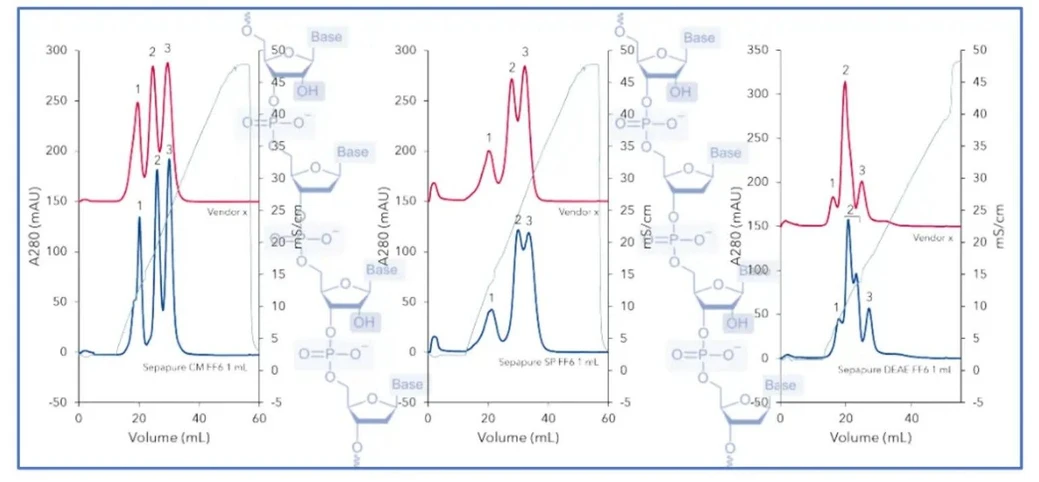
Retention in AEX is governed primarily by charge. Molecules with weaker overall charge interact less strongly with the stationary phase and elute earlier, while more highly charged oligonucleotides bind more tightly and require stronger elution conditions.

KNAUER: Oligos Made Easy - Part 2 AEX: Figure 1 IEX overview including elution order dependency on analyte charge.KNAUER: Oligos Made Easy - Part 2 AEX: Figure 1 IEX overview including elution order dependency on analyte charge.

The Five-Step Workflow of Ion Exchange Chromatography

AEX separations generally follow a well-established sequence of steps:

  1. Column equilibration
    The column is conditioned with the starting buffer until the baseline and pH are stable. This ensures that all charged sites on the resin are ready for interaction.
  2. Sample loading
    Samples, prepared in the starting buffer, are introduced under conditions that promote binding of the target oligonucleotides while minimizing retention of unwanted impurities.
  3. Washing
    The column is washed with the starting buffer to remove uncharged or weakly interacting components. The baseline stabilizes as these species are flushed away.
  4. Elution
    Bound oligonucleotides are released using a salt or pH gradient. Increasing ionic strength introduces competing ions that displace the analytes from the resin. Weakly bound species elute first; strongly charged oligonucleotides elute later.
  5. Regeneration and re-equilibration
    A high-salt buffer removes any remaining bound material. The column is then returned to starting conditions in preparation for the next analysis.

KNAUER: Oligos Made Easy - Part 2 AEX: Figure 2  Five steps of IEX procedure (in blue), outlined using an example chromatogram (in red).KNAUER: Oligos Made Easy - Part 2 AEX: Figure 2 Five steps of IEX procedure (in blue), outlined using an example chromatogram (in red).

Why AEX Is Especially Effective for Oligonucleotides

The repeating phosphate backbone of oligonucleotides gives rise to a strong and uniform anionic character across a wide pH range (typically pH 7–9). This makes oligonucleotides exceptionally well suited for anion exchange separations.

Key factors influencing AEX behavior include:

  • Charge density: Longer oligonucleotides carry more negative charges and therefore exhibit stronger retention.
  • Resin chemistry: Strong and weak anion exchangers differ in functional groups and pH stability, influencing selectivity and robustness.
  • Buffer composition: The choice of buffering ions and salt gradients directly affects elution strength and resolution.

Salt gradients—commonly based on chloride ions—compete with the oligonucleotide backbone for binding sites on the resin. By carefully tuning gradient slope and composition, analysts can achieve highly reproducible and finely resolved separations.
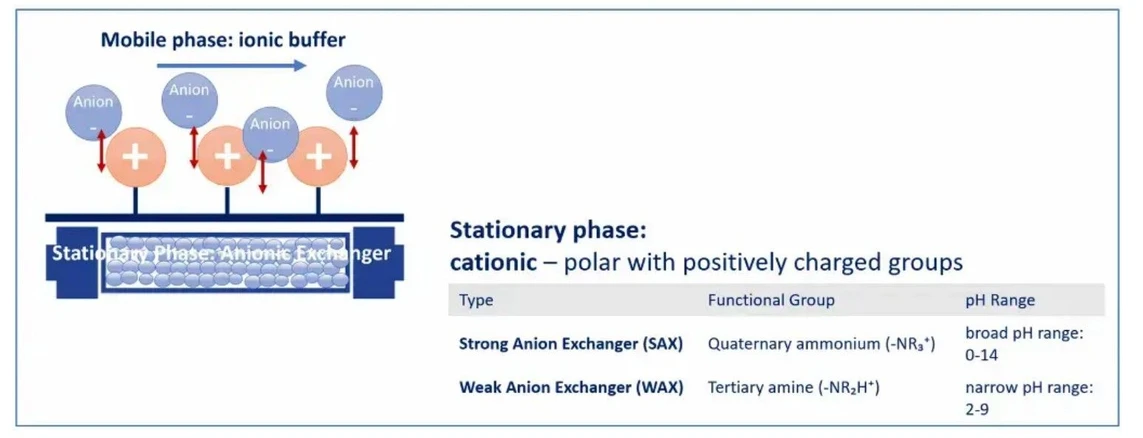
KNAUER: Oligos Made Easy - Part 2 AEX: Figure 3 Ionic interactions and pH influence on Anion Exchange Chromatography (AEX).KNAUER: Oligos Made Easy - Part 2 AEX: Figure 3 Ionic interactions and pH influence on Anion Exchange Chromatography (AEX).

KNAUER: Oligos Made Easy - Part 2 AEX: Figure 4 AEX buffer selection and gradient strategy (chromatogram with red buffer gradient curve).KNAUER: Oligos Made Easy - Part 2 AEX: Figure 4 AEX buffer selection and gradient strategy (chromatogram with red buffer gradient curve).

AEX as the Gold Standard for Oligonucleotide Separation

Anion exchange chromatography has become the method of choice for both analytical and preparative oligonucleotide workflows. Its advantages include:

  • High resolving power: Closely related impurities, including n–1 or n–2 species, can often be separated and quantified.
  • Predictable retention behavior: In many cases, retention time correlates linearly with oligonucleotide length, simplifying identification.
  • Compatibility with modified oligonucleotides: Even chemically modified sequences retain their anionic nature, allowing AEX to resolve both products and related impurities.
  • Excellent control via gradient elution: Salt gradients provide precise tuning of selectivity and resolution.

Typically, shorter or degraded oligonucleotides elute at lower ionic strength, while full-length products with higher charge density appear later in the chromatogram.
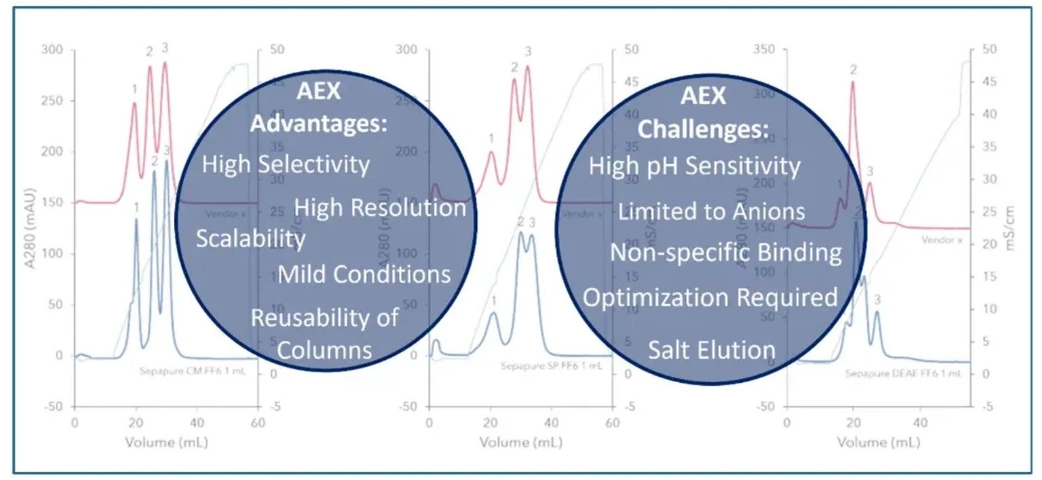
KNAUER: Oligos Made Easy - Part 2 AEX: Figure 5 AEX Advantages and Challenges.KNAUER: Oligos Made Easy - Part 2 AEX: Figure 5 AEX Advantages and Challenges.

Final Perspective: Mastering AEX with Confidence

Anion exchange chromatography may appear complex at first, but with thoughtful optimization of pH, buffer composition, and gradient conditions, it becomes a highly precise and reliable tool for oligonucleotide analysis. When properly applied, AEX delivers sharp peaks, excellent resolution, and robust performance—even for challenging sequences and modifications.

For laboratories developing or refining oligonucleotide workflows, AEX offers both analytical depth and operational confidence.

If you would like to discuss AEX method development or optimization for oligonucleotides, feel free to contact us at [email protected]. More insights into practical oligonucleotide analysis will follow in our “Oligos Made Easy” series.

For technical questions or in-depth discussion, the author can be reached at [email protected]

This version of the article was adapted from the original text using AI-assisted rewriting and editorial review.
KNAUER
LinkedIn Logo
 

Related content

Overcoming Strong Solvent Effects in the Analysis of Vepdegestrant

Applications
| 2026 | Agilent Technologies
Instrumentation
HPLC
Manufacturer
Agilent Technologies
Industries
Pharma & Biopharma

Identification of Double Bond Positions and Relative Acyl Chain Positions in Egg Yolk Phosphatidylcholines Using OAD-TOF System

Applications
| 2026 | Shimadzu
Instrumentation
LC/MS, LC/MS/MS, LC/TOF, LC/HRMS
Manufacturer
Shimadzu
Industries
Food & Agriculture

High Molecular-Weight Polysaccharide Characterization by SEC-MALS Using GTxResolve™ 1000 and 2000 Å SEC Columns

Applications
| 2026 | Waters
Instrumentation
GPC/SEC, Consumables, LC columns
Manufacturer
Waters
Industries
Pharma & Biopharma, Food & Agriculture

Development and Optimization for a Comprehensive LC/MS/MS Method for the Detection of 74 PFAS Compounds

Applications
| 2026 | Agilent Technologies
Instrumentation
LC/MS, LC/MS/MS, LC/QQQ
Manufacturer
Agilent Technologies
Industries
Food & Agriculture

PFAS in Biota: Risk Context & Robust Analytical Solutions

Others
| 2026 | ALS Europe
Instrumentation
Laboratory analysis, LC/MS, LC/MS/MS
Manufacturer
Industries
Environmental
 

Related articles

Unlocking Hemoglobin Variant Detection: LC-HR-MS Breakthrough with Ainslie Chen
Interview | Science and research

Unlocking Hemoglobin Variant Detection: LC-HR-MS Breakthrough with Ainslie Chen

Interview with Ainslie Chen on using LC-HRMS and C4 reversed-phase chromatography for precise hemoglobin variant detection and future clinical proteomics applications.
Organomation
tag
share
more
Webinars LabRulezLCMS Week 08/2026
Article | Webinars

Webinars LabRulezLCMS Week 08/2026

11 webinars: AAV genome analysis, amino acid panel, capillary LC, data integrity, InfinityLab Assist, LC-MS proteomics, Orbitrap Astral, PFAS testing, peptide mapping, USP <621>
LabRulez
tag
share
more
Imaging of Protein Assemblies up to 231 kDa in Tissues with Nano-DESI Mass Spectrometry
Scientific article | Science and research

Imaging of Protein Assemblies up to 231 kDa in Tissues with Nano-DESI Mass Spectrometry

This study extends nano-DESI mass spectrometry imaging to intact protein assemblies up to 231 kDa, enabling direct identification of large complexes in tissue.
LabRulez
tag
share
more
Unlocking Phytoplankton Metallomes with Comparative Analysis of Metal Quotas, Quantitative Proteomics, and Inferred Metalloproteomes
Scientific article | Science and research

Unlocking Phytoplankton Metallomes with Comparative Analysis of Metal Quotas, Quantitative Proteomics, and Inferred Metalloproteomes

This study integrates metal quotas, quantitative proteomics, and inferred metalloproteomes to reveal trace metal requirements and adaptation strategies in phytoplankton.
LabRulez
tag
share
more
 

Related content

Overcoming Strong Solvent Effects in the Analysis of Vepdegestrant

Applications
| 2026 | Agilent Technologies
Instrumentation
HPLC
Manufacturer
Agilent Technologies
Industries
Pharma & Biopharma

Identification of Double Bond Positions and Relative Acyl Chain Positions in Egg Yolk Phosphatidylcholines Using OAD-TOF System

Applications
| 2026 | Shimadzu
Instrumentation
LC/MS, LC/MS/MS, LC/TOF, LC/HRMS
Manufacturer
Shimadzu
Industries
Food & Agriculture

High Molecular-Weight Polysaccharide Characterization by SEC-MALS Using GTxResolve™ 1000 and 2000 Å SEC Columns

Applications
| 2026 | Waters
Instrumentation
GPC/SEC, Consumables, LC columns
Manufacturer
Waters
Industries
Pharma & Biopharma, Food & Agriculture

Development and Optimization for a Comprehensive LC/MS/MS Method for the Detection of 74 PFAS Compounds

Applications
| 2026 | Agilent Technologies
Instrumentation
LC/MS, LC/MS/MS, LC/QQQ
Manufacturer
Agilent Technologies
Industries
Food & Agriculture

PFAS in Biota: Risk Context & Robust Analytical Solutions

Others
| 2026 | ALS Europe
Instrumentation
Laboratory analysis, LC/MS, LC/MS/MS
Manufacturer
Industries
Environmental
 

Related articles

Unlocking Hemoglobin Variant Detection: LC-HR-MS Breakthrough with Ainslie Chen
Interview | Science and research

Unlocking Hemoglobin Variant Detection: LC-HR-MS Breakthrough with Ainslie Chen

Interview with Ainslie Chen on using LC-HRMS and C4 reversed-phase chromatography for precise hemoglobin variant detection and future clinical proteomics applications.
Organomation
tag
share
more
Webinars LabRulezLCMS Week 08/2026
Article | Webinars

Webinars LabRulezLCMS Week 08/2026

11 webinars: AAV genome analysis, amino acid panel, capillary LC, data integrity, InfinityLab Assist, LC-MS proteomics, Orbitrap Astral, PFAS testing, peptide mapping, USP <621>
LabRulez
tag
share
more
Imaging of Protein Assemblies up to 231 kDa in Tissues with Nano-DESI Mass Spectrometry
Scientific article | Science and research

Imaging of Protein Assemblies up to 231 kDa in Tissues with Nano-DESI Mass Spectrometry

This study extends nano-DESI mass spectrometry imaging to intact protein assemblies up to 231 kDa, enabling direct identification of large complexes in tissue.
LabRulez
tag
share
more
Unlocking Phytoplankton Metallomes with Comparative Analysis of Metal Quotas, Quantitative Proteomics, and Inferred Metalloproteomes
Scientific article | Science and research

Unlocking Phytoplankton Metallomes with Comparative Analysis of Metal Quotas, Quantitative Proteomics, and Inferred Metalloproteomes

This study integrates metal quotas, quantitative proteomics, and inferred metalloproteomes to reveal trace metal requirements and adaptation strategies in phytoplankton.
LabRulez
tag
share
more
 

Related content

Overcoming Strong Solvent Effects in the Analysis of Vepdegestrant

Applications
| 2026 | Agilent Technologies
Instrumentation
HPLC
Manufacturer
Agilent Technologies
Industries
Pharma & Biopharma

Identification of Double Bond Positions and Relative Acyl Chain Positions in Egg Yolk Phosphatidylcholines Using OAD-TOF System

Applications
| 2026 | Shimadzu
Instrumentation
LC/MS, LC/MS/MS, LC/TOF, LC/HRMS
Manufacturer
Shimadzu
Industries
Food & Agriculture

High Molecular-Weight Polysaccharide Characterization by SEC-MALS Using GTxResolve™ 1000 and 2000 Å SEC Columns

Applications
| 2026 | Waters
Instrumentation
GPC/SEC, Consumables, LC columns
Manufacturer
Waters
Industries
Pharma & Biopharma, Food & Agriculture

Development and Optimization for a Comprehensive LC/MS/MS Method for the Detection of 74 PFAS Compounds

Applications
| 2026 | Agilent Technologies
Instrumentation
LC/MS, LC/MS/MS, LC/QQQ
Manufacturer
Agilent Technologies
Industries
Food & Agriculture

PFAS in Biota: Risk Context & Robust Analytical Solutions

Others
| 2026 | ALS Europe
Instrumentation
Laboratory analysis, LC/MS, LC/MS/MS
Manufacturer
Industries
Environmental
 

Related articles

Unlocking Hemoglobin Variant Detection: LC-HR-MS Breakthrough with Ainslie Chen
Interview | Science and research

Unlocking Hemoglobin Variant Detection: LC-HR-MS Breakthrough with Ainslie Chen

Interview with Ainslie Chen on using LC-HRMS and C4 reversed-phase chromatography for precise hemoglobin variant detection and future clinical proteomics applications.
Organomation
tag
share
more
Webinars LabRulezLCMS Week 08/2026
Article | Webinars

Webinars LabRulezLCMS Week 08/2026

11 webinars: AAV genome analysis, amino acid panel, capillary LC, data integrity, InfinityLab Assist, LC-MS proteomics, Orbitrap Astral, PFAS testing, peptide mapping, USP <621>
LabRulez
tag
share
more
Imaging of Protein Assemblies up to 231 kDa in Tissues with Nano-DESI Mass Spectrometry
Scientific article | Science and research

Imaging of Protein Assemblies up to 231 kDa in Tissues with Nano-DESI Mass Spectrometry

This study extends nano-DESI mass spectrometry imaging to intact protein assemblies up to 231 kDa, enabling direct identification of large complexes in tissue.
LabRulez
tag
share
more
Unlocking Phytoplankton Metallomes with Comparative Analysis of Metal Quotas, Quantitative Proteomics, and Inferred Metalloproteomes
Scientific article | Science and research

Unlocking Phytoplankton Metallomes with Comparative Analysis of Metal Quotas, Quantitative Proteomics, and Inferred Metalloproteomes

This study integrates metal quotas, quantitative proteomics, and inferred metalloproteomes to reveal trace metal requirements and adaptation strategies in phytoplankton.
LabRulez
tag
share
more
 

Related content

Overcoming Strong Solvent Effects in the Analysis of Vepdegestrant

Applications
| 2026 | Agilent Technologies
Instrumentation
HPLC
Manufacturer
Agilent Technologies
Industries
Pharma & Biopharma

Identification of Double Bond Positions and Relative Acyl Chain Positions in Egg Yolk Phosphatidylcholines Using OAD-TOF System

Applications
| 2026 | Shimadzu
Instrumentation
LC/MS, LC/MS/MS, LC/TOF, LC/HRMS
Manufacturer
Shimadzu
Industries
Food & Agriculture

High Molecular-Weight Polysaccharide Characterization by SEC-MALS Using GTxResolve™ 1000 and 2000 Å SEC Columns

Applications
| 2026 | Waters
Instrumentation
GPC/SEC, Consumables, LC columns
Manufacturer
Waters
Industries
Pharma & Biopharma, Food & Agriculture

Development and Optimization for a Comprehensive LC/MS/MS Method for the Detection of 74 PFAS Compounds

Applications
| 2026 | Agilent Technologies
Instrumentation
LC/MS, LC/MS/MS, LC/QQQ
Manufacturer
Agilent Technologies
Industries
Food & Agriculture

PFAS in Biota: Risk Context & Robust Analytical Solutions

Others
| 2026 | ALS Europe
Instrumentation
Laboratory analysis, LC/MS, LC/MS/MS
Manufacturer
Industries
Environmental
 

Related articles

Unlocking Hemoglobin Variant Detection: LC-HR-MS Breakthrough with Ainslie Chen
Interview | Science and research

Unlocking Hemoglobin Variant Detection: LC-HR-MS Breakthrough with Ainslie Chen

Interview with Ainslie Chen on using LC-HRMS and C4 reversed-phase chromatography for precise hemoglobin variant detection and future clinical proteomics applications.
Organomation
tag
share
more
Webinars LabRulezLCMS Week 08/2026
Article | Webinars

Webinars LabRulezLCMS Week 08/2026

11 webinars: AAV genome analysis, amino acid panel, capillary LC, data integrity, InfinityLab Assist, LC-MS proteomics, Orbitrap Astral, PFAS testing, peptide mapping, USP <621>
LabRulez
tag
share
more
Imaging of Protein Assemblies up to 231 kDa in Tissues with Nano-DESI Mass Spectrometry
Scientific article | Science and research

Imaging of Protein Assemblies up to 231 kDa in Tissues with Nano-DESI Mass Spectrometry

This study extends nano-DESI mass spectrometry imaging to intact protein assemblies up to 231 kDa, enabling direct identification of large complexes in tissue.
LabRulez
tag
share
more
Unlocking Phytoplankton Metallomes with Comparative Analysis of Metal Quotas, Quantitative Proteomics, and Inferred Metalloproteomes
Scientific article | Science and research

Unlocking Phytoplankton Metallomes with Comparative Analysis of Metal Quotas, Quantitative Proteomics, and Inferred Metalloproteomes

This study integrates metal quotas, quantitative proteomics, and inferred metalloproteomes to reveal trace metal requirements and adaptation strategies in phytoplankton.
LabRulez
tag
share
more
Other projects
GCMS
ICPMS
Follow us
More information
WebinarsAbout usContact usTerms of use
LabRulez s.r.o. All rights reserved. Content available under a CC BY-SA 4.0 Attribution-ShareAlike