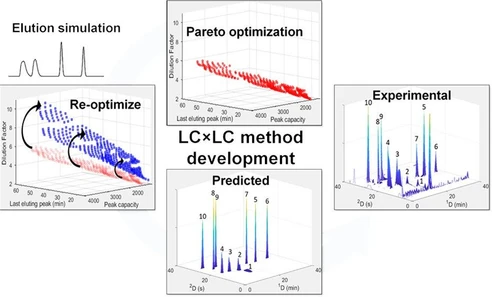
Automation & challenges in LC & 2DLC method development: What is optimal? (Tijmen S. Bos, MDCW 2025)
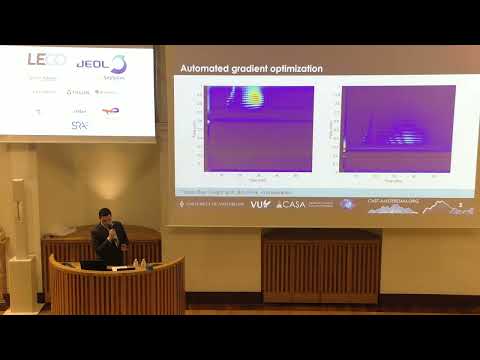
- Photo: MDCW: Automation & challenges in LC & 2DLC method development: What is optimal? (Tijmen S. Bos, MDCW 2025)
- Video: LabRulez: Tijmen S. Bos: Automation & challenges in LC & 2DLC method development: what is optimal? (MDCW 2025)
🎤 Presenter: Tijmen S. Bos (Analytical Chemistry Group, Van ’t Hoff Institute for Molecular Sciences, Amsterdam, Netherlands / Centre for Analytical Sciences Amsterdam (CASA), Amsterdam, Netherlands)
💡 Book in your calendar: 17th Multidimensional Chromatography Workshop (MDCW) 13 - 15. January 2026
Abstract
High-resolution liquid chromatography (LC) and two-dimensional liquid chromatography (2D-LC) have significantly enhanced the resolving power of separation technologies. However, a major barrier to widespread adoption is the substantial investment required for method development, data processing, and validation.
Our vision is to make advanced separation technologies accessible across various sectors, and our mission is to develop the necessary tools to achieve this. The chemometrics and chromatography communities have introduced a wide range of techniques that, when integrated, can facilitate the automation of multiple aspects of method development. Nevertheless, realizing this innovation requires addressing several scientific challenges.
In this context, we have recently developed a comprehensive, modular, closed-loop, and interpretive algorithm for automated LC method development, specifically designed for complex samples with unknown compositions. This platform was designed to iteratively program the LC system with new method parameters derived from previous experimental data until a specified objective function converges. By utilizing peak tracking, multi-start regression, retention modeling, and Bayesian optimization, such algorithms can automate the selection of various method parameters.
This presentation will discuss the current challenges in scaling automated method development technology for 2D-LC separations. Both retention modeling and machine learning approaches rely heavily on the chromatographic response function to optimize separation methods. A similar challenge arises in 2D column selection as we have to define what is optimal.
-Workshop-LOGO_s.webp)


_s.webp)