A Novel Platform to Generate Highly Realistic LC×LC and GC×GC data (Nino Milani, MDCW 2025)
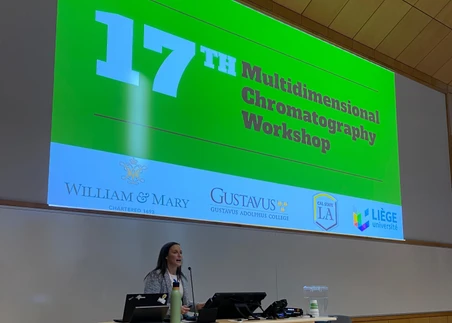
- Photo: MDCW: A Novel Platform to Generate Highly Realistic LC×LC and GC×GC data (Nino Milani, MDCW 2025)
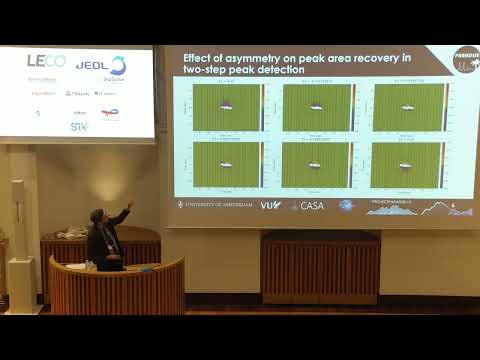
- Video: LabRulez: Nino Milani: A Novel Platform to Generate Highly Realistic LC×LC and GC×GC data (MDCW 2025)
🎤 Presenter: Nino Milani (University of Amsterdam, Amsterdam, Netherlands)
💡 Book in your calendar: 17th Multidimensional Chromatography Workshop (MDCW) 13 - 15. January 2026
Abstract
The success of any (two-dimensional) chromatographic separation does not depend exclusively on the ability of the chromatographer to achieve a separation, but also on the computational tools used to extract information. For users, the selection of the appropriate computational tools method may be a daunting task, but this is also true for automated workflows where chromatograms must be processed for use in unsupervised closed-loop method development. Arguably, the most critical step is peak detection as – ultimately – computational efforts such as library searches, peak integration, peak tracking, and retention modeling all hinge on the ability of peak detection methods to quantify, identify, or characterize sample constituents.
In this presentation, we present the results of our most recent study, where we have studied the effect of different peak and signal characteristics on the success of different peak detection (and, by extension, peak integration) methods in comprehensive two-dimensional chromatography (i.e. GC×GC and LC×LC). The peak properties studied included peak width in both dimensions, peak ratios, peak shape characteristics, and the impact of two types of modulation shifting (e.g., diagonal elution patterns as seen with shifted gradients in 2D-LC) on peak detection. We hope that our work contributes to (i) the much-needed further development of peak detection tools, (ii) aiding researchers in the selection of appropriate detection techniques, and (iii) raising awareness of the strengths and weaknesses.
-Workshop-LOGO_s.webp)