News from LabRulezLCMS Library - Week 22, 2025
LabRulez: News from LabRulezLCMS Library - Week 22, 2025
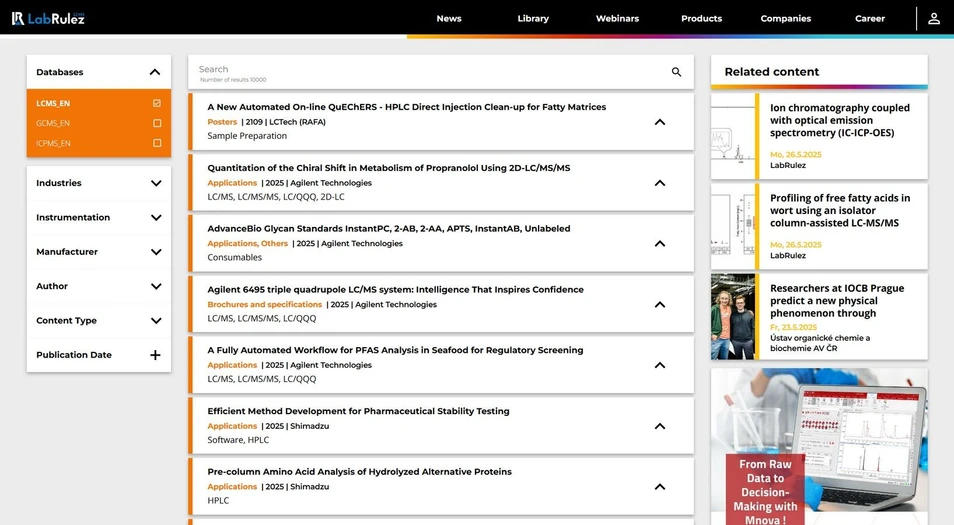
Our Library never stops expanding. What are the most recent contributions to LabRulezLCMS Library in the week of 26th May 2025? Check out new documents from the field of liquid phase, especially HPLC and LC/MS techniques!
👉 SEARCH THE LARGEST REPOSITORY OF DOCUMENTS ABOUT LCMS AND RELATED TECHNIQUES
👉 Need info about different analytical techniques? Peek into LabRulezGCMS or LabRulezICPMS libraries.
This week we bring you application notes by Agilent Technologies, Knauer, Shimadzu and Waters Corporation and brochure by Thermo Fisher Scientific!
1. Agilent Technologies: Expanding PFAS Coverage in Nontargeted Analysis Using Data-Independent Analysis
- Application note
- Full PDF for download
PFAS are a group of synthetic chemicals widely used in various industrial and consumer products due to their resistance to heat, water, and oil. However, their persistence in the environment and potential health risks have raised significant concerns, necessitating robust analytical methods for their detection and characterization.
This study used samples from NIST PFAS Interlaboratory Studies to assess the capabilities of the FluoroMatch IonDecon software in processing Agilent DIA files. The objective was to evaluate the performance of fragmentation from the Agilent All Ions MS/MS mode using an Agilent Revident quadrupole time-of-flight LC/MS (LC/Q-TOF) system.
The FluoroMatch suite is an open-source set of tools designed to streamline the suspect and nontarget screening of PFAS compounds. It automates several processes including file conversion, chromatographic peak picking, blank feature filtering, PFAS annotation based on precursor and fragment masses, and annotation ranking. The software library contains 15,643 PFAS fragmentation patterns, with the capability to add more.2
IonDecon, the latest enhancement to FluoroMatch, filters All Ions MS/MS data to retain only fragments correlating with precursor ions. This software can deconvolute any All Ions files and generate open-source data-dependent acquisition (DDA) formatted files for downstream nontargeted analysis workflows. In complex samples, incorporating All Ions fragmentation (AIF) and IonDecon can enhance MS/MS coverage of PFAS.
This methodology aims to improve the accuracy and efficiency of nontargeted PFAS analysis, providing a comprehensive approach to identifying and characterizing these persistent environmental contaminants.
Experimental
Three test methanolic solutions of NIST Interlaboratory Studies3 samples were analyzed using an Agilent 1290 Infinity II LC interfaced with a high-resolution Agilent Revident LC/Q-TOF with an Agilent Dual Jet Stream ESI source.
NIST A was comprised of a methanolic dilution of several commercially available calibration solutions. NIST B was a solution consisting of a methanolic dilution of two aqueous film-forming foam (AFFF) commercial solutions. NIST C was created by extracting, fortifying, and filtering a candidate soil material impacted by AFFF into methanol. Only one additional PFAS, commercially available, was used to fortify NIST C. Data were acquired in negative mode ionization using All Ions MS/MS and iterative exclusion information data-dependent analysis (iterative MS/MS) with four consecutive injections. Blanks were acquired every other injection for blank filtering.
Data were acquired from m/z 50 to 1,500, with collision energy for All Ions set at 0, 20, and 40 V, and, for Auto MS/MS, set at 40 eV. Table 1 details the LC and MS method parameters used for this analysis.
Results and discussion
Many structure elucidation algorithms focus on the six main chemical elements essential for life: carbon (C), hydrogen (H), nitrogen (N), oxygen (O), phosphorus (P), and sulfur (S). Consequently, these algorithms often perform poorly when analyzing anthropogenic compounds such as PFAS.
In this study, FluoroMatch software enabled the use of the Agilent peak picking method. FluoroMatch then performed blanks filtering, isotope grouping, alignment, and gap filling using mzXML format data. IonDecon was employed to remove fragment ions unlikely to be related to the precursor ion, resulting in an open-source data-dependent acquisition (DDA) file; the basic algorithm is depicted in Figure 1.
Once the MS and MS/MS data were collected, FluoroMatch generated a systematic scoring framework to communicate confidence for every feature. FluoroMatch Visualizer, developed using Microsoft Power BI Desktop software, provided users with customizable graphs, variables, and tables to aid in data interpretation. For example, new columns could be added to tables containing information of interest, new plots could be added, and new splicers and filters could be developed.
Conclusion
FluoroMatch software leverages in silico PFAS fragmentation libraries and rule-based annotation to automate the identification of PFAS compounds. With rules derived from over 15,643 PFAS across 97 subclasses, using spectra from literature and authentic standards, FluoroMatch significantly enhances PFAS analysis. In NIST Sample A, Agilent All Ions MS/MS mode increased the coverage of the 16 annotated compounds by 56%. It proved essential for this less complex sample. In contrast, iterative exclusion offered no additional hits in this sample. In the more complex NIST Sample C, containing nearly 200 PFAS, IE improved coverage by 45%, with All Ions providing five unique and correct hits not obtained by other MS/MS modes.
All Ions with IonDecon complements data-dependent acquisition methods such as Auto MS/MS with iterative exclusion. It improves coverage in complex matrices, provides fragmentation for every feature, and aids in the characterization of unknowns through isotopic ratios in fragmentation spectra. FluoroMatch Visualizer further facilitates the investigation of PFAS trends by narrowing down the number of features, making it a powerful tool for comprehensive PFAS analysis.
FluoroMatch was used to identify PFAS classes and highlight homologous series. The tentative identifications were then evaluated through SIRIUS+ CSI:FingerID fragmentation trees. SIRIUS is not optimized for perfluoro compounds, but the CSI:FingerID fragmentation trees were useful in ranking the possible annotations. The power of integrating orthogonal approaches is evident in the DIM004 sample results with a good balance between false negative and positive rates across all three samples.
2. Knauer: Quality control of oligonucleotides using HPLC coupled to UV and MS detection
- Application note
- Full PDF for download
During the last two decades oligonucleotides have become an important tool in basic research and a potent technology for drug development. These oligonucleotide-based drugs proved their therapeutic potency and showed an excellent toxicology profile. One aspect in the manufacturing process is the purification of the active pharmaceutical ingredient (API) and its separation from unwanted side products. To assure the successful synthesis and purification, analytical quality control is mandatory. The quality control requires a confident confirmation of oligonucleotide mass as well as quantification of impurities. Aborted sequences especially N-1 are often not baseline separated, which complicates a reliable quantification. Other impurities that occur because of degradation, as for instance depurination, cannot be separated sufficiently from the main peak. Such co-eluting impurities can be accurately quantified by a mass spectrometer. Liquid chromatography, especially ion pair-reversed phase (IP-RP) HPLC is one of the most widely used methods for the analysis of oligonucleotide impurities [1]. The below application shows a possible workflow, using an exemplary sample, for the characterization of oligonucleotides and impurity quantification via LC-UV and LC-MS. In this work we collaborated with BianoGMP GmbH. The company specialised in the production of high purity and quality oligonucleotides and has many years of experience in the development of therapeutic oligonucleotides with a focus on GMP services and oligonucleotide analytical methods.
RESULTS
The oligonucleotide was analyzed under ion-pairing reversed phase conditions using an aqueous solution containing hexafluoro isopropanol (HFIP) and triethylamine (TEA) as eluent A and 100 % methanol as eluent B. An injection volume of 2 µl of the reference solution (25 nmol/ml) was injected. The UV absorption at 260 nm was recorded. Fig. 1 shows the UV chromatogram of the injected sample. Peak area, peak height and retention time can be calculated by the software and be used for quantification.
CONCLUSION
Expanding the HPLC-UV method for quality control with MS benefits in mass confirmation and impurity identification. Impurities such as aborted sequences (N-1), depurination products or other modifications can be investigated although they are not, or not sufficiently, separated from the complete sequence (N). HPLC coupled with negative ESI-MS provides a reliable method with unique capabilities for separation and identification of (therapeutic) oligonucleotides. The described workflow only made use of the first quadrupole, but MS/MS or MRM experiments can be useful for the quantitative analysis of low-level oligonucleotide impurities and co-eluting substances.
3. Shimadzu: Highly Sensitive LC-MS/MS Method for Quantification of Beclomethasone in Human Plasma
- Application note
- Full PDF for download
User Benefits
- Rapid, simple and sensitive method with LLOQ of 5.0 pg/mL
- An extended Calibration Curve reduces reanalysis of samples outside range
- Quick and single step sample extraction method increased sample productivity
Beclomethasone dipropionate (BDP) is an inhaled corticosteroid used as maintenance treatment in the prophylaxis of asthma attacks[1]. Beclomethasone is a 17 alphahydroxy steroid that is prednisolone in which the hydrogens at the 9 alpha and 16 beta positions are substituted by a chlorine and a methyl group, respectively[2]. Structure of the prodrug of BDP is provided in Fig. 1.
Formulations for oral inhalation, intranasal, and topical use are available for BDP. Compared to earlier corticosteroids such as dexamethasone and prednisolone, BDP is reported to be less irritating to the nasal mucosa with a longer duration of action when administered intranasally [1]. BDP administered in the form of oral inhalation results in very low systemic bioavailability. This translates into significant challenges to develop a sensitive and reproducible bioanalytical method that can reliably measure plasma levels of BDP at very low expected levels.
The required LLOQ for most inhalation products is typically in the range of pg/mL to sub pg/mL. Very few analytical methods have been developed to determine BDP in biological samples using HPLC with tandem mass spectrometric detection (LC– MS/MS) and the lowest reported LLOQ of 25.0 pg/mL[3–4]. These methods fall short of the ideal target sensitivity required by the pharmaceutical research, and this motivated us for the current study. The main aim of this work is to develop a LC-MS/MS method at picogram level (LLOQ –5.0 pg/mL) using BDP-D10 as internal standard to support regulatory studies. Structure of BDP-D10 (BDP-D10) is presented in Fig. 2.
3. Experimental
3.2. Instrument parameters on LCMS-8045
Refer Table 2 for analytical conditions and instrument parameters. BDP produced two intense product ions (refer Table 3 for MRM transition) and the sum of both product ions was used for quantification of BDP as presented in Table 3.
4. Result and Discussion
4.1. Method Development
Both BDP and BDP-D10 produced higher signals by ESI than by APCI. In the mass spectrum of BDP, we observed that the summation of product ions at m/z 411.3 and m/z 319.1 resulted in achieving LLOQ of 5.0 pg/mL successfully. Several commercially available reversed phase HPLC columns were evaluated for BDP, but separation was achieved best on Shimpack GIST C18 column with satisfactory chromatography, low back pressure and minimal background noise (refer Fig. 4).
Protein precipitation, LLE and SPE are the three commonly used sample preparation techniques which were evaluated to isolate BDP from biological matrices. In comparison to protein precipitation and LLE, SPE contributed to good recovery, reproducibility and consistent results. No interference and matrix effect were observed at the retention time and MRM transition of BDP and BDP-D10.
4.2. Method Validation
The method was validated for linearity, accuracy, precision, selectivity, matrix effect, recovery and stability according to the FDA guidelines for the validation of bioanalytical methods (for summary of results refer Table 1). Three independent standard curves were prepared on each of three separate days. Linearity was assessed by weighted linear regression (1/x2) of analyteinternal standard peak area ratios. Accuracy and precision were determined using QC samples at 5.0, 25.0, 250.0 and 1000.0 pg/mL in plasma. Intra- and inter-day precisions were found
5. Conclusion
LCMS-8045, along with special sample preparation, optimized chromatography provides a very selective and sensitive method for bioanalytical assay of BDP. Ultra-high speed and high-separation analysis was achieved on Nexera X2 UHPLC by using a simple mobile phase at a minimal gradient flow rate of 1.0 mL/min. These applications serve as important tools for detecting extremely low plasma concentrations during bioequivalence and pharmacokinetic studies of generic drug molecules. By providing these ready to use solutions, we partner with your labs to achieve desired results in your scientific endeavors.
4. Thermo Fisher Scientific: Analytical solutions for biopharmaceutical characterization and control
- Brochure
- Full PDF for download
Your partner on every step of your journey
As biotherapeutics grow in complexity—from monoclonal antibodies to gene therapies—the need for advanced, fit-for-purpose analytical tools becomes essential. Thermo Fisher Scientific provides comprehensive solutions that span the entire drug development lifecycle, from discovery and characterization to quality control and manufacturing. These tools support critical tasks like identifying modifications, monitoring molecular attributes, and ensuring regulatory compliance.
Central to Thermo Fisher’s offering are high-resolution mass spectrometers such as the Orbitrap Eclipse Tribrid, Q Exactive UHMR, and Orbitrap Exploris 480, which enable precise intact protein analysis, peptide mapping, and characterization of post-translational modifications (PTMs). Complementing these instruments are advanced separation platforms like the Vanquish UHPLC systems and ZipChip CE-MS, providing robust, reproducible performance for even the most demanding biotherapeutic samples.
To streamline analysis, Thermo Fisher offers powerful software solutions like BioPharma Finder and Chromeleon CDS, which guide users through peptide mapping, intact mass analysis, and host cell protein detection. These platforms ensure compliance-readiness and facilitate automation, enabling high-throughput workflows and deeper insights into complex biomolecules.
In addition to hardware and software, the portfolio includes specialized chemistries and consumables for glycan profiling, oligonucleotide mapping, and antibody-drug conjugate (ADC) analysis. These tools support emerging therapies and novel modalities, such as viral vectors and biosimilars, by providing precise structural and functional data.
Whether addressing early-stage research or GMP-quality control, Thermo Fisher’s integrated analytical ecosystem delivers the speed, accuracy, and confidence required to accelerate biopharmaceutical development and ensure product quality from discovery through to market.
5. Waters Corporation: Leveraging Analytical Quality by Design Principles for Efficient Development of a Targeted Assay Method for Routine Monitoring of Mannose-5 Glycans Using Fluorescence Detection
- Application note
- Full PDF for download
Benefits
- The ACQUITY™ QDa™ II Mass Detector complements method development workflows by easily monitoring coeluting peaks over various chromatographic conditions
- Integration of Fusion QbD® Software with Empower™ 3 Chromatography Data System (CDS) facilitates seamless data exchange by efficiently transferring method conditions and exporting processed results
- AQbD provides a comprehensive understanding of the relationship between method parameters and analytical performance
AQbD is a systematic, scientific, and proactive approach to method development that begins with predefined objectives. In the context of chromatographic methods, AQbD principles provide a structured framework that enhances the efficiency, robustness, and reliability of analytical methods. Traditionally, methods were developed using a one-factor-at-a-time (OFAT) approach where one variable is changed sequentially until a suitable method is produced. This type of development can create adequate methods but provides a limited understanding of method capabilities and method robustness. According to the ICH Q14 guidelines, the traditional approach remains an acceptable method for developing robust analytical procedures that are fit for their intended purpose. However, the enhanced approach integrates elements of AQbD and risk management into the development process, offering a more comprehensive understanding of the interactions between variables and the collective impact on method performance.2 This enhanced approach to method development uses statistical tools, including DoE, which is a structured approach for planning, analyzing, and interpreting experiments to study the relationship between factors and responses, and robustness simulators, for the identification of optimal method conditions. These tools enable the identification of critical method parameters and their interactions, allowing for the optimization of method conditions to achieve desired performance characteristics.
The primary objective of this application note is to develop a targeted Man-5 assay utilizing a software-assisted AQbD approach. Typically, glycans are analyzed using a HILIC method, however, closely related glycan structures can coelute, making it difficult to achieve high-resolution separations. Utilizing AQbD principles, CMPs such as buffer concentration, column temperature, and gradient slope were systematically evaluated and optimized. The use of DoE allowed for the exploration of a wide range of these conditions, leading to the establishment of a MODR. This approach ensured that the method conditions were fine-tuned to achieve optimal separation of Man-5 from other glycans.
Results and Discussion
During method development, particularly within the framework of AQbD, established platform methods can serve as a strategic starting point for creating robust and reliable analytical procedures. While these methods can be valuable during the development stages, they may fall short when targeting specific peaks of interest. As shown in Figure 1A, a universal N-glycan HILIC method was previously developed to separate diverse types of Nglycans from mAb drug products. This platform method is the basis of the GU integrated scientific library within UNIFI and is the recommended method for a variety of RapiFluor-MS standards.
In this chromatogram, the RapiFluor-MS Intact mAb Standard produces a similar N-glycan profile to that of therapeutic mAbs and at least 14 different N-glycans can be readily identified.3 However, several peaks are only partially resolved and consequently difficult to monitor by FLR. In Figure 1B, one critical glycan species that is not fully resolved is the Man-5 glycan. This glycan impacts the pharmacokinetics and efficacy of mAbs and requires monitoring due to its influence on clearance rates.4 Therefore, robust separation of the Man-5 glycan is the Critical Quality Attribute (CQA) defined for this study. Its coelution in the platform method necessitates the use of the ACQUITY QDa II Mass Detector to leverage the specificity of SIR mass analysis for separating Man-5 from the coeluting FA1G1 and A2G1 glycans as shown in Figure 1C. By applying AQbD principles, the universal Nglycan HILIC method will be systematically optimized to develop a targeted assay for monitoring Man-5 glycans by FLR.
Conclusion
By applying AQbD principles, the universal N-glycan HILIC method was efficiently transformed into a targeted, high-performance assay for Man-5 glycan monitoring using FLR detection. Leveraging tools such as DoE, Fusion QbD Software, and the ACQUITY QDa II Mass Detector enabled a data-driven approach to method optimization. This resulted in a comprehensive understanding of critical method parameters and their impact on chromatographic performance. This process led to the establishment of a robust MODR, ensuring the methods reliability, robustness, and compliance with regulatory requirements. Methods within the MODR demonstrated high resolution, specificity, and consistency, ideal for routine analytical workflows focused on Man-5 monitoring. Overall, the tailored method developed through AQbD principles offers a more efficient and effective solution than a traditional OFAT approach. This approach highlights the advantages of using AQbD for method development, ultimately leading to enhanced method performance and reduced variability.