News from LabRulezLCMS Library - Week 25, 2025
LabRulez: News from LabRulezLCMS Library - Week 25, 2025
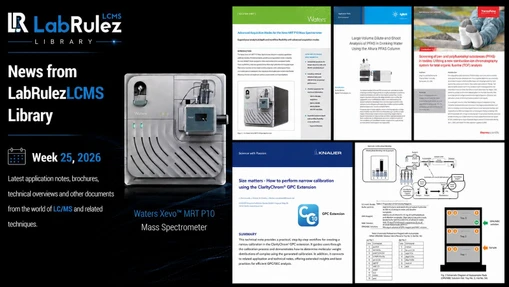
Our Library never stops expanding. What are the most recent contributions to LabRulezLCMS Library in the week of 16th June 2025? Check out new documents from the field of liquid phase, especially HPLC and LC/MS techniques!
👉 SEARCH THE LARGEST REPOSITORY OF DOCUMENTS ABOUT LCMS AND RELATED TECHNIQUES
👉 Need info about different analytical techniques? Peek into LabRulezGCMS or LabRulezICPMS libraries.
This week we bring you brochure by Agilent Technologies and application notes by Shimadzu, Thermo Fisher Scientific and Waters Corporation!
1. Agilent Technologies: PFAS Analysis Without Compromise
- Brochure
- Full PDF for download
The brochure presents Agilent’s comprehensive solutions for environmental PFAS (per- and polyfluoroalkyl substances) analysis, designed to support laboratories in meeting increasingly stringent regulatory standards. Given the persistence and bioaccumulative nature of PFAS in water, soil, and biological samples, effective and contamination-free sample preparation is crucial. Agilent offers a complete range of solid phase extraction (SPE) cartridges and start-up kits specifically tailored for EPA and ISO PFAS methods, including EPA 533, 537.1, and 1633, as well as ISO 21675:2019. These tools ensure high recovery rates, method compliance, and minimal contamination risk.
At the heart of Agilent’s offering are the Bond Elut PFAS WAX and Bond Elut PFAS WAX/Carbon S dual-phase cartridges. The WAX cartridges utilize polymeric PSDVB sorbent with diamino functionality for strong retention and selectivity, making them ideal for extracting a broad range of PFAS classes, from carboxylic and sulfonic acids to fluorotelomer sulfonates and polyfluoroalkyl ethers. The dual-phase WAX/Carbon S cartridges combine high PFAS recovery with superior matrix cleanup, effectively handling complex samples like biosolids and fish tissues in compliance with EPA Method 1633.
Agilent ensures batch-to-batch consistency through rigorous quality control. Each cartridge batch comes with a Certificate of Analysis (CoA), verifying PFAS cleanliness and recovery. This level of assurance helps labs reduce verification workload while ensuring reliable, reproducible results. Additionally, the products are compatible with automated sample preparation systems, which is essential for high-throughput labs aiming to optimize workflow efficiency.
To further support labs, Agilent offers specialized PFAS Start-Up Kits and PFC-free HPLC conversion kits for ultratrace PFAS analysis. These complete workflow solutions include vials, columns, filters, and sorbents engineered to prevent PFAS contamination. Whether the application is environmental or food-related, Agilent’s portfolio equips laboratories with the tools they need to conduct PFAS testing with confidence, accuracy, and regulatory compliance.
2. Shimadzu: Chiral Amino Acid Analysis Using a Single Quadrupole Mass Spectrometer
- Application note
- Full PDF for download
User Benefits
- Separation with a chiral column enables direct analysis of chiral amino acids without pretreatment by derivatization.
- By using a high-performance single quadrupole LC-MS system, even trace quantities of D-amino acids can be detected in foods and cosmetics
Of the 20 types of amino acids included in proteins, optical isomers exist for all but glycine. Most naturally occurring amino acids are L-amino acids, but advancements in analytical technology have revealed the presence of D-amino acids in many organisms. It is also becoming evident that D-amino acids have different physiological functions than L-amino acids. Consequently, D-amino acids perform attracted attention in basic research related to their physiological and medical functions and for applications in the fields of food, health, and beauty.
This Application News article describes using a single quadrupole LC-MS system with a crown ether-type chiral column to analyze chiral amino acids, which enables rapid analysis of chiral amino acids without derivatization pretreatment. If a comprehensive analysis of all hydrophilic metabolites that includes amino acids is required, refer also to Application News No. 01-00334-EN, which describes a useful technique forsuch analysis.
Instruments and Analysis Conditions
Analysis was performed with a Nexera series HPLC system that was combined with an LCMS-2050 LC-MS system (Fig. 1). Although compact, the LCMS-2050 single quadrupole mass spectrometer offers easy operability and outstanding performance. Equipped with a DUIS heated ion source, which provides the benefits of both ESI and APCI, it can analyze masses ranging from m/z 2 to 2000. That makes it well suited for simultaneously analyzing all metabolites, including amino acids, as described in Application NewsNo. 01-00334-EN.
The analysis condition settings for HPLC and MS are shown in Table 1. The analysis conditions for LCMS-2050 was configured based on the analysis conditions in the LC/MS/MS Method Package for D/L Amino Acids. Using a crown ether-type chiral column enables the chiral separation of all amino acids except proline, which is a secondary amine.
Conclusion
This article describes using a chiral column and a single quadrupole LC-MS system to analyze chiral amino acids. The technique enables direct analysis of chiral amino acids without derivatization pretreatment. Although sensitivity is lower than a triple quadrupole LC-MS system, it offers equivalent or higher sensitivity than a quadrupole time-of-flight LC-MS system or a fluorescence detector. So while it is not appropriate for analyzing ultra-trace concentrations of chiral amino acids, it is well suited to analyzing foods and other samples that contain large amounts of chiral amino acids. It also offers good throughput, with the ability to analyze samples within 15 minutes, even if that involves switching between (+) and (-) columns to separate components from contaminants in the samples. This also makes it well suited for analyzing large quantities of samples. Widespread adoption of the described techniques for chiral amino acid analysis can be expected to lead to continuous advancements in the R&D of foods, cosmetics, and othersamples.
3. Thermo Fisher Scientific: Enhanced screening of PFAS compounds in wastewater: Implementing U.S. EPA Method 1621 with improved combustion-ion chromatography
- Application note
- Full PDF for download
Per- and polyfluoroalkyl substances (PFAS) is the collective name for over 14,000 synthetic fluorinated compounds. A PFAS compound is defined as a compound containing a fully fluorinated methyl group or methylene on an alkane functional group (Organisation of Economic Co-operation and Development (OECD)) or as a fluorinated compound with at least two adjacent saturated carbons with one carbon fully fluorinated and the other at least partially fluorinated (U.S. Environmental Protection Agency (EPA)).1,2 Since the 1940s, PFAS have been prevalent in many polymers, surfactants, fire-suppression chemicals, industrial products, and consumer products.3-6 In addition to their extensive presence, PFAS compounds are persistent and bioaccumulate. Consequently, PFAS compounds are an environmental contamination concern. Toxicological studies of several PFAS compounds, such as perfluorooctanoic acid (PFOA) and perfluorooctane sulfonate (PFOS), indicate the potential for acute to chronic effects impacting reproductive health.7-11 Fewer studies have been conducted on the thousands of other compounds grouped under the EPA PFAS classification.2
The U.S. EPA has defined targeted and non-targeted analysis methods for PFAS.12-18 Combustion-ion chromatography (C-IC) was previously demonstrated as a screening method for PFAS; PFAS compounds are converted to HF, and the subsequent fluoride is analyzed by ion chromatography (IC) with suppressed conductivity detection.19-24 This technique is incorporated into EPA Method 1621 for non-targeted determinations of PFAS as adsorbable organic fluorine (AOF).25-28 Our results from the EPA Method 1621 multi-laboratory study are also published in the Thermo Scientific Application Note AN002748 with additional tips for successful implementation in the Thermo Scientific Technical Note TN003056.29,30
In the EPA Method 1621 collaboration study, we found that reduced baseline contamination and increased sensitivity, accuracy, and precision can be achieved by minimizing sources of contamination.29,30 Another approach to reduce baseline contamination is to design the adsorption and combustionabsorption systems in a way that reduces or eliminates contamination sources. In this application, EPA Method 1621 is implemented on the offline Thermo Scientific™ Cindion™ Adsorption module, a Cindion Combustion / Absorption module with liquid and solid sample handling, and a Thermo Scientific™ Dionex™ Inuvion™ Reagent-free Ion Chromatography (RFIC™) System. The adsorption module was designed to minimize contamination by eliminating contamination sources. To increase throughput, the adsorption module is designed to semiautomatically adsorb PFAS from six water samples at a time. The Thermo Scientific™ Cindion™ Combustion-Ion Chromatography (C-IC) System was optimized for increased combustion efficiency by incorporating a Z-fold combustion tube to introduce oxygen at multiple locations. As a result, the combustion tube and furnace are shorter, and combustion times are reduced. This also results in a smaller footprint, saving crowded bench space. Data processing and system management are also more efficient because the Cindion C-IC system is controlled by a single software, the Thermo Scientific™ Chromeleon™ Chromatography Data System (CDS). Overall, this solution provides improved sensitivity due to increased signal-to-noise, improved recoveries of added standards, and comparable reproducibility to previous results in a smaller footprint.
Experimental
Equipment
Cindion C-IC system
- Thermo Scientific™ Cindion™ Combustion / Absorption Module (P/N B51006425) with Thermo Scientific™ Cindion™ C-IC Solids Kit (P/N B51006426)
- Thermo Scientific™ Cindion™ Solid / Liquids Autosampler (P/N B51006429)
- Thermo Scientific™ Cindion™ Adsorption Module (P/N B51006430), includes six column holders
- Thermo Scientific™ Dionex™ Inuvion™ IC System with RFIC (P/N 22185-60108)
- Optional Thermo Scientific™ Dionex™ Eluent Monitor, 4 L (P/N 22185-62708)
- Thermo Scientific™ Thermolyne™ Muffle furnace, 2 L small bench top, to clean combustion cups, recommended for EPA Method 1621 (P/N FB1415M)
Software
- Chromeleon CDS software, Chromeleon 7 version 3.2, with Cindion C-IC system and eluent monitor drivers
Results and discussion
The official EPA Method 1621 was updated from the draft method, and therefore, some of the section enumerations have changed. In addition, this method was updated from the EPA method by initiating the gradient at 4 min instead of 6 min to ensure that all anions are fully eluted from the column. Initial demonstration of capability In EPA Method 1621, the initial demonstration of capability (IDC) is required before analyzing samples. IDC includes determining the retention time windows of fluoride and chloride, calibration with relative standard error (RSE) 1 min from the water dip (void volume) and other peaks eluting near fluoride for accurate determinations. In hydroxide eluent separations with suppressed conductivity, as shown in Figure 2, the water dip is small and isolated from fluoride. Fluoride elutes away from the water dip in a flat baseline region. The results of these retention time experiments are summarized in Table 1. Fluoride meets the retention time criteria.
Conclusion
This application note demonstrates U.S. EPA Method 1621 results using an improved C-IC workflow solution. The C-IC complete flow path includes the adsorption of PFAS in wastewater samples using the offline Cindion adsorption module, the combustion of the PFAS to fluoride using the Cindion combustion-absorption system, and quantitation using a Dionex Inuvion IC instrument with RFIC. The results were improved compared to previous implementation of EPA Method 1621 in Thermo Scientific Application Note AN002748. MDLs were improved (1.7 μg/L vs. 2.3 μg/L) with comparable reproducibility (4.5% RSDs vs. 4.6%) and improved accuracy (82–101% vs. 70–120%) as compared to previous results. This method showcases significant advantages of the Cindion C-IC system for measuring AOF and screening for PFAS in wastewater. In addition to ease of use, RFIC with hydroxide eluents provides more accurate reporting because fluoride easily elutes from the water dip, eliminating the need for manual integration. These data collectively highlight the power of C-IC in eliminating the sample matrix and measuring only adsorbable fluorine content in samples, successfully achieving the goals outlined in U.S. EPA Method 1621.
4. Waters Corporation: Enhanced Reliability for Long-Term PFAS Analysis with the Xevo TQ Absolute XR Mass Spectrometer
- Application note
- Full PDF for download
Benefits
- Xevo TQ Absolute XR provided maximal system uptime for PFAS analysis across 10 weeks and more than 7000 injections with no unscheduled downtime.
- Reliable calculated concentrations were maintained for PFAS at relevant levels in extracts of river water, biosolid, and landfill leachate with %RSDs of <8.4%.
- Seamless batch review and long-term calibration management using waters_connect™ for Quantitation Software accelerated data validation workflows.
As awareness grows around the environmental and health impacts of PFAS, regulatory pressure continues to intensify globally. The EPA Method 1633A1 has become a critical protocol for the quantitation of 40 PFAS compounds in diverse environmental matrices, including non-potable water, soils, biosolids, and tissues. Although the method describes a solid phase extraction (SPE) clean-up step for all sample types, these matrices still contain co-extractive interferents when introduced into an LC-MS/MS system, which can contaminate the system and degrade method performance over time. This application note describes how the StepWave XR Ion Guide, a novel slotted bandpass ion guide within the Xevo TQ Absolute XR Mass Spectrometer, can be integrated into a typical PFAS workflow to enhance signal robustness while preserving sensitivity and speed, thereby boosting method reliability.
Experimental
LC Conditions
- UPLC system: ACQUITY™ Premier System with Binary Solvent Manager and Flow-Through Needle
MS Conditions
- MS system: Xevo TQ Absolute XR Mass Spectrometer
Results and Discussion
QC Performance
Method performance was evaluated every 10 sample extract injections to ensure that the weekly calibration of the method was stable. Figure 2 shows the QC plots for GenX, L-PFHxS, L-PFOS, PFBS, PFNA, and PFOA with a tolerance of ±30% set from the assigned concentration level (0.1–0.2 ng/mL) over the course of the study. Table 1 lists the %RSDs for the ion ratios for the same compounds. QC measured concentrations and ion ratios were within the set tolerances across 10 weeks and more than 7,000 injections with no unscheduled downtime. This illustrates the reliability of the Xevo TQ Absolute XR for PFAS analysis using a weekly calibration routine.
Conclusion
The StepWave XR Ion Guide within the Xevo TQ Absolute XR Mass Spectrometer was introduced into a typical PFAS workflow and shown to maintain method reliability for extended periods of time. The Xevo TQ Absolute XR provided maximal system uptime for PFAS analysis across 10 weeks and more than 7,000 injections with no unscheduled downtime. Concentrations for PFAS at relevant levels were reliably calculated in extracts of river water, biosolids, and landfill leachate with trueness in the range 70–130% and %RSDs of <8.4%. These findings
support the Xevo TQ Absolute XR as a powerful platform for laboratories seeking to meet regulatory requirements for PFAS monitoring while minimizing system downtime and maintenance.