Systematic method optimisation approach for small molecule imaging on the SELECT SERIES MALDI MRT - Drug mapping in fingerprints, a case study
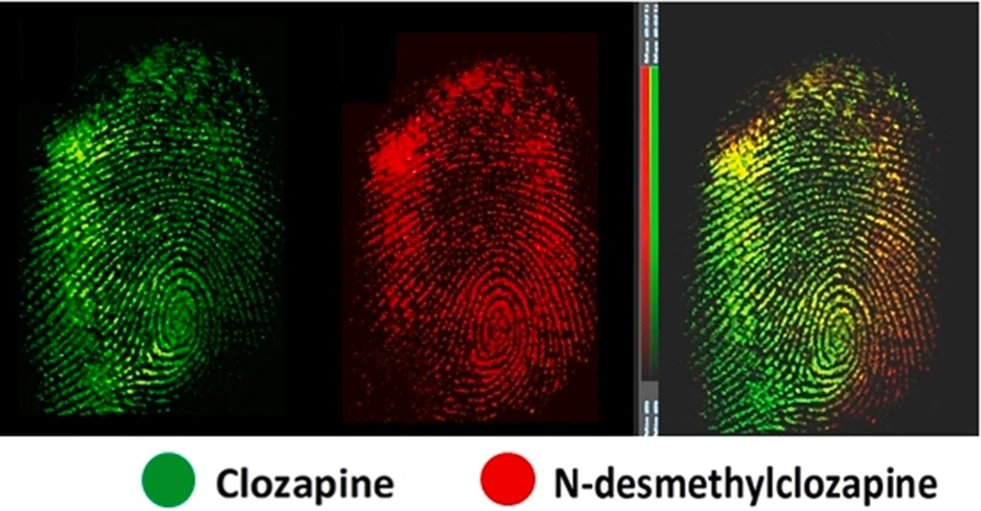
Analytica Chimica Acta, Volume 1354, 2025, 343998: Graphical abstract
MALDI-MSI and MSP enable molecular fingerprinting that reveals biometric and lifestyle information from fingermarks, aiding forensic investigations. This study explores the capabilities of the SELECT SERIES MALDI-MRT mass spectrometer, leveraging its sub-ppm mass accuracy and 15 μm spatial resolution.
A systematic method optimization was carried out, including laser parameters, source voltage, quadrupole profile, transfer gas, and RF settings. Applied to both latent and drug-contaminated fingerprints, the optimized method significantly improved image resolution, enhancing the forensic potential of molecular fingerprinting.
The original article
Systematic method optimisation approach for small molecule imaging on the SELECT SERIES MALDI MRT - Drug mapping in fingerprints, a case study
Rohith Krishna, James Langridge, Emmanuelle Claude, Robert Bradshaw, Laura Cole, Simona Francese
Analytica Chimica Acta, Volume 1354, 2025, 343998
https://doi.org/10.1016/j.aca.2025.343998
licensed under CC-BY 4.0
Selected sections from the article follow. Formats and hyperlinks were adapted from the original.
The ability to visualise drug distribution in fingermarks can provide an important link between the biometric information (ridge pattern, identifying the individual) and contextual information relating, for example, to suspect's activities prior to depositing the fingermark. The presence and distribution of the drug metabolite may indicate consumption rather than handling, which is information that may not be readily accessible to the investigators if the suspect is apprehended outside the half lifetime of the drug/metabolite. Current efforts in our laboratory aim to expand the range of illicit drugs, medications and their metabolites that is possible to detect and image in fingermarks, taking stock from the work on drug imaging via MALDI MSI reported by our group and others [[19], [20], [21], [22]].
In this study, we report the development of a MALDI MSI method on the SELECT SERIES MRT to map the antipsychotic medication clozapine and its main metabolite N- desmethyl clozapine, in a physiological ratio and abundance, in a doped fingermark. The eventually optimised method has been successfully applied to simultaneously image the distribution of these species in a fingerprint, in amounts as low as 1.9 ng/mm2, whilst contextually delivering biometric information. The method was “validated” on another antipsychotic (quetiapine) and its metabolite (7-hydroxyquetiapine) to demonstrate versatility and extendibility of the method.
As such, this paper must be taken as (i) an effort to provide a small molecule MALDI MS imaging method development framework on an advanced and state-of-the-art instrument, likely to be used by more and more mass spectrometry laboratories in the next few years and (ii) a general and logical framework of imaging method development, underpinned by the fundamental knowledge of the different mass spectrometry parameters, settings and instrumental parts.
2. Materials and methods
2.2. Instrumentation, data acquisition and data processing
Spray-coat matrix deposition was performed on the HTX M3+ Sprayer™ (HTX Imaging, North Carolina, USA). The MALDI measurements were performed on the multi-reflecting QToF SELECT SERIES™ MRT (Waters Corp., Wilmslow, UK) incorporating a 2.5 kHz solid state Nd:YAG laser at a repetition rate of 1 KHz, utilizing a 50 μm step size at a scan rate of 0.2 s, and operated in positive ion mode, within the instrument operating between m/z 50 and 2400. Data acquisition was conducted using MassLynx™ v4.2 and the Quartz v2.7.1 software. All imaging experiments were continuous lockmass corrected (CLMC) during acquisition using the α-CHCA ion at m/z 212.03233 (included within the instrument method file). The instrument was calibrated prior to every analysis using phosphorus red to achieve sub-ppm levels mass accuracy in the m/z 50–2400 mass range. The laser intensity (LI), lens focus (LF) and functions of the secondary attenuator (SA) were primarily optimised followed by the tuning and evaluation of the sample plate voltage (SPV) and extraction voltage (EV) effects. The quadrupole profile optimisation and then the transfer RF optimisation were finally undertaken to target specific m/z ranges and achieving higher sensitivity. Aside from laser tuning and source parameter comparison for which fingerprints of 2 × 2 mm and 6 × 6 mm in size were used, fingerprint regions of 1 × 1 mm in size were employed for the source voltages, gas flow, quadrupole profile and RF optimisations.
For data processing, all the raw data were initially processed and visualised in HDI™ 1.7 (Waters Corporation, Wilmslow UK), with the following parameters: MS resolution of 200,000, m/z window of 0.005 Da, and the number of most intense peaks set to 1000. All the images were TIC (Total Ion Count) normalised, except for the EFP mode selection experiment to avoid image artefacts due to the variation in TIC. In TIC normalisation, the systematic artefacts in the mass spectral intensity are removed by dividing the intensity value of each peak, by the sum of all peak intensities in that particular pixel. Relevant regions of interests (ROI) were exported to MassLynx™ v4.2 software for spectral interrogation.
3. Results and discussion
3.1. MALDI MSI method testing
The optimised settings reported in Supplementary Table S1 and discussed in the previous section for the imaging of the small molecule range, and in particular for spotted clozapine in fingerprints, were applied to clozapine and N-desmethylclozapine in both spotting experiment (1000 ng/mL-0.1 ng/mL) as well as for drug-contaminated fingerprints, prepared according to Groeneveld et al. [19]. As shown in Fig. 8, specifically 8 A and 8 B, the optimised MALDI MSI method enabled the detection of clozapine down to 1 ng/mL concentration, and N-desmethylclozapine down to 10 ng/mL in the sensitivity experiments. In the case of the drug-contaminated fingerprints experiments (Fig. 8C–D), a 1:1 solution of the drug and metabolite was employed to eventually contaminate a fingertip and subsequently generate a fingerprint. This ratio was selected for demonstration purposes; although in 20 schizophrenic patients study by Ming and Heathcote [37], clozapine and N-desmethylclozapine were detected in serum at an average ratio of 1.4, the ratios varied between 0.86 and 2.2. Considering that ratios depend on individual variability, formulation and also on drug adherence, and that the average ratio in sera may not necessarily be the same in other biological fluids/specimens, we considered in our study a 1:1 ratio for simplicity. Within this experiment, both clozapine and metabolite were visualised on the ridges. The overlay of the MALDI images of clozapine and its metabolite shown in Fig. 8E improved the ridge pattern detail and continuity; as such, images in Fig. 8C–E can provide both toxicological and biometric intelligence.
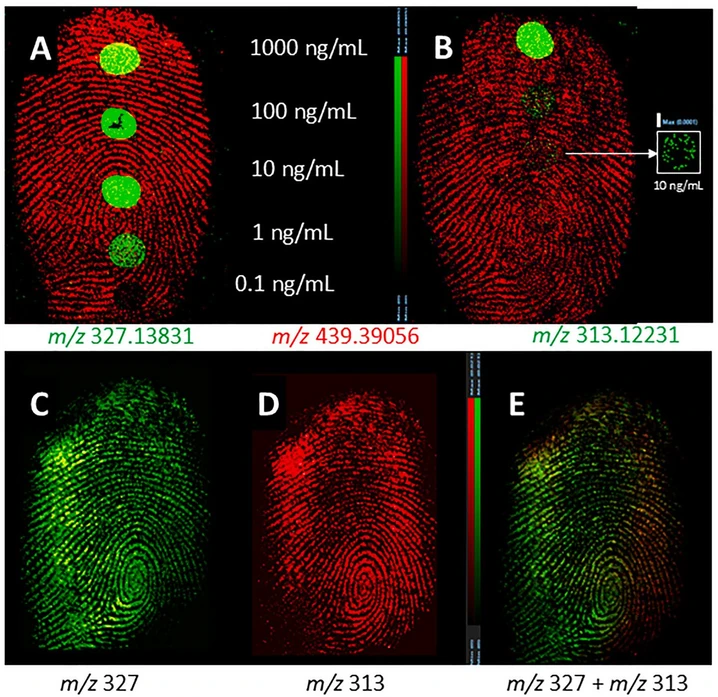 Analytica Chimica Acta, Volume 1354, 2025, 343998: Fig. 8. Application of optimised small molecules MSI method for clozapine (m/z 327.13831) and its metabolite N-desmethylclozapine (m/z 313.12231). A and B show sensitivity test for clozapine and its metabolite by spotting them in multiple 10-fold serial dilutions between 1000 ng/mL and 0.1 ng/mL, and the fingerprint is overlayed with an ion image at m/z 439.39056. C: clozapine and D: N-desmethylclozapine contaminated-fingerprints, and E: showing the overlay of both the drug and metabolite. Data is normalised by TIC. Pixel size at 50 μm.
In order to further demonstrate that the optimised MALDI MSI method is applicable to small molecule imaging in general within the 100–1500 m/z range, the method was applied to another fingerprint contaminated with a second antipsychotic drug, quetiapine hemifumarate (prescribed to patients with bipolar disorder and schizophrenia), and to its metabolite 7-hydroxyquetiepine.
The optimised MALDI MSI method enabled the visualisation of the spotted quetiapine hemifumarate (Fig. 9A), down to 1 ng/mL which is still visible within the overlaid image with an endogenous fingerprint molecule (Fig. 9A). It was also possible to visualise 7-hydroxyquetiepine down to 10 ng/mL (Fig. 9B). As for clozapine and N-desmethylclozapine fingerprint imaging experiments shown in Fig. 8C–E, fingerprints were also generated by contaminating a fingertip with a mixed solution of the two species. As previously, using the same rationale employed for preparing the mixed solution clozapine/N-desmethylclozapine, a 1:1 ratio quetiapine/7-hydroxyquetiepine was employed. The drug-contaminated fingerprint enables visualisation of both the drug (Fig. 9C) and metabolite.
 Analytica Chimica Acta, Volume 1354, 2025, 343998: Fig. 9. Application of the optimised small molecules MALDI MSI method to quetiapine (m/z 384.17517) and 7-hydroxyquetiepine (m/z 400.17007) in fingerprints. A and B: sensitivity test for quetiapine and metabolite by spotting them in multiple 10-fold serial dilutions from 1000 ng/mL to 0.1 ng/mL; the images for these ions are overlaid with a fingerprint ion image at m/z 299.30692. C: MALDI MSI of fingerprints contaminated with a 1:1 mixture of quetiapine and D 7-hydroxyquetiapine contaminated fingerprints; E: shows the overlay of both the drug and metabolite, and F: shows the further overlay of the ions at m/z 550.63031 and m/z 522.59814 for the purpose of a better-quality ridge pattern. Data is normalised by TIC. Pixel size at 50 μm.
(Fig. 9D). The individual MALDI-MS images for the two species have been overlaid in Fig. 9E to provide the full fingerprint image. In order to provide even better biometric information, ridge pattern continuity was improved by overlaying additional ion images from ions at m/z 550.63031 and m/z 522.59814 (Fig. 9F).
With respect to detection and quantification of clozapine, quetiapine and their metabolites, extraction and LC MS or LC MS/MS have been the golden standard methods.
The aforementioned study by Ming and Heathcote [37] detected clozapine and N-desmethylclozapine in the sera of 20 schizophrenic patients, following a therapeutic dosage of 600 mg/day, in a range between 32.27 ng/mL (in one instance <10 ng/mL) and 1147.37 ng/mL for clozapine and 49.45 ng/mL (in one instance <10 ng/mL) and 1402.26 ng/mL for N-desmethylclozapine using UPLC-Tandem MS. In a more recent study by Longman et al. [26], clozapine (and to a lesser extent N-desmethylclozapine) were detected in the fingerprints of medicated patients, indicating for the first time that these species are excreted through sweat and specifically sweat from fingertips, even for patients dosed with as little as 25 mg/day clozapine (normal range is between 150 and 300 mg/day [38]), thus fully justifying method development to detect and image in situ both the drug and the metabolite in fingerprints, as presented in this paper.
In 2009, quietipine was quantified in patients' plasma at a concentration as low as 1 ng/mL. Quetiapine and 7- hydroxyquetiapine were quantified also in patients’ hair at concentrations between 0.35 ng/mg to 10.21 ng/mg hair, and between 0.02 ng/mg to 3.19 ng/mg hair, respectively [39] with ratios varying between 0.97 and 13. Finally, quetiapine and 7-hydroxyquetiepine were detected in fingerprints of patients medicated in a range between 100 and 500 mg/day [26] or dosed at 300 and 600 mg/day [40], but in these studies, no quantification data were reported.
In MALDI MSI experiments, clozapine, quetiapine and their primary metabolites were imaged and detected directly in a drug-contaminated fingerprint with no prior extraction. As such, considering the fingerprint area of ∼261.2 mm2, and the concentrations and volumes of the two species employed (10 μg/mL, 50 μL), both clozapine and quetiapine have been visualised at an over-estimated “density” of ∼1.9 ng/mm2.
Whilst not directly comparable with the quantification data in the literature and reported earlier, the sensitivity achieved for the detection and imaging of both clozapine and quetiapine (and their metabolites) via MALDI MSI is considered relevant and enabling detection and mapping of these species in physiological concentrations and ratios with their metabolites.
4. Conclusion
This study illustrates the systematic tuning of parameters to develop an optimal MALDI-MS imaging method for small molecules using one of the latest technological developments, namely the multi-reflection device as incorporated by the SELECT SERIES MALDI-MRT. Molecular fingerprinting, specifically drug imaging in latent fingerprints has been used as case study and, for the first time clozapine and quietapine along with their metabolites have been imaged in a fingerprint in physiological ratios and abundance.
This study was prompted by both the need to expand the applications to fingerprint molecular analysis and the necessary optimisation of this new system which affords enhanced mass accuracy and spatial resolution.
Herein, the authors reported the effects and the benefits of selecting the most appropriate acquisition settings, laser and source parameters, selecting appropriate quadrupole profiles, exploring the MALDI gas and transfer collision gas parameters as well as RF parameters in order in a step-wise approach in order to maximise sensitivity and spatial resolution for small molecule imaging. This study therefore offers guidance to a systematic approach for method optimisation and provides the readers with a better understanding of this technology to maximise the information sought in their small molecule MALDI-MSI applications and a framework to accelerate method development. Importantly, The general guiding principles illustrated and underpinning understanding are transferable/applicable to other instrumentation and applications. Further optimisation may be achieved by studying the interplay of different variables in the same analytical instance and will be considered in our laboratory in future investigations.