EnviroMail™4/Europe: Analysis of Formaldehyde and Carbonyl Compounds in Ambient Air

ALS Czech Republic: EnviroMail™4/Europe: Analysis of Formaldehyde and Carbonyl Compounds in Ambient Air
Formaldehyde and other carbonyl compounds are representatives of significant environmental pollutants. ALS laboratories have accredited the new method for the analysis of carbonyl compounds in both, indoor and outdoor air.
The method is based on Method EPA TO-11A and ISO 16000-3 document. These standards are recognised by regulatory agencies, making ALS method compliant with regulatory requirements worldwide.
The method was validated and currently is valid for: Formaldehyde, Acetaldehyde, Benzaldehyde, Butyraldehyde, Hexanaldehyde, Methacrolein, m-Tolualdehyde, Propionaldehyde, and Valeraldehyde at levels 0.005 mg/m³.
Introduction
Formaldehyde and other carbonyl compounds are significant contributors to air pollution, emitted from various sources such as combustion processes, industrial emissions and indoor activities. The primary way people can be exposed to formaldehyde is by breathing air containing formaldehyde that has off-gassed from various products, including composite wood products. As these pollutants can have adverse effects on human health (irritation of the skin, eyes, nose, and throat) and the environment, it is crucial to have a robust and reliable method for their analysis in air samples.
The maximum hygienic levels of formaldehyde are regulated in outdoor and indoor air, workplace environment, homes with pressed wood products, indoor air of automotive vehicles, etc. For example, levels of formaldehyde are regulated in Europe by EU Indoor Air Quality Directive and by REACH (Registration, Evaluation, Authorisation and Restriction of Chemicals). In the USA limits are set by EPA (The Environmental Protection Agency) and OHSA (The Occupational Safety and Health Administration). New ALS method implemented in our laboratories follows all above mentioned documents with sufficiently low reporting limits.
The implementation of this state-of-the-art method offers:
- Accurate and Reliable Results: Our method follows the EPA TO-11A and ISO 16000-3 documents, which are widely accepted and recognized for their accuracy and reliability in the analysis of formaldehyde and carbonyl compounds in air samples. The method is fully validated and accredited by the Czech Accreditation Institute (CIA), according to ISO 17025.
- Comprehensive Analysis: Our method covers a wide range of carbonyl compounds, allowing for a comprehensive analysis of various pollutants in air samples. In addition to formaldehyde we offer analysis of Acetaldehyde, Benzaldehyde, Butyraldehyde, Hexanaldehyde, Methacrolein, m-Tolualdehyde, Propionaldehyde and Valeraldehyde. This range of analytes enables to obtain a thorough understanding of the carbonyl compound profile in tested air samples.
- Reporting limits 0.0001 mg/sampling tube or 0.005 mg/m³ (the value is valid for sampling of 0.02 m³ of air).
Sampling
ALS laboratories provide specific air sampling services based on the method EPA TO11A and ISO 16000-3 document. The sampling method includes specific procedures for sample collection using a sorbent cartridge, sample preservation, and derivatization of target compounds using 2,4-dinitrophenylhydrazine (DNPH) to form stable derivatives.
A known volume of ambient air is drawn through a prepacked cartridge coated with acidified DNPH at a defined sampling rate of 100-2000 mL/min for an appropriate period of time. Sampling rate and time are dependent upon carbonyl concentration in the test atmosphere. The sampling method gives a time-weighted average sample. It can be used for ambient air long-term (1-24 hr) sampling, where the concentration of formaldehyde is generally low, or short-term (5-60 min) sampling for source-impacted atmospheres.
After sampling, the sample cartridges and field blanks are individually capped and placed in shipping tubes with polypropylene caps. The cartridges are usually placed in cold storage until analysis.
Typical Sampling Conditions
- Sampling cartridge: A glass cartridge containing a dual-bed configuration (300/150 mg) of DNPH-coated silica gel adsorbent (SKC Cat. No. 226-119 or 226-120 with ozone scrubber)
- Capacity of tubes: approx. 75 µg of formaldehyde
- Sampling rate: 100 – 2000 mL/min
- Sampling time: Long-term (1 to 24 hrs) / Short-term (5 to 60 min)
- Sampling temperature: 10 – 100°C
- Sample volume: 0.02 m³
- Holding time: 14 days at 4°C
 ALS Czech Republic: EnviroMail™4/Europe: Analysis of Formaldehyde and Carbonyl Compounds in Ambient Air: Figure 1. The Photo of SKC Tube.
Analytical Method
The target analytes are eluted from the cartridge by acetonitrile. Part A and Part B of the sampling tube are extracted separately. The instrumental analysis is performed by a fast, sensitive and reliable method using ultra-high-performance liquid chromatography tandem mass spectrometry (UHPLC–MS/MS) that offers excellent selectivity compared to commonly used UV detector. Results obtained from part A are subtracted from results of part B. Part B represents a background values as well as provides information on potention(al) breakthrough of part A.
Due to the modern technology and experience of our analytical team, we achieve sufficiently low reporting limits enabling comparison with legislation requirements. Our results can help to make informed decisions and take appropriate actions to mitigate environmental risks.
 ALS Czech Republic: EnviroMail™4/Europe: Analysis of Formaldehyde and Carbonyl Compounds in Ambient Air: Figure 2. Derivatization Reaction of Aldehyde Compounds Using DNPH.
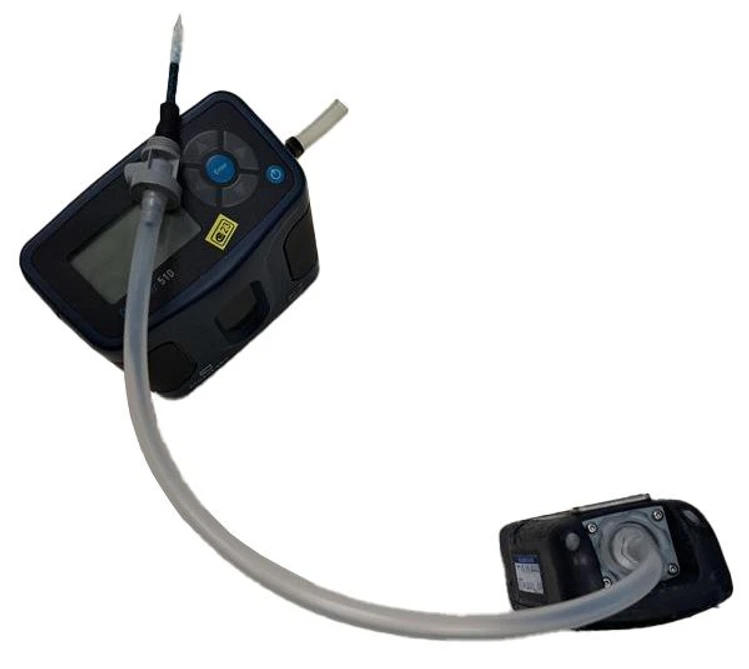 ALS Czech Republic: EnviroMail™4/Europe: Analysis of Formaldehyde and Carbonyl Compounds in Ambient Air: Figure 3. Sampling Pump with SKC Tube.
- „Compendium Method TO-11A: Determination of Formaldehyde in Ambient Air Using Adsorbent Cartridge Followed by High Performance Liquid Chromatography (HPLC)“ published by the United States Environmental Protection Agency (EPA), EPA/625/R-96/010b, 1999.
- ISO 16000-3:2022(E) Indoor air – Part 3: Determination of formaldehyde and other carbonyl compounds in indoor and test chamber air – Active sampling method.