News from LabRulezLCMS Library - Week 44, 2025
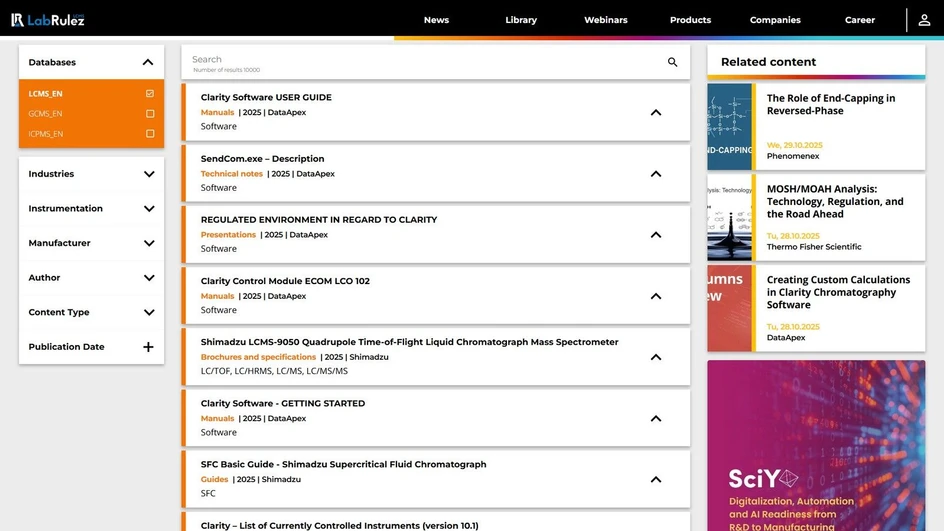
LabRulez: News from LabRulezLCMS Library - Week 44, 2025
Our Library never stops expanding. What are the most recent contributions to LabRulezLCMS Library in the week of 27th October 2025? Check out new documents from the field of liquid phase, especially HPLC and LC/MS techniques!
👉 SEARCH THE LARGEST REPOSITORY OF DOCUMENTS ABOUT LCMS AND RELATED TECHNIQUES
👉 Need info about different analytical techniques? Peek into LabRulezGCMS or LabRulezICPMS libraries.
This week we bring you application notes by Agilent Technologies, ALS Europe, Shimadzu and Waters Corporation and poster by Thermo Fisher Scientific!
1. Agilent Technologies: Determination of Per- and Polyfluoroalkyl Substances in Soil and Sediment
Using blended Agilent Bond Elut PFAS WAX/Carbon S SPE cartridges for U.S. EPA Method 1633
- Application note
- Full PDF for download
U.S. EPA Method 1633 was developed to standardize the determination of PFAS in aqueous, solid, and tissue samples.¹ The method was validated through multilaboratory studies using a two-step extraction process using polymeric weak anion exchange (WAX) SPE followed by matrix reduction with loose carbon. Since its release, many laboratories have adopted a simplified one-step approach by combining WAX and carbon sorbents into a single dual-phase cartridge with layered sorbents. This dual-phase SPE streamlines sample preparation by integrating analyte extraction and matrix reduction into a single step.
As a performance-based method, EPA 1633 allows procedural modifications provided they comply with 40 CFR Part 136.6, which mandates documentation and adherence to quality acceptance criteria. An alternative to layering is blending the sorbents, which simplifies cartridge design and eliminates the need for a separating frit. Blended sorbents are applicable to all matrix types specified in the method.
An earlier application note comparing blended versus layered sorbents demonstrated equivalent performance for PFAS extraction from aqueous environmental samples, meeting the quality control requirements of EPA Method 1633.² In this application note, Agilent blended dual-phase PFAS WAX/Carbon S SPE cartridges, 200/50 mg, 6 mL, were evaluated for the extraction of 40 PFAS from soil and sediment samples following the solid sample procedure in EPA Method 1633. Results show that all quality control criteria were met using the blended dual-phase cartridges.
Experimental
Instrumentation and method
Sample analysis was performed using an Agilent Infinity II LC system consisting of an Agilent 1290 Infinity II high‑speed pump (G7120A), an Agilent 1260 Infinity II hybrid multisampler (G7167C), and an Agilent 1290 Infinity II multicolumn thermostat (G7116B). The LC system was modified for PFAS analysis using the Agilent InfinityLab PFC‑free HPLC conversion kit (part number 5004-0006). The LC system was coupled to an Agilent 6475A triple quadrupole LC/MS equipped with an Agilent Jet Stream Electrospray ion source. Agilent MassHunter Workstation software, version 12.1 update 3 and analysis version 12.1 update 2, were used for data acquisition. The Agilent extended PFAS MRM Database for LC/TQ (G1736AA) was used for optimized MRM settings. The optimized LC, hybrid multisampler, and ion source conditions are listed in Tables 3, 4, and 5, respectively. The hybrid multisampler was operated in classic flow-through mode with extended inner and outer wash enabled.
Results and discussion
Cartridge blank determination
Three replicate cartridge washes were analyzed to assess the presence of any interfering PFAS residues originating from the sorbent blend, cartridge tubes, or frits. Each cartridge was rinsed with 5 mL of 1% ammonium hydroxide in methanol under vacuum, and the rinseate was collected for analysis. As shown in Figure 2, the green dashed line represents the LOQ, while the red dashed line indicates half the LOQ for each native PFAS. All measured residues in the replicates were below the half LOQ threshold, demonstrating a high level of cleanliness in the SPE cartridges.
Soil and sediment analysis
Topsoil and river sediment samples were analyzed in duplicate. Table 7 lists the native PFAS compounds detected above the LOQ, along with the relative percent deviation (RPD) between replicates. For most compounds, RPD values were well below 30%, indicating good reproducibility. Exceptions included 6:2 FTS and PFTrDA in the topsoil sample, which exhibited slightly elevated RPDs above 30%. Compounds detected in only one of the two replicates were present at concentrations near the LOQ; in these cases, one replicate fell just below the LOQ and was therefore not reported.
Conclusion
The use of blended dual-phase Agilent Bond Elut PFAS WAX and Carbon S SPE cartridges offers a streamlined and effective alternative to layered sorbent configurations for PFAS extraction from soil and sediment samples. All method performance criteria outlined in EPA Method 1633 were met, including acceptable recoveries and reproducibility for matrix spikes and internal standards. This approach simplifies sample preparation while maintaining analytical integrity, supporting its implementation in routine environmental monitoring workflows.
2. ALS Europe: Modern analytical methods for tracing explosives in the environment
- Other document
- Full PDF for download
In 2025, the ALS laboratory expanded its analytical portfolio to include accredited methods for the determination of explosives and related compounds in water and soil. These procedures are based on internationally recognized standards such as US EPA 8330B, EN ISO 22478, and ISO 11916-1.
Developing effective strategies to detect and remediate explosives contamination in environmental samples, particularly in testing regions, is crucial, as current methods depend on limited data regarding explosives and their environmental impacts. Commonly used explosive compounds, such as nitroaromatics and nitramines, pose a relatively high risk of environmental contamination, while nitramines are highly mobile. Despite their reactivity, these substances are relatively stable in nature under normal conditions. TNT, for example, can persist in soil for decades, particularly in areas with limited oxygen access and low microbial activity. A significant example of long-term contamination is the Kolberger Heide area in the Baltic Sea, where munitions were extensively dumped after World War II. A 2025 study confirmed the presence of TNT metabolites in the urine and bile of fish, indicating the bioaccumulation of explosive substances in marine organisms and their persistence in the environment for over eight decades.
Analysis of Explosives
The implementation of accurate analytical methods enables the reliable identification and quantification of a wide range of explosive substances, including their degradation products, antioxidants, and propellants. The introduction of such methods reflects the growing need to monitor these contaminants from both civilian and military sources. The U.S. Environmental Protection Agency (EPA) uses Method 8330B (SW-846) for the analysis of nitroaromatics, nitramines, and nitrate esters using HPLC, a standardized method that ensures precise analytical results.
In ALS, sample handling and preparation adhere to procedures outlined by applicable standards, and the analyses are conducted on state-of-the-art HPLC-DAD systems of the latest generation. Each positive finding is initially verified based on spectral matching and subsequently confirmed using an alternative stationary phase of the chromatographic column. This approach ensures high reliability of the measured data.
3. Shimadzu: Breakthrough Sensitivity and Robustness for PFAS Analysis in Chicken Tissue for EPA Method 1633A
- Application note
- Full PDF for download
User Benefits
- LCMS-8065XE achieved up to 80 times lower limit of quantifications than LLOQ concentration in EPA Method 1633A.
- The measurement time was 10 min while meeting the chromatographic requirements by EPA Method 1633A.
- This method showed the excellent robustness across 7 days of over 900 continuous injections of the matrix sample.
Per- and polyfluoroalkyl substances (PFAS) are a diverse group of synthetic chemicals widely used in industry and consumer products. Owing to their persistence and potential health risks, PFAS have become a major environmental concern. The U.S. Environmental Protection Agency (EPA) has developed standardized analytical methods, including EPA Method 1633A, to monitor PFAS contamination in a wide range of environmental and biological matrices. This study evaluates the performance of LCMS-8065XE for PFAS analysis in accordance with EPA Method 1633A. By assessing calibration stability over the course of one week, we demonstrate the method’s suitability for routine PFAS monitoring. All aspects of the workflow including sample extraction, preparation, and analysis, were performed in compliance with EPA Method 1633A guidelines(1). Our results highlight the system’s robustness and minimal downtime, underscoring its value for laboratories responsible for delivering rapid and reliable PFAS determinations.
Instrument and Operational Conditions
LCMS analyses were performed using a Shimadzu triple quadrupole mass spectrometer, LCMS-8065XE, coupled with a Shimadzu NexeraTM 40 series UHPLC. To minimize PFAS background contamination, a delay column was installed between the mixer and high-pressure valve. The LC and MS parameters are summarized in Table 2 and 3. Analyses included a calibration curve, instrument blank, a calibration verification (CV), method blanks, and spiked chicken tissue samples.
A robustness test was conducted by monitoring calibration verification, method blanks, and spiked chicken tissue samples. Prior to each LC-MS/MS run, every vial was vortexed to resuspend PFAS compounds that may have adsorbed to the vial walls. This procedure helped improve the relative standard error (RSE), as PFAS compounds are knows to adsorb to glass surfaces.
Chromatographic separation
Cholic acids, such as taurodeoxycholic acid (TDCA), taurochenodeoxycholic acid (TCDCA), and tauroursodeoxycholic acid (TUDCA), can interfere with PFOS during the ionization process because their precursor and product ions are similar. These bile acids are present in tissue and wastewater samples. Therefore, one of the requirements of the LC method for EPA Method 1633A is to achieve a separation of at least 1 min between PFOS and these cholic acids. In this study, acetonitrile was used as mobile phase B to meet this requirement. Figure 4 shows the chromatographic separation of forty PFAS listed in EPA Method 1633A. With acetonitrile, the cholic acids eluted much earlier than both branched and linear PFOS. The retention time difference was 1.5 min, which exceeded the required one-minute separation.
Conclusion
The LCMS-8065XE was able to detect concentrations up to 80 times lower than the LLOQ required in EPA Method 1633A, using a neat standard solution. Excellent linearity was achieved with the developed method, as indicated by RSE values below 20% and high R2 values. This method demonstrates high throughput and robust instrument performance, maintaining accurate quantification in complex chicken tissue matrices without the need for maintenance or cleaning.
4. Thermo Fisher Scientific: Highly Sensitive Targeted Method for Single Cell Lipidomics on Stellar MS – A Hybrid Nominal Mass Instrument
- Poster
- Full PDF for download
Lipids play critical roles in multiple biological processes and their heterogeneous distribution among cells has significant biological implications.
Why single cell analysis?
Single-cell analysis offers a significantly higher resolution and deeper understanding of biological systems compared to bulk cell analysis.
- Resolving Cellular Heterogeneity
- Identifying Rare Cell Types
- Understanding Developmental Processes and Cell Lineage
- Dissecting Complex Biological Systems
- Revealing Hidden Differences and Subpopulations
Bulk analysis provides an "average" picture, single-cell analysis provides a "cellular census," allowing for a much more nuanced and comprehensive understanding of biological complexity
Why targeted analysis?
- Cheaper Instrumentation
- Sensitivity
- Quantitative
- Data Processing
Materials and methods
LC-MS method
Lipid extract was separated using Thermo Scientific EASY-Spray PepMap Neo UHPLC column (C18, 75µmx150mm, 2µm) connected to a Thermo Scientific Vanquish Neo UHPLC system. Data acquisition was carried out on the Orbitrap Ascend Tribrid MS and nominal mass Stellar MS. Both instruments are capable of alternate fragmentation techniques and multi-stage fragmentation.
Data analysis
Data processing, including quantitation of analytes and annotation of unknowns, was performed using Thermo Scientific Compound Discoverer 3.4 software, Thermo Scientific LipidSearch software and Skyline software
Conclusion
We have successfully showed the use of targeted platform for single cell analysis. We hope that this can lead to more labs adapting this technology to reveal interesting biological insights.
5. Waters Corporation: Increased Identification Confidence for Extractables Screening Using the Xevo™ MRT Mass Spectrometer
- Application note
- Full PDF for download
Benefits
- The Xevo MRT Mass Spectrometer provides consistent low- to sub-ppm mass accuracy, allowing for increased extractables identification confidence.
- High mass resolution, sensitivity, and fast acquisition rates ensure exceptional data quality for scientific interpretation, suited to large complex data sets.
- A DIA workflow delivers accurate mass of both precursor and associated fragment ion data further increasing the confidence of identifying unknowns when screening against a library and aiding structural elucidation.
- The UNIFI™ application within the waters_connect™ Software provides customized workflows to simplify screening and structural elucidation in complex datasets.
Medical devices, pharmaceutical packaging, and manufacturing components contain different chemicals, including polymers, polymer additives such as antioxidants, slip agents, colorants, and other compounds. These chemicals, their impurities, and degradation products can migrate out of the materials resulting in potentially unsafe substances. Due to this, there are regulations, standards, and guidance in place to ensure that safety limits for the consumer are met.1-3
To ensure safety, it is therefore crucial to screen for and identify potential extractables and leachables (E&L). Compounds that are found at levels above the analytical evaluation threshold (AET) must be identified and reported for toxicological assessment.4 The confidence level in the identifications of these compounds must be as high as possible, which can be challenging due to the complexity of samples, potential false positives, and the number of possible compound identifications for each chromatographic peak. Technological advancements are critical to assist in reducing the burden of this process on the analyst.
The Xevo MRT Mass Spectrometer (Figure 1) utilizes a novel quadrupole-multi reflecting time-of-flight design that delivers mass resolution of up to 100,000 full width half maximum (FWHM) at 50 Hz (MS) and 100 Hz (MS/MS) scan rates, resulting in low- to sub-ppm mass accuracy across a wide m/z range for confident extractables screening analyses. The system can be employed using the DIA approach, MSE , 5 that ensures the acquisition of precursors and their associated fragment ions with low- to sub-ppm mass accuracy. Combining the DIA strategy with the Xevo MRT Mass Spectrometer attributes significantly reduces the possibility of false positives, while greatly reducing the number of potential candidate compounds per chromatographic peak, hence increasing identification confidence. This data is also critical for confident structural elucidation of unknowns that is necessary for an extractables screening report.
Here, an extractables analysis is reported using the Xevo MRT Mass Spectrometer with a data independent acquisition workflow. The subsequent data is processed using the compliance ready waters_connect Software with the UNIFI application that provides automated data acquisition, processing, and reporting.
Experimental
- LC system: ACQUITY Premier System
- Column: ACQUITY CORTECS™ C18, 90 Å, (1.6 μm, 2.1 x 100 mm)
- MS system: Xevo MRT Mass Spectrometer
Conclusion
Screening with the Xevo MRT Mass Spectrometer is a highly specific tool for E&L screening analyses. The multi reflecting-time of flight technology ensures consistent low- to sub-ppm mass accuracy for the wide mass range typical of extractable compounds. For example, the mass accuracy for all E&L SST analytes across standard injections had an RMS of 0.81 ppm.
Utilizing MSE mode provides highly informative and accurate data for both precursor and fragment ions in sample matrix. This reduces the false positive rate and significantly reduces the possible candidate matches therefore greatly increasing identification confidence. For example, from no filters to applying fragment matches, binary compare, and mass accuracy filters of ±5 ppm, reduced the number of candidate matches by 80%. Narrowing the mass accuracy window to ±1 ppm further reduces the matches by another 60% in this case, reducing the burden on the analyst. MSE mode is also critical to assist with the structural elucidation of unknowns, for example, a putative identification of N,N’-1,12-dodecanediyldidodecanamide was made with a mass error –0.77 ppm and multiple fragment matches.
Software tools were employed to aid review of the highly accurate mass data within complex datasets. These included binary compare, filtering, multivariate statistical analysis, and trend plots. This combined with the technology of the Xevo MRT Mass Spectrometer, ensures a seamless and highly confident extractables screening workflow.