News from LabRulezLCMS Library - Week 10, 2026
LabRulez: News from LabRulezLCMS Library - Week 10, 2026
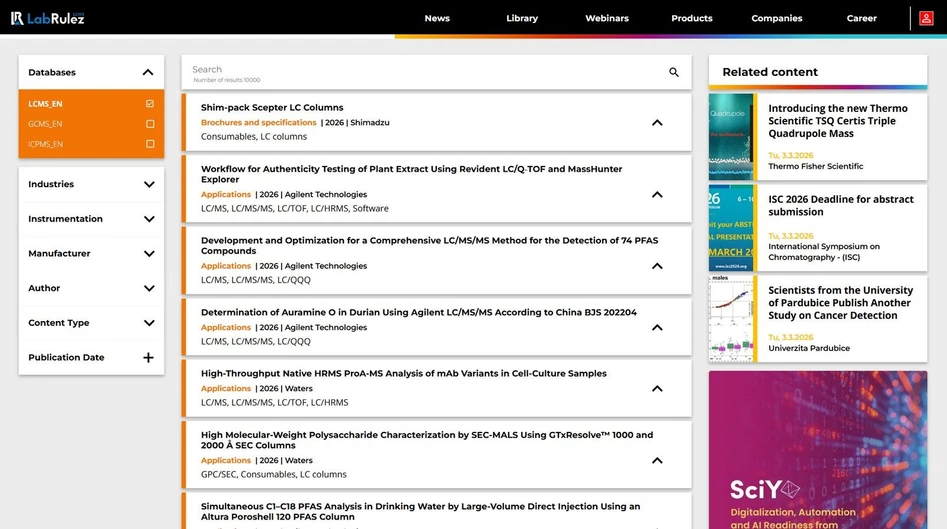
Our Library never stops expanding. What are the most recent contributions to LabRulezLCMS Library in the week of 2nd March 2026? Check out new documents from the field of liquid phase, especially HPLC and LC/MS techniques!
👉 SEARCH THE LARGEST REPOSITORY OF DOCUMENTS ABOUT LCMS AND RELATED TECHNIQUES
👉 Need info about different analytical techniques? Peek into LabRulezGCMS or LabRulezICPMS libraries.
This week we bring you application notes by KNAUER, Shimadzu, Thermo Fisher Scientific and Waters Corporation and technical note by Agilent Technologies!
1. Agilent Technologies: Reduce PFAS Background with the Agilent PFAS Analysis HPLC Conversion Kit
An ideal solution for trace level PFAS analysis with LC/MS/MS
- Technical note
- Full PDF for download
Per- and polyfluoroalkyl substances (PFAS) are a group of persistent organic pollutants, widely found in the environment.1 To protect people from exposure to these pollutants international, national, and regional agencies such as the United States Environmental Protection Agency (US EPA) and the International Organization for Standardization (ISO) provide methods for trace-level analysis of these compounds. For example, US EPA methods 533 and 537.1, as well as ISO method 21675 can be used for the analysis of drinking water with liquid chromatography/tandem mass spectrometry (LC/MS/MS).
High-performance liquid chromatography (HPLC) instruments in their standard configuration contain per- and polyfluorinated compounds, including fluoropolymers such as PTFE, PFA, etc. These materials are used because of their chemical inertness, ensuring the compatibility of the LC instruments with a broad range of acids, bases, and organic solvents. However, during the production of fluoropolymers, per- and polyfluorinated alkyl substances (PFASs), such as perfluorooctanoic acid (PFOA), perfluorooctanesulfonic acid (PFOS), or replacement chemicals with similar properties are used as processing agents. Traces of these PFAS processing agents can remain in fluoropolymers. When running PFAS analysis at the ppb level and below, using LC/MS/MS instruments, the PFAS leaching from the LC instrument during operation can cause an increased background. This increased background can have a severe impact on meeting the required quantification and detection limits set by regional and national regulations. Therefore, it is up to the user to take the necessary steps to minimize the impact of the LC/MS system on the analytical results. Two recommendations from the US EPA are (1) to replace standard solvent lines with alternative ones made of PEEK and (2) to use a delay column, which can help to further reduce the background, especially if it is caused by the mobile phase.
Overview
Agilent offers the InfinityLab PFAS Analysis HPLC Conversion Kit, a ready‑to‑use, easy‑to‑install kit for minimizing PFAS background from LC instruments, to support customers running PFAS applications. The HPLC Conversion Kit for PFAS Analysis offers substitutes for all critical parts of the LC system made from materials that contain organic fluorine compounds. The kit also includes the newly developed Agilent InfinityLab PFC delay column to delay potential PFAS impurities from the mobile phases. The delay column is installed in the (U)HPLC pump in front of the autosampler and should not be used as a separation column. The new solvent lines in this kit are made of polypropylene (PP), which offers the same reduction of PFAS background, compared to PEEK, while improving the usability, due to the higher flexibility and transparency. The new and uniquely developed polypropylene Stay Safe bottle caps lack any fluorinated materials and help to minimize organic solvent vapors contaminating the lab environment. The new polypropylene Stay Safe caps are LC/MS compatible with mobile phases typically used for PFAS workflows. The kit includes Agilent InfinityLab Quick Connect fittings to allow quick, easy, and tool-free delay column connection. The additional parts make this kit a full solution, including tags for easy identification of the special parts in the converted LC instrument.
The kit is designed to be installed on an Agilent 1290 Infinity II/III LC with a high-speed pump (G7120A) and an Agilent 1290 Infinity II/III Multisampler (G7167B) with multiwash option, Agilent 1260 Infinity II/III Hybrid Multisampler (G7167C), or an Agilent 1290 Infinity III Hybrid Multisampler (G7137B). The use of the Hybrid Multisamplers allows maximizing sensitivity by allowing high injection volumes of samples dissolved in high organic solvents, without undesired solvent effects in feed injection mode.6 These LC modules provide the best possible performance for PFAS analysis applications, including wash options for cleaning the injection needle of the sampler, the needle seat, and the needle seat capillary with several different wash solvents to reduce carry over from analytes potentially sticking to the surface of these parts. However, some parts of the kit are universal parts and can be used with any other LC pump or sampler module, such as the bottle head assemblies for the mobile phases. For more details, please see the "Converting other Agilent LC Modules" section.
Agilent recommends the use of the full kit on LC instruments dedicated for PFAS analysis. The kit was tested with mobile phases common in PFAS analysis applications, including water, methanol, acetonitrile, and mixtures of these as well as with mild additives at relatively low concentrations, such as 20 mM ammonium acetate or 0.1% acetic acid. For users running applications other than PFAS analysis on the same LC instrument, it is up to the user to verify the compatibility of the kit parts with the mobile phases used. If there are issues with compatibility, the use of the delay column only is recommended.
2. KNAUER: Benefits of KNAUER´s trouble-free analytical capillaries in terms of HPLC and UHPLC system performance
- Application note
- Full PDF for download
Every (U)HPLC user needs to install and replace capillaries and fittings on a regular basis. These comparably small and inexpensive supplies can have a major influence on both the user experience and the system performance. Both factors are important regarding the outcome of every single analysis. KNAUER decided to use the well-established IDEX MarvelXACTTM capillaries and fittings for all AZURA® Analytical systems. They are finger tight up to UHPLC pressure, so that no tools are required. They auto adjust to various port depths and do not depend on ferrules. The sealing at the bottom of the port is achieved without complex techniques, which significantly reduces required torque (Fig.1).
Start-up kits are available for any standard AZURA® Analytical system. These kits have been designed for most convenient installation with a comparable back pressure rating to the former used kits, providing equal or better system performance at the same time. The benefits of user experience are clear, but what about system performance compared to the conventional capillary/ferrule connection systems? In this tech note, we show the results and unravel the mystery of whether this design worked as planned in laboratory reality.
SYSTEM BUILD-UP
Conventional K-Connect, which uses the classical system of ferrule and fitting, and trouble-free MarvelXACTTM connections were tested on an AZURA® Analytical HPLC 862 bar system and a UHPLC 1240 bar system. The system build-up (Fig.2), HPLC method, solvents and sample were kept the same, only the capillaries and fittings were exchanged according to the instructions of the start-up kits. A well-established method used for system performance verification was used and adapted for these tests. After an isocratic run to determine the system performance based on the changed extra-column volume (ECV), also a gradient run was performed to see the impact of the changed dwell volume (see Tab.1 and Tab.2). The extra column volume is defined as the volume between the point of the injection and the point of detection. It relates to the band spread, and every connection, tubing, or fitting in the post-injection flow path contributes to the ECV. The dwell volume, also known as gradient delay volume, is determined by the pump characteristics. It is defined as the volume from the point of mobile phase mixing to the inlet of the column.
CONCLUSION
Applying KNAUER´s trouble-free start-up kits for AZURA® Analytical HPLC and UHPLC/ULDC systems brings benefits to everyday laboratory life. The ease of use and the reusability of capillaries and fittings as well as the resulting system performance contribute to a positive user experience. These kits can replace the former recommended K-Connect kits without any limitations. Work tool-free and trouble-free while keeping the known HPLC or UHPLC system performance or even enhancing it.
3. Shimadzu: Determination of Authenticity of Manuka Honey Using the MALDI-8030 Benchtop Linear MALDI-TOF Mass Spectrometer
- Application note
- Full PDF for download
Manuka honey is produced by bees using nectar from the Manuka tree Leptospermum scoparium (Figure 1). There are reported health benefits and qualities associated with Manuka honey including antimicrobial activity, antioxidant and antiinflammatory properties. Given the criteria that must be met in order for a honey product to qualify as ‘Manuka honey’, the number of producers and yield of Manuka honey is lower than that of regular non-Manuka honey. As a result, Manuka-certified honey products attract a price-premium making them obvious targets for adulteration and misrepresentation. MALDI-TOF mass spectrometry has several advantages for high-throughput screening applications. Here, we evaluate for the first time the use of MALDI-TOF MS to detect and characterise key Manuka honey markers allowing the differentiation of Manuka/nonManuka products.
Measurement Conditions and Samples
Honey products labelled as ‘Manuka’ were purchased from local supermarkets. In order to detect the polyphenols, including the unique Manuka honey markers, the samples were subjected to SPE extraction to remove the abundant sugar component. Using Strata-X polymeric reversed phase (RP) SPE cartridges (Phenomenex), the extraction procedure was optimised allowing efficient enrichment of the non-polar components which were subsequently analysed using 2,4,6-trihydroxyacetophenone (THAP) MALDI matrix containing 10 mM sodium trifluoroacetate (NaTFA) in positive ion mode on a benchtop linear MALDI-TOF mass spectrometer (MALDI-8030, Shimadzu; Figure 2). The MS-based assignments from the MALDI-MS analysis were confirmed by MALDI-MS/MS (data not shown).
Conclusion
This work demonstrates the usefulness of MALDI-TOF mass spectrometry to determine the authenticity of Manuka honey through detection of key markers. We hope the proposed new workflow can be used to rapidly screen the authenticity of Manuka honey products.
4. Thermo Fisher Scientific: Novel semi-automated method for the analysis of per- and polyfluoroalkyl substances (PFAS) in soil samples
- Application note
- Full PDF for download
Application benefits
- Increased efficiency: The method streamlines multiple steps of US EPA Method 1633A by automating extraction and clean-up processes, significantly increasing throughput and reducing the potential for human error and contamination.
- Reduced manual labor: By eliminating the need for extract evaporation and filtration steps, the method minimizes manual handling, thereby reducing labor and the risk of introducing errors.
- Enhanced accuracy and reliability: The use of the EXTREVA ASE and Thermo Scientific™ Dionex™ AutoTrace™ 280 PFAS instruments, which exhibit lowto-no PFAS background, ensures that the method meets the stringent performance requirements of US EPA Method 1633A, providing reliable and precise PFAS analysis of soil samples.
PFAS, a group of synthetic chemicals comprising more than 12,000 species, have a ubiquitous presence in our ecosystem due to their extensive use since the 1940s. These chemicals are characterized by their persistence in the environment, their ability to bioaccumulate, and their ease of transport through soil and water. Exposure to even low levels of PFAS can adversely impact human health.1 Consequently, regulatory agencies are working to restrict and remediate PFAS contamination in drinking water, soils, fish tissue, and biosolids. The United States Environmental Protection Agency (US EPA) has recently published the US EPA Method 1633A for PFAS analysis in solid and semi-solid samples.2 US EPA Method 1633A involves several intricate steps, including sample preparation, sample extraction, extract enrichment via evaporation, extract reconstitution, pH adjustment, extract cleanup by solid phase extraction (SPE), and extract filtration prior to liquid chromatography-mass spectrometry (LC-MS) analysis. Typically, these procedures are performed manually, which can be labor-intensive and time-consuming. Additionally, several sample and extraction handling steps can introduce human errors and potential PFAS contamination. Reducing sample and extract handling is imperative, as US EPA Method 1633A requires PFAS analyses in low parts-per-billion (ppb) to parts-per-trillion (ppt) levels in samples. To enhance automation and reduce sample handling and manual labor, a modified gas-assisted dynamic accelerated solvent extraction (GA-dASE) system, known as the Thermo Scientific EXTREVA ASE Accelerated Solvent Extractor,3 was employed for the automated extraction of soil samples. Additionally, the Thermo Scientific Dionex AutoTrace 280 PFAS System was utilized for semi-automated SPE cleanup. This innovative approach also eliminates the need for extract evaporation and filtration steps, thereby streamlining the workflow and significantly reducing sample handling. Consequently, this modification not only increases throughput but also meets the stringent method performance criteria established by US EPA Method 1633A.
Experimental
Materials
PFAS backgrounds from instruments, chemicals, and general lab supplies are a huge problem in trace-level PFAS analysis. To accomplish trace-level analysis of PFAS, instruments are often upgraded to minimize fluorinated components. The EXTREVA ASE system was upgraded for PFAS analysis with the EXTREVA ASE PFAS upgrade kit (Table 1). Specifically, PEEK tubing was used from the solvent bottle to the solvent mixer inlet, and stainless steel (SS) tubing was used from the solvent mixer inlet to the solvent pump. As demonstrated previously in AN73883, the Dionex AutoTrace 280 PFAS system has low PFAS background.4 PFAS upgrade kits were used in the Thermo Scientific™ Vanquish Flex™ Binary UHPLC System to make it amenable for PFAS analysis (Table 1).
LC-MS method
Samples were analyzed by LC-MS/MS for quantitation using a Vanquish Flex Binary UHPLC system coupled with a TSQ Altis triple quadrupole mass spectrometer.⁵ The UHPLC system was configured with a PFAS upgrade kit to replace wetted Teflon™ surfaces with PEEK lines and fittings. Additionally, the kit included a Hypersil GOLD C18 delay column installed between the pump and analytical column to stagger the retention time of any PFAS found in the system or mobile phases. The system was further modified with a strong solvent loop installed between the autosampler and the analytical column to preserve peak shape while injecting larger volumes of high organic samples on the Acclaim RSLC 120 C18 analytical column. LC parameters and gradient program can be found in Table 4.
The TSQ Altis mass spectrometer was equipped with a heated electrospray ionization (HESI) source and operated in negative ionization mode. The spray voltage was set to -1,000 V. The sheath gas, auxiliary gas, and sweep gas were set to 50, 12, and 0.5 arbitrary units, respectively. The ion transfer tube temperature was set to 225°C, and the vaporizer temperature was set to 300°C. The mass spectrometer was operated in SRM mode. The chromatographic peak width was set to 5 sec, and the chromatographic filter was enabled. Cycle time was enabled and set to 12.5 points per peak. The Q1 and Q3 resolutions for every transition at full width at half maximum were set to 0.7 Da. Argon was used as the collision gas at a pressure of 2.5 mTorr.
Conclusion
The method described for analyzing PFAS has demonstrated high efficiency and reliability in both low- and high-concentration samples. Specifically, the method has achieved excellent analyte recoveries at concentrations as low as 0.2 ng/g and as high as 46 ng/g, with RSD often below 15%. This indicates a robust performance across a wide range of concentrations, ensuring precise and accurate quantification of PFAS.
An important aspect of this method is its automation of several critical steps in the analytical workflow, including extraction and sample clean-up. Automation significantly reduces both the turnaround time and the manual labor required for the analysis. These efficiencies not only enhance throughput, but also minimize the potential for human error, thereby improving the overall reliability and reproducibility of the results. The reduction in time and labor underscores the method’s practical advantages in a high-throughput laboratory setting, where efficiency and accuracy are paramount.
In summary, the method not only meets the analytical performance criteria for US EPA Method 1633A but also offers significant operational benefits. The combination of high-recovery rates, low RSD, and substantial reductions in turnaround time and manual labor make this method a valuable tool for laboratories tasked with PFAS analysis.
5. Waters Corporation: Streamlined LC-MS/MS Data Processing with waters_connect™ for Quantitation: Application to Free Inositol Analysis in Foods
- Application note
- Full PDF for download
Benefits
- Consolidated display of LC-MS/MS results for an entire batch on a single screen for rapid review
- Streamlined data processing and review of individual injections on a single screen, eliminating the need to switch between different screens
- Automated flagging of results that fall outside predefined normal ranges for thorough review
LC-MS/MS is a powerful analytical technology that provides excellent analytical performance in terms of sensitivity, selectivity, specificity, accuracy, and throughput as compared to LC analysis coupled with conventional optical detection techniques, such as ultra-violet spectrometry, fluorescence spectrometry, or differential refractive index detection. LC-MS/MS analysis is less susceptible to sample matrix interference and is therefore often preferred for complex and challenging samples. On the other hand, however, LC-MS/MS often generates exponentially larger data sets, which require significant expertise and time to process. This challenge becomes even greater when many analytes are included in the analysis, and data processing can become the primary bottleneck in the entire LC-MS/MS analysis. The waters_connect for Quantitation Software platform was developed to address this challenge. This software hosts a suite of browser-based applications for chromatographic data management. Among these, MS Quan is an application specifically designed to streamline LC-MS/MS data processing and review.1 Previously, we developed an LC-MS/MS method for analyzing free inositol stereoisomers in a variety of foods.2 In this study, we focus on data processing and reviewing using MS Quan within waters_connect for Quantitation platform, demonstrating the capabilities of this powerful software for LC-MS/MS data processing and review in the analysis of free inositol stereoisomers in food samples.
Experimental
LC-MS/MS analysis of free inositols in foods was conducted on an Arc Premier System coupled with a Xevo TQS cronos triple quadrupole Mass Spectrometer, using an ACQUITY UPLC BEH Amide Column (1.7 μm, 2.1 mm x 150 mm, p/n: 186004802). Instrument control and data acquisition were managed by MassLynx™ 4.3 Software. The raw LC-MS/MS data and the processing method were uploaded to waters_connect for Quantitation platform. Full details regarding chemicals, standards, food samples, preparation of reagents, calibration standard solutions, samples, and LC-MS/MS analysis conditions can be found in a previously published study.2
Conclusion
MS Quan in waters_connect for Quantitation platform offers significant advantages for LC-MS/MS data processing and review, as demonstrated in the analysis of free inositol in food samples. The Overview screens enable rapid, side-by-side comparisons of all injections (including standards and samples) within the entire batch using multiple screen layouts that are designed for different sample types and processing tasks. The raw chromatographic data from individual injections, along with relevant results and processing parameters, can be accessed directly on a single screen by simply clicking on any data point or chromatogram within the Overview screens.
Task-specific screen layouts are tailored for different sample types or data processing tasks. This task-oriented, single-screen design enables scientists to review and process data without navigating between different screens, which greatly simplifies data review and processing workflows. The Rule Set criteria further enhance data processing and review by defining expected result characteristics and automatically flagging any exceptions, ensuring thorough evaluation of anomalies and minimizing potential processing errors.
Together, these features streamline data processing and review while significantly improving the overall quality and throughput of analysis. MS Quan offers an intuitive, efficient software solution for routine and high-throughput LC-MS/MS analyses.