News from LabRulezLCMS Library - Week 14, 2026
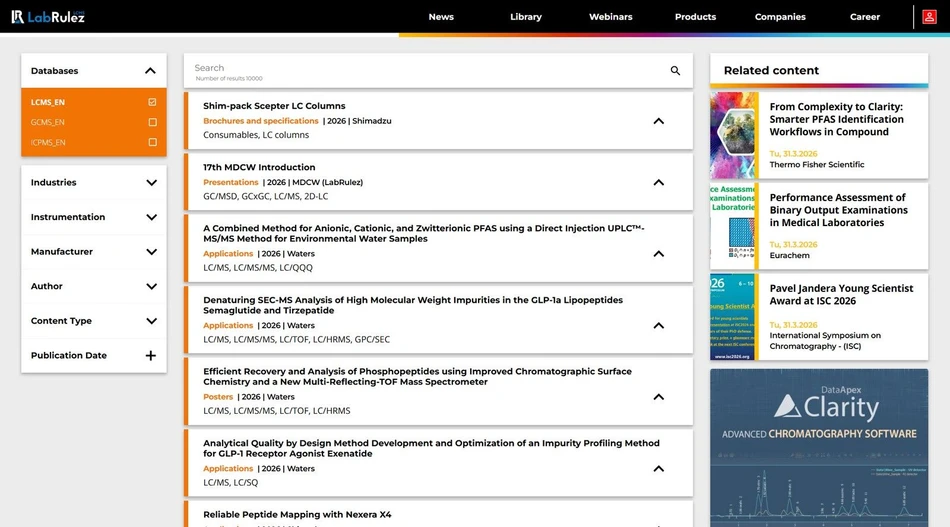
LabRulez: News from LabRulezLCMS Library - Week 14, 2026
Our Library never stops expanding. What are the most recent contributions to LabRulezLCMS Library in the week of 30th March 2026? Check out new documents from the field of liquid phase, especially HPLC and LC/MS techniques!
👉 SEARCH THE LARGEST REPOSITORY OF DOCUMENTS ABOUT LCMS AND RELATED TECHNIQUES
👉 Need info about different analytical techniques? Peek into LabRulezGCMS or LabRulezICPMS libraries.
This week we bring you application notes by Agilent Technologies, KNAUER, Shimadzu and Waters Corporation and technical note by Thermo Fisher Scientific!
1. Agilent Technologies: Reliable Ultra Short Chain PFAS Analysis in Water and Landfill Groundwater
Using the Agilent Altura Poroshell PFAS column and LC/MS/MS
- Application note
- Full PDF for download
The increasing detection of ultrashort‑chain PFAS in environmental waters1 has created a pressing need for highly sensitive, reliable analytical methods capable of separating and quantifying these challenging compounds. Because ultrashort PFAS, such as TFA and DFA, show little retention on typical C18 columns, their analysis requires a specialized analytical and delay column, optimized mobile phases, and rigorous contamination control.
This application note evaluates the performance of the Altura Poroshell PFAS column (Altura PFAS column) paired with an Agilent 1290 Infinity III LC system and 6495D LC/TQ for the analysis of ultrashort-chain PFAS across laboratory-prepared matrices and real-world groundwater samples. The study presents detection limits, retention‑time stability under ionic‑strength conditions, matrix-spike recovery and precision in synthetic water, and field-sample results from landfill groundwater. Groundwater samples were also analyzed by an external collaborator following EPA 1633A2 , and the PFBA results were compared. Synthetic-water experiments were designed to specifically challenge the method under high-salt conditions, while groundwater samples from seven landfills provided insight into real-world interferences and matrix behavior.
Experimental
LC/TQ conditions
Analysis was performed using a 1290 Infinity III LC system consisting of an Agilent 1290 Infinity III high-speed pump (G7120A), an Agilent 1290 Infinity III Multisampler (G7167B), and an Agilent 1290 Infinity III Multicolumn Thermostat (G7116A). The LC system was modified using an Agilent InfinityLab PFC-free HPLC conversion kit (part number 50040006) with the Agilent InfinityLab PFC delay column (p/n 5062-8100) replaced with the Agilent InfinityLab Poroshell 120 PFAS delay column (p/n 027403-007). Chromatographic separation was performed with an Altura PFAS column. Full separation details are provided in Table 2.
MS/MS acquisition and transitions
The LC system was coupled to a 6495D LC/TQ equipped with an Agilent Jet Stream source. The source conditions for the 6495D are shown in Table 3 and were optimized to minimize the TFA baseline. Compound transitions are provided in Table 4 and were optimized for 6495D using MassHunter Optimizer. Data acquisition and analysis were carried out with Agilent MassHunter Workstation software.
Results and discussion
Field sample analysis: landfill groundwater A range of groundwater samples collected for landfill monitoring were analyzed from multiple sites across seven different landfills, and the results are presented in Figure 5. TFA was detected in every sample followed in frequency by PFPrA, PFMeS, DFA, and PFBA. Compared with the laboratory synthetic water, these groundwater samples exhibited less variation in retention time, with RTs matching the calibration standards exactly. Internal standard performance was also consistent and reliable recoveries between 66% and 99%.
PFBA analysis overlapped between EPA 1633A and the direct‑injection method presented here. Because EPA 1633A includes SPE extraction and concentration, lower detection levels were achieved compared with the direct‑injection workflow. To enable a consistent comparison, concentrations slightly below the MDL for the direct‑injection method were reported for PFBA down to 3 ng/L. Concentrations for the same set of samples were compared, as shown in Figure 6, and good comparability between the methods across the concentration range evaluated. In addition, PFBA results generated using the Altura and Poroshell PFAS columns showed a strong linear correlation (r = 0.84, p < 0.001), indicating that the two columns (one from an external collaborator) track PFBA levels consistently in the tested matrices. As expected, these correlations demonstrate agreement in overall trends.
Conclusion
The Agilent Altura Poroshell PFAS column paired with Agilent LC/TQ technology delivers stable chromatography for ultrashort-chain PFAS in both RO water and a high-ionic-strength synthetic water. Calculated detection limits in this study were in the low-ng/L range, and TFA and PFMeS were blank‑limited under the conditions evaluated because method‑blank levels exceeded spike‑based estimates. Retention‑time stability was maintained across ionic strength, with a maximum observed shift of 0.1 min (PFPrA). In synthetic water matrix spikes, most analytes met 70% to 130% recovery with < 15% RSD, except for DFA and TFA; DFA performance was impacted by high‑salt matrix effects and the lack of a DFA isotopically labeled analog (surrogate correction used 13C2 -TFA). Field testing of groundwater from seven landfills showed retention times matching calibration standards and consistent internal‑standard behavior.
2. KNAUER: I.N.G.W.E.R. – Instrumental Analysis of Nutritional Ginger Wellness Extracts
- Application note
- Full PDF for download
The pungent ginger root (Zingiber officinale Roscoe) is considered healthy . This is largely due to its gingerol content. The star ingredient in fresh, raw ginger is [6]-gingerol. It is the most abundant and best -studied compound in the raw root, responsible for much of its famous anti-nausea and anti-inflammatory effects. But ginger also contains smaller amounts of [8]- and [10 ]-gingerol.
However, when ginger is dried or heated, something fascinating happens. The gingerol undergoes a chemical transformation and turns into a new family of compounds called shogaols. Shogaol has high antioxidant capacity and can combat oxidative stress in the body. It also has anti-inflammatory properties and can help reduce pain and inflammation.
MATERIALS & METHOD
Different types of ginger shots were measured. They were first centrifuged and the supernatant was removed. The remaining solid was extracted with a mixture of MeOH :H₂O 50:50 (v/v) and centrifuged again. The obtained extract was filtered through a 0.22 µm nylon filter and then injected into the HPLC system. Analysis was performed under reversed phase conditions with a KNAUER Eurospher II C 18H column in a dimension 150 x 3 mm ID and 3 µm particle size at a flow rate of 0.8 ml/min.
CONCLUSION
[6]-gingerol could be identified /measured in all samples. Compared to the freshly extracted root, the classic ginger shot and the pomegranate ginger shot contained the highest amount of [6]-gingerol. The lowest amount of gingerol was found in the fruit shot. Due to extraction with hot water instead of methanol :water, only a small amount of gingerol was found in the tea. Additionally, [8]-gingerol, [10]- gingerol and [6]-shogaol were present in the classic, pomegranate, pineapple and vitamin acai samples.
3. Shimadzu: Multidirectional Analysis of Plant Alkaloids Using MS Imaging and OAD-TOF System
- Application note
- Full PDF for download
User Benefits
- By combining the iMScope QT and OAD-TOF systems, it is possible to perform distribution analysis through MS imaging and structural analysis via OAD-MS/MS.
- The combination of OAD-MS/MS with CID-MS/MS for structural analysis is expected to enable more accurate identification of compounds
Plant alkaloids are naturally occurring compounds that contain nitrogen atoms and are widely distributed in plants, known for their pharmacological activities. Many alkaloids exhibit toxicity and function as defense mechanisms against herbivores and pathogens. Well-known examples include morphine obtained from poppies (used as a pain reliever) and quinine derived from the bark of the cinchona tree (used for malaria treatment). Other noteworthy alkaloids include caffeine, nicotine, and atropine. These compounds play crucial roles in medicine, agriculture, and the economy, and research on alkaloids is essential for the development of new drugs and the understanding of plant biology. In this study, we used the iMScope QT and OAD-TOF systems (Fig. 1) to perform distribution analysis of potato plant alkaloids through mass spectrometry imaging (MSI) and structural analysis by combining a unique new fragmentation technique called Oxygen Attachment Dissociation (OAD)1-3) with traditional Collision Induced Dissociation (CID).
Pre-treatment and Analysis Conditions
We used commercially available potatoes (Solanum tuberosum L.) that were placed under sunlight to induce sprouting as a model. The potato sprouts were frozen, and sections with a thickness of 10 µm were cut using a cryomicrotome and mounted on ITOcoated glassslides. Using the iMLayer deposition system (Fig. 3), α-cyano-4-hydroxycinnamic acid (CHCA) was applied as a matrix at a thickness of 0.7 µm. MSI, OAD-MS/MS, and CID-MS/MS analyses were performed using the iMScope QT and OAD-TOF systems (Table 1). MSI data were analyzed using IMAGEREVEAL MS (Fig. 4 left), and MS/MS data were analyzed using LabSolutions Insight Explore (Fig. 4 right).
Conclusion
In this study, we conducted distribution analysis of plant alkaloids in potatoes using MS imaging. Subsequently, by combining OAD-specific diagnostic fragment ions obtained from OAD-MS/MS with CID-MS/MS for structural analysis, we were able to enhance the identification accuracy of solanine. These results suggest that the iMScope QT and OAD-TOF systems are expected to contribute to the discovery and identification of new plant alkaloids that are biologically or pharmacologically relevant.
4. Thermo Fisher Scientific: Simultaneous Quantitation and Discovery analysis: Combining targeted and untargeted metabolomics on Orbitrap mass spectrometers
- Technical note
- Full PDF for download
Metabolomics, the study of metabolites within biological systems, involves analyzing small molecules that reflect cellular metabolic activity. This field encompasses untargeted and targeted approaches, each with strengths and challenges.
Untargeted metabolomics seeks to identify and quantify all measurable metabolites in a sample, providing a broad overview of metabolic changes. This approach is useful for discovering new biomarkers and understanding complex biological processes but struggles with detecting a vast array of metabolites and accurately identifying them due to the diverse nature of biological samples and the limitations of analytical techniques.
Targeted metabolomics, on the other hand, focuses on measuring specific metabolites with high sensitivity and accuracy. This method is driven by hypotheses and is well-suited for validating known biomarkers or studying defined metabolic pathways. It uses technologies like mass spectrometry (MS) and chromatography to achieve high sensitivity and specificity. However, it can miss biologically relevant metabolites that fall outside the predefined set, and acquiring necessary chemical standards can be challenging.
To address the limitations of these traditional methods, we developed a hybrid approach called Simultaneous Quantitation and Discovery (SQUAD) analysis (Figure 1). SQUAD integrates the strengths of both untargeted and targeted metabolomics. It allows for the quantification of a predefined set of metabolites while also identifying novel metabolites not included in the predefined list. This dual functionality is achieved through the simultaneous use of targeted quantification and untargeted discovery techniques, leveraging highresolution mass spectrometry (HRMS) and advanced data analysis tools.
This technical note provides guidelines on performing a SQUAD analysis on various Thermo Scientific™ Orbitrap™ mass spectrometers. It covers the design of the experiment, sample preparation, method setup for data acquisition, and data analysis. Additionally, a case study using NIST SRM 1950 spiked with different concentrations of isotopelabeled amino acids will be demonstrated.
4. Data acquisition
The untargeted component of SQUAD analysis involves discovering new metabolites and understanding their roles within the biological system, all from a single sample injection. This method enhances the efficiency and depth of analysis by combining targeted and discovery approaches, providing a more comprehensive view of the metabolic landscape.
The SQUAD approach offers several advantages. It maximizes the use of limited sample volumes and resources, making it ideal for scenarios with sample constraints. It also improves the sensitivity and reliability of metabolic profiling by capturing both known and unknown metabolites. Innovations like the Thermo Scientific™ AcquireX™ intelligent data acquisition workflow further enhance the SQUAD analysis by automating data acquisition and integrating multiple experimental routines, thus increasing productivity and data quality.
4.1 Orbitrap Exploris mass spectrometers
SQUAD analysis on hybrid mass spectrometers leverages the combined capabilities of quadrupole and Thermo Scientific™ Orbitrap™ technologies for high-resolution MS1 analysis. This powerful approach supports both quantitation and untargeted metabolite discovery, enabling comprehensive profiling of the metabolome. The high-resolution Thermo Scientific™ Orbitrap™ analyzer ensures accurate mass measurements, while the quadrupole facilitates selective ion filtering for precise targeting of metabolites.
The faster scanning speeds of Thermo Scientific™ Orbitrap™ hybrid quadrupole mass spectrometers allow rapid polarity switching, even in high-throughput methods. This capability significantly expands metabolome coverage by efficiently alternating between positive and negative ionization modes, enabling the detection of a broader range of metabolites in a single analysis. The AcquireX workflow (Figure 6) further enhances this capability by increasing MS2 fragmentation, which improves compound annotation and structural elucidation.
4.2 Orbitrap Tribrid mass spectrometers
SQUAD analysis on Orbitrap Exploris mass spectrometers and Thermo Scientific™ Orbitrap™ Tribrid™ mass spectrometers integrates quadrupole, Orbitrap, and linear ion trap technologies to deliver unparalleled analytical performance. This advanced setup enables high-resolution Orbitrap MS1 analysis for discovery and sensitivity, rapid ion trap tMS2 analysis for quantitation (Figure 7). The combination of these technologies supports both untargeted metabolite discovery and accurate quantitation, making Orbitrap Tribrid mass spectrometers ideal for comprehensive metabolomics studies. The integration of the AcquireX workflow further enhances the analysis by increasing MSn fragmentation, leading to improved compound annotation and structural elucidation.
4.3 Orbitrap Astral mass spectrometers
The Thermo Scientific™ Orbitrap™ Astral™ Mass Spectrometer combines comprehensive HRAM Orbitrap MS1 analysis with rapid and sensitive HRAM data-dependent acquisition (DDA) MS² in the Thermo Scientific™ Astral™ analyzer (Figure 9). This innovative approach enables both untargeted and targeted metabolomics analysis in a single injection, eliminating the variability associated with iterative fragmentation of QC pooled samples for unknown annotation. By avoiding repeated sample preparation or injection, this method mitigates issues such as sample dilution, particularly in large-scale studies.
5. Data analysis
5.1 Targeted quantitation with TraceFinder software
TraceFinder software is tailored for targeted quantitation of metabolites, offering an efficient and streamlined workflow. This software enables quick access to results, boosting productivity across the laboratory. Key features like smart sample flagging, flexible data review, and custom report generation eliminate bottlenecks in data review and simplify sample analysis at every step. By standardizing operating procedures and reducing training needs, TraceFinder software makes lab operations easier and more efficient.
5.2 Untargeted discovery with Compound Discoverer software
Compound Discoverer software streamlines compound identification and comparative analyses, providing extensive filtering and data visualization capabilities in easy-to-use, powerful workflows. These workflows are designed to drive rapid insights from valuable SQUAD data. The software enhances certainty with multi-factorial peak quality scoring for confident detection, identification, and quantification. It identifies elemental composition through isotopic fine structure analysis of full-scan HRAM data and boosts identification confidence with automated MSn tree searches in the mzCloud mass spectral library.
5. Waters Corporation: Non-Targeted Screening of Biosolids with the Xevo™ MRT Mass Spectrometer Reveals New Isoforms of PFAS
- Application note
- Full PDF for download
Benefits
- Exceptional mass measurement accuracy: Xevo MRT Mass Spectrometer achieves RMS mass accuracy consistently ≤ 0.59 ppm, effectively reducing the number of candidate compounds for identification.
- Broad PFAS profiling: Identification and quantification of 40 PFAS compounds, including linear and branched isomers, with high confidence using HRMS and data-independent acquisition (MSE ).
- Integrated non-target screening and quantification platform: The waters_connect Software Platform, including the UNIFI Application and Pattern Analysis Application, supports non-targeted screening and absolute quantification within a unified platform, enhancing productivity and data traceability.
- Capability of HRMS-based NTS to deliver comprehensive PFAS characterization and exploratory screening in environmental monitoring programs.
PFAS are persistent environmental contaminants found in complex matrices such as biosolids, landfill leachate, and surface waters, and are of growing regulatory concern. To evaluate the risk caused by these compounds, there is a growing need for total PFAS content analysis. Targeted approaches, while highly specific, are limited to a predefined list of well‑characterized compounds and therefore cannot fully represent total PFAS content. NTS approaches, using HRMS, offer a broader screening capability, enabling the detection of both known and unknown PFAS. This approach provides comprehensive identification and accurate quantification of known PFAS and facilitates the discovery of previously unrecognized compounds. However, NTS approaches generate large amounts of data from complex matrices, which can be challenging to interpret. Consequently, advanced software tools are essential to simplify data complexity and differentiate PFAS from non-PFAS-like compounds. Different open-source software tools such as FluoroMatch,1 FindPFΔS,2 mzMine3 , and others4 have been developed to help facilitate the data interpretation. A total workflow solution for data interpretation eliminates workflow gaps that often arise when relying on multiple open-source tools.
In this study, HRMS with NTS workflows was employed to characterize PFAS profiles in biosolids, leachate, and river water. Samples were prepared following the US EPA 1633 protocol and analyzed with LC-HRMS using the Xevo MRT Mass Spectrometer with data-independent acquisition (MSE ). The workflow integrated accurate mass measurements (<0.59 ppm), and fragment ion data to enable confident identification of both known and suspect PFAS compounds. Across matrices, 40 PFAS were identified and quantified. These data were then mined for additional PFAS-like compounds. A novel PFAS isoform—previously overlooked using targeted methods—was tentatively identified in biosolids, building on findings from earlier work.5
This app note demonstrates the performance of the Xevo MRT Mass Spectrometer for non-target screening and quantification of PFAS and PFAS-like compounds in river, leachate, and biosolid reference material showing the sensitivity, mass accuracy, and suitability of the instrument for both quantitative and NTS workflows.
The results highlight the value of a sensitive HRMS platform like the Xevo MRT Mass Spectrometer in delivering both NTS and quantitative analysis, complementing targeted methods to provide a more holistic understanding of PFAS content.
Experimental
- LC system: ACQUITY™ Premier LC System modified with PFAS Kit (p/n: 205000588, 205000589)
- Column(s): Analytical column: ACQUITY Premier BEH™ C18 Column, 1.7 µm, 2.1 x 100 mm, 90 Å (p/n: 186009453)
- MS system: Xevo MRT Mass Spectrometer System
- Software Tools: Data acquisition and processing were performed using the waters_connect Software Platform with UNIFI Application and Pattern Analysis Application, supporting both targeted quantification and NTS workflows.
Conclusion
This study demonstrates the robust analytical performance of the Xevo MRT Mass Spectrometer for the direct identification and quantification of PFAS in biosolids, leachate, and river water. The platform consistently delivered high mass accuracy (RMS < 0.590 ppm) and exceptional sensitivity, meeting the US EPA 1633 regulatory requirements.
Integration of the waters_connect Software Platform applications UNIFI and Pattern Analysis facilitated both targeted quantification and NTS within a unified software environment. Beyond the 40 compounds included in the EPA 1633 method, Pattern Analysis Application in the waters_connect Platform revealed 11 PFAS-like components, two of which were putatively identified as a branched form of PFDS (confidence level 3a and 3d, respectively) and one of the isomers as a sulfonate ester, confidence level 3c.
The Xevo MRT Mass Spectrometer , together with the waters_connect Software tools, deliver a solution addressing both targeted quantification and discovery-based workflows.