News from LabRulezLCMS Library - Week 06, 2026
LabRulez: News from LabRulezLCMS Library - Week 06, 2026
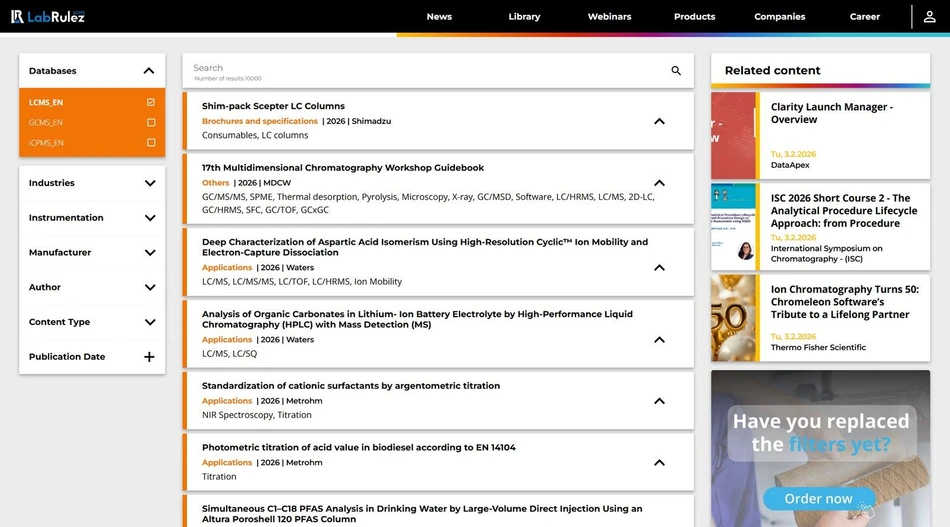
Our Library never stops expanding. What are the most recent contributions to LabRulezLCMS Library in the week of 2nd February 2026? Check out new documents from the field of liquid phase, especially HPLC and LC/MS techniques!
👉 SEARCH THE LARGEST REPOSITORY OF DOCUMENTS ABOUT LCMS AND RELATED TECHNIQUES
👉 Need info about different analytical techniques? Peek into LabRulezGCMS or LabRulezICPMS libraries.
This week we bring you application notes by Agilent Technologies and Waters Corporation, technical note by Shimadzu and poster by Thermo Fisher Scientific / MSACL!
1. Agilent Technologies: Quantitative Separation of THC Isomers and Metabolites from Whole Blood
Using Agilent Captiva Enhanced Matrix Removal (EMR) cartridges and LC/MS/MS
- Application note
- Full PDF for download
THC isomers (Δ8- and Δ9-THC, in particular) are psychoactive compounds of increasing interest in forensic toxicology, where accurate identification and quantification of these individual isomers and their respective metabolites are essential for legal and clinical assessments. However, an analytical challenge derives from their structural or empirical similarity and the presence of potential isobaric interferences.
Isobaric compounds are molecules that are empirically identical, share the same nominal mass, but differ in structure. In the context of THC analysis, CBD and exo-THC are notable isobaric interferences. These compounds can coelute or produce overlapping mass spectral signals, complicating the interpretation of results. CBD, a nonpsychoactive cannabinoid, shares an identical molecular weight and similar fragmentation pattern with THC isomers, making it difficult to distinguish using conventional mass spectrometry alone. Exo-THC, another structural analog, further adds to the complexity for the same reasons.
Without adequate chromatographic separation, these isobaric interferences can lead to false positives or inaccurate quantitation. This is particularly problematic in forensic settings, where precise identification of psychoactive substances is critical. Therefore, a robust analytical method that can resolve these compounds and potential interferents is desirable.
This study introduces a workflow that combines enhanced matrix removal (EMR) with LC/MS/MS to achieve baseline separation of THC isomers and their metabolites from the isobaric interferences that were examined within the scope of this application note. The method enables confident separation, identification, and quantification in a single 15-minute analysis.
Experimental
Chromatographic separation and LC/MS/MS detection
This procedure can be accomplished using different instrument configurations. Chromatographic separation was verified using both an Agilent 1260 Infinity II LC and an Agilent 1290 Infinity II LC. Analyte detection and quantitation were performed via both an Agilent 6475 triple quadrupole LC/MS and an Agilent Ultivo triple quadrupole LC/MS. Method parameters are detailed in Tables 1 and 2. Detailed MRM transition settings are outlined in Appendix A.
Conclusion
This study presents an effective, integrated workflow for the separation and quantification of THC isomers and metabolites in whole blood. Agilent Captiva EMR–Lipid cartridges removed sufficient matrix interferences to enable clean extraction and high analyte recovery. Chromatographic separation using an Agilent InfinityLab Poroshell 120 PFP column provided reliable resolution of isobaric compounds, including CBD and exo-THC. Coupled with Agilent LC/MS/MS systems featuring Agilent Jet Stream ionization technology, the method delivered consistent sensitivity and selectivity across a complex panel of analytes. Together, this methodology offers the basis of a streamlined workflow for the separation of Δ8-, Δ9-, and Δ10-THC isomers and their respective hydroxy and carboxy metabolites and potential interferents from whole blood.
2. Shimadzu: Optimization of Supercritical Fluid Extraction Parameters for Vitamins D2, D3, and K1 from Pharmaceutical Preparations
- Technical note
- Full PDF for download
Vitamins are organic compounds, essential in small amount, crucial for the normal functioning of the human body, facilitating numerous enzymatic and metabolic functions[1]. Since the human organism cannot produce vitamins, the diet represents the main route of ingestion of these compounds. As consumer awareness grows, reliable information about the vitamin content in foods is becoming a critical issue. However, considering that vitamins could be losses during food processing and storage, the readyto-use multi-vitamin pharmaceutical preparations are becoming widely employed among consumers. These facts, together with the introduction of labelling regulations, introduced the need for ensure the quality control of these types of formulation.
2. Experimental
2.3 Instrumentation
The supercritical fluid extraction (SFE) was carried out by using a SFE pretreatment system (Shimadzu Nexera UC) equipped with: a CBM-40 controller, an SFE-30A module, an LC-30ADSF CO2 pump, an LC-40D XR modifier pump, an LC-40D make-up pump, an SFC-30A back pressure regulator, a DGU-40 on-line degasser, an FRC-40 fraction collector. A combination of static and dynamic extraction was employed (Figure 2).
Conclusion
Considering the obtained results, the vitamins extraction revealed as strictly matrix dependent, according to the formulation excipients. Therefore, detailed study needs to be performed to better understand the vitamin formulation.
3. Thermo Fisher Scientific / MSACL: Simultaneous quantitation and discovery (SQUAD) of fecal bile acids and their conjugates in children with autism spectrum disorder (ASD)
- Poster
- Full PDF for download
This study presents a Simultaneous Quantitation and Discovery (SQUAD) metabolomics workflow applied to the analysis of fecal bile acids and their microbial conjugates in children with Autism Spectrum Disorder (ASD) undergoing microbiota transfer therapy (MTT). Bile acids play a key role in lipid metabolism and gut–brain signaling, and alterations in gut microbiota composition in ASD have been linked to disrupted bile acid metabolism. The SQUAD approach was designed to address the need for both targeted quantification of known bile acids and untargeted discovery of novel metabolic features within a single LC–MS injection.
The workflow integrates reversed-phase liquid chromatography with advanced mass spectrometry using a Thermo Scientific Orbitrap Ascend Tribrid mass spectrometer coupled to a Thermo Scientific Vanquish Horizon UHPLC system. Quantitative analysis was performed using parallel reaction monitoring (PRM) in the linear ion trap, while high-resolution MS¹ scanning in the Orbitrap enabled confident metabolite annotation. The Tribrid architecture—combining a quadrupole, linear ion trap, and Orbitrap—allowed high selectivity and sensitivity, including MSⁿ capabilities for resolving co-eluting structural isomers such as leucine- and isoleucine-conjugated bile acids.
Using calibrated bile acid standards, the method achieved absolute quantitation across six orders of magnitude, with limits of quantitation below 1.8 femtomoles on column. The SQUAD workflow was applied to fecal samples collected before and after MTT, revealing distinct shifts in bile acid and lipid-related metabolite profiles following treatment. Multivariate analysis, including principal component analysis (PCA), demonstrated clear separation between pre- and post-treatment samples in the MTT group, while no comparable changes were observed in placebo controls.
Overall, the results demonstrate that SQUAD metabolomics enables high-throughput, highly sensitive, and information-rich analysis by combining quantitative rigor with deep metabolic coverage in a single experiment. This integrated LC–MS workflow provides valuable insight into the biochemical effects of microbiome modulation in ASD and highlights the power of Orbitrap Tribrid–based metabolomics for studying complex host–microbiome interactions in clinical research.
4. Waters Corporation: Analysis of Organic Carbonates in Lithium- Ion Battery Electrolyte by High-Performance Liquid Chromatography (HPLC) with Mass Detection (MS)
- Application note
- Full PDF for download
Benefits
- Sensitive method for low-level detection and quantification of carbonate solvents (0.05–1 ppm) and carbonate-based aging products (0.00075–0.0025 ppm) in lithium-ion battery electrolyte solutions using the ACQUITY QDa II Mass Detector with SIR acquisition mode.
- Robust chromatographic separation using the XSelect Premier HSS PFP Column under 7 minutes analysis time, operated under reversed-phase conditions.
The electrolyte is one of the main components in the lithium-ion battery.1,2 It is a conductive solution that transports lithium ions from the cathode to the anode during the charging process. During discharge, the lithium ions flow from the anode to the cathode. The electrolyte solution is composed of lithium salt dissolved in a mixture of organic solvents.1,2 The organic solvents are typically a mixture of cyclic and linear carbonates, including EC, PC, DMC, EMC, and DEC.2 Lithium hexafluorophosphate (LiPF₆) is commonly used as the conducting lithium salt,2 providing the necessary ionic conductivity for efficient battery operation.
The LiPF6 salt in carbonate-based systems can exhibit chemical and thermal instability, which can impact the performance of the lithium-ion batteries.2-4 Electrolyte solutions can also degrade, forming aging products including DMDOHC and DEDOHC.2 Various techniques are employed to investigate quality and properties of the electrolytes. Techniques such as scanning calorimetry (DSC) and thermogravimetric analysis (TGA) offer a comprehensive analysis of an electrolyte’s thermal properties, while rheology measures viscosity of the conductivity solutions.1 Additionally, chromatographic methods are used to measure the quantity of carbonate solvents in electrolyte solutions.2-4 Gas chromatography mass spectrometry (GC/MS) and liquid chromatography mass spectrometry (LC/MS) are common techniques used to investigate carbonate-based electrolytes.3
In this application note, an HPLC method with mass detection was developed for the analysis of five common carbonate solvents and two carbonate-based aging products (Table 1). The method employed an ACQUITY QDa II Mass Detector coupled with an Arc Premier System. Method performance characteristics including limit of detection (LOD), limit of quantification (LOQ), linearity and system suitability were demonstrated. Additionally, the developed method was applied for the analysis of LiPF6-based electrolyte solution.
Experimental
Method Conditions
- System: Arc Premier System, Column Manager with active pre-heating, PDA and the ACQUITY QDa II Mass Detector
- Column: XSelect Premier HSS PFP Column, 2.5 µm, 4.6 mm x 100 mm (Waters, p/n: 186010051)
- MS system: ACQUITY QDa II Mass Detector
Data Management
- Chromatography data software (CDS): Empower™ 3.6.1
Results and Discussion
Chromatographic columns with a wide range of selectivity were explored during this study to ensure separation between carbonate solvents and carbonate-based aging products. The selected columns (XSelect Premier CSH™ C18, XSelect Premier CSH Phenyl Hexyl, XSelect Premier HSS T3, XSelect Premier HSS PFP) were tested with acetonitrile and methanol solvents. The study showed that XSelect Premier HSS PFP Column with methanol provided the best retentivity and separation for all analytes (Figure 1). The method successfully separated carbonate solutions and carbonate-based aging products in less than a 7-minute gradient time. The MS total ion chromatogram (TIC) data was collected across the mass range of 35–300 Da using electrospray ionization in positive (ESI+) mode (Figure 1A). The mass spectral data facilitated quick and accurate identification of the components. The carbonate solvents formed [M + H]+ molecular ions, while the selected aging products formed sodium adducts, [M + Na]+. These ions were measured using a selected ion recording (SIR) acquisition mode, which determines intensity for a single ion of interest (Figure 1B).
Conclusion
A sensitive and reliable HPLC-MS method using the Arc Premier System coupled with the ACQUITY QDa II Mass Detector was developed for the analysis of carbonate solvents and carbonate-based aging products in lithium-ion battery electrolyte. This reversed-phase LC method successfully separated all five carbonate solvents (EC, PC, DMC, EMC, DEC) and two aging products (DMDOHC/DEDOHC) on an XSelect Premier HSS PFP Column. Low-level quantification limits were achieved using SIR acquisition mode ranging from 0.05 to 1 ppm and 0.00075–0.0025 ppm for carbonate solvents and aging products, respectively. The method was demonstrated to be applicable for the analysis of lithium-ion battery electrolyte.