News from LabRulezLCMS Library - Week 04, 2026
LabRulez: News from LabRulezLCMS Library - Week 04, 2026
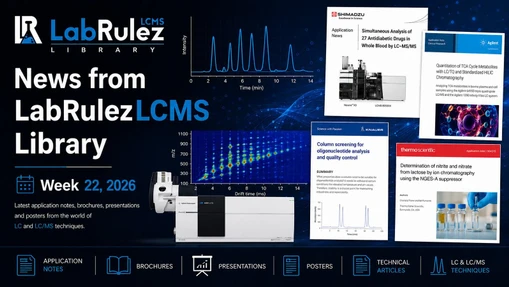
Our Library never stops expanding. What are the most recent contributions to LabRulezLCMS Library in the week of 19th January 2026? Check out new documents from the field of liquid phase, especially HPLC and LC/MS techniques!
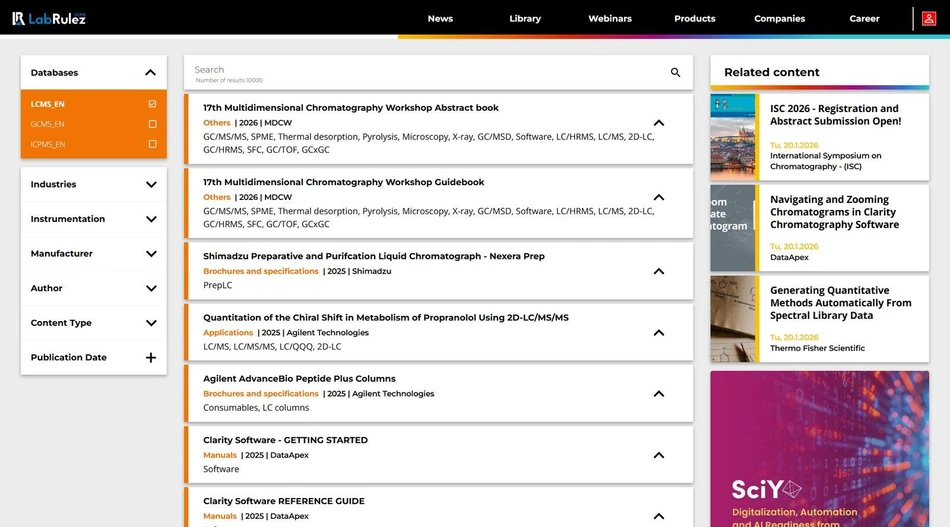
👉 SEARCH THE LARGEST REPOSITORY OF DOCUMENTS ABOUT LCMS AND RELATED TECHNIQUES
👉 Need info about different analytical techniques? Peek into LabRulezGCMS or LabRulezICPMS libraries.
This week we bring you application notes by Agilent Technologies, Shimadzu, Waters Corporation and poster by Thermo Fisher Scientific!
1. Agilent Technologies: Automated Bioprocess Monitoring with Agilent 1290 Infinity III Bio Online LC Solutions
Process analytics of L-alanine production using genetically modified Vibrio natriegens
- Application note
- Full PDF for download
Bioprocess engineering is a challenging field because of the constantly changing nature of bioprocess models which make them difficult to validate.1 Consequently, process control needs to be developed at various levels using strategies tailored to these specific requirements.1 The performance and effectiveness of the bioreactor are determined by key performance indicators such as product yield, titer, production rate, and quality of the product.1 These factors can be quickly influenced by changes in process variables and the raw materials used.1,2 The ability to react quickly to problems is therefore crucial for preserving ongoing production, a factor that can be particularly significant in bioprocesses due to the substantial cost and time investmented.1,2 Such challenges can be tackled by constantly monitoring the bioprocess, which requires the ability to analyze and collect data quickly. Therefore, monitoring is of the utmost importance.
This application note describes the advantages of using an Agilent 1290 Infinity III Bio Online LC solution with Agilent Online LC Monitoring software. A bioreactor was interfaced with a Flownamics Seg-Flow S3 sampling system for aseptic withdrawal and an Agilent 1290 Infinity III Bio Online LC to make an hourly analysis.
This is a fully automated approach for taking sterile samples from a bioreactor and preparing or diluting them. In addition, the 1290 Infinity III Bio Online LC solution displays data in near real time, which is a crucial element for effective bioprocess monitoring.
Experimental
Equipment
The 1290 Infinity III Bio Online LC comprised the following modules:
- Agilent 1290 Infinity III Bio Flexible Pump (G7131A) with an InfinityLab Quick Change Bio inline filter assembly (part number 5067-1607), 2.1 mm id, 0.2 µm pore size
- Agilent 1290 Infinity III Bio Online Sample Manager (G3167B) with Sample Thermostat (option #101) clustered with Agilent 1290 Infinity Valve Drive (G1170A), featuring a reactor valve pod (part number 5067-6680) and Online LC Monitoring Software
- Agilent 1290 Infinity III Multicolumn Thermostat (G7116B) equipped with an Agilent Quick Connect Bio Heat Exchanger Std. (G7116-60071)
- Agilent 1290 Infinity III Diode Array Detector (DAD) (G7117B), equipped with a Bio Max-Light Cartridge Cell (G4212-6008), 10 mm, 1 µL
- Agilent 1260 Infinity High-Performance Degasser (G4225A) is connected between S1 (transport solvent) solvent line and Agilent 1290 Infinity III Bio Online Sample Manager (G3167B)
Software
- Agilent OpenLab CDS version 2.8 or later versions
- Agilent Online LC Monitoring Software version 1.3 or later versions
- Flownamics FlowWeb control software
Instrumental configuration
The 1290 Infinity III Bio Online LC solution was used with a Seg-Flow interface for automatic sampling and online analysis (see Figure 1). The Seg-Flow interface was used to withdraw samples from a bioreactor through a Flownamics F-Series 310 FISP probe with a ceramic membrane filter (0.2 µm pore size) from a 5 L bioreactor. The drawn samples were sent through the built-in sample collection cup on the Seg‑Flow to the LC and the samples were retained into vials. The collected samples were then automatically derivatized by using an injector program and subsequently analyzed. A more detailed description of the instrumental configuration has been published.3
Conclusion
For online bioprocess monitoring, a fully automated setup consisting of a bioreactor, a Flownamics sampling system, and an Agilent 1290 Infinity III Bio Online LC solution was successfully established. This setup is capable of taking aseptic samples from a bioreactor, preparing, analyzing, and processing samples without the need for manual interaction. In addition, the added value of the Agilent Online LC Monitoring software was evident in the display method and the ability to track it quickly.
2. Shimadzu: Analysis of Oligonucleotide Impurities Using Single Quadrupole Mass Spectrometer
- Application note
- Full PDF for download
User Benefits
- Combination use of LCMS-2050 single quadrupole mass spectrometer and LabSolutions Insight Biologics provides comprehensive characterization of oligonucleotides and related impurities.
- Purity calculations for target components can be performed even on poorly separated peaks by utilizing MS spectra simultaneously acquired with UV chromatogram.
In recent years, oligonucleotide therapeutics have been paid attention as a novel drug discovery modality because of their rapid progress of development. During the synthesis of oligonucleotide therapeutics, impurities that have differing base chain lengths are generated along with the target oligonucleotide. To ensure the safety and efficacy of the drug, comprehensive detection and identification of these impurities are required.
Reversed phase ion-pair chromatography is often employed as a method to separate the target compound from co-existing impurities. However, it is often difficult to establish analytical conditions that provide compete separation of all impurities that are formed in synthesis process due to their similar structures and properties to the principal compound of active ingredient. Against this drawback, liquid chromatography-mass spectrometry (LC-MS) is commonly used for impurity detection and identification. For analysis of oligonucleotide impurities, quadrupole time-of-flight mass spectrometers are mainly used because of their high mass resolution and ability to perform sequence and structure estimations via MS/MS analysis. However, in quality control process, the use of a single quadrupole mass spectrometer is expected to be advantageous because of providing mass information with easy operation when impurity information is already known.
This article presents a simulated impurity analysis of synthetic oligonucleotide using the LCMS-2050 high-performance liquid chromatography-mass spectrometer and LabSolutions Insight Biologics.
Analytical conditions
The employed instrument setup was Nexera XS inert and LCMS-2050. HPLC conditions are shown in Table 2, and MS conditions are shown in Table 3. The conditions were set where n-1(5') co-eluted with FLP, while n-3(5') was separated (Fig. 1) to demonstrate impurity analysis performance.
Conclusion
The simulated sample consisting of mainly FLP and small amounts of n-1(5')/n-3(5') was analyzed using the LCMS-2050 and LabSolutions Insight Biologics software and obtained data were processed appropriately. Detection, identification, and quantitation at low concentrations were accomplished not only for n-3(5') well-separated from FLP but also for n-1(5') co-eluted with FLP. In case that establishing analytical conditions is difficult, Using this instrument setup and software will provide efficient quality confirmation of oligonucleotide therapeutics.
3. Thermo Fisher Scientific: Simultaneous Quantitation and Untargeted Discovery (SQUAD) workflow using multiple fragmentation techniques for quantitation and characterization of trace level nitrosamine in biological matrices
- Poster
- Full PDF for download
N-Nitrosamines are a class of carcinogenic chemical compounds that pose threat to humans exogenously through matrices like drinking water, food, cosmetics, and endogenously by nitrosation in gastrointestinal tract, nitrate to nitrite conversion, etc. An accurate, reliable analytical method is critical for detection and quantification of these trace-level, polar and low molecular weight compounds to understand the association between their exposure and related diseases.
An optimized SQUAD workflow is presented that discovers unknown compounds in the matrix by using high resolution orbitrap and a sensitive linear ion trap detector that quantifies the low intensity nitrosamines in a single run. The workflow uses multiple fragmentation types – HCD, CID and UVPD and MSn to help characterize isomeric structures.
Methods
Serial dilution of Nitrosamine standards were subjected to Simultaneous Quantitation and Discovery (SQUAD) analysis using Thermo Scientific™ Vanquish™ Horizon UHPLC system and the Thermo Scientific™ Orbitrap IQ-X™ Tribrid™ mass spectrometer . Nitrosamine spiked matrices of human pooled urine and human Serum were subjected to SQUAD analysis.
Data Analysis
Spectra were evaluated for nitrosamines using Thermo Scientific™ FreeStyle™ software and annotated using Thermo Scientific™ Mass Frontier™ 8.0 software. Untargeted data analysis was performed using Compound Discoverer 3.4 software. Calibration curves were generated using Thermo Scientific™ TraceFinder™ 5.2 software.
Conclusions
- Detection limits as low ppb levels ( 0.2 ppb –0.5 ppb) and quantitation limits (0.2 ppb- 5 ppb ) in presence of the matrix were achieved for all seven nitrosamines by applying parallel ion trap analysis
- SQUAD analysis was run on Orbitrap IQ-X Tribrid MS and achieved low ppb level quantitation in ion trap and identified unknown compounds through discovery analysis in Orbitrap.
- Employing nano LC helped achieve lower limit of quantitation (5 ppt)
4. Waters Corporation: Validated LC-MS/MS Method for Vitamin E Acetate in Cannabis Plants and Derived Products
- Application note
- Full PDF for download
Benefits
- The validated LC-MS/MS method provides high sensitivity and specificity for VEA quantification in complex cannabis matrices, including flower and concentrates.
- Minimal sample preparation reduces handling time and improves laboratory throughput, supporting efficient routine analysis.
- The method demonstrates robust performance across multiple matrices, ensuring reliable detection even in lipid-rich, chemically diverse samples.
- Use of Waters ACQUITY UPLC H-Class System and Xevo TQ-S micro Mass Spectrometer enables accurate quantitation well below regulatory requirements.
- The validated method complies with Missouri DCR and DHSS regulatory limits, enabling laboratories to confidently monitor VEA in cannabis products.
VEA is used as a diluent and viscosity modifier in certain cannabis-derived products, including vaping formulations. Following increased public health awareness during 2019, VEA became a marker of interest for quality control and regulatory surveillance across cannabis supply chains due to its potential impact on lung health. In addition to concentrates and vape liquids, trace residues may be present in infused products and processing intermediates. Therefore, reliable quantification of VEA in these chemically diverse, lipid-rich matrices requires an analytical method that is sensitive, selective, and robust against matrix effects. In February 2024, Missouri’s DCR revised the tolerance limit for VEA in cannabis products from 0.2 ppm to 5 ppm.1
Liquid chromatography coupled with tandem quadrupole mass spectrometry (LC-MS/MS) provides the sensitivity and specificity required to distinguish VEA from endogenous cannabinoids, terpenes, and other lipophilic excipients, while also offering the sensitivity to support low-ppm and sub-ppm action limits. Unlike UVbased methods, where co-eluting chromophores may interfere, LC-MS/MS enables targeted multiple reaction monitoring (MRM) for confident identification and accurate quantitation in complex cannabis matrices.
This application note describes the validation of an LC-MS/MS method for the quantitation of VEA in two inhalable products, cannabis flower and cannabis concentrates. The method was developed and validated using the Waters ACQUITY UPLC H-Class System coupled with a Xevo TQ-S micro Triple Quadrupole Mass Spectrometer. Chromatographic separation was achieved with a reversed-phase ACQUITY UPLC BEH C18 Column. A streamlined sample preparation approach was applied for cannabis flowers and concentrates, which minimizes handling time and increases sample throughput.
The validation study was conducted at GPA. Method performance was evaluated for calibration range, linearity, LOD, LOQ, accuracy, precision, recovery, repeatability, and robustness. The results of these are evaluated against acceptance criteria set by State of Missouri DHSS and presented in this application note.
Experimental
- LC system: ACQUITY UPLC H-Class Plus System
- MS detection: Xevo TQ-S micro Mass Spectrometer
- Column: ACQUITY UPLC BEH C18 Column, 2.1 x 50 mm, 1.7 µm (p/n: 186002350)
- Software: MassLynx™ 4.1 Software
- Data processing: TargetLynx™ Application
Conclusion
The LC-MS/MS method developed and validated for VEA quantification in cannabis flower and concentrates demonstrates excellent linearity, accuracy, precision, and robustness, and meets the regulatory requirements. Calibration curves achieved R² values greater than 0.999, with LOD and LOQ well below the Missouri action limit of 5 ppm. Matrix-spiked recoveries across flower and concentrate samples were within the 70–130% acceptance range, and QC samples met all performance criteria, confirming method reliability. Robustness testing across analysts and matrices further validated the method’s reproducibility. Overall, this approach provides a streamlined, sensitive, and regulatory-compliant workflow for laboratories, enabling accurate monitoring of VEA to support quality control, consumer safety, and regulatory compliance in cannabis-derived products