LCMS
More information
WebinarsAbout usContact usTerms of use
LabRulez s.r.o. All rights reserved. Content available under a CC BY-SA 4.0 Attribution-ShareAlike
Author
Organomation
Organomation
Organomation, founded in 1959, designs and manufactures high-quality nitrogen evaporators and extraction systems. Known for innovation and durability, their lab instruments are used globally for efficient sample preparation with strong customer support.
Tags
Article
Product
LinkedIn Logo

How Are Laboratories Supplied with Nitrogen?
Th, 25.9.2025
| Original article from: Organomation / David Oliva
Discover how cylinder, bulk liquid, or on-site nitrogen supply impacts lab efficiency, costs, and reliability, and find the best option for your research.
<p>Organomation: How Are Laboratories Supplied with Nitrogen?</p>

Organomation: How Are Laboratories Supplied with Nitrogen?

Nitrogen gas is the unsung hero of modern laboratory operations, quietly enabling countless analytical procedures, protecting sensitive equipment, and maintaining the inert atmospheres essential for accurate scientific work. Yet despite its critical importance, many laboratory managers struggle with selecting the optimal nitrogen supply method for their facility's unique needs.

The choice between traditional cylinder delivery, bulk liquid supply, or on-site generation can significantly impact your laboratory's operational efficiency, costs, and research capabilities. This blog explores each supply method in detail, helping you make an informed decision that aligns with your laboratory's requirements and long-term goals.

Understanding Laboratory Nitrogen Demand

Before diving into supply methods, it's essential to understand why laboratories consume such substantial quantities of nitrogen. Modern analytical instruments are increasingly nitrogen-hungry, with applications ranging from liquid chromatography-mass spectrometry (LC-MS) systems that require continuous gas flow to maintain optimal performance, to nuclear magnetic resonance (NMR) spectroscopy equipment that depends on nitrogen for cooling and atmospheric control.

Beyond instrumentation, nitrogen serves critical roles in sample preparation, where it prevents oxidation during reactions, and in maintaining inert atmospheres within gloveboxes used for handling air-sensitive materials. The gas also protects valuable cell cultures in incubators and ensures proper atmospheric conditions in fume hoods, making it indispensable across virtually every laboratory discipline.

While Organomation sample concentrators are more conservative when it comes to nitrogen consumption, nitrogen is the driving force in blowdown evaporation.

Traditional Cylinder Supply: The Familiar Choice

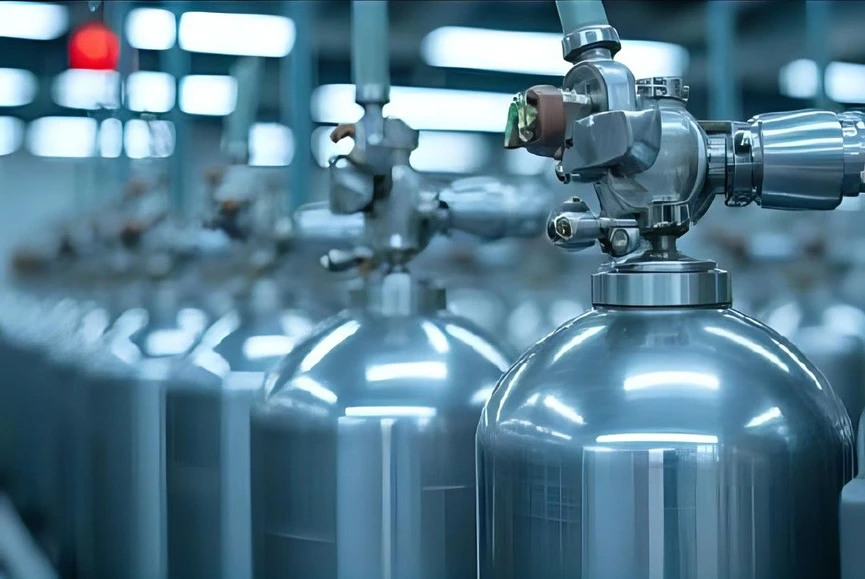
Cylinders of nitrogen gas have long been the default choice for laboratory nitrogen supply, and for good reason. These high-pressure vessels offer immediate availability, require minimal infrastructure investment, and provide flexibility for laboratories with variable or seasonal nitrogen demands.

The Cylinder Advantage

Cylinder supply excels in situations where nitrogen usage is intermittent or unpredictable. Small research facilities, teaching laboratories, and specialized testing facilities often find cylinders perfectly adequate for their needs. The system requires no upfront capital investment in generation equipment, and maintenance responsibilities rest entirely with the gas supplier.

Hidden Costs and Operational Challenges

However, the apparent simplicity of cylinder supply masks several significant drawbacks. The per-unit cost of nitrogen from cylinders is substantially higher than other supply methods, particularly when factoring in delivery charges, cylinder rental fees, and administrative overhead. More critically, cylinders introduce operational risks that can disrupt research workflows.

Running out of nitrogen mid-analysis can invalidate hours of work and potentially damage sensitive samples. The physical handling of heavy cylinders presents safety risks, while the need for regular ordering and delivery coordination creates administrative burden. Additionally, cylinder storage requires dedicated space and proper ventilation, reducing available laboratory real estate.

Bulk Liquid Supply: Scaling Up Efficiency

For laboratories with substantial nitrogen consumption, bulk liquid supply offers a compelling middle ground between cylinders and on-site generation. This approach involves storing nitrogen in liquid form in large tanks, then vaporizing it to gas as needed and distributing it throughout the facility via permanent piping. While liquid nitrogen dewars can be placed outside of a building, they are also stored in warehouse storage or dedicated rooms as well.

Economic and Operational Benefits

Bulk liquid supply dramatically reduces the per-unit cost of nitrogen compared to cylinders, making it economically attractive for high-volume users. The system eliminates the constant cycle of cylinder changes, reducing both labor costs and operational disruptions. Large storage capacity means fewer deliveries and greater supply security.

Infrastructure Requirements and Limitations

The transition to bulk liquid supply requires significant infrastructure investment, including outdoor storage tanks, vaporization equipment, and internal distribution piping. Facilities must have adequate outdoor space for tank placement and comply with safety regulations governing cryogenic liquid storage.

On-Site Nitrogen Generation: The Modern Solution

On-site nitrogen generators represent the cutting edge of laboratory gas supply, offering unprecedented control, cost-effectiveness, and operational reliability. These systems produce nitrogen gas directly from ambient air, eliminating external dependencies while providing unlimited supply capacity.

Pressure Swing Adsorption Technology

Pressure Swing Adsorption (PSA) generators utilize specialized adsorbent materials, typically carbon molecular sieves, to separate nitrogen from compressed air. The process operates through cyclical pressurization and depressurization, with adsorbent beds alternately capturing oxygen and other gases while allowing nitrogen to pass through.

PSA technology excels in applications requiring high purity nitrogen, capable of producing gas with purity levels up to 99.999%. This makes PSA nitrogen generators ideal for critical analytical applications, pharmaceutical manufacturing, and research requiring ultra-pure atmospheres. The technology offers excellent energy efficiency and can be precisely tuned to match specific purity requirements.

Membrane Separation Technology

Membrane nitrogen generators employ semi-permeable hollow fiber membranes that exploit the different permeation rates of atmospheric gases. Oxygen, water vapor, and carbon dioxide pass through the membrane walls more rapidly than nitrogen, effectively concentrating nitrogen in the non-permeate stream.

While membrane technology typically produces nitrogen with purity levels up to 99.5%, it offers several advantages including lower maintenance requirements, simpler operation, and excellent reliability. Membrane generators are particularly well-suited for applications where ultra-high purity isn't critical, such as general laboratory atmospheres, packaging applications, and routine analytical work.

How Should Nitrogen be Supplied to your Lab?

Selecting the right nitrogen supply method represents a strategic decision that will impact your laboratory's operations for years to come. While the initial analysis may seem complex, the long-term benefits of choosing the optimal solution far outweigh the effort required for proper evaluation.

Consider engaging with multiple suppliers to obtain detailed proposals and cost analyses based on your specific requirements. Many suppliers offer trial periods or pilot programs that allow hands-on evaluation of different technologies before making final commitments.

Remember that the lowest initial cost rarely represents the best long-term value. Focus on total cost of ownership, operational reliability, and alignment with your laboratory's research mission when making your final decision.

The investment in proper nitrogen supply infrastructure pays dividends in improved research capabilities, reduced operational stress, and enhanced scientific productivity. Choose wisely, and your laboratory will benefit from reliable, cost-effective nitrogen supply for years to come.

Luckily, Organomation offers several tools to help make the analysis and task of product selection easier:

Organomation
LinkedIn Logo
 

Related content

Overcoming Strong Solvent Effects in the Analysis of Vepdegestrant

Applications
| 2026 | Agilent Technologies
Instrumentation
HPLC
Manufacturer
Agilent Technologies
Industries
Pharma & Biopharma

Identification of Double Bond Positions and Relative Acyl Chain Positions in Egg Yolk Phosphatidylcholines Using OAD-TOF System

Applications
| 2026 | Shimadzu
Instrumentation
LC/MS, LC/MS/MS, LC/TOF, LC/HRMS
Manufacturer
Shimadzu
Industries
Food & Agriculture

High Molecular-Weight Polysaccharide Characterization by SEC-MALS Using GTxResolve™ 1000 and 2000 Å SEC Columns

Applications
| 2026 | Waters
Instrumentation
GPC/SEC, Consumables, LC columns
Manufacturer
Waters
Industries
Pharma & Biopharma, Food & Agriculture

Development and Optimization for a Comprehensive LC/MS/MS Method for the Detection of 74 PFAS Compounds

Applications
| 2026 | Agilent Technologies
Instrumentation
LC/MS, LC/MS/MS, LC/QQQ
Manufacturer
Agilent Technologies
Industries
Food & Agriculture

PFAS in Biota: Risk Context & Robust Analytical Solutions

Others
| 2026 | ALS Europe
Instrumentation
Laboratory analysis, LC/MS, LC/MS/MS
Manufacturer
Industries
Environmental
 

Related articles

JUNIOR STAR Grants at UCT Prague: Two talented women from abroad driving innovation in science
Article | Scientists

JUNIOR STAR Grants at UCT Prague: Two talented women from abroad driving innovation in science

Two outstanding early-career researchers at UCT Prague, Filipa Oliveira and Stella Gonsales, received prestigious GAČR JUNIOR STAR grants for innovative research in materials science and sustainable chemistry.
UCT Prague
tag
share
more
Research from IOCB Prague reveals a previously unknown mechanism of genetic transcription
Article | Science and research

Research from IOCB Prague reveals a previously unknown mechanism of genetic transcription

Scientists at IOCB Prague reveal a previously unknown mechanism that initiates gene transcription. Using cryo-EM, they uncover how alarmone molecules enable RNA synthesis under stress.
Institute of Organic Chemistry and Biochemistry of the Czech Academy of Sciences
tag
share
more
Food Adulteration and How It Is Revealed by Analytical Chemistry
Article | Food

Food Adulteration and How It Is Revealed by Analytical Chemistry

Food adulteration threatens quality and consumer trust. Discover how HPLC and modern chromatographic systems from Watrex Praha help identify oil, honey, and wine adulteration with high confidence.
Watrex Praha
tag
share
more
Affinity, Gel Filtration, Size Exclusion Chromatography: Repurposing Kinase Inhibitors for Malaria
Interview | Video

Affinity, Gel Filtration, Size Exclusion Chromatography: Repurposing Kinase Inhibitors for Malaria

This podcast explores how chromatography (FPLC/SEC) and mass spectrometry support malaria drug discovery, from protein purification and QC to interaction studies and complex sample preparation.
Organomation
tag
share
more
 

Related content

Overcoming Strong Solvent Effects in the Analysis of Vepdegestrant

Applications
| 2026 | Agilent Technologies
Instrumentation
HPLC
Manufacturer
Agilent Technologies
Industries
Pharma & Biopharma

Identification of Double Bond Positions and Relative Acyl Chain Positions in Egg Yolk Phosphatidylcholines Using OAD-TOF System

Applications
| 2026 | Shimadzu
Instrumentation
LC/MS, LC/MS/MS, LC/TOF, LC/HRMS
Manufacturer
Shimadzu
Industries
Food & Agriculture

High Molecular-Weight Polysaccharide Characterization by SEC-MALS Using GTxResolve™ 1000 and 2000 Å SEC Columns

Applications
| 2026 | Waters
Instrumentation
GPC/SEC, Consumables, LC columns
Manufacturer
Waters
Industries
Pharma & Biopharma, Food & Agriculture

Development and Optimization for a Comprehensive LC/MS/MS Method for the Detection of 74 PFAS Compounds

Applications
| 2026 | Agilent Technologies
Instrumentation
LC/MS, LC/MS/MS, LC/QQQ
Manufacturer
Agilent Technologies
Industries
Food & Agriculture

PFAS in Biota: Risk Context & Robust Analytical Solutions

Others
| 2026 | ALS Europe
Instrumentation
Laboratory analysis, LC/MS, LC/MS/MS
Manufacturer
Industries
Environmental
 

Related articles

JUNIOR STAR Grants at UCT Prague: Two talented women from abroad driving innovation in science
Article | Scientists

JUNIOR STAR Grants at UCT Prague: Two talented women from abroad driving innovation in science

Two outstanding early-career researchers at UCT Prague, Filipa Oliveira and Stella Gonsales, received prestigious GAČR JUNIOR STAR grants for innovative research in materials science and sustainable chemistry.
UCT Prague
tag
share
more
Research from IOCB Prague reveals a previously unknown mechanism of genetic transcription
Article | Science and research

Research from IOCB Prague reveals a previously unknown mechanism of genetic transcription

Scientists at IOCB Prague reveal a previously unknown mechanism that initiates gene transcription. Using cryo-EM, they uncover how alarmone molecules enable RNA synthesis under stress.
Institute of Organic Chemistry and Biochemistry of the Czech Academy of Sciences
tag
share
more
Food Adulteration and How It Is Revealed by Analytical Chemistry
Article | Food

Food Adulteration and How It Is Revealed by Analytical Chemistry

Food adulteration threatens quality and consumer trust. Discover how HPLC and modern chromatographic systems from Watrex Praha help identify oil, honey, and wine adulteration with high confidence.
Watrex Praha
tag
share
more
Affinity, Gel Filtration, Size Exclusion Chromatography: Repurposing Kinase Inhibitors for Malaria
Interview | Video

Affinity, Gel Filtration, Size Exclusion Chromatography: Repurposing Kinase Inhibitors for Malaria

This podcast explores how chromatography (FPLC/SEC) and mass spectrometry support malaria drug discovery, from protein purification and QC to interaction studies and complex sample preparation.
Organomation
tag
share
more
 

Related content

Overcoming Strong Solvent Effects in the Analysis of Vepdegestrant

Applications
| 2026 | Agilent Technologies
Instrumentation
HPLC
Manufacturer
Agilent Technologies
Industries
Pharma & Biopharma

Identification of Double Bond Positions and Relative Acyl Chain Positions in Egg Yolk Phosphatidylcholines Using OAD-TOF System

Applications
| 2026 | Shimadzu
Instrumentation
LC/MS, LC/MS/MS, LC/TOF, LC/HRMS
Manufacturer
Shimadzu
Industries
Food & Agriculture

High Molecular-Weight Polysaccharide Characterization by SEC-MALS Using GTxResolve™ 1000 and 2000 Å SEC Columns

Applications
| 2026 | Waters
Instrumentation
GPC/SEC, Consumables, LC columns
Manufacturer
Waters
Industries
Pharma & Biopharma, Food & Agriculture

Development and Optimization for a Comprehensive LC/MS/MS Method for the Detection of 74 PFAS Compounds

Applications
| 2026 | Agilent Technologies
Instrumentation
LC/MS, LC/MS/MS, LC/QQQ
Manufacturer
Agilent Technologies
Industries
Food & Agriculture

PFAS in Biota: Risk Context & Robust Analytical Solutions

Others
| 2026 | ALS Europe
Instrumentation
Laboratory analysis, LC/MS, LC/MS/MS
Manufacturer
Industries
Environmental
 

Related articles

JUNIOR STAR Grants at UCT Prague: Two talented women from abroad driving innovation in science
Article | Scientists

JUNIOR STAR Grants at UCT Prague: Two talented women from abroad driving innovation in science

Two outstanding early-career researchers at UCT Prague, Filipa Oliveira and Stella Gonsales, received prestigious GAČR JUNIOR STAR grants for innovative research in materials science and sustainable chemistry.
UCT Prague
tag
share
more
Research from IOCB Prague reveals a previously unknown mechanism of genetic transcription
Article | Science and research

Research from IOCB Prague reveals a previously unknown mechanism of genetic transcription

Scientists at IOCB Prague reveal a previously unknown mechanism that initiates gene transcription. Using cryo-EM, they uncover how alarmone molecules enable RNA synthesis under stress.
Institute of Organic Chemistry and Biochemistry of the Czech Academy of Sciences
tag
share
more
Food Adulteration and How It Is Revealed by Analytical Chemistry
Article | Food

Food Adulteration and How It Is Revealed by Analytical Chemistry

Food adulteration threatens quality and consumer trust. Discover how HPLC and modern chromatographic systems from Watrex Praha help identify oil, honey, and wine adulteration with high confidence.
Watrex Praha
tag
share
more
Affinity, Gel Filtration, Size Exclusion Chromatography: Repurposing Kinase Inhibitors for Malaria
Interview | Video

Affinity, Gel Filtration, Size Exclusion Chromatography: Repurposing Kinase Inhibitors for Malaria

This podcast explores how chromatography (FPLC/SEC) and mass spectrometry support malaria drug discovery, from protein purification and QC to interaction studies and complex sample preparation.
Organomation
tag
share
more
 

Related content

Overcoming Strong Solvent Effects in the Analysis of Vepdegestrant

Applications
| 2026 | Agilent Technologies
Instrumentation
HPLC
Manufacturer
Agilent Technologies
Industries
Pharma & Biopharma

Identification of Double Bond Positions and Relative Acyl Chain Positions in Egg Yolk Phosphatidylcholines Using OAD-TOF System

Applications
| 2026 | Shimadzu
Instrumentation
LC/MS, LC/MS/MS, LC/TOF, LC/HRMS
Manufacturer
Shimadzu
Industries
Food & Agriculture

High Molecular-Weight Polysaccharide Characterization by SEC-MALS Using GTxResolve™ 1000 and 2000 Å SEC Columns

Applications
| 2026 | Waters
Instrumentation
GPC/SEC, Consumables, LC columns
Manufacturer
Waters
Industries
Pharma & Biopharma, Food & Agriculture

Development and Optimization for a Comprehensive LC/MS/MS Method for the Detection of 74 PFAS Compounds

Applications
| 2026 | Agilent Technologies
Instrumentation
LC/MS, LC/MS/MS, LC/QQQ
Manufacturer
Agilent Technologies
Industries
Food & Agriculture

PFAS in Biota: Risk Context & Robust Analytical Solutions

Others
| 2026 | ALS Europe
Instrumentation
Laboratory analysis, LC/MS, LC/MS/MS
Manufacturer
Industries
Environmental
 

Related articles

JUNIOR STAR Grants at UCT Prague: Two talented women from abroad driving innovation in science
Article | Scientists

JUNIOR STAR Grants at UCT Prague: Two talented women from abroad driving innovation in science

Two outstanding early-career researchers at UCT Prague, Filipa Oliveira and Stella Gonsales, received prestigious GAČR JUNIOR STAR grants for innovative research in materials science and sustainable chemistry.
UCT Prague
tag
share
more
Research from IOCB Prague reveals a previously unknown mechanism of genetic transcription
Article | Science and research

Research from IOCB Prague reveals a previously unknown mechanism of genetic transcription

Scientists at IOCB Prague reveal a previously unknown mechanism that initiates gene transcription. Using cryo-EM, they uncover how alarmone molecules enable RNA synthesis under stress.
Institute of Organic Chemistry and Biochemistry of the Czech Academy of Sciences
tag
share
more
Food Adulteration and How It Is Revealed by Analytical Chemistry
Article | Food

Food Adulteration and How It Is Revealed by Analytical Chemistry

Food adulteration threatens quality and consumer trust. Discover how HPLC and modern chromatographic systems from Watrex Praha help identify oil, honey, and wine adulteration with high confidence.
Watrex Praha
tag
share
more
Affinity, Gel Filtration, Size Exclusion Chromatography: Repurposing Kinase Inhibitors for Malaria
Interview | Video

Affinity, Gel Filtration, Size Exclusion Chromatography: Repurposing Kinase Inhibitors for Malaria

This podcast explores how chromatography (FPLC/SEC) and mass spectrometry support malaria drug discovery, from protein purification and QC to interaction studies and complex sample preparation.
Organomation
tag
share
more
Other projects
GCMS
ICPMS
Follow us
More information
WebinarsAbout usContact usTerms of use
LabRulez s.r.o. All rights reserved. Content available under a CC BY-SA 4.0 Attribution-ShareAlike