Non-targeted analysis of PFAS using two dimensional gas chromatography (Christopher Freye, MDCW 2025)
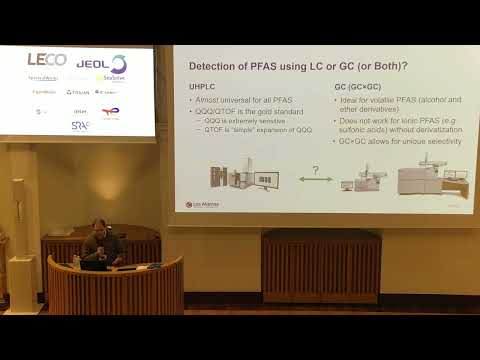
- Photo: MDCW: Non-targeted analysis of PFAS using two dimensional gas chromatography (Christopher Freye, MDCW 2025)
- Video: LabRulez: Christopher Freye: Non-targeted analysis of PFAS using two dimensional gas chromatography MDCW 2025
🎤 Presenter: Christopher Freye (Los Alamos National Laboratory, Los Alamos, USA)
💡 Book in your calendar: 17th Multidimensional Chromatography Workshop (MDCW) 13 - 15. January 2026
Abstract
Analysis of per- and polyfluoroalkyl substances (PFAS) has become necessary due to their presence in the environment and associated health risks. PFAS detection is usually accomplished using a targeted liquid chromatography tandem mass spectrometry (LC-MS/MS) methodology focusing on the 40 EPA regulated PFAS compounds. While LC-MS/MS is sensitive (part-per-trillion, ppt), it lacks the ability to measure all (EPA and non-EPA regulated) PFAS compounds that are present.
Using two-dimensional gas chromatography time-of-flight mass spectrometry (GC×GC-TOFMS), it is demonstrated that it is possible to reach sub-ppt levels of sensitivity while also performing non-targeted analyses, allowing for detection of all PFAS compounds that are present.
The GC×GC-TOFMS methodology was applied to a class of fluoropolymers (chlorotrifluoroethylene-co-vinylidene difluoride) for fingerprinting the numerous PFAS compounds present allowing for lot-to-lot differentiation.
Furthermore, the application of high-resolution mass spectrometry was investigated for its ability to discover unknown PFAS compounds.
Video transcription
Los Alamos National Laboratory (LANL) is investigating PFAS occurrence (“PAS” as referred to in the talk) associated with historical and current use of fluoropolymers in plastic-bonded explosives (PBXs). PBXs encapsulate energetic crystals in a polymer matrix (≈5–10% polymer, with possible plasticizers and stabilizers) to improve safety, pressability, and machinability. From 1959 to 2003, LANL processed ~91,000 kg of fluoropolymer-containing PBXs, creating many potential contamination points across manufacturing, pressing, machining, and disposal. Because historical records and supplier declarations do not always reflect actual PFAS usage, the team is pursuing non-targeted analytical strategies to (i) comprehensively characterize PFAS and PFAS-like species in legacy fluoropolymers and PBXs, (ii) develop fingerprints that differentiate materials, and (iii) ultimately link fingerprints to environmental samples. The work spans LC-MS and GC×GC-MS, augmented by high-resolution mass spectrometry (HRMS) and Kendrick Mass Defect (KMD) analysis.
Experimental
Materials and context
- Matrices: archival fluoropolymers (e.g., Kel-F®/CTFE-based materials) and PBX formulations containing those polymers.
- Strategy: non-targeted screening to avoid assumptions about which PFAS are present; archival polymers from the 1950s–1960s serve as pseudo-standards.
Sample preparation
- LC track: EPA water-leach approaches failed on solid polymer matrices. Effective workflow required first dissolving the polymer in an organic solvent, then adding water to re-precipitate the polymer (“crash out”), yielding a cleaner extract for LC analysis.
- GC track: To avoid derivatization (commonly reported as necessary for PFAS GC analysis), the team employed thermal desorption (TD) with cryotrapping, enabling narrow, large-volume injections without solvent interferences.
Instrumental methods
- LC-MS(/MS): Began with an EPA-style HPLC method (initially with a QSR detector), later optimized for molecular fingerprinting; platform extensible from triple quadrupole to QTOF/IMS for non-targeted work.
- GC-MS: Initial single-quadrupole GC-MS for standards; complex real-sample isomerism motivated GC×GC for enhanced peak capacity.
- High-resolution MS: Transition from unit-mass to HRMS to resolve non-unique nominal ions (e.g., m/z 69, 131), enable exact-mass filtering (e.g., CF₃ at 4th decimal place), and support advanced data analytics (AI/ML, KMD using CF₂ as the repeating unit).
Results
LC findings and workflow insight
- The dissolve-then-crash approach produced clean separations from polymers and PBXs containing Kel-F-type materials.
- Contrary to some historical claims (e.g., specific sulfonamide use), analyses revealed perfluoro-carboxylic acids (notably PFOA) and other PFAS-like signals.
- The LC method evolved from compliance-style targeted conditions toward non-targeted fingerprinting.
GC/GC×GC performance
- Thermal desorption + cryotrapping achieved ~10 tg on-column LOD for PFAS-diagnostic channels (e.g., m/z 131) on standards—comparable to LC-QqQ sensitivity without cartridge-based sample prep.
- Real fluoropolymer/PBX extracts showed high isomeric complexity and elevated baseline features; GC×GC substantially improved 2D separation, though PFAS-diagnostic ions (m/z 69, 131) remained non-unique at unit mass.
High-resolution MS & KMD insights
- HRMS restored selectivity (e.g., distinguishing CF₃ at exact mass) at the cost of ~3× sensitivity versus unit mass—an acceptable trade for non-targeted elucidation.
- KMD (CF₂ base unit) condensed thousands of HRMS features (~3,100 mass channels) into interpretable series, aiding recognition of PFAS-like homologs and differentiation from non-PFAS background.
- Two representative unknowns illustrated the approach:
- Unknown #2: PFAS-like KMD pattern with prominent perfluoroalkyl signatures.
- Unknown #1: Exhibited single-chlorine isotopic splitting and shared some KMD features with PFCA but also distinct motifs; consistent with monomers/oligomers derived from CTFE-block fluoropolymer chemistry.
- Overall, data suggest a mixture of classical PFAS (e.g., PFCAs) and polymer-related fragments/oligomers, both relevant to exposure and source attribution.
Conclusion
LANL’s non-targeted, multi-platform workflow reveals that legacy and current PBX-related fluoropolymers can yield complex suites of PFAS and PFAS-like substances. Key technical enablers include (i) polymer dissolve-then-crash extraction for LC, (ii) TD-GC×GC to avoid derivatization while reaching sub-picogram on-column sensitivity, and (iii) HRMS + KMD to decode isomeric complexity and support fingerprinting. Next steps focus on (1) improving GC×GC separations specifically for PFAS classes, (2) integrating AI/ML with KMD-based features for robust source fingerprinting of polymers and PBXs, and (3) assessing emissions during PBX disposal/detonation and environmental transformation pathways. This foundation aims to link laboratory fingerprints to environmental samples and clarify the historical and ongoing PFAS footprint associated with explosive materials and their processing.
This text has been automatically transcribed from a video presentation using AI technology. It may contain inaccuracies and is not guaranteed to be 100% correct.
-Workshop-LOGO_s.webp)