Czech population’s exposure to toxic polycyclic aromatic hydrocarbons has decreased, a new study shows
RECETOX: Czech population’s exposure to toxic polycyclic aromatic hydrocarbons has decreased, a new study shows
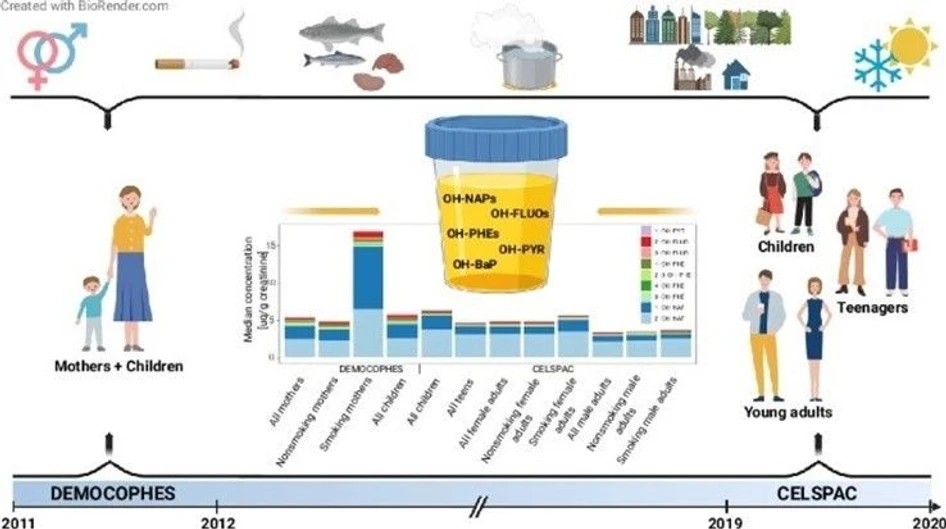
Good news: Between 2011 and 2020, the burden of polycyclic aromatic hydrocarbons (PAHs) in the Czech population decreased. This is shown by a study from the RECETOX team, published in the Journal of Exposure Science & Environmental Epidemiology. The reduction in exposure occurred during a period when several environmental policies were introduced, including the Air Protection Act, the so-called anti-smoking law, and the boiler subsidy programme.
“Polycyclic aromatic hydrocarbons (PAHs) are primarily produced during incomplete combustion in transport, local heating systems, and industry. They are also released during food preparation, such as frying or grilling. A significant source is tobacco smoke. These substances are toxic and proven to be carcinogenic, which is why their concentrations are monitored in the air,” explains one of the study’s authors, Soňa Smetanová.
The study analysed urine samples from over a thousand volunteers across two time periods and various age groups: mothers and children from the DEMOCOPHES-CZ project (2011–2012), and children, adolescents, and young adults from the CELSPAC cohort (2019–2020). In addition to measured concentrations of PAH metabolites in urine, data were collected on participants’ place of residence, heating and cooking methods, diet, smoking habits, and other sociodemographic factors.
The most significant factors influencing exposure to PAHs were smoking, the energy source used for cooking (electricity/gas), certain types of food, place of residence (urban/rural), and the season – which relates to the type and intensity of heating.
“The study showed a significant decrease in PAH metabolites in urine between the two periods, both in children and adults. This reduction coincided with the implementation of the Air Protection Act in 2012, the anti-smoking law in 2017, and the boiler subsidy programme between 2014 and 2024,” adds Soňa Smetanová.
The main conclusion of the study is a positive one: the burden of polycyclic aromatic hydrocarbons in the Czech Republic is decreasing. It also highlights how legislative measures can directly and indirectly improve environmental quality – for example, by changing people’s behaviour (less smoking, switching to e-cigarettes, replacing old solid-fuel boilers with gas boilers or heat pumps).
And another piece of good news: each of us can reduce our own exposure to PAHs. This can be achieved by avoiding smoking, eating quality food prepared in a healthy way, and not burning solid fuels in low-quality stoves or boilers.
The original article
Changing pattern of exposure to polycyclic aromatic hydrocarbons over time in the Central European population
Soňa Smetanová, Akrem Jbebli, Jiří Kohoutek, Vladimíra Puklová, Milena Černá, Andrea Krsková, Martin Zvonař, Zdenko Reguli, Lenka Andrýsková, Pavel Piler, Petra Přibylová, Jana Klánová, Elliott J. Price & Klára Komprdová
Journal of Exposure Science & Environmental Epidemiology (2025)
https://doi.org/10.1038/s41370-025-00793-z
licensed under CC-BY 4.0
Abstract
Background
Temporal trends of chemicals in the population are key to identifying changing sources of chemicals and determining the effectiveness of various legislative measures.
Objective
The present study focused on time comparisons to explore a possible decrease in PAH metabolite levels in the Czech population. Legislative measures occurred between sampling periods, including restricting smoking and the Air Protection Act.
Methods
Ten metabolites of PAHs were measured in urine samples collected in 2011–2012 from mothers and children from DEMOCOPHES-CZ study (N = 235) and in 2019–2020 from children, teenagers, and young adults from CELSPAC studies (N = 809). Multivariate linear regression, Kruskal-Wallis ANOVA, and Mann-Whitney test (MW) were used to investigate differences in OH-PAHs between periods, age categories, and exposure determinants.
Results
Median concentrations significantly decreased between 2011-2020 by 30–35% for 1-OH-NAP, 2-and 3-OH-FLUO, 85% for 1-OH-PHE, and 44% for 2/3-OH-PHE, while 2-OH-NAP increased by 29% in non-smoking adults. In children, median concentrations of all metabolites decreased by 10–51%, with 2-OH-NAP rising by 49%. Smokers showed the largest differences, with significant decreases of 46–59% in the median concentrations of 2-OH-NAP, 2/3-OH-PHE, 9-OH-PHE, and 1-OH-PYR, and 76–91% in OH-FLUOs, 1-OH-NAP, and 1-OH-PHE. Fish and offal consumption, season, locality, and type of cooking were significant factors associated with levels of OH-PAHs, explaining 4–9% of the variability. Smoking was the main contributor in 2011, explaining up to 45% variability; no difference was found between smokers and non-smokers in 2019. New reference values of OH-PAHs in urine were calculated for the Czech population.
Impact
This study analyses the temporal trends of OH-PAHs in the population in the context of introduced legislative measures. In addition, it examines OH-PAH exposure in children, adolescents, and young adults in relation to lifestyle factors and establishes new reference values for polycyclic aromatic hydrocarbons that are important for public health decision-making. Biomonitoring over time is an essential tool for establishing new measures to protect public health.