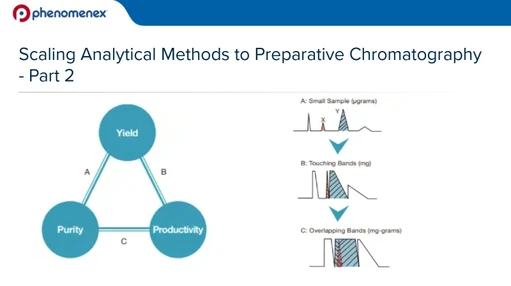
What is the most appropriate way to approach scaling up your analytical method when transferring it to preparative chromatography scale? Part 1
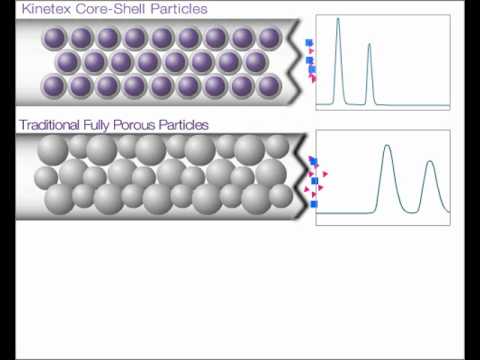
- Photo: Phenomenex: What is the most appropriate way to approach scaling up your analytical method when transferring it to preparative chromatography scale?
- Video: Phenomenex: Kinetex Core-shell Technology:Ultra-High Performance on Any LC System
In preparative chromatography there are three goals. How you balance these will dictate how you approach your scale up from analytical to preparative scale for large scale HPLC purifications.
Part 1: Optimizing Separation
In preparative HPLC there is a balance between purity, yield, and throughput, and often you must sacrifice one to achieve the other two. The three diagrams below show different outcomes depending on the purification objectives:
- Left: you could have a balanced triangle, where all three components are achieved, albeit none of these reach their maximum,
- Middle: you could prioritize purity and yield at the cost of longer sample processing times, or
- Right: you could prioritize sample processing speed and purity, sacrificing purification yield.
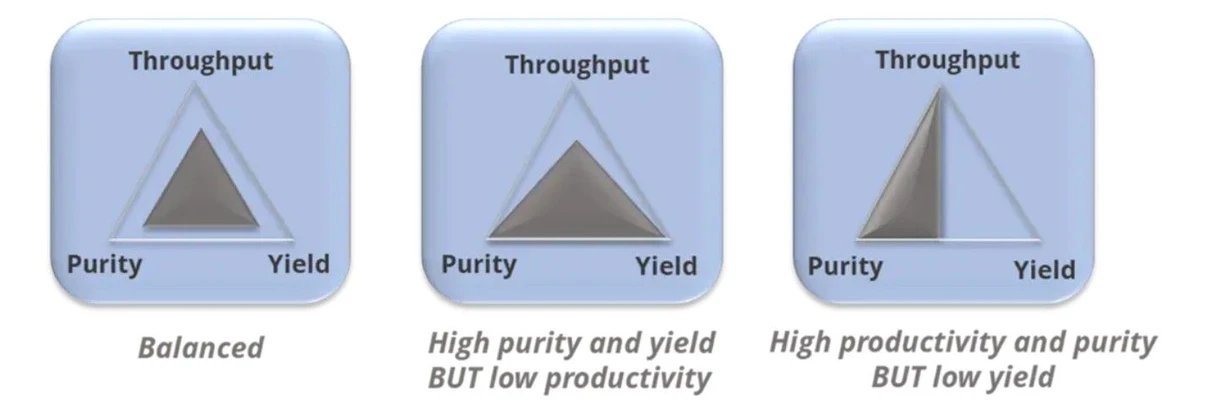 Phenomenex: Part 1 - Optimizing Separation
Before you begin you would want to consider:
- What is the required final purity?
- Is the desired final product a specific salt form, a solid or a solution?
- How can you balance processing time and yield?
Once your objectives are outlined, a suitable analytical method must be established to evaluate purification conditions. Often a screening method is carried out to quickly evaluate large numbers of samples with key results confirmed by the full analytical method. During analytical screening multiple sets of conditions are typically tested to determine the most effective for preparative purification. Below we can see the effect of different solvent systems on the separation of two peaks required for preparative purification.
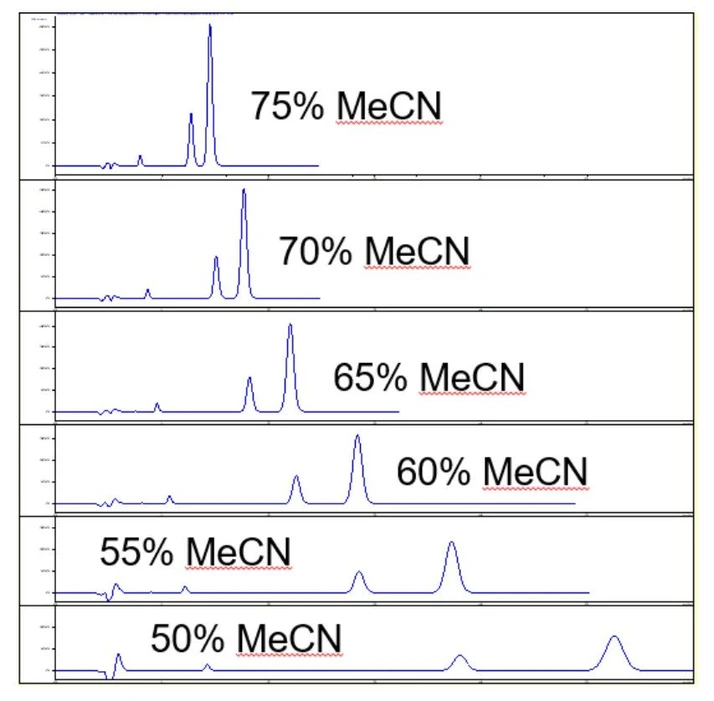 Phenomenex: The effect of different solvent systems on the separation of two peaks required for preparative purification.
Typically, with crude samples the impurities can lie close to the peak of interest. Although the desired resolution may be achieved analytically, it is important to ascertain, during the development process, how much of your sample you can load before resolution is lost. Shown below is an example of column screening for liraglutide where four stationary phases were screened under various conditions to ascertain optimal separation of impurities. Once you complete your screening you are able to select the most appropriate separation for scale up (covered in Part 2 - our next week's technical tip).
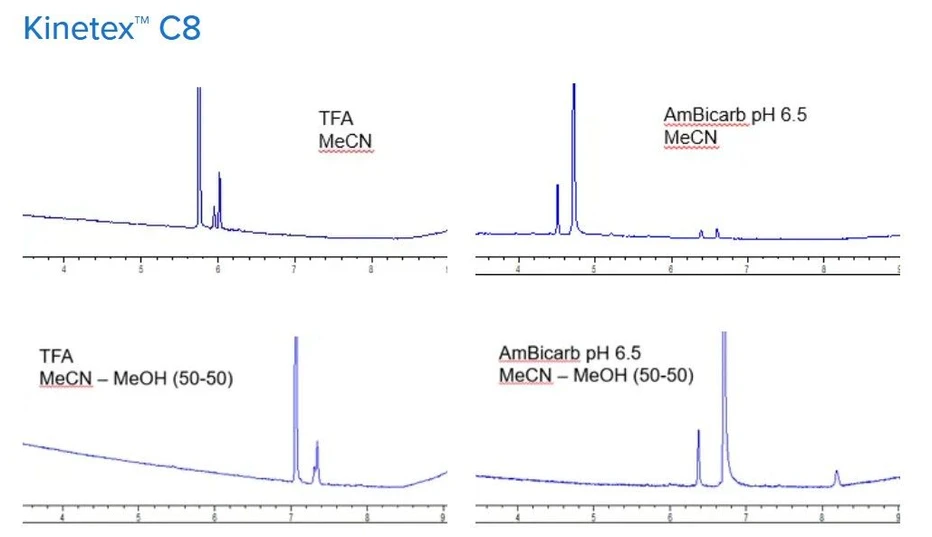 Phenomenex: Kinetex C8 - comparison of different solvents
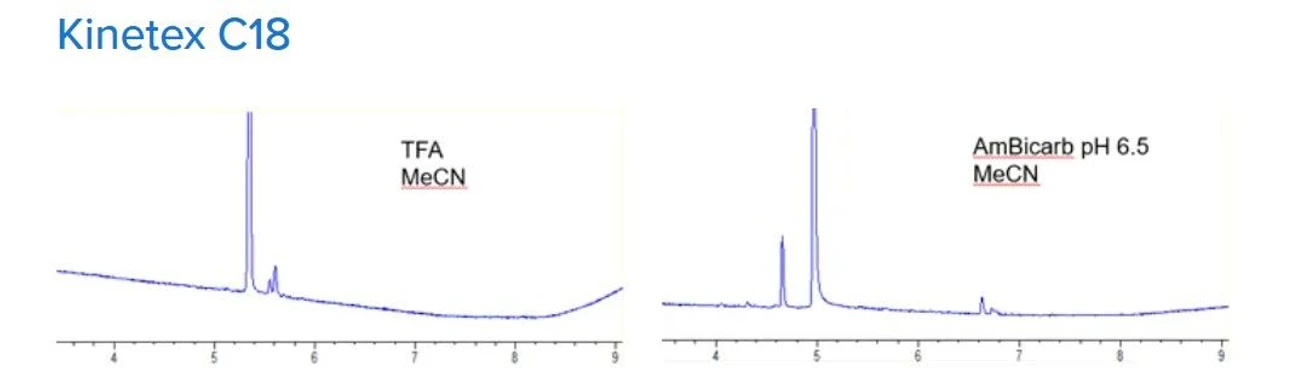 Phenomenex: Kinetex C18 - comparison of different solvents
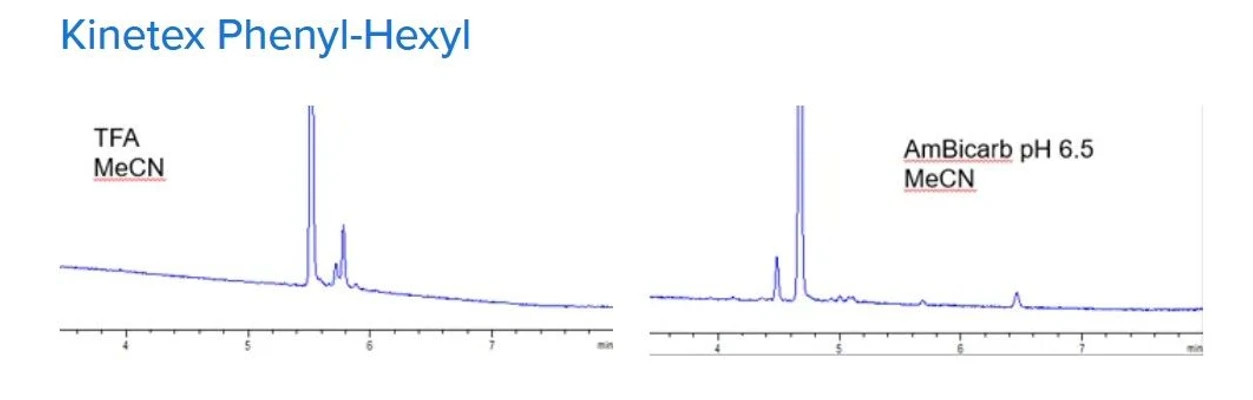 Phenomenex: Kinetex phenyl-hexyl - comparison of different solvents
Preparative Chromatography meets UHPLC: Axia™ Packed Kinetex Columns
The power of Kinetex core-shell technology with the performance of piston packed prep columns.
- Download brochure HERE
An Overview of Preparative Chromatography
- Watch webinar HERE