News from LabRulezLCMS Library - Week 47, 2025
LabRulez: News from LabRulezLCMS Library - Week 47, 2025
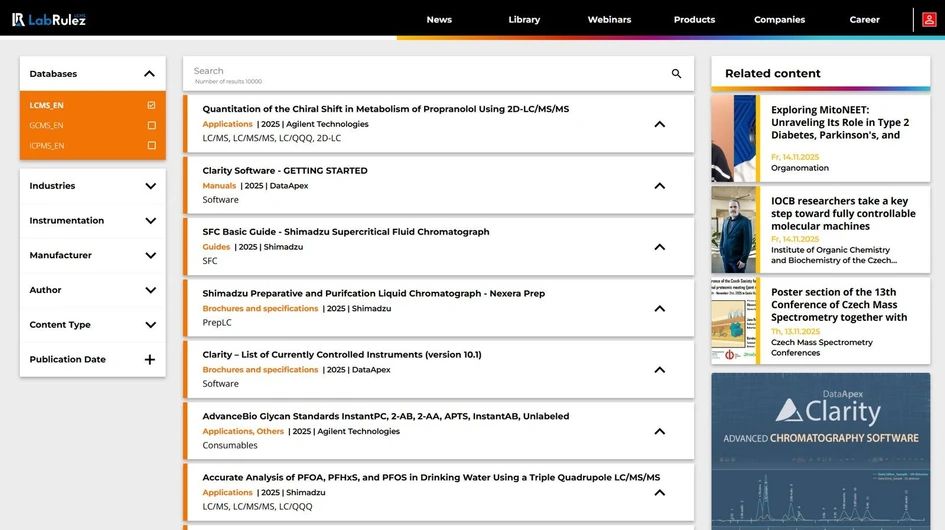
Our Library never stops expanding. What are the most recent contributions to LabRulezLCMS Library in the week of 17th November 2025? Check out new documents from the field of liquid phase, especially HPLC and LC/MS techniques!
👉 SEARCH THE LARGEST REPOSITORY OF DOCUMENTS ABOUT LCMS AND RELATED TECHNIQUES
👉 Need info about different analytical techniques? Peek into LabRulezGCMS or LabRulezICPMS libraries.
This week we bring you application notes by Agilent Technologies, Shimadzu and Waters Corporation and poster by Thermo Fisher Scientific / HPLC!
1. Agilent Technologies: Simultaneous Estimation of Eleven Nitrosamine Impurities in Metformin Drug Product Using an Agilent 6495D LC/TQ
- Application note
- Full PDF for download
Nitrosamines are a class of chemical compounds characterized by the presence of a nitroso group (–NO) bonded to an amine group. These compounds are classified as probable mutagenic (Group 2A) by the International Agency for Research on Cancer (IARC). This classification is based on strong evidence from animal studies and limited evidence from human data linking nitrosamines to mutagenicity.1 Nitrosamines can form during manufacturing processes, storage, or even through chemical reactions involving excipients and active pharmaceutical ingredients (APIs). Their presence in pharmaceutical products has raised significant patient safety concerns, prompting regulatory agencies to establish stringent limits to mitigate exposure.
Regulatory bodies, including the U.S. Food and Drug Administration (FDA) and the European Medicines Agency (EMA), have implemented strict guidance on nitrosamine impurities in pharmaceuticals. Acceptable intake (AI) limits, expressed in nanograms per day, have been established for specific nitrosamines such as N-Nitrosodimethylamine (NDMA) and N-Nitrosodiethylamine (NDEA). These limits are based on a lifetime mutagenic risk threshold of 1 in 100,000, ensuring that exposure remains minimal and within acceptable safety margins. For instance, the FDA's AI limit for NDMA is 96 ng per day, while for NDEA it is 26.5 ng per day. These thresholds are critical for protecting patient safety, as even trace levels of nitrosamines in long-term drug consumption could pose significant risks.2 In September 2024, the FDA issued a revised guidance titled "Control of Nitrosamine Impurities in Human Drugs," which includes updated AI limits for various nitrosamine impurities. This guidance provides drug manufacturers with a framework for risk-based safety assessments of nitrosamines that may be present in both approved and marketed formulations. Establishing and updating AI limits for nitrosamines is crucial for ensuring patient safety. By adhering to these limits, manufacturers can minimize the risk of long-term exposure to potentially carcinogenic impurities, thereby safeguarding health.3
Results and discussion
Metformin and NDMA separation were critical. Therefore, the method development process involved extensive evaluation of various chromatographic columns and gradient conditions to optimize the separation between metformin and NDMA. This optimization was crucial to minimizing matrix effects caused by the API, which can interfere with the accurate quantification of targeted nitrosamine impurities. The inbuilt diverter valve program was used to avoid the entry of a large amount of API into the MS, eliminating the chances of contamination, as described in Table 4. The MS/MS instrument parameters were rigorously optimized to maximize sensitivity and ensure robust detection of the nitrosamine impurities at trace levels.
Key performance characteristics of the method were systematically characterized, including linearity, which demonstrates a proportional response over a wide concentration range for all nitrosamine impurities specified. Linear regression (weighting factor 1/x) was applied (Figure 1). The regression coefficient (R2 ) was > 0.999, which shows a linear response throughout the concentration range of 10 to 1,000 pg/mL (1.0 to 100 ppb with respect to a drug load of 10 mg).
Conclusion
The analytical method described in this application note enables the simultaneous quantification of 11 nitrosamine impurities at trace levels. The advanced sample preparation techniques and optimized column chemistries meet stringent regulatory requirements, ensuring high precision and reliability. Results show that this method achieves a remarkable limit of detection (LOD) of 5 pg/mL with a signal‑to-noise ratio (S/N) of 10, and a limit of quantification (LOQ) of 10 pg/mL with an S/N of 20. Recovery studies confirm the method's accuracy, with recovery rates between 80 and 120%, demonstrating robustness in quantifying trace impurities in metformin formulations. Reproducibility is also demonstrated by RSD values consistently ≤ 5% at the LOD, LOQ, and 100 pg/mL levels.
Integrated with an Agilent 6495D LC/TQ system, automated workflows optimize method performance and enhance throughput, streamlining impurity screening processes. The method can be validated for diverse pharmaceutical formulations, and with slight tweaks, can expand its applicability across various drug delivery systems and product types. The high sensitivity, precision, and adaptability of this method make it an invaluable tool for supporting diverse analytical needs in pharmaceutical quality control.
2. Shimadzu: Quantitative Determination of Semaglutide and Preservative in Semaglutide Injection by High Performance Liquid Chromatography
- Application note
- Full PDF for download
User Benefits
- This method enables simultaneous quantification of both the active ingredient and the preservative in semaglutide injection using a single sample injection.
- The method demonstrates excellent repeatability and is simple to operate.
Semaglutide is a long-acting glucagon-like peptide-1 (GLP-1) analog that exerts its effects by activating insulin receptors, promoting insulin secretion, and suppressing glucagon secretion. It is primarily used in the treatment of type 2 diabetes and has also shown potential in weight management. In multidose formulations of semaglutide injection, a certain concentration of phenol is added as a preservative to inhibit microbial growth. The Chinese Pharmacopoeia sets specific requirements for preservative content in pharmaceutical preparations, with phenol typically maintained at around 0.5 %. Currently, there is limited published literature on analytical methods for semaglutide formulations. Therefore, developing a validated analytical method for quality control of semaglutide injection is of significant practical value in ensuring product quality and enhancing medication safety and consistency for patients.
This article establishes a high-performance liquid chromatographic (HPLC) method for the determination of semaglutide and the preservative phenol in semaglutide injection. The method has been fully validated and is provided here as a reference for relevant professionals.
Sample Preparation and Analytical Conditions
1.3 Instruments
The experiment was conducted using the Shimadzu Nexera LC-40D X3 high-performance liquid chromatograph.
Results and Discussion
2.4 Assay of Sample Content and Spike Recovery Test
The sample was prepared according to the method described in Section 1.2 and analyzed. The measured contents were 1.41 mg/mL for semaglutide and 5.76 mg/mL for phenol. According to the sample label, the indicated content is 1.34 mg/mL for semaglutide and 5.50 mg/mL for phenol. Calculated values correspond to 104.7 % and 105.0 % of the labeled amounts, respectively. Given that the sample volume is 3 mL, the total content of semaglutide is 4.02 mg. According to the pharmacopeial requirement for preparations with a labeled amount under 0.1 g, the actual measured value must fall within 90.0 % to 110.0 % of the labeled content. The results of this experiment are compliant with the pharmacopeial specification.
A spike and recovery test was conducted on the above sample. The semaglutide was spiked at 0.31, 1.22, and 6.10 mg/mL, and phenol at 1.38, 5.50, and 27.50 mg/mL. The recovery results are shown in Table 5.
Conclusion
This study established an HPLC method for the quantitative determination of semaglutide, the main active ingredient, and phenol, the preservative, in semaglutide injection. The analytical results demonstrate that the method offers high accuracy, excellent repeatability, and is simple to operate, making it suitable for the routine quality control of semaglutide injections.
3. Thermo Fisher Scientific / HPLC: Overcoming nonspecific binding in liquid chromatography: enhancing assay sensitivity, accuracy, and reproducibility in peptide/protein workflows
- Poster
- Full PDF for download
The use of advanced high-throughput LC–MS methods are required in the evolving landscape of drug discovery and the development of complex biotherapeutics such as peptides and proteins. As the industry strives to improve drug efficacy and analyte concentrations decrease, these methods require more selective and sensitive techniques to meet stringent method validation standards. A critical challenge in this context is the phenomenon of nonspecific binding (NSB).
NSB is commonly overlooked and can lead to poor, nonlinear, or non-reproducible analyte recoveries and negatively impact the overall method robustness. Analytes, from sample preparation until entering an analytical instrument, are prone to adsorb onto various surfaces including sample handling equipment, the LC instrument and analytical column. While pharmaceutical guidelines require consistent recoveries, stability, accuracy, and precision in analytical methods, they do not extend the investigation of NSB to sample handling equipment. This oversight can critically influence the method’s robustness (sensitivity, precision, accuracy). Furthermore, the lack of consideration for cross-validation between different materials can result in potential inaccuracies and inter-laboratory imprecision as there is insufficient information on analyte adsorption properties.
The analyte loss may occur due to multiple complex interactions such as electrostatic, hydrogen, or hydrophobic/hydrophilic bonding with adsorption surfaces, including sample containers, pipette tips, and vials. Differences in sample nature and vial materials, such as glass or plastic (polypropylene), can lead to significant levels of analyte loss during analysis due to NSB. Since samples are periodically stored in vials, this study focuses on the impact of vial material, sample environment and instrumental method conditions. By investigating various biotherapeutics each exhibiting different adhesion mechanisms, a better understanding how to mitigate analyte loss is achieved.
Methods: The workflow uses a Thermo Scientific Vanquish Horizon LC system in the reversed phase (RP) analysis with UV detection and implementing Thermo Scientific Hypersil GOLD C18 or Thermo Scientific MAbPac RP Phenyl columns
Conclusions
- Autosampler temperature influence varied for all tested protein samples, most evident positive impact was observed in glucagon.
- No significant influence for vial fill volumes for each tested protein samples. Results were within error.
- Presence of organic additive greatly improves recoveries for most proteins. NISTmAb did not show substantial influence.
- Over 24 hours of sample storage, no significant recoveries change were observed, the only exception being semaglutide with greatly reduced recoveries from 6th hour onwards. Future research opportunities may involve more in-depth tested factors analysis, extension of tested vial materials, influencing factors and protein samples.
4. Waters Corporation: Taking Advantage of 12k psi Pressure Capabilities for Modernizing USP Methods on the Alliance™ iS HPLC System
- Application note
- Full PDF for download
Benefits
- The Alliance iS HPLC System with PDA Detector provides a higher system operating pressure that allows for scaling methods to smaller particle size columns
- Improved throughput and decreased solvent consumption are obtained by scaling isocratic and gradient HPLC methods to newer column technologies with smaller particles sizes and shorter column lengths
- The USP quetiapine assay method run time was reduced by 57% and solvent consumption was reduced by 71%
- The USP quetiapine impurities gradient method was reduced by 51% and solvent consumption was reduced by 57%
The continual development and modernization of pharmaceutical procedures help to ensure product quality and safety while taking advantage of new instruments and column technologies. Specifically, HPLC methods can be scaled to smaller particle columns to increase throughput while maintaining the analytical performance of the method. Method scaling also provides a greener method. When scaling a method, it is important to consider characteristics of the LC system operating pressure and how this might impact the chromatographic results. The LC system operating pressure may impose a physical limitation on the ability to scale some methods due to higher system pressure from the smaller particle size columns. The Alliance iS HPLC System is a modern HPLC system with a system pressure limit of 12,000 psi compared to typical HPLC system pressures with a limit of around 9,000 psi. With an increase in system pressure over other HPLC systems, the Alliance iS HPLC System allows for a greater capacity to scale a USP legacy method to smaller particle size columns since the newer technology of smaller particle size increases the overall system pressure of a method. The advantage of higher pressure also requires columns that can operate at these conditions.
In this study, the USP assay and impurity methods for quetiapine fumarate3 will be analyzed on the Alliance iS HPLC System with compendium columns and then scaled to a smaller particle size column using the Waters™ Columns Calculator. The method will be scaled to 3 mm, 2.5 µm columns to take advantage of the higher system pressures. The scaled method will then be compared to the original HPLC method to ensure no loss of chromatographic performance or quantitative analysis. The chromatographic assessment is based upon the resolution, tailing factor, %RSDs of area and retention time specified for each method in the monograph.3 The quantitative performance is assessed by the calculated active pharmaceutical ingredient (API) and the calculated impurities of an unknown sample. The scaled methods for both the assay and the impurity method will be assessed by the analytical method greenness scores (AMGS) Metric for Greener HPLC4 methods as it provides decreased run times and lower solvent consumption.
Method Conditions
- LC system: Alliance iS PDA HPLC System
Data Management
Results and Discussion
When scaling the column and method conditions using USP Chapter on a single instrument, it is important to consider the operating pressure limit of the LC system. When column particle size and column dimensions are scaled to smaller particles and ID, the resulting backpressure also typically increases. Therefore, scaling some methods may not be possible due to the pressure limits of the LC system. The Alliance iS HPLC System has the highest operating system pressure and allows for more flexibility when scaling methods with an operating pressure of 12,000 psi. The Waters Columns Calculator tool can provide an estimated system pressure for a scaled method,5 in which, if necessary, certain parameters, such as the flow rate, may be altered to decrease the overall system pressure and allow for the method to be scaled successfully. When using smaller particle size columns, it is important to review the care and use manuals to determine the pressure limits of the column since different columns have different maximum pressure limits. Using columns with higher pressure limits also allows more flexibility with smaller particle sized columns and lower dimensions. Select Waters columns and general values are shown in Table 1 below.
The quetiapine assay and impurities methods were first analyzed on the Alliance iS HPLC System with the prescribed monograph conditions.3 The column dimensions and method conditions were then scaled to a ultrahigh-performance liquid chromatography (UHPLC) column with smaller particle size, inside diameter (I.D.), and length using the Waters Column Calculator. Resolution, tailing, and RSDs for peak area and retention time were used to assess the chromatographic performance of the scaled methods. To verify the quantitative performance of the scaled methods, the amount of API and impurity in an unknown sample was determined.
Scaling of the isocratic assay method
The USP isocratic assay method for quetiapine fumarate was scaled to a 3.0×150 mm, 2.5 µm particle column with a maximum column pressure of 18,000 psi. The maximum pressure of the column allows for the flexibility of running at higher flow rates with higher overall system operating pressure on the Alliance iS HPLC System. The Waters Columns Calculator was used to determine the scaled flow rate of 1.10 mL/min and an injection volume of 13 µL (Figure 1).
Conclusion
Using the method scaling guidelines within the USP General Chapter ,1 traditional isocratic and gradient HPLC methods are capable of being scaled to columns with smaller particle sizes and shorter lengths in order to significantly decrease run time and solvent consumption while still providing the same chromatographic and quantitative performance. Scaling a USP method enables the use of modern column chemistries and modern LC hardware to deliver improved throughput with decreased solvent consumption all while providing accurate and reproducible chromatographic data. Both the isocratic quetiapine fumarate assay method and the gradient quetiapine impurities method were successfully scaled to smaller particle size columns using the Waters Columns Calculator on the Alliance iS HPLC System. By taking advantage of the higher-pressure limits of the system, scaling to 3.0 mm ID, 2.5 µm columns was achievable. The scaled isocratic and gradient methods maintained similar chromatographic performance in terms of resolution, peak tailing, and retention time and peak area RSD. Additionally, quantitative results for the calculated API and the calculated impurities contained in the API sample were consistent for the original and scaled methods. Using the AMGS metric comparing the original USP impurity method to the scaled USP quetiapine impurity method, it was concluded that the use of the scaled USP quetiapine impurity method improves the “Greenness Score” of the method and the sustainability of the laboratory.