

Visible-Light-Driven Photoactivity of Copper/PVA Composite Films against Murine Coronavirus
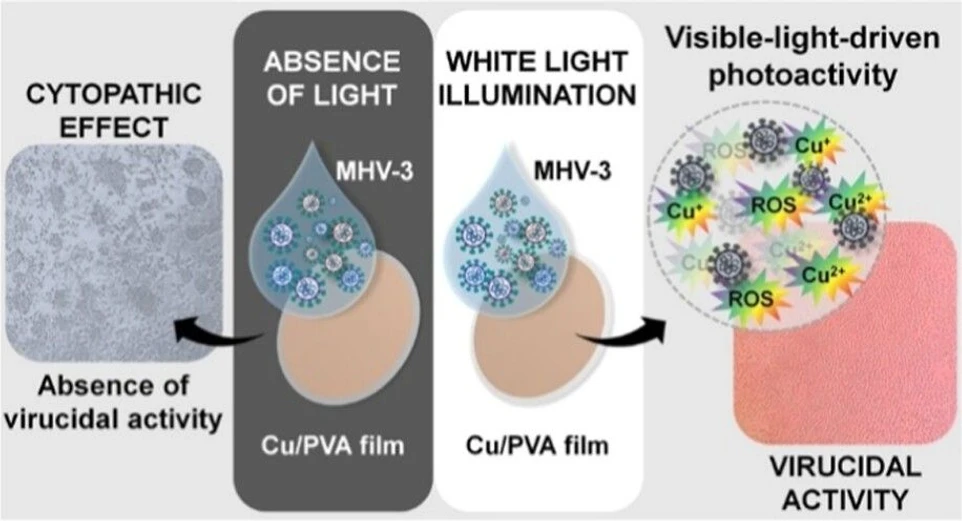
ACS Omega 2025, 10, 40, 46524–46532: Graphical abstract
The development of self-disinfecting surfaces has gained importance since the SARS-CoV-2 pandemic. In this study, composite PVA films containing copper micro-/nanoparticles and copper(I) oxide were synthesized and evaluated for their antiviral potential against the enveloped murine coronavirus MHV-3. Because copper can absorb visible light, the films were tested under both dark and illuminated conditions to explore potential photoactive effects.
Only films containing copper microparticles showed visible-light-driven antiviral behavior, with ICC-RT-qPCR analysis revealing a 43.1% reduction in viral load under illumination, compared with less than 7% reduction in the dark. These results demonstrate that low-cost copper microparticles can be used to create photoactive antiviral coatings through simple fabrication methods. The findings highlight the potential of visible-light-responsive materials for developing next-generation photofunctional surfaces that leverage solar energy to help reduce viral transmission.
The original article
Visible-Light-Driven Photoactivity of Copper/PVA Composite Films against Murine Coronavirus
Aline L. Schio*, Michele S. de Lima, Marina D. Giustina, Rafael D. Cadamuro, Catielen P. Pavi, Alexandre F. Michels, Gislaine Fongaro, Mariana Roesch-Ely, Carlos A. Figueroa*
ACS Omega 2025, 10, 40, 46524–46532
https://doi.org/10.1021/acsomega.5c02542
licensed under CC-BY 4.0
Selected sections from the article follow. Formats and hyperlinks were adapted from the original.
Since the first pandemic caused by a coronavirus, designated as SARS-CoV-2, in late 2019, more than 7 million deaths have been reported worldwide due to COVID-19. During the outbreak, one of the measures implemented worldwide to mitigate the spread of the virus was the use of face masks. This measure was maintained even after the start of vaccination, as it takes months to administer the doses required to achieve the proposed efficacy rate. (1−3)
Additional measures to control the spread of the virus included basic sanitation and the use of chemical agents, primarily aimed at the disinfection of inanimate objects and surfaces. Ozone and ultraviolet radiation have also demonstrated virucidal efficacy along with natural compounds such as essential oils and chitosan. However, despite the wide range of options, none of these agents provide lasting decontamination, as repeated exposure to viral loads results in recontamination. (4−7)
This scenario, combined with studies demonstrating that SARS-CoV-2 and several other viruses can survive for hours or even days on inanimate surfaces and objects, underscores their significant role in the spread of pathogens. This has highlighted the importance of researching and developing materials and coatings with intrinsic virucidal activity. (4,5,8,9)
Among the most studied materials in this field, copper stands out. Copper has been known as a disinfecting agent since ancient times. According to Grass, Rensing, and Solioz, the Smith Papyrus, an Egyptian text that dates back to 2200 B.C., mentions the use of copper to treat wounds and contaminated water. (10) As the centuries passed, its use kept growing along, and in 2008, it was the first metal agent recognized by the United States Environmental Protection Agency (EPA) to destroy pathogenic microorganisms. (11) During the pandemic of 2019, studies demonstrated that copper surfaces could eliminate viable SARS-CoV-2 within just 4 h, while in comparison, the virus remained viable for up to 24 h on cardboard and up to 48 h on plastic and stainless steel. (12)
However, despite this long-standing knowledge of copper’s properties, its biocidal and virucidal photoactivity remains largely underexplored. This research gap is even more pronounced, concerning the use of metallic copper particles. Most studies have focused on copper’s photoactivity when combined with semiconductors, (13−15) carbon-based materials, (16,17) and so on. (18−20) Notably, no studies have evaluated the photocatalytic effects of copper microparticles against viruses. Since the advent of nanotechnology, research efforts have predominantly shifted toward investigating material properties at the nanoscale, often seen as a benchmark of innovation.
Therefore, based on our previous findings that visible light enhances the bactericidal activity of copper particles (21) and that incorporating them into a polymer matrix preserves their activity, (22) the present work evaluated the virucidal photoactivity of metallic copper micro- and nanoparticles and copper oxide (I) microparticles, incorporated into poly(vinyl alcohol) (PVA), in the presence and absence of white light illumination. PVA was used as a polymeric matrix due to its noncytotoxicity, biocompatibility, and film-formation ability. Also, as hydrophilic, it can release the particles incorporated to provide a constant interaction with the medium. (23−25) The tests were performed with murine coronavirus type 3, also known as murine hepatitis virus type 3 (MHV-3).
Experimental Section
Materials
Copper microparticles (CuMPs) were purchased from Metal Pó (code D2200065), while copper nanoparticles (CuNPs, code 774081), copper oxide (I) microparticles (Cu2OMPs, code 208825), and poly(vinyl alcohol) (PVA, code 363146) were purchased from Merck. A micrograph of each particle sample obtained by scanning electron microscopy (SEM; Shimadzu SSX-550 Superscan) is presented in Figure 1a–c, followed by the respective particle size distribution histogram below estimated using the ImageJ software (26) (Figure 1d–f). The full characterization of the particles is reported in our previous work, including the optical absorbance in the visible range (UV–vis, Shimadzu Spectrophotometer, model UV-2600i), the band gap calculated by the Tauc plot using the Kubelka–Munk function, the crystalline structure, phase, and crystallite size determined by X-ray powder diffraction (XRD; Shimadzu LabX XRD-6000 with Cu Kα radiation, λ = 1.5406 Å), and the surface chemical composition analyzed by ex situ X-ray photoelectron spectroscopy (XPS; Thermo Alpha 110 Hemispherical Analyzer with a 10 kV Al Kα nonmonochromatized radiation source).
 ACS Omega 2025, 10, 40, 46524–46532: Figure 1. Micrographs of CuMPs (a), CuNPs (b), and Cu2OMPs (c) obtained by SEM and their respective size distribution histograms below presenting the mean ± SD of measurements (d–f). ACS Omega 2025, 10, 40, 46524–46532: Figure 3. Representative scheme of the assay to evaluate the virucidal photoactivity of the films. Created with BioRender.com.
Virucidal Photoactivity Test
The virucidal photoactivity of the films was evaluated using a neutral white LED light source from Thorlabs, Inc. (21) The test was developed according to the representative scheme in Figure 3 based on ISO 21702:2019 with modifications. (35) Before each test, all samples were sterilized in a chamber with UV irradiation for 2 h on each side of the surface.
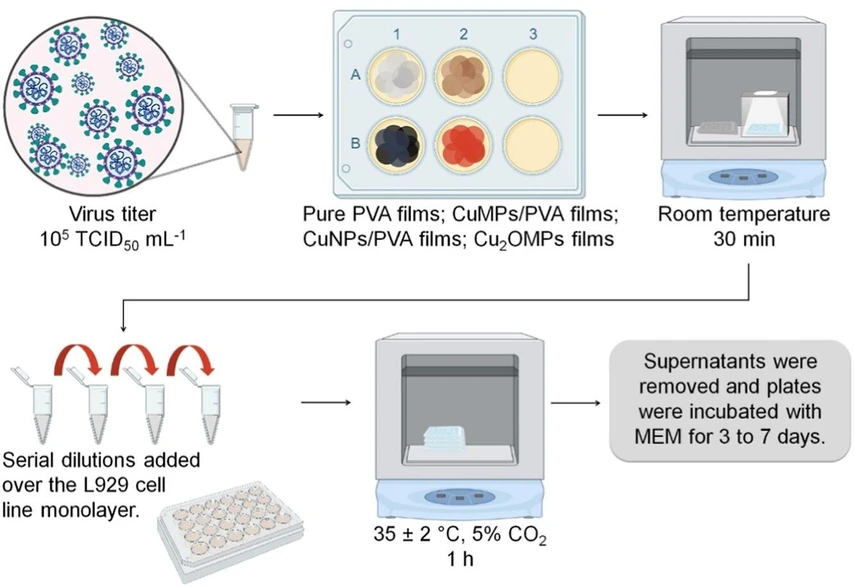 ACS Omega 2025, 10, 40, 46524–46532 - Figure 3. Representative scheme of the assay to evaluate the virucidal photoactivity of the films. Created with BioRender.com.
Results and Discussion
According to different specific studies in this area, the main mechanism of the virucidal (preinfection) activity of copper is disinfection by contact. The adhesion of copper particles, including Cu+ and Cu2+ ions and generated reactive oxygen species (ROS), to the viral wall breaks the protection and/or the capsid proteins, denaturing the genome and destroying the structure and function of proteins and nucleic acids. (27,40−42)
The higher virucidal activity of the composite film exposed to visible light may be attributed to enhanced ROS generation via photocatalysis. Commonly associated with the use of a semiconductor as a photocatalyst, photocatalysis should be understood as a process that combines photochemistry with heterogeneous catalysis. There are four main steps in this process: (i) the absorption of light irradiation at appropriate wavelengths (with sufficient energy), (ii) the excitation of electrons from the valence band to the conduction band of the semiconductor, (iii) the migration of the generated electron–hole (e–/h+) pairs to the surface of the semiconductor, and (iv) the redox reactions that result in the formation of ROS. In the presence of viruses, ROS induce oxidative damage to capsid proteins, disrupting the structure and function of both proteins and nucleic acids, thereby preventing infection. (43−46) Regarding metals, defined as materials in which the conduction band is partially filled, only energy levels above a specific energy called the Fermi level can accept excited electrons. Consequently, all incident radiation can be absorbed regardless of its wavelength, also promoting a redox environment that leads to a biocidal effect. (30,45)
Therefore, the combined effect of metallic copper and its surface oxides (21) contributes to the notably higher photoactivity observed. Figure 6 presents a schematic representation of the CuMPs/PVA film under dark and visible light conditions, along with photographs of treated cell monolayers. A cytopathic effect is characterized by cellular lesions and morphological changes due to viral infection (left microscopy), while its absence indicates virucidal activity of the tested material, evidenced by a uniform and well-distributed cell monolayer (right microscopy). (47−49)
 ACS Omega 2025, 10, 40, 46524–46532: Figure 6. Schematic representation of the CuMPs/PVA activity in the absence and presence of white light illumination against MHV-3. Created with BioRender.com.
Cytotoxicity of the Films
Within 24 h, no cytotoxicity of PVA was observed, as the average cell viability remained above 100%, indicating cell growth (replication) compared to the control and, consequently, biocompatibility. As for the composite films, all exhibited high relative cytotoxicity, since the average cell viability ranged between 13% and 16% (Figure 7). The recommended threshold to ensure biosafety is above 70%. (38) Thus, we adapted the assay to be conducted with a 30 min incubation period, replicating the contact time used in virucidal tests. In this shorter period, we observed that light influences the cytotoxicity of the PVA-CuMPs film: in the absence of light, the average cell viability was 92%, while under illumination, it decreased to 67%. This result is justified by the material’s photoactivity, already demonstrated in previous assays. Regarding the film containing CuNPs, cytotoxicity was evident even within this short time frame, confirming the strong oxidative power of the nanoparticles. Finally, the PVA-Cu2OMPs film showed higher cell viability values, but still within the range considered cytotoxic.
 ACS Omega 2025, 10, 40, 46524–46532: Figure 7. Cell viability of the L929 cell line by the MTT assay using PVA films and composite films. Error bars represent ± SD, and data are from multiple experiments.
Conclusions
Pure PVA films, as well as CuMPs/PVA, CuNPs/PVA, and Cu2OMPs/PVA films, obtained by a low-cost deposition technique, were tested in the dark and under visible light against a murine coronavirus of the same genus as SARS-CoV-2. The influence of light on the virucidal activity of the films was observed.
CuMPs/PVA films showed virucidal photoactivity against the enveloped virus after 30 min of contact only under white light illumination. Using the ICC-RT-qPCR assay to quantify this activity, it was found that the composite film reduced the viral load by 43.1% under white light illumination, compared to merely 6.8% in the dark, presenting a photoactive behavior.
The finding of the influence of illumination over the virucidal activity of copper-based films represents a promising step forward in the research of photoactive disinfectant surfaces, a globally relevant topic to combat the spread of pathogens, particularly on frequently touched surfaces, in public spaces, and in hospitals. The promise of these films lies in their ability to damage pathogen structures without relying on chemical agents and using solar energy as a power source once the copper band gap range enables visible-light-driven application.




![Gunacins: Novel Benzo[g]chromene Derivatives from the Fungus Exobasidium sp. and Their Potent Anti-Leishmania and Trypanosoma Activities](https://lcms.labrulez.com/labrulez-bucket-strapi-h3hsga3/ACS_Omega_2025_10_22_23222_23234_Graphical_abstract_cover_68d40d7cfd_s.webp)


