News from LabRulezLCMS Library - Week 52, 2025
LabRulez: News from LabRulezLCMS Library - Week 52, 2025
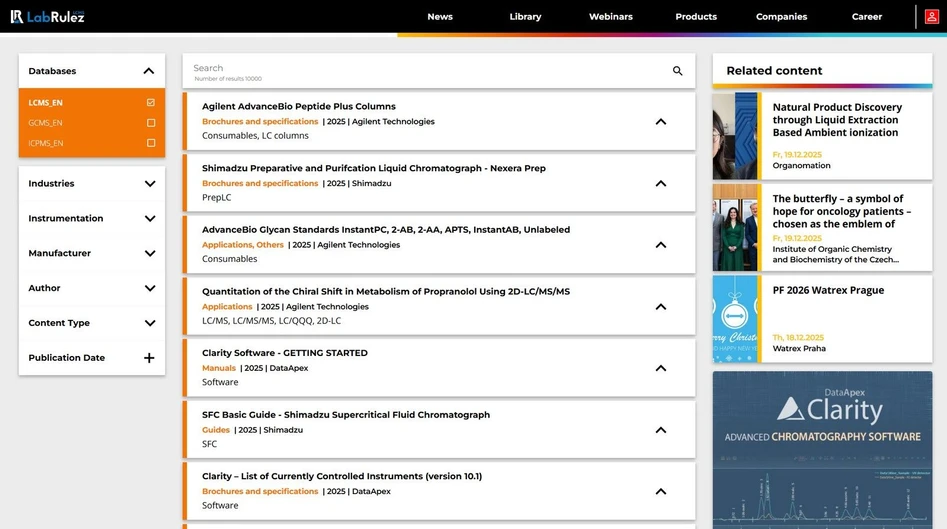
Our Library never stops expanding. What are the most recent contributions to LabRulezLCMS Library in the week of 22nd December 2025? Check out new documents from the field of liquid phase, especially HPLC and LC/MS techniques!
👉 SEARCH THE LARGEST REPOSITORY OF DOCUMENTS ABOUT LCMS AND RELATED TECHNIQUES
👉 Need info about different analytical techniques? Peek into LabRulezGCMS or LabRulezICPMS libraries.
This week we bring you application notes by Agilent Technologies, Metrohm, Shimadzu and Waters Corporation!
1. Agilent Technologies: Determination of 43 PFAS in Beer and Wine
Using the Agilent Captiva EMR PFAS Food I passthrough cleanup and LC/MS/MS detection
- Application note
- Full PDF for download
Determination of PFAS residues in food has become an increasing concern in recent years. In April 2023, the European Commission (EC) implemented regulations for four PFAS compounds—PFOS, PFOA, PFNA, and PFHxS—across various food categories.1 In November 2023, AOAC released SMPR 2023.003, establishing performance requirements for the analysis of 30 PFAS compounds in 11 food categories.2 Although alcoholic beverages are not yet included in either EC regulation or AOAC SMPR guideline, the demand for PFAS analysis in these products—particularly wine and beer—has grown rapidly.3,4 Studies have reported that PFAS contamination in wine and beer is linked to the use of municipal water and the geographic location of production. Beverages produced in areas with water sources highly contaminated with PFAS tend to show elevated levels of PFAS residues.
Alcoholic beverages are not considered complex matrices, but rather unique ones due to the presence of alcohol as a key component. The alcohol content in these beverages, which ranges from 3 to over 50%, presents challenges for common sample extraction techniques such as QuEChERS and solid-phase extraction (SPE). Specifically, high alcohol percentages can hinder efficient phase separation during the salt partitioning step in QuEChERS extraction. Additionally, alcohol in the sample matrix increases the risk of analyte breakthrough during sample loading in SPE‑based approaches. A direct dilute-and-shoot approach may be considered due to the relatively lower matrix complexity. However, the presence of various additives—such as sugars, acids, flavorings, preservatives, emulsifiers, colorants, and even proteins—can compromise the robustness, cleanliness and longer-term durability of LC/MS/MS instrumentation.
To address these challenges, this study developed a direct solvent extraction method for PFAS analysis in alcoholic beverages. Samples were extracted using acidified acetonitrile (ACN), followed by centrifugation. However, the crude extract obtained through this approach may contain more matrix co-extractives than those from QuEChERS extraction, necessitating stronger EMR cleanup in subsequent steps. The EMR mixed-mode passthrough cleanup using Captiva EMR PFAS Food I has previously demonstrated streamlined and efficient matrix cleanup for fresh, plant‑based matrices, such as fresh fruits, vegetables, juices5 , and baby food.6 In this study, matrix cleanup was further improved by using EMR PFAS Food I cartridges with a higher bed mass of 680 mg, providing enhanced cleanup for alcoholic beverage samples.
Experimental
Equipment and material
The study was conducted using an Agilent 1290 Infinity II LC system consisting of an Agilent 1290 Infinity II high speed pump (G7120A), an Agilent 1290 Infinity III Hybrid Multisampler (G7137B), and an Agilent 1290 Infinity II Multicolumn Thermostat (G7116B). The LC system was coupled to an Agilent 6495D Triple Quadrupole LC/MS (LC/TQ) system equipped with an Agilent Jet Stream iFunnel Electrospray ion source. Data acquisition and analysis were performed using Agilent MassHunter Workstation software.
The 1290 Infinity II LC system was modified using an Agilent InfinityLab PFC-free HPLC conversion kit (part number 5004-0006), which includes the InfinityLab PFC delay column (4.6 × 30 mm; part number 5062-8100) to minimize background PFAS contamination. Chromatographic separation was performed using an Agilent ZORBAX RRHD Eclipse Plus C18 column (95 Å, 2.1 × 100 mm, 1.8 µm; part number 959758-902), rated for up to 1200 bar pressure. An Agilent ZORBAX RRHD Eclipse Plus C18 column (2.1 × 5 mm, 1.8 µm; part number 821725-901) was also used to protect the analytical column and extend its lifetime.
Conclusion
A simplified, rapid, and reliable method was developed and validated for the quantitative determination of 43 PFAS targets in alcoholic beverages. The method utilized solvent extraction followed by EMR mixed-mode passthrough cleanup using Agilent Captiva EMR PFAS Food I, 680 mg, cartridges, and LC/MS/MS detection. As a result of its simplicity, robustness, and cost-effectiveness, the sample preparation approach offers significant savings in time and resources. The method was validated in accordance with the acceptance criteria outlined in the AOAC SMPR guidelines.
2. Metrohm: Online analysis of acids, bases, and aluminum in anodizing baths
- Application note
- Full PDF for download
Aluminum is the most abundant metal found on Earth and is a very reactive base metal [1]. It is suitable for industrial use because it is lightweight, conducts electricity and heat well, and resists corrosion [2]. Aluminum metal reacts with oxygen, water, or other oxidizing agents to create a protective layer of aluminum oxide (passivation) [3–5]. This natural oxide layer protects the underlying aluminum against corrosion, but with some limitations [5]. Anodizing is an electrochemical treatment that increases the thickness of the aluminum oxide layer on the metal surface. The anodizing process makes aluminum harder and more resistant against rust [6]. It involves pretreatment, core treatment, and finishing steps to complete the cycle (Figure 1) [7].
First, the workpiece is cleaned to remove dirt, oil, and lubricants. Then, it is treated with a special solution to remove the natural oxide layer before anodizing. This step is known as alkaline etching.
Maintaining the proper balance between dissolved aluminum and other chemicals in the etching bath is crucial in this step. This balance is often referred to as the aluminum-to-free-soda ratio.
If this ratio strays outside of the recommended range, a reaction occurs where sodium aluminate breaks down into an aluminum trihydroxide substance. This undesirable byproduct coats the workpiece and hinders the anodizing process from achieving a successful finish. In simpler terms, keeping the ideal ratio of substances in the bath ensures a smooth anodizing operation, while an inadequate mixture disrupts the process by forming a layer that blocks anodization. Traditionally, etching processes can suffer from inconsistencies as the etching agent (like sodium hydroxide in this case) is depleted. This depletion leads to a gradual slowdown in the etching rate, resulting in variations in the final product's appearance.
To combat these inconsistencies and ensure highquality results, recurrent monitoring is necessary by mean of an online process analyzer. These analyzers continuously track two crucial components: the concentration of the basic solution (often sodium hydroxide) and the level of dissolved aluminum within the etching bath. By maintaining these within a designated range, consistent etching is ensured throughout the process.
ACID MONITORING
Additionally, anodizing baths are typically made up of a sulfuric acid electrolyte. During the anodizing process, the workpiece is made anodic so that the metal reacts with oxygen from the anion, and an oxide layer forms on the surface. For a flawless anodized finish, meticulous control of the aluminum and sulfuric acid concentration within this bath is essential. If the aluminum concentration is too high, it can negatively impact the final surface appearance and lead to increased electrical resistance during the process. Sulfuric acid is consumed due to a degree of product drag out and must be replenished regularly to reduce running costs while still generating a high-quality finish.
While laboratory analysis has traditionally been used to monitor anodizing bath chemistry, it has limitations. This method typically involves manually collecting a sample from the bath, sending it to a lab for analysis, and then waiting for the results. This time delay can lead to inconsistencies in the anodizing process, as the bath chemistry can fluctuate between sampling times. Additionally, laboratory analysis can be labor-intensive and costly.
In contrast, online process analyzers offer a more efficient and reliable solution for maintaining optimal bath chemistry. These instruments continuously monitor the concentration of critical parameters within the bath, such as dissolved aluminum, sodium hydroxide, and sulfuric acid (free acid). This near realtime data allows for immediate adjustments to be made, ensuring the bath chemistry remains within the designated range 24/7.
The elimination of manual sampling combined with the continuous monitoring offered by online analyzers significantly reduces the risk of bath chemistry fluctuations, ultimately leading to fewer defects and the need for rework. By providing a constant flow of accurate data, online process analyzers empower manufacturers to achieve consistent, high-quality anodizing results.
CONCLUSION
To ensure optimal surface properties are obtained during aluminum anodizing, continuous monitoring of both the cleaning chemicals (basic and acidic solutions) and the aluminum itself is crucial. This can be effectively accomplished through online process analysis using either the 2060 TI Process Analyzer for multiparameter analysis or the 2026 HD Titrolyzer for single-parameter monitoring.
3. Shimadzu: Analysis of Saccharides Using Integrated HPLC and Size Exclusion-Ligand Exchange (Na Type) Column
- Application note
- Full PDF for download
User Benefits
- Ca-type size exclusion-ligand exchange column retain sugar alcohols more strongly than Na-type column and can separate sugar alcohols and monosaccharides more selectively.
- Just water can be employed as mobile phase, requiring no mobile phase preparation.
- The integrated HPLC system allows for the installation of a refractive index detector without changing the footprint.
Saccharides are the main component of sweetness in food and an important source of energy. However, excessive saccharide intake has been reported to increase the risk of lifestyle-related diseases such as obesity and dental caries1). Monitoring the amount of saccharide in food plays an important role in quality control and nutritional management. Since saccharides are hydrophilic compounds, reversed phase chromatography, which provides mutual separation of analytes based on hydrophobic interaction, is not suitable for saccharide analysis. In this study, ligand exchange chromatography is applied to saccharides separation. The fundamental principle of this separation mode is size exclusion chromatography, in which analytes are separated based on differences in molecular size in solution. Furthermore,saccharides are retained through complex formation between metal counterions and the hydroxyl groups of saccharides and eluted through ligand exchange with water molecules in the mobile phase. Saccharides can be reliably separated by utilizing the difference in complex formation between metal cations on the stationary phase surface and respective saccharides. Here, Saccharide analysis using size exclusion-ligand exchange (Ca-type) column with integrated HPLC isintroduced.
Analyses of standard solutions
Shim-pack SCR-101C column was used for analysis. The retention of saccharides varies depending on the metal counterions. When the packing material with calcium as the counterion is employed, the retention of saccharides tends to be stronger than when sodium is employed as the counterion. Consequently, more selective retention of sugar alcohols and monosaccharides can be accomplished. Saccharide anomers may be separated to form two peaks at low temperature in ligand exchange chromatography. So, around 80 ˚C column temperature is generally required. There is no need to prepare the mobile phase and simple analysis can be done since just water is used as the mobile phase. Detection was performed using a differential refractive index detector. Table 1 shows the analytical conditions, and Fig. 1 shows the appearance of integrated HPLC (LC-2070) used for analysis. Fig. 2 shows the chromatogram of a mixed standard solution of four saccharides(sucrose, glucose, fructose, and sorbitol).
Conclusion
Simultaneous analyses of saccharides in soft drink and energy drink were conducted. Saccharides were detected using integrated HPLC connected to differential refractive index detector. Separation was performed using a Shim-pack SCR101C column in size exclusion -ligand exchange mode. Not only monosaccharides such as glucose and fructose, but also sorbitol, a type of sugar alcohol, was able to be separated. Satisfactory results were obtained for the linearity of the calibration curves for respective compounds, the reproducibility of retention times forstandard solutions, the spike and recovery rates.
4. Waters Robustness in Regulated Bioanalysis: A 30,000 Injection Study of Naltrexone in Human Plasma using the Xevo™ TQ Absolute XR Mass Spectrometer
- Application note
- Full PDF for download
Benefits
- Robust analytical performance across more than 30,000 matrix injections and over 21 mL of human plasma are injected into the system, with no instrument downtime, demonstrating suitability for high-throughput discovery and regulated bioanalysis applications
- Reliable quantification at sub-ng/mL levels in complex human plasma matrix, with calculated bias and precision fully compliant with FDA M10 criteria across the entire study
- Streamlined data review in waters_connect™ for Quantitation Software, enhancing analyst efficiency and overall workflow productivity
Quantitative bioanalysis is a cornerstone in the understanding of drug exposure, efficacy, and safety, throughout both drug development and post-market monitoring. Central to these studies is the need for analytical platforms capable of accurately quantifying low-level analyte concentrations, often at sub-ng/mL, in complex biological matrices such as plasma or serum.
Liquid chromatography coupled with tandem quadrupole mass spectrometry (LC–MS/MS) has become the established benchmark for such analyses, providing high selectivity, sensitivity, and throughput for targeted quantification. As bioanalytical laboratories manage both an increasing volume and a broader spectrum of sample assays, instrumentation must be capable of withstanding diverse workflows while maintaining reliable analytical performance.
For such laboratories, operating under high-throughput conditions with long-term assay stability and uptime is essential for sustained productivity. However, these workflows often involve the quantification of trace-level analytes in complex biological matrices where matrix effects, ion suppression, and signal variability present significant analytical challenges. Achieving reliable performance under these conditions, therefore, requires instrumentation that maintains performance for a given method, over prolonged and demanding analytical workflows.
In practice, large-scale analytical batches comprising thousands of injections further amplify these demands, as gradual contamination of the MS ion path can compromise reproducibility and increase maintenance frequency. Such interruptions can slow the generation of critical data, delaying scientific insight, decision-making, and overall project advancement across bioanalytical workflows. Whether in discovery, development, or regulated studies, increased downtime and maintenance reduce efficiency, elevate operational costs, and limit the throughput of essential analyses.
Maintaining instrument robustness is therefore essential to sustaining productivity, accelerating data delivery, and supporting cost-effective, confident decision-making while maintaining trace-level analytical performance. The StepWave XR Ion Guide, a novel slotted bandpass ion guide within the Xevo TQ Absolute XR Mass Spectrometer, effectively mitigates MS1 quadrupole contamination by preventing unwanted high mass ion transmission. Filtering out high m/z ions from biological matrices prevents quadrupole charging and associated losses in sensitivity, which are observed when these ions accumulate on the MS1 quadrupole rods.
In this study, the long-term robustness and quantitative analytical performance of the Xevo TQ Absolute XR Mass Spectrometer (Figure 1) was evaluated through the determination of Naltrexone and its primary active metabolite, 6β-Naltrexol, in human plasma. Naltrexone is an opioid receptor antagonist widely used in the management of alcohol and opioid dependence, and its analysis typically requires highly sensitive and selective analytical methods due to low systemic concentrations.
Experimental
- LC system: ACQUITY Premier System with Binary Solvent Manager and Flow-Through Needle
- MS system: Xevo TQ Absolute XR Mass Spectrometer
Results and Discussion
The Xevo TQ Absolute XR Mass Spectrometer demonstrated consistent performance throughout the entire analytical workflow, with no measurable decline in sensitivity, precision, or accuracy over the study period. More than 30,000 injections were successfully analyzed in this study, over more than 55 days of continuous acquisition. Over 21 mL of human plasma was injected into the system throughout the duration of the study. QC samples within each 96-well plate replicate were quantified using bracketed calibration curves - generated using a 1/x² weighting - which met the FDA M10 Bioanalytical Method Validation (BMV) and study sample analysis acceptance criteria2 , confirming the robustness and reliability of the method. Each of the 320 individual sample plate runs successfully met these regulatory standards for calibration linearity, QC accuracy and precision, as well as the absence of carryover in subsequent blank samples. Implementation of the review-by-exception workflow within MS Quan in waters_connect for Quantitation Software substantially streamlined data processing, flagging any outliers or exceptions in the dataset for manual review. This functionality enabled efficient oversight of parameters such as linearity, QC accuracy, and blank carryover assessment, acceptance criteria for which can be set using a predefined ruleset within the software. This significantly reduced analyst workload in manual processing and data review for high-throughput datasets. Figure 4 shows how calibration and QC samples can be reviewed within MS Quan Application.
Conclusion
The Xevo TQ Absolute XR Mass Spectrometer, which is equipped with the novel slotted bandpass StepWave XR ion guide, demonstrated exceptional robustness and uptime over more than 30,000 matrix injections for a typical bioanalysis workflow. Quantitative accuracy and reproducibility were upheld throughout the study, with continuous and reliable operation enabling seamless transitions between sample assays. Sensitivity and selectivity were demonstrated across a high-throughput workflow, in a complex human plasma matrix, even at LLOQ method limits, demonstrating suitability for high-throughput discovery and regulated bioanalysis applications.