Coupling Liquid Chromatography to Orbitrap Isotope Ratio Mass Spectrometry: Overcoming Isotope Effects of Chromatography and Amount-Dependency by Peak Homogenization
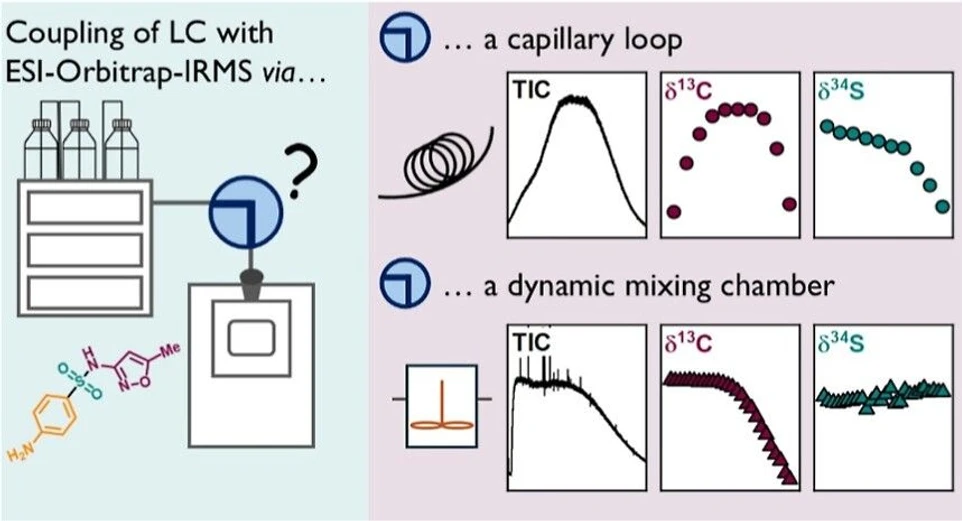
Anal. Chem. 2026, 98, 1, 590–600: Graphical abstract
ESI-Orbitrap mass spectrometry enables compound- and position-specific stable isotope analysis, but applications have largely relied on direct infusion of pure standards. This study presents the online coupling of liquid chromatography to ESI-Orbitrap-MS using sulfamethoxazole as a model compound and evaluates strategies to mitigate chromatographic isotope effects.
Capturing analytes in a capillary preserved peak shape but introduced large isotope biases due to chromatographic fractionation and amount dependency. In contrast, a dynamic mixing chamber homogenized the eluting peak, eliminating these effects and yielding stable carbon, nitrogen, and sulfur isotopologue ratios. Calibration against magnetic sector IRMS achieved precisions of 1.5‰ for δ¹³C and 0.9‰ for δ³⁴S, demonstrating the method’s suitability for future LC-based compound- and position-specific isotope analyses.
The original article
Coupling Liquid Chromatography to Orbitrap Isotope Ratio Mass Spectrometry: Overcoming Isotope Effects of Chromatography and Amount-Dependency by Peak Homogenization
Aoife Canavan, Leonhard Prechtl, Habib Al-Ghoul, Nils Kuhlbusch, Andrea M. Erhardt, and Martin Elsner*
Anal. Chem. 2026, 98, 1, 590–600
https://doi.org/10.1021/acs.analchem.5c05530
licensed under CC-BY 4.0
Selected sections from the article follow. Formats and hyperlinks were adapted from the original.
For compound-specific isotope analysis (CSIA), gas or liquid chromatography is hyphenated with IRMS (GC-IRMS, LC-IRMS) to measure the isotopic signature of target analytes. (19,20) However, GC-IRMS, the commonly used approach for carbon and nitrogen isotope analysis, is restricted to volatile and semivolatile compounds. LC-IRMS, on the other hand, is primarily limited to carbon isotope analysis and─in the absence of tailor-made solutions─is incompatible with widely used carbon-containing eluents. (21,22) Beyond instrumental challenges, a fundamental disadvantage of CSIA by GC- and LC-IRMS is that analyte conversion to the respective measurement gas only yields the average isotopic composition of a molecule. This process results in the rescrambling of multiply substituted isotopologues, which hinders clumped isotope analysis. Furthermore, this can dilute meaningful isotope effects occurring at a specific position within the target analyte, which is particularly pronounced in large molecules. Such position-specific isotope information could provide valuable insights during degradation processes when the isotopic signature at the reactive site changes, whereas isotope ratios at other, nonreactive positions still represent the compound’s origin. (23)
Orbitrap mass analyzers, known for their high resolution and accuracy, have gained recent attention for their ability to simultaneously determine intramolecular isotope ratios of various elements. (18,27−29) The minimum sample size of the target analyte is smaller than that of NMR (nanomoles instead of micromoles). Then, electrospray ionization (ESI) enables the introduction of aqueous solutions, broadening the range of analytes compared to GC-IRMS. Further, analyte molecules are introduced as intact ions, preserving their molecular structure, unlike in GC- and LC-IRMS, where conversion to CO2, N2, etc. is required. Consequently, analytes can be fragmented─either directly after ionization or after preselection of ions in a quadrupole within a subsequent collision cell, where selected ions can be accelerated and brought into collision with neutral gas molecules. This process provides fragment-specific isotope information, which subsequently can be used to calculate the isotope ratios of specific molecular sites.
A growing number of studies have explored the development and assessment of the Orbitrap-MS for measuring isotope ratios in polar compounds. Orbitrap-based CSIA was conducted for fatty acids, methanesulfonate, and oxyanions, allowing for the simultaneous study of multiple elements. (30−36) A recent study demonstrated precise measurements of carbon isotope values of perfluorooctanoic acid. (37) For amino acids, both molecular average and position-specific carbon isotope analyses were performed. (27,38−42) Orbitrap-MS CSIA of acetate allowed differentiation of metabolic pathways in bacteria and tapped for the first time the hydrogen isotope exchange within acetate to constrain its geological lifetime. (43,44) A technique to measure methyl phosphonic acid indicated potential source substrates, synthetic routes, and possible degradation mechanisms. (45) Finally, Orbitrap-derived carbon isotope values of polycyclic aromatic hydrocarbons from the asteroid Ryugu and the Murchison meteorite could indicate different formation environments. (46)
However, in the absence of chromatographic separation, a critical bottleneck to applications is still the isolation of the target compound. Compared to conventional analysis, this is even more important, because isotope artifacts in the Orbitrap-MS can arise from interferences during ionization or space-charge effects. (45,47) While coupling with chromatography has been brought forward for GC-Orbitrap-MS, such a solution is still missing for liquid chromatography. In GC-Orbitrap-MS, peak broadening proved to be essential for obtaining isotope measurements with high precision, as accomplished through capturing the target analyte in a post-GC reservoir before isotope measurement. (39,48) An analogous setup for liquid chromatography, including peak capturing and broadening, is, hence, of great interest to spearhead precise isotope measurements of polar, nonvolatile analytes by ESI-Orbitrap-MS.
Coupling LC with Orbitrap-MS can be challenged, however, by two kinds of potential artifacts. First, partitioning isotope effects are at work during chromatographic separation, leading to slightly different retention times. (21,49−51) Such effects were not observed in GC-Orbitrap-MS, indicating effective mixing within the reservoir. Whether this is also the case in the liquid phase, where diffusivities are lower by 5 orders of magnitude, remains to be investigated. Second, linearity tests are a hallmark of isotope analysis: they ensure that isotope values are concentration-independent and can, thus, be accurately integrated over different concentration regimes of a chromatographic peak. However, analyte–analyte interactions during ionization by ESI and inside the mass analyzer may potentially lead to nonlinearity, as demonstrated for the oxyanion nitrate: the linear range for 15N/14N extended down to 25 μM, below which measurements had to be accomplished by matching concentrations of sample and reference. (31)
It was, hence, the aim of our study to explore whether isotope values showed artifacts from chromatography; whether they were, in addition, concentration-dependent across a chromatographic peak; and whether such interferences could be avoided by peak capturing and homogenization, similar to the peak broadening reservoir in GC-Orbitrap-MS. We chose the synthetic antibiotic sulfamethoxazole (SMX) as a model compound due to its widespread use and potential ecological impact, as demonstrated by numerous CSIA studies investigating its various degradation pathways. (52−57) The objectives of this work were (i) to investigate the linear range at concentrations between 1 and 10 μM for different fragments of SMX; (ii) to assess hyphenation of Orbitrap-MS with LC by capturing SMX within a capillary loop (0.7 mm inner diameter); (iii) to investigate whether isotope effects of chromatography would be observable in the captured peak leading to artifacts; (iv) to explore whether a nonlinear behavior of isotope values at low concentrations would affect the isotope values after peak capture; (v) if so, to develop strategies to avoid such effects; and last (vi) to validate the accuracy of this setup by measuring ratios of 13C/12C and 34S/32S within fragments of SMX and comparing them with conventional magnetic sector IRMS techniques.
Experimental Section
Orbitrap Instrumentation
A Vanquish liquid chromatography system was coupled with an electrospray ionization Orbitrap Exploris 240 mass spectrometer (both, Thermo Fisher Scientific, Germany). The Vanquish liquid chromatography system consisted of a Split Sampler HT VH-A10-A, Binary Pump N VN-P10-A (“low-flow pump”), Binary Pump H VH-P10-A (“high-flow pump”), Diode Array Detector (DAD) FG VF-D11-A, and Column Compartment VH-C10-A (all, Thermo Fisher Scientific, Germany). The sample was introduced into the ESI source in two ways: either by the low-flow pump via the autosampler of the Vanquish system (total loop volume: 130 μL, Thermo Fisher Scientific, Germany) or through a syringe pump (SKE 10, Chemyx Inc., USA) at a flow rate of 4 μL min–1. For ionization, the atmospheric pressure ion source OptaMax NG was used with a nonheated ESI probe equipped with a low-flow needle insert (Thermo Fisher Scientific, Germany).
The ionization mode, either positive or negative, was chosen depending on the target fragments. The ESI spray was optimized before each sequence to ensure a stable and intense TIC (relative standard deviation <8%) by adjusting the spray voltage, sheath gas (0–30), and auxiliary gas values (0–1). After ionization, the continuous beam of ions was filtered by an advanced quadrupole technology (AQT) mass filter, which allowed only ions within the set isolation window to pass. They were then transmitted through the curved linear trap (C-trap) and stored as packages in the ion-routing multipole (IRM), with their quantity being regulated by the automatic gain control (AGC) algorithm. The accumulated ions were transferred back through the C-trap into the Orbitrap mass analyzer for measurement. The oscillation of each ion package inside the analyzer was recorded as image current and stored as transient. By increasing the microscan setting, 10 transients were averaged prior to performing an enhanced Fourier Transform (eFT) to generate the mass spectrum. Fragmentation was induced by either collision-induced dissociation (CID) before ions entered the AQT mass filter (so-called source fragmentation), or, after passage of the AQT, by Higher Energy Collisional Dissociation (HCD) in the IRM. Accessible fragments for position- and fragment-specific isotope analysis were identified by increasing the energy for either CID or HCD while directly infusing an SMX solution (5 μM, 36% MeOH in H2O with 0.1% formic acid) with the syringe pump into the Orbitrap-MS (Figure S1). Fragments of interest included one representing the isoxazole moiety (F99), one representing the aromatic aniline part (F92), and one representing the SO2 group (F64) (Scheme 1). The optimal settings for each of these fragments were selected by choosing conditions that yielded the highest abundance of the fragment of interest, along with a resolution that would resolve the isotopologues of interest (Table 1 and Figure S2).
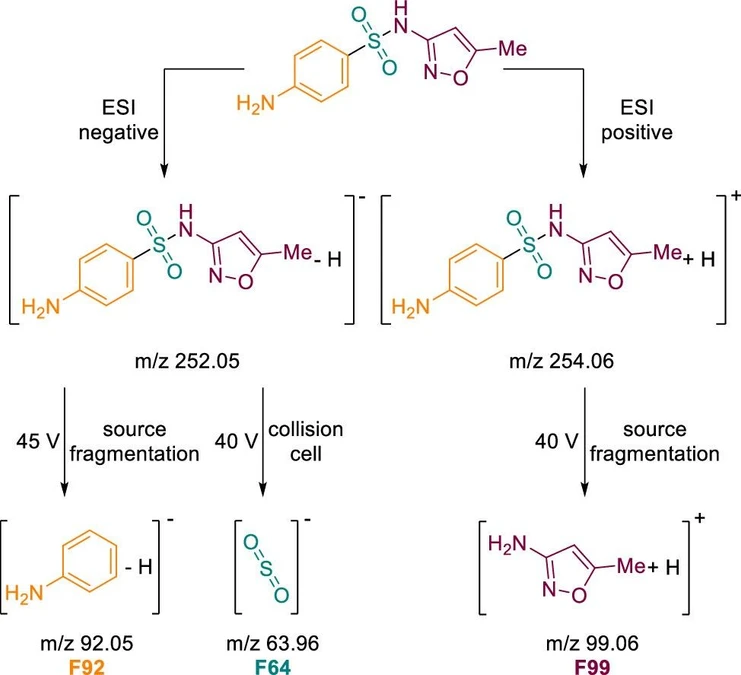 Anal. Chem. 2026, 98, 1, 590–600: Scheme 1. Target Fragments of Sulfamethoxazole after Positive or Negative Electrospray Ionization Using Source Fragmentation or HCD Fragmentation in the IRM
Results and Discussion
Observation of Chromatographic Effects on Isotope Values
The Δδ34SF64 in F64 from the captured SMX showed a consistent trend from negative to positive values over the chromatographic peak spanning a range of 20‰ (Figure 3d). Artifacts cannot arise solely from amount-dependency, as the linearity experiments only showed deviations up to 9‰. We hypothesize that this change in Δδ34SF64 values was primarily caused by isotope fractionation due to partitioning during liquid chromatography. A normal isotope effect was observed for 34S, meaning that the heavier isotope was retained more strongly than the lighter one (note that in our experimental setup, the end of the captured chromatographic peak was infused into the Orbitrap-MS first so that the peak order appears reversed in Figure 3). The existence of such chromatographic effects is well-established and has previously been observed in LC-IRMS, where isotope effects were inverse for 13C of caffeine, vanillin, and SMX. (21) In the chromatography experiment for F92, a significant variation of ∼80‰ in the Δδ15NF92 of F92 was observed (Figure 3f), suggesting again isotope effects of chromatography. We hypothesize that this finding is likely associated with the compounds’ speciation. SMX has a pKa value of 1.7, representing the protonation of its amine group in F92. (60) The solvent mixtures used for samples and pumps contained 0.1% formic acid, resulting in a pH of ∼2.9. Hence, at a pH of ∼2.9, SMX exists in both protonated and neutral forms. Importantly, the existence of such partitioning isotope effects implies that it is not sufficient to measure only one part, but that the entire peak would have to be captured and analyzed to avoid losing information. This not only results in long measurement times but also emphasizes the problem of correcting simultaneously for amount-dependency across the peak, as highlighted for carbon in fragment F99.
Accuracy of the Hyphenation Setup
To assess the accuracy of our optimized mixing chamber approach, we used two standard solutions enriched with 13.2 ± 0.5‰ and 18.2 ± 0.5‰ at one carbon atom in F99, respectively. The calibration was performed by measuring the two position-enriched standards with different isotopic signatures (SMXF991 and SMXF992) and the one at natural abundance (SMXF990) on five individual days. First, we used SMXF990 as an anchor and reported SMXF991 and SMXF992 against these values (Figure 5a). Here, on measurement day three, both standard solutions showed a deviation from the expected value. However, a two-point calibration using SMXF990 and SMXF992 successfully compensated for this scale expansion (Figure 5c). For δ13C measurements in F99, we found 95% CIs of 1.5‰ using this setup.
 Anal. Chem. 2026, 98, 1, 590–600: Figure 5. Accuracy of Δδ13C in F99, and of δ34S in F64, on five different days by comparing HPLC-ESI-Orbitrap-MS data to GC-IRMS and EA-IRMS data, respectively. (a + c) Δδ13C in F99 and δ34S in F64 using a one-point calibration, (b + d) Δδ13C in F99 and δ34S in F64 using a two-point calibration. The uncertainties represent the 95% confidence intervals of the quadruplicate drift-corrected values from one injection. The horizontal black lines indicate the isotope value determined by GC-IRMS or EA-IRMS with their respective uncertainties (black dashed lines) 0.5‰ for δ13C and 0.3‰ for δ34S.
Standardization of δ34S in F64 was performed using SMX from three different batches (SMXF640, SMXF641, and SMXF642), which were characterized by EA-IRMS to span a calibration range of 7‰. The results using only one standard (−4.4‰) as an anchor show correct isotope values except on day 3 (Figure 5b). While in this case, the two-point calibration was not fully effective in reducing the scatter of all measurement days (Figure 5d), we note that the isotopic signatures between SMXF641 and SMXF642 differed by only 1.9‰. This is similar in magnitude to the 95% CIs of 0.9‰ we achieved for δ34S in F64, and is, hence, a result that can be expected within the given precision. Results obtained for δ33S are further consistent with isotope values that would be expected for mass-dependent fractionation (Table S2); however, again within a precision that makes it difficult to distinguish the different batches within our calibration range (Figure S7).
Conclusion
ESI-Orbitrap-MS proved a powerful technique for measuring fragment- and position-specific isotope ratios of the antibiotic sulfamethoxazole as a polar organic model compound. To isolate SMX prior to isotope analysis, the present study brings forward homogenization of captured chromatographic peaks in a dynamic mixing chamber as an essential step in the hyphenation of HPLC with ESI-Orbitrap-MS. Applying this setup, we successfully measured δ13C and δ34S values in respective fragments of SMX with 95% CIs of 1.5‰ and 0.9‰, respectively, using only 4 nmol of target analyte for analysis of each fragment. In contrast, our findings demonstrate that the use of a capillary loop to capture the target analyte presents challenges, including concentration effects and isotope fractionation during chromatography, which limit the ability to correct for instrumental drifts. Here, hyphenation via our dynamic mixing chamber provided the solution to multiple problems. First, artifacts from linearity and chromatographic isotope effects were eliminated, enabling precise measurements. Second, this allowed for frequent switching between the sample and a reference solution to correct for instrumental drifts, because the need to closely follow isotope trends across a chromatographic peak was eliminated. Third, this greatly shortened measurement time, since analyses could be stopped once the necessary counting statistics had been reached. Fourth, this enables the measurement of different fragments from SMX during a single sample injection, as the remaining time can be used to run analyses in different ionization modes and mass selections. The new approach, therefore, paves the way for the development of similar methods in HPLC-Orbitrap-MS for other compounds, advancing future research across various fields and promising to enable more informative isotopic studies.