Advancing Drug Analysis with VeriSpray PaperSpray Mass Spectrometry

- Photo: Thermo Fisher Scientific: Advancing Drug Analysis with VeriSpray PaperSpray Mass Spectrometry
- Video: Sci Spec Co., Ltd.: VeriSpray™ PaperSpray Ion Source
At the January 2025 CFSRE Seized Drugs Symposium, a Thermo Fisher Scientific–sponsored workshop showcased the potential of Thermo Scientific VeriSpray PaperSpray mass spectrometry (PS-MS) to transform drug analysis workflows in both forensic and clinical toxicology. Three researchers from King’s College London (KCL)—PhD candidate Stefania Boccuzzi and MSc graduates Marwa AlJanahi and Saeed Almheiri—presented their findings on how to optimise this cutting-edge technique for faster, more sensitive, and more cost-effective detection of drugs of abuse.
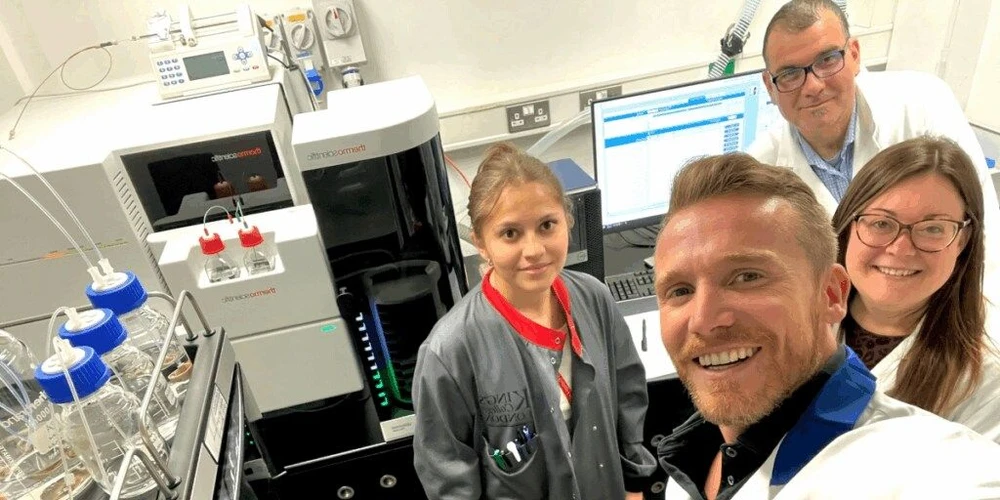 Thermo Fisher Scientific: Advancing Drug Analysis with VeriSpray PaperSpray Mass Spectrometry: Thermo Fisher Scientific’s Edward Goucher and Alexandra Graham pictured beside KCL’s Stefania Boccuzzi and Vincenzo Abbate
Why VeriSpray? A simpler, faster path to results
Traditional LC-MS workflows can be powerful, but when labs are overwhelmed by backlogs, the time and complexity of sample preparation and chromatography can be limiting. VeriSpray offers a remarkably simplified path to MS analysis, directly ionizing complex matrices using a paper substrate—no LC step required.
Key benefits include:
- <2-minute results thanks to minimal sample prep and elimination of LC
- Reduced cost per test by cutting solvent use and simplifying training requirements
- Automation-ready with support for unattended operation of up to 240 samples
- Seamless integration with Thermo Scientific triple quadrupole systems
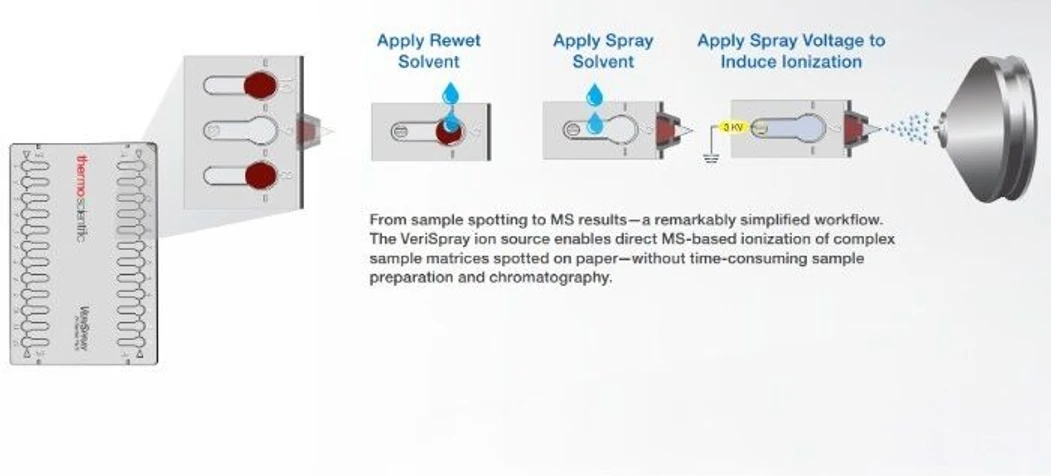 Thermo Fisher Scientific: Advancing Drug Analysis with VeriSpray PaperSpray Mass Spectrometry
Enhancing emergency toxicology with direct MS analysis
In the emergency room, timely drug identification is critical, but clinicians often rely on patient self-report or symptom-based assessments. Stefania’s PhD research seeks to change that. Her team is developing a rapid, extraction-free method using VeriSpray PS-MS for the targeted analysis of plasma samples from patients presenting with acute drug toxicity.
By using dried matrix spots on a paper substrate and coupling this with a Thermo Scientific TSQ Altis Plus Triple Quadrupole Mass Spectrometer, Stefania’s work provides an alternative screening technique to chromatography, delivering faster, actionable results to guide early clinical decision-making.
Key takeaways:
- Paper spray MS is an ambient ionization technique suitable for emergency toxicology due to its rapid results and minimal sample prep.
- Enhancing the paper substrate and adding microextraction steps can boost sensitivity without sacrificing speed.
Substrate matters: boosting detection with paper treatment
One key limitation of PS-MS is the interference that can arise from the paper substrate itself. Marwa’s research explored nine different paper treatments, ranging from acids to solvents, to improve the signal-to-blank (S/B) ratio when analyzing eight common drugs in whole blood.
The most promising results came from formic acid and nitric acid treatments, which significantly enhanced analyte detection. Although these methods are currently time-consuming, Marwa envisions future industrial-scale production of pre-treated cartridges to support scalable clinical workflows.
Key takeaways:
- Substrate optimization can significantly reduce background noise in PS-MS analysis.
- Acid-treated paper enhances S/B ratios, enabling more reliable detection of drugs in blood.
- Industrial pre-treatment could make these improvements broadly accessible.
DLLME meets paper spray: improving sensitivity in plasma
Saeed Almheiri’s presentation focused on dispersive liquid-liquid microextraction (DLLME) as a sample prep technique to increase sensitivity for PS-MS analysis of drugs in plasma, without adding significant complexity to the workflow.
Using DLLME prior to VeriSpray analysis, Saeed demonstrated improved detection limits (as low as 0.3 ng/mL) across a panel of 10 drugs, including buprenorphine, cocaine, and MDMA. Importantly, this method maintained the fast, minimal-prep advantages that make paper spray ionization so appealing.
Key takeaways:
- DLLME enhances analyte extraction from plasma, reducing matrix effects and improving quantitation.
- Combining DLLME with VeriSpray maintains a low-complexity, high-speed workflow.
Conclusion: a new frontier for forensic and clinical toxicology
The data shared at this workshop underscores the transformational potential of VeriSpray PaperSpray MS. Whether it’s detecting drugs in plasma for emergency toxicology, enhancing substrate performance, or integrating clever microextraction steps, researchers at KCL are proving that simplified workflows can still deliver high sensitivity and accuracy.
As toxicology labs continue to face growing backlogs and limited resources, adopting a faster path to MS analysis with VeriSpray could dramatically change how drugs of abuse are detected and quantified, getting results faster, cutting costs, and ultimately supporting better outcomes in both forensic and clinical environments.
Resources:
- Watch the full workshop on Box- 2025 Seized Drugs Symposium Workshop and the tag is Toxicology
- Explore the VeriSpray product brochure
- Case study – Paper spray mass spectrometry simplifies and expedites turnaround of drug toxicity screening King’s College London aims to investigate its use in emergency department applications
- Case study – How paper spray mass spectrometry facilitated harm reduction drug checking
- Past blogs in this toxicology series
- Stay tuned to register for next years symposium at www.forensicsymposium.org
- Check out our drug screening and confirmation webpage
Visit us on LinkedIn: #PSMS #VeriSpray #PaperSprayMS #Toxicology
Ema Ruzic
Vertical Marketing Manager, Chromatography and Mass Spectrometry Division (CMD)