Behind the Bench: Tips to Simultaneously Analyze THC, Its Metabolites, and Other Drugs of Abuse Using LC-MS
- Thermo Fisher Scientific: Behind the Bench: Tips to Simultaneously Analyze THC, Its Metabolites, and Other Drugs of Abuse Using LC-MS
Continuing the conversation on toxicology innovation
In our ongoing toxicology blog series, we’ve explored sample preparation strategies, cutting-edge HRAM methods, innovative PaperSpray MS techniques, and productivity boosters for toxicology labs. Now, let’s take a deep dive into one of the most commonly requested yet technically challenging areas of forensic toxicology—accurate, efficient detection of THC and its metabolites.
Thermo Fisher Scientific: Behind the Bench - Tips to Simultaneously Analyze THC, Its Metabolites, and Other Drugs of Abuse Using LC-MS
The challenge: THC’s lipophilic nature and matrix effects
Tetrahydrocannabinol (THC) remains one of the most frequently detected drugs in forensic testing after alcohol. Yet, its strong lipophilic properties make reliable measurement by LC-MS particularly challenging. THC and its metabolites tend to adhere to nonpolar surfaces of consumables and biological matrices, often leading to signal loss or inconsistent recovery.
The latest Thermo Fisher Scientific smart note demonstrates how strategic sample handling and consumable selection can mitigate these challenges. By maintaining methanol (MeOH) in every step of the extraction process—from collection through elution—analysts can prevent THC adsorption and improve recovery. For example, increasing MeOH content during sample prep and using a 30% MeOH wash step helped boost signal strength dramatically.
Extraction optimization: simple tweaks, big gains
The study’s workflow employed DPX XTR tips with mixed-mode SCX/WAX chemistry, analyzed on the Thermo Scientific Vanquish Horizon UHPLC system and Thermo Scientific Stellar mass spectrometer. Four small but impactful changes—raising MeOH concentration, adjusting the SPE wash, switching to a biphenyl column, and altering the solvent reconstitution order—resulted in a sevenfold increase in THC signal intensity (Figure 1).
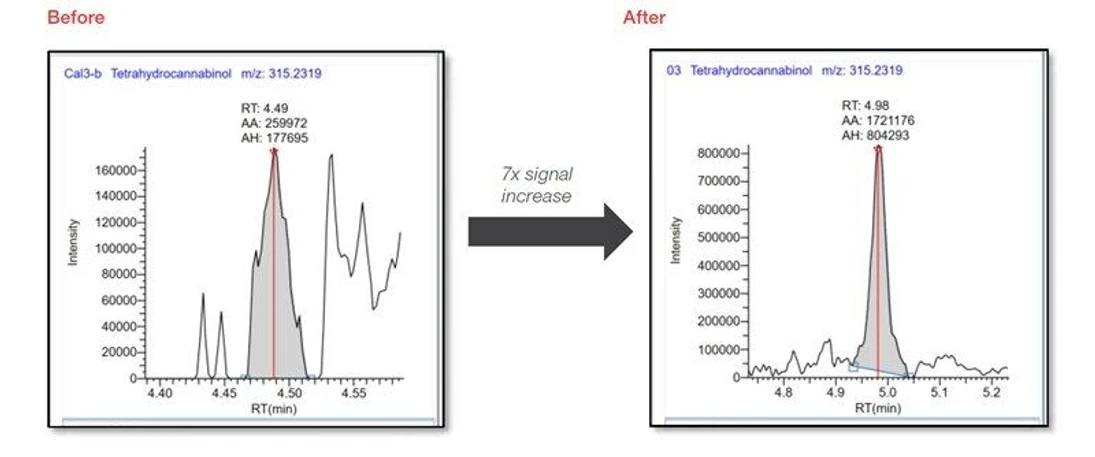 Thermo Fisher Scientific: Behind the Bench: Tips to Simultaneously Analyze THC, Its Metabolites, and Other Drugs of Abuse Using LC-MS: Figure 1. THC signal in extracted oral fluid sample before and after changes were made to increase signal by 7x.
These incremental adjustments underscore how critical it is to balance organic composition and consumable materials for each matrix type. For oral fluid assays, using silanized glass vials and incorporating Quantisal™ collection buffers can also prevent degradation and significantly improve stability—up to 150× higher THC signal compared to common buffers (Figure 2).
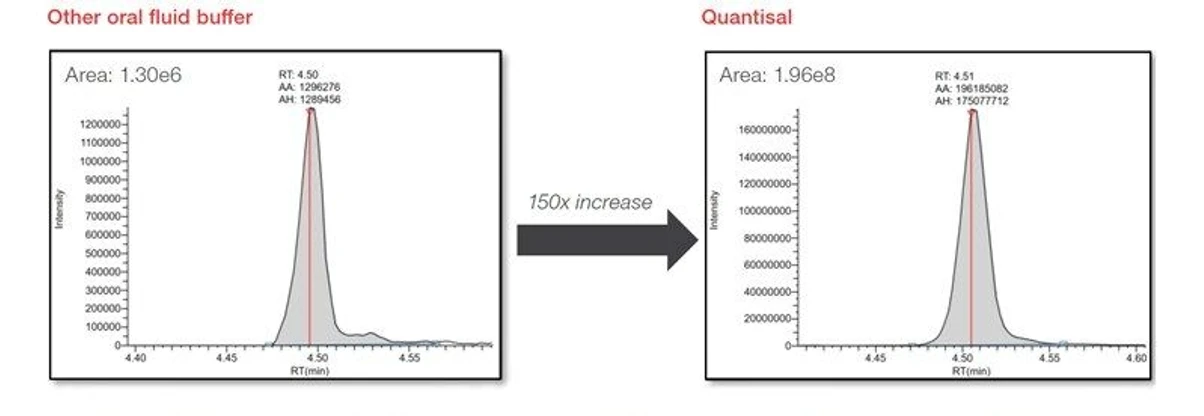 Thermo Fisher Scientific: Behind the Bench: Tips to Simultaneously Analyze THC, Its Metabolites, and Other Drugs of Abuse Using LC-MS: Figure 2. Extracted ion chromatogram of THC using common oral fluid buffer compared to Quantisal extraction buffer.
Ensuring stability and recovery
Beyond extraction, analyte stability is another make-or-break factor. THC degrades quickly in standard plastic vials or at room temperature but can remain stable 6–12 months when stored at –20°C in sodium heparin tubes. The Smart Note also provides practical recovery assessments for extraction development, including dry down tests and sequential elution testing, to ensure that each analyte is retained through every stage of the workflow.
By quantifying pre- and post-extraction spikes, analysts achieved high percent drug recovery and low LOQ’s across a 31-drug oral fluid panel, meeting or exceeding clinical cutoff requirements.
Isomer separation: Δ⁸-THC vs. Δ⁹-THC
With emerging cannabinoids on the market, separating Δ⁸-THC and Δ⁹-THC is increasingly important. The note highlights that Pentafluorophenyl (PFP) columns—paired with a water/methanol mobile phase containing 0.1% formic acid—can efficiently resolve these isomers. Using a Vanquish Horizon UHPLC coupled to a Thermo Scientific™ Orbitrap Exploris™ 120 MS, researchers achieved clear chromatographic separation (Figure 3).
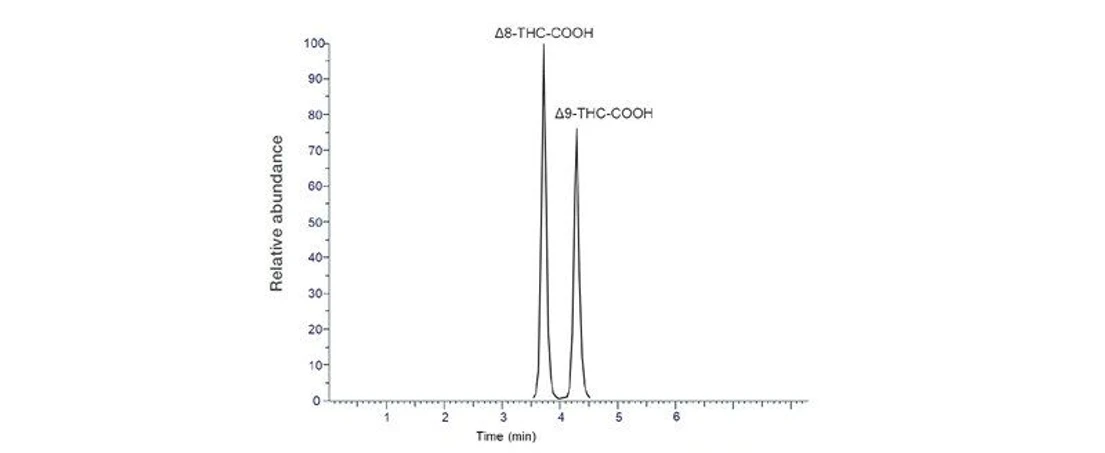 Thermo Fisher Scientific: Behind the Bench: Tips to Simultaneously Analyze THC, Its Metabolites, and Other Drugs of Abuse Using LC-MS: Figure 3. Extracted ion chromatogram of Δ8-THC-COOH and Δ9-THC-COOH separation.
The takeaway: Building a robust, reliable THC assay
The bottom line? Including THC and its metabolites within a broader LC-MS drug panel is not only cost-effective but also critical to modern toxicology workflows. With deliberate choices in solvent composition, consumables, column chemistry, and buffer systems, laboratories can dramatically enhance recovery and detection reliability.
These “behind the bench” optimizations, rooted in real-world forensic workflows, illustrate how small procedural changes can deliver big performance improvements.
Continue your toxicology journey
Stay tuned for the next post in our Analyte Guru series and learn more on our website: Forensic Toxicology.
Resources
- Drug screening and confirmation workflows
- Stellar Mass Spectrometer & Orbitrap Exploris 120 MS webpages
- Promotions
- Save up to 40% on complete LC-MS toxicology configurations
- Mass spectrometer affordability programs
- Refurbished MS
- Trade-in
- Financing/ leasing
- Past blogs in this series
- Sample prep – Sample Preparation Strategies Demystified: Choosing the Right Fit for Your Toxicology Workflow
- Tox Explorer – Beyond Blood: Sheffield Teaching Hospitals NHS Foundation Trust Develops HRAM-Powered Method for Post-Mortem Toxicology Analysis
- VeriSpray – Advancing Drug Analysis with PaperSpray MS
- Boosting Productivity in Toxicology Labs
- On-demand workshop – Next-Generation Workflows for Small Molecule Quantitation Using the Thermo Scientific Stellar Mass Spectrometer
- Featured content: Tips and tricks smartnote
Visit us on LinkedIn: #THC #LCMS #DrugsOfAbuse #DoA