Stop Using C18 for Polar Analytes
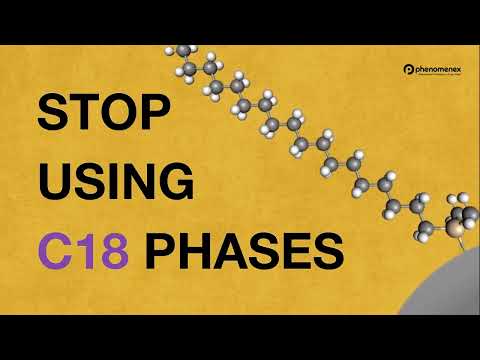
- Photo: Phenomenex: Stop Using C18 for Polar Analytes
- Video: Phenomenex: HILIC Explained in 1 minute
C18 phases do not provide sufficient retention for polar compounds. The result is often coelution and signal suppression in LC–MS. When analyzing polar analytes, C18 is therefore usually not the appropriate choice.
HILIC (Hydrophilic Interaction Liquid Chromatography) represents a different separation approach.
Principle of HILIC
The initial mobile phase composition is 90% acetonitrile and 10% ammonium buffer. The high organic content creates a thin water-enriched layer on the polar stationary phase. Analytes partition into this layer, and as the water content in the mobile phase increases, they elute.
Method Development Essentials
1. Selection of the Stationary Phase
Choose an appropriate polar stationary phase, for example:
- silica
- diol
- amino
- zwitterionic
2. Initial Mobile Phase Conditions
- Start at 90% acetonitrile with an ammonium buffer.
- Do not use methanol — it disrupts the water-enriched layer and affects retention.
3. Gradient Strategy
In HILIC, water is the strong eluent. The gradient therefore starts at high organic content and then progressively increases the water content.
4. pH Optimization
Compare:
- pH 3.2 (ammonium formate)
- pH 5.8 (ammonium acetate)
Check the differences.
5. Equilibration
Ensure proper equilibration of the system.
Practical Note
Excess water in the sample disrupts HILIC retention and leads to poor peak shape.