News from LabRulezLCMS Library - Week 15, 2026
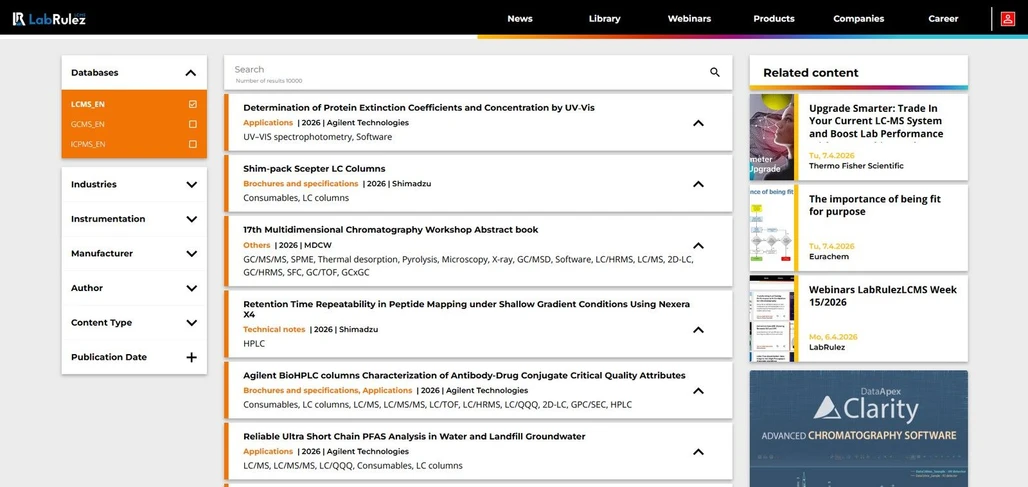
LabRulez: News from LabRulezLCMS Library - Week 15, 2026
Our Library never stops expanding. What are the most recent contributions to LabRulezLCMS Library in the week of 6th April 2026? Check out new documents from the field of liquid phase, especially HPLC and LC/MS techniques!
👉 SEARCH THE LARGEST REPOSITORY OF DOCUMENTS ABOUT LCMS AND RELATED TECHNIQUES
👉 Need info about different analytical techniques? Peek into LabRulezGCMS or LabRulezICPMS libraries.
This week we bring you application notes by Agilent Technologies, KNAUER, Shimadzu and Waters Corporation and brochure by Thermo Fisher Scientific!
1. Agilent Technologies: Complementary LC/MS and UV‑Vis Spectrophotometry for siRNA Quality Control and Thermal Stability Assessment
- Application note
- Full PDF for download
Small interfering RNAs (siRNAs) are short, double-stranded molecules that silence gene expression through RNA interference. Their ability to target specific genes has made siRNAs a promising class of therapeutics, driving growing interest and adoption for innovative treatment strategies in the pharmaceutical market.
Ion-pair reversed-phase chromatography (IP-RP) coupled with MS is the most common analytical strategy for siRNA characterization. By adjusting chromatographic conditions, siRNAs can be analyzed either as intact double‑stranded duplexes under non‑denaturing conditions, or as individual single strands under denaturing conditions. Combining both approaches provides a comprehensive structural assessment, ensuring accurate characterization of siRNA sequence integrity and duplex stability.
Thermal stability analysis by UV spectroscopy is commonly used to evaluate the conformational stability of nucleic acids. Tm is defined as the temperature at which 50% of the double‑stranded molecule is unfolded (single stranded). The measurement serves as an indicator of siRNA duplex stability and is therefore a valuable parameter for their rational design and optimization.
In this application note, an siRNA sample was characterized under both denatured and non-denatured conditions using the Agilent InfinityLab Pro iQ Plus coupled with the 1290 Infinity II Bio LC System. Additionally, the Tm was determined using the 3500 Multicell UV-Vis Spectrophotometer. This study demonstrates how combining LC/MS and UV-Vis techniques (Figure 1) provides a complementary approach for siRNA quality control and structural assessment.
Experimental
Instrumentation
For LC/MS analysis, the 1290 Infinity II Bio LC coupled to the InfinityLab Pro iQ Plus mass detector system included:
- Agilent 1290 Infinity II Bio high-speed pump (G7132A)
- Agilent 1290 Infinity II Bio multisampler (G7137A)
- Agilent 1290 Infinity II multicolumn thermostat (G7116B)
- Agilent 1290 Infinity II variable wavelength detector (G7114B)
- InfinityLab Pro iQ Plus mass detector
Tm measurements were performed on an 3500 Multicell UV-Vis Spectrophotometer using Agilent quartz semimicro cuvettes (part number 50636559) with an Agilent Temperature Probe (part number G9889-60005), 800 µL volume, and 10 mm pathlength. Drops of mineral oil were layered on the sample using an Agilent mineral oil dropper (part number FSSMO15) to minimize evaporation.
Software
Agilent OpenLab CDS (version 2.8) and Agilent Cary UV Workstation software (version 1.6) were used for data acquisition and analysis.
Results and discussion
siRNA stability at various temperatures
Quality control of siRNA duplexes is often performed using an IP-RP LC method. Unlike antisense oligonucleotide (ASO), the siRNA duplex structure is sensitive to temperature and mobile phase composition. Denaturation of the duplex can occur on-column under high temperature conditions.1 To find the optimal non-denaturing temperature for our siRNA, a series of column temperatures from 30 to 60 °C in 10 °C intervals was tested. The results in Figure 2 indicate that the siRNA remained in duplex from at column temperatures of 30 and 40 °C. With increasing column temperature, the siRNA eluted earlier despite use of an identical gradient. This behavior reflects the enhanced mass‑transfer efficiency and reduced viscosity of the mobile phase at elevated temperatures, which together decrease analyte retention and accelerate chromatographic elution. The broadened peak of siRNA under non‑denatured conditions can be attributed to the partial separation of its different phosphoramidate diastereomers.1
The onset of duplex melting happened at column temperatures between 40 and 50 °C. At a column temperature of 60 °C, siRNA is almost fully denatured to single strands as depicted in the overlaid chromatogram of antisense strand (AS), sense strands (SS) and duplex (Figure 3). Meanwhile, the wide siRNA peak measured under denatured conditions reflects its various denatured conformations and the diastereomer content.
Conclusion
This application note demonstrates that integrating LC–MS and UV–Vis Tm analysis provides a powerful, complementary strategy for siRNA structural characterization and quality control. By evaluating the effects of column temperature on chromatographic results, we identified 30 to 40 °C as optimal non‑denaturing conditions for maintaining duplex integrity in IP‑RP LC separations, while enabling effective resolution of AS, SS, and duplex species. Mass confirmation showed excellent agreement between measured and theoretical molecular weights, supporting reliable identification of individual strands and duplex components. UV–Vis analysis further revealed substantial differences in Tm between physiological buffer (PBS) and LC elution solvent, underscoring the critical role of formulation conditions in siRNA stability. Overall, the combined workflow offers a robust analytical platform for siRNA development, providing orthogonal confirmation of structural integrity, accurate mass determination, and quantitative thermal stability assessment. This integrated approach is well‑suited for method development, comparability studies, and routine QC of therapeutic siRNA products.
2. KNAUER: Boosting GPC/SEC data reproducibility and accuracy with a flow marker
- Application note
- Full PDF for download
GPC/SEC (Gel Permeation Chromatography/Size Exclusion Chromatography) is a liquid chromatographic technique used to determine important properties of macromolecules, such as molecular weight. Calibration is an essential part of GPC/SEC, as it enables the accurate determination of molecular weight. This involves measuring the retention time also called elution volume of various calibration standards with known molecular weights to create a calibration curve that describes the relationship between molecular weight and elution volume (Fig. 1).
To ensure the accuracy of molar mass determinations, it is crucial to maintain a constant flow rate during the measurement. Minor fluctuations in elution volume have the potential to result in significant deviations in molar mass values. In this context, a flow marker (FM) can help to increase the reproducibility and accuracy of GPC/ SEC results. By providing a reference peak within each chromatogram (Fig. 2), the FM allows the detection of fluctuations in elution conditions. Consequently, correction factors can be applied to account for variations in flow rate, ensuring that retention times and elution volumes are consistent across measurements. This approach facilitates precise calibration and reliable molar mass determination, ultimately enhancing the robustness of the analytical method. In principle, any substance can be used as a FM. However, for optimal application, it is recommended to select substances with a narrow distribution and with a hydrodynamic radius close to the exclusion limit of the column to avoid overlaps with other peaks in the chromatogram. Ideally, the FM should also be soluble in the same solvent as the standards and samples. Examples include ethylene glycol for aqueous applications and ethylbenzene or butylated hydroxytoluene (BHT) for organic solutions. The substance is added at an appropriate concentration during sample and standard preparation, resulting in a distinct peak visible in the chromatogram (Fig. 2).
SEC system configuration
- Pump: AZURA® P 6.1L Isocratic Pump with 10 ml pump head, stainless steel
- Autosampler: AZURA® AS 6.1L
- Detector: AZURA® RID 2.1L
- Thermostat: AZURA® CT 2.1
- Eluent tray: AZURA® E 2.1 L
- Column: AppliChrom SuperOH-P-Multipore, 7 µm, 300 x 8 mm, 100 - 1 000 000 Da
- Capillaries: Start-Up Kit with flexible, precut capillaries for analytical HPLC systems with 1/16" connections
- Software
- ClarityChrom® 9.1.0 - Workstation, autosampler control included
- ClarityChrom® 9.1.0 - SEC/GPC extension
CONCLUSION
The series of experiments demonstrated that implementing a FM in GPC/SEC analyses significantly enhances data reproducibility and accuracy. The experiments showed that flow fluctuations during standard measurements can be effectively corrected using the FM, leading to more reliable calibration curves. Furthermore, we confirmed the accuracy of the correction calculations by measuring a standard mixture at various flow rates, demonstrating the ability of the FM to compensate flow rate variations. Finally, the experiments illustrated that deviations in flow rate during sample measurement from those used in calibration can be corrected through FM based correction, ensuring precise molar mass determinations. Overall, the use of a FM is a simple, practical, and effective approach to improve the quality of GPC/SEC data, but attention must be paid to the solubility of the FM in the mobile phase, its detectability and the prevention of interaction or co-elution with other peaks.
3. Shimadzu: Conformation of Molecular Weight of Intact Proteins by Single Quadrupole Mass Spectrometer
- Application note
- Full PDF for download
User Benefits
- The molecular weight of intact proteins can be confirmed by using the simple handling LCMS -2050 single quadrupole mass
spectrometer. - By using LabSolutions Insight Biologics, the results of multiply-charged ion analyses can be understood easily by a simple visual comparison.
Biopharmaceuticals are a class of pharmaceuticals produced using biotechnologies such as genetic modification and cell culture. The proteins that serve as the active components of biopharmaceuticals are macromolecular compounds with multiple ionization sites. When multiply-charged ions are detected, their molecular weights can be estimated by analysis processing (deconvolution) on an appropriate software program. More accurate estimation of molecular weight is possible by using a high-resolution mass spectrometer. However, when the main components can be assumed in advance, for example, in quality control applications, the molecular weight can be confirmed by using a simple handling single quadrupole massspectrometer. This article introduces an example of analysis of proteins using a single quadrupole mass spectrometer for synthesis confirmation of the macromolecular compounds.
Analysis Conditions
The measuring instruments used in this experiment were a Nexera X3 high-performance liquid chromatograph and an LCMS-2050 single quadrupole mass spectrometer. Table 2 and Table 3 show the analysis conditions used with the two instruments, respectively.
Conclusion
Simple conformation of the molecular weights of three intact protein samples was possible by using the LCMS-2050 single quadrupole mass spectrometer and LabSolutions Insight Biologics analysis software. By using LabSolutions Insight Biologics, analysis results can be understood easily by visual comparison when multiple components are assumed to exist or impurities are detected.
4. Thermo Fisher Scientific: Purpose-built performance for complex contaminant analysis - Orbitrap Exploris EFOX Mass Detector
- Brochure
- Full PDF for download
This high-resolution accurate mass (HRAM) system is designed to satisfy market industry demands with the ability to perform targeted analysis and precise quantitation, suspect screening, as well as sample profiling. Welcome to the Thermo Scientific™ Orbitrap Exploris™ EFOX (Environmental Food Organic Xenobiotics) Mass Detector, the perfect fit for environmental and food safety testing. Beyond the renowned high-resolution accurate mass detection provided by Thermo Scientific™ Orbitrap™ mass analyzers, this built-for-purpose system is simple to operate and compliance ready with Thermo Scientific™ Chromeleon™ software. HRAM data provides utmost confidence for enabling retrospective data analysis and the ability to easily add new compounds of interest without redeveloping methods and the need to reinject your sample, unlike conventional systems that require time-consuming MS/MS development and optimization, in addition to retention time adjustments.
Simplicity for environmental and food safety laboratories
The Chromeleon software offers built in methods, control, data processing and management that simplify tasks and reduce errors for more ‘right first time’ analyses. A suite of smart tools make work faster and easier, while ensuring reproducible, high-quality mass monitoring.
Productivity to accelerate commercialization
High uptime boosts productivity. Rapid “set and forget” calibration procedures provide consistent mass stability for at least four weeks at prescribed conditions. Instrument status monitoring and optimized pressure control alert users when maintenance is needed, avoiding unnecessary downtime and repeat analyses.
Compliance for competitive advantage
Designed for data integrity, data security, and compliance, fully scalable Chromeleon software gives you a competitive edge in meeting global regulatory requirements.
Consistent results deliver confidence
Robust and reliable performance from system to system and from site to site ensure high-confidence results used to make critical decisions. Industry-proven Orbitrap technology, now purposely designed for mass monitoring in future-proof lab operations.
Complexities in environmental testing
The Orbitrap Exploris EFOX Mass Detector simplifies environmental testing workflows, enabling faster and more reliable detection of a wide range of pollutants, including ubiquitous contaminants like per- and polyfluoroalkyl substances (PFAS). Its highresolution capabilities and streamlined data processing reduce turnaround time and operational burden, helping labs achieve and maintain regulatory compliance adherence more efficiently.
Challenges in food safety testing
With out-of-the-box workflows for key environmental and food safety applications, including PFAS and pesticide testing, the high-throughput Orbitrap Exploris EFOX Mass Detector is ready for compliance, supporting labs in meeting stringent regulatory requirements with confidence and efficiency
5. Waters Corporation: Minimized Carryover Using BioResolve™ Protein A Affinity Columns
- Application note
- Full PDF for download
Benefits
- Low-level or non-detectable carryover injection-to-injection
- Greater confidence in titer data accuracy
- Minimized risk of cross-contamination or fouling from column reuse
Owing to the unique “on/off” retention mechanism harnessed in affinity chromatography, a major pain point of affinity resins is sample carryover across injections. For Protein A (ProA) Affinity Columns, carryover occurs when monoclonal antibodies (mAbs) of interest and/or host cell-related impurities remain bound to the column following an elution cycle. These sample remnants are then released during subsequent elutions, resulting in poor reproducibility and introducing variability during titer quantitation. Alternatively, the small quantity of remaining proteins can begin to aggregate and affect chromatographic performance, sample recovery, and column lifetime.1,2 Carryover can result from several factors, both system and column dependent, though only those related to the ProA resin and column hardware are within the scope of this application brief. These include incomplete elution from the Protein A ligand under suboptimal conditions, non-specific interactions with column hardware or resin packing, and incomplete or ineffective cleaning protocols.1,2,3
Sample carryover can be particularly problematic during bioprocess development, where analysts may require reuse of one ProA Affinity Column to monitor titer output from multiple reactors or for differing mAbs. If the eluate is intended for further downstream analyses, carryover can lead to cross-contamination by not only errant mAbs but also process-specific impurities.4,5 ProA Affinity chromatography is largely considered the first purification step in mAb bioprocessing, and impurities introduced at this step can confound further downstream analyses. To bypass this, common practice is to designate one ProA column to a specific product, however this then results in column use for only a fraction of demonstrated lifetimes.1,4,5 As affinity resins on average cost 50% more than other chromatographic media, the economics of affinity column reuse and the importance of carryover minimization become apparent.4
Column-related carryover can be reduced through method optimization and the implementation of a rigorous clean-in-place (CIP) protocol, but fundamental interactions with the affinity column will pervade. To this end, selecting a ProA Affinity Column with the lowest demonstrable carryover will result in more efficient downstream analysis, extended column longevity, and greater confidence in titer measurement.
Conclusion
Carryover is a persistent challenge in Protein A mAb titer analyses, leading to data variability at best and sample contamination at worst. Waters BioResolve Protein A Affinity Columns demonstrate significantly improved performance in minimizing carryover compared to a leading commercial benchmark evaluated in this study. Notably, the 3.9 × 5 mm column format, intended for high-throughput method analyses, further enhances this advantage and exhibits no detectable carryover following a 1 µg NISTmAb injection. This reduction in carryover enhances data integrity, reduces the risk of cross-contamination, and prolongs column lifespan by mitigating sample-induced fouling.