AppliChrom® SEC columns for biopolymers and aqueous polymers
Optimally suited for aqueous SEC separations. Aqueous and highly hydrophilic polymeric base material. Polymethacrylate resin, cross-linked with polyhydroxylated ether (surface contains some residual carboxyl functional groups)
Properties:
- Particle size: 7 µm for pore sizes up to 300 Å and 10 µm for pore sizes over 350 Å and the multipore columns
- Stable between: pH 2–12.5
- Pressure stable: for 30–70 bar depending on pore size
- Temperature stability: between 10–85 °C
- Flow rate: maximum 1 ml/min
- Low column bleed for low detector noise
- Large pore volume for optimal resolution
- Individual pore sizes for individual molecular weight ranges
- Multi-pore technology for a wide range of molecular sizes
- Increased lifetime of SEC columns through combination of proprietary particle and packing technology
- Recommended eluents: H₂O, buffers
 KNAUER: AppliChrom® ABOA SuperOH-P - Pore sizes
Applications
Water soluble (bio)polymers up to 40 000 kDa:
- proteins, oligonucleotides, virus, heparin, polyethylene oxide (PEO), polyethylene glycol (PEG), pullulan, maltodextrin, inulin, pectine, polycarboxylate ethers, gelatine, dextranes, polyacrylamide (PAM), PEGylated proteins acrylate dispersions
GPC & SEC Columns
GPC & SEC systems offer solutions for various applications and laboratories
Gel permeation chromatography (GPC) and size exclusion chromatography (SEC) separate analytes by size using special columns with a porous matrix. The basic separation principle is based on the fact that smaller molecules penetrate these pores more strongly and therefore move more slowly through the matrix than larger molecules. GPC/SEC is often used as gentle and powerful purification technique or for quality control in research and development. Typical target molecules are polymers, dissolved in organic solvents for GPC, and macro biomolecules like proteins, antibodies or polysaccharides, dissolved in aqueous eluents for SEC.
Separation is facilitated by selecting optimal particle and pore sizes. Therefore we offer a wide range of pore sizes (35, 100, 150, 250, 350, 500, 1000, 1500, 10E5, 10E6, 10E7 Å) and several particle sizes (5, 7, 10, 12, 20 µm) as a choice to customize for every application task.
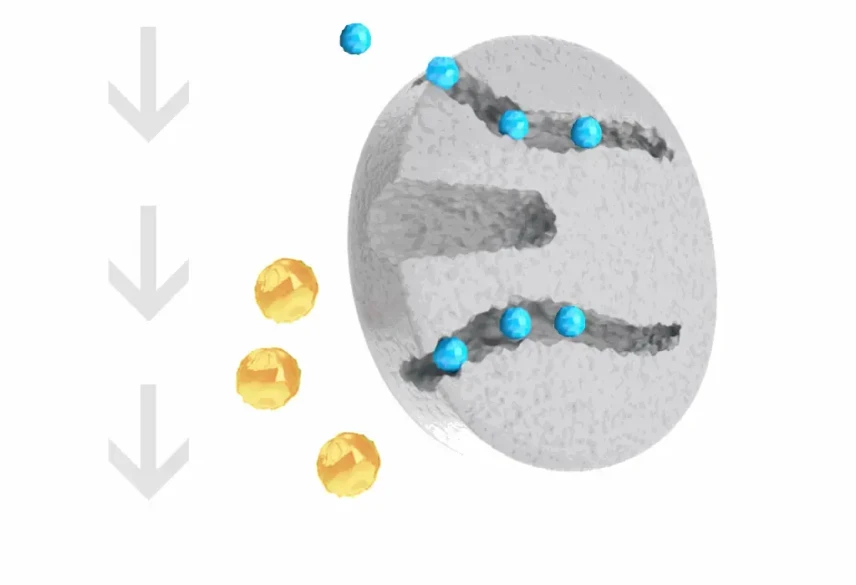 KNAUER: Size Exclusion - principle
KNAUER AppliChrom® ABOA columns for aqueous SEC, organic GPC, and special applications
- AppliChrom® ABOA StyDiViBe Series GPC-columns for GPC analysis of organic molecules using THF, toluene, chloroform.
- AppliChrom ABOA SuperOH-P Series for aqueous GPC/SEC-analysis of mainly neutral and anionic polymers like heparins, polysaccharides, PEO,
PEG,.... - AppliChrom® ABOA DMSO-Phil-P Series for DMSO GPC/SEC analysis (humic substances, UF/MUF-glue, p-NIPA, many polycondensates, protein from pea or leguminosae,...)
- AppliChrom® ABOA DMAc-Phil-P Series for GPC/ SEC analysis in DMAc, DMF, NMP. Good for many medium polar substances, polyoxazolines, lignin,...
- AppliChrom® ABOA Cat-Phil-P Series for aqueous GPC/SEC-analysis of special aminic and polycationic polymers like p-DADMAc, PEI/ polyethylenimin, chitosan, copolymers with polyaminofunctions, but also useful for polyanions or neutral polymers like heparin or PEO/PEG, dextran or pullulan.
- Seperation Ranges: 100–50 000 000 Da
You decide between classical GPC/SEC columns with conventional mixed pore technology or AppliChrom® BPT technology:
Separate oligomers and polymers with the new GPC media line from AppliChrom® BPT synthesis technology for large range, high resolution separations with increased accuracy in calibration (patent pending).
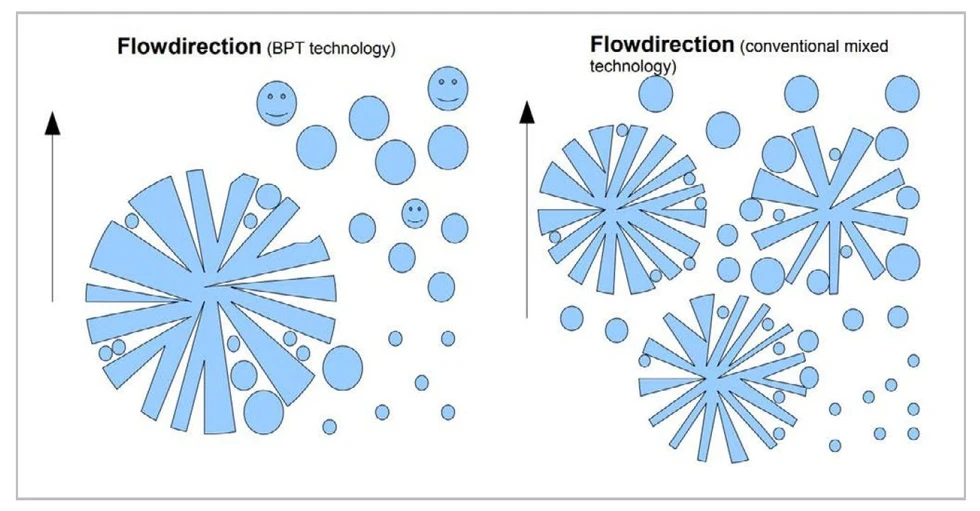 KNAUER: AppliChrom® ABOA columns.