GPC/SEC Made Easy – Fingerprint analysis of Gummy Candies

KNAUER: GPC/SEC Made Easy – Fingerprint analysis of Gummy Candies
The science behind gummy candies
Who can resist colourful, fruity gummy candies 🍬 with their signature chewy and elastic texture? While they may appear simple, their formulation is actually quite sophisticated. Each gummy is produced using a precisely balanced combination of gelling agents, sugars, acids, flavourings, and colourants, all working together to deliver the desired taste and texture.
For instance, the characteristic chewiness of gummy sweets results from the interaction between gelatin and sugars. Even minor adjustments—such as changing the type or concentration of the gelling agent—can significantly alter the final product. In addition, manufacturers must meet regulatory and labeling requirements, including certifications like Halal compliance. This makes accurate and consistent monitoring of ingredients essential throughout production.
The importance of SEC fingerprinting
Size Exclusion Chromatography (SEC), also known as Gel Permeation Chromatography (GPC), offers a fast and reliable way to analyze gummy formulations. By separating molecules according to their hydrodynamic size, SEC generates a unique molecular “fingerprint” for each product.
This fingerprint enables manufacturers to:
- confirm the type and origin of gelling agents (e.g., for Halal verification)
- ensure batch-to-batch consistency and detect production variations
- monitor changes during storage to assess shelf life
- evaluate low-molecular-weight compounds such as sugars in a semi-quantitative manner
Overall, SEC fingerprinting supports consistent product quality and regulatory compliance, ensuring that every gummy maintains the same expected characteristics.
Influence of column selection on SEC performance
Column selection plays a crucial role in achieving high-quality separations and detailed molecular fingerprints. To illustrate this, porcine and bovine gelatin standards were analyzed using two different configurations:
- a single Multipore SuperOH-P column
- a coupled system of SuperOH-P 350 and SuperOH-P 150 columns
Although both setups cover the same molecular weight range (100–1,000,000 Da), the coupled configuration effectively doubles the separation length. This results in improved resolution, which was confirmed experimentally. The coupled columns provided clearer separation between porcine and bovine gelatin, producing more distinct and informative fingerprints.
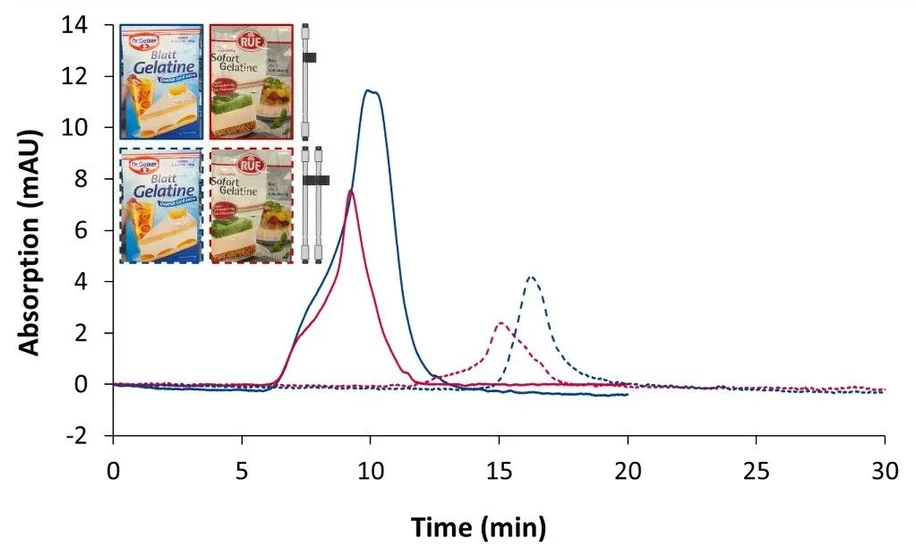 KNAUER: Fig. 1 Overlay chromatograms measured with DAD at 230 nm, 20 µL. Dark blue: porcine reference standard; red: bovine reference standard; solid line: measured with column A; dotted line: measured with column set B. Graphic by KNAUER.
Achieving reliable SEC fingerprints
Reproducibility is key when using SEC for quality control. The process begins with consistent sample preparation—maintaining identical dissolution procedures, concentrations, and filtration steps is essential, as even small variations can influence peak shape and overall results.
Beyond the column, the entire system setup is equally important. For example, combining a Refractive Index Detector (RID) with a Diode Array Detector (DAD) allows simultaneous detection of sugars, acids, and polymers within a single analysis.
Accurate peak identification further enhances reliability. By analyzing reference standards based on known ingredient compositions, chromatographic peaks can be correctly assigned, enabling detailed interpretation of both high- and low-molecular-weight components.
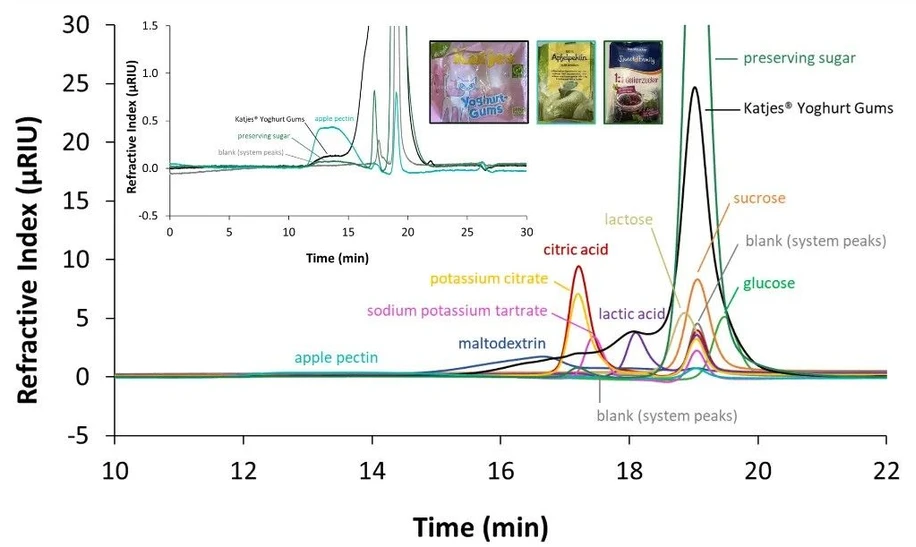 KNAUER: Fig. 2 Zoom overlay chromatograms measured with RID, 20 µL and column set B. Black: Katjes® Yoghurt Gums; turquoise: apple pectin diluted 1:10; dark green: preserving sugar 1:1 (sugar; citric acid; pectin; fully hydrogenated sunflower oil); dark blue: maltodextrin; pink: sodium potassium tartrate; yellow: potassium citrate; red: citric acid; purple: lactic acid; beige: lactose; orange: sucrose; green: glucose; grey: blank. Graphic by KNAUER.
Additionally, incorporating a flow marker helps correct for system-related variations, such as fluctuations in flow rate, thereby improving retention time stability and peak assignment accuracy. More details on the flow marker and its use in SEC are described in this technical note.
Verification of gelatin origin using SEC
Determining the source of gelatin is critical for proper labeling and compliance, particularly for Halal-certified products where porcine gelatin is not permitted.
To demonstrate SEC’s capability, two gummy samples with identical formulations but different gelatin sources were analyzed. One sample contained porcine gelatin, while the other used bovine gelatin. The resulting SEC fingerprints showed clear differences in the gelatin region, allowing unambiguous identification. The standard Haribo® Goldbears corresponded to the porcine reference, whereas the Halal version matched the bovine standard.
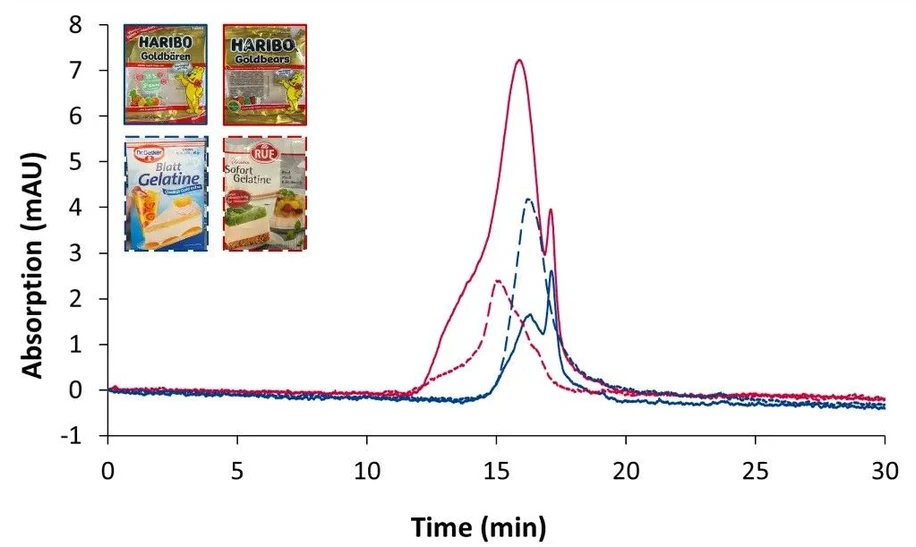 KNAUER: Fig. 3 Overlay chromatograms measured with DAD at 230 nm, 20 µL and column set B. Solid dark blue line: Haribo® Goldbears; solid red line: Halal Haribo® Goldbears; dotted dark blue line: porcine reference standard; dotted red line: bovine reference standard. Graphic by KNAUER.
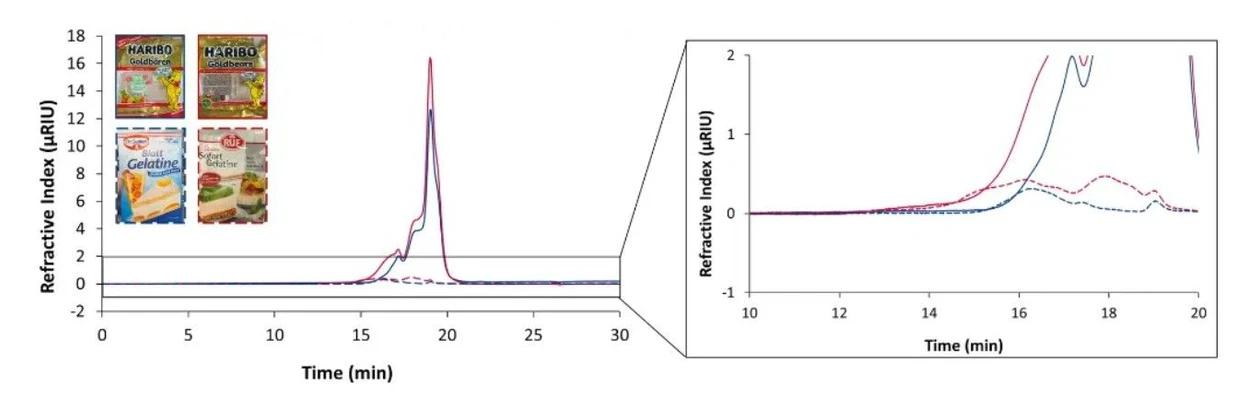 KNAUER: Fig. 4 Overlay chromatograms measured with RID, 20 µL and column set B. Solid dark blue line: Haribo® Goldbears; solid red line: Halal Haribo® Goldbears; dotted dark blue line: porcine reference standard; dotted red line: bovine reference standard. Graphic by KNAUER.
This confirms that SEC is a reliable method for distinguishing gelatin origin.
Role of low-molecular-weight components
In addition to polymers such as gelatin, SEC can also reveal smaller molecules, including sugars and organic acids. While SEC is not a replacement for fully validated HPLC methods, it serves as a rapid screening tool for comparing samples and supporting quality control.
Using RID detection, differences in sugar composition become visible. For example, chromatograms showed a significantly higher sucrose signal in preserving sugar compared to gummy candies, reflecting formulation differences.
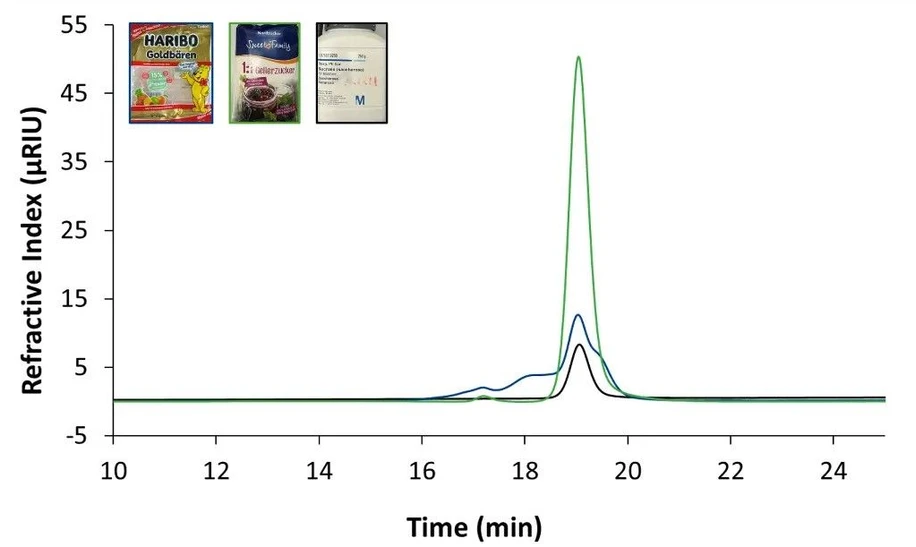 KNAUER: Fig. 5 Zoom overlay chromatograms measured with RID, 20 µL and column set B. Black: sucrose 1mg/ml; blue: Haribo® Goldbears; green: preserving sugar 1:1 (sugar; citric acid; pectin; fully hydrogenated sunflower oil). Graphic by KNAUER.
Conclusion
SEC is a powerful analytical technique for monitoring product quality and ensuring process consistency in gummy candy production. By generating detailed molecular fingerprints, it enables manufacturers to verify ingredients, maintain consistency, and comply with regulatory requirements.
Importantly, this approach is not limited to gummy candies—it can be adapted to a wide range of products where molecular characterization is essential.
- If you're planning to set up or optimize your GPC/SEC workflow, feel free to contact us at [email protected]. Stay tuned for more exciting insights into the GPC/SEC world in our “GPC/SEC Made Easy” series.
- For more information on the technical details, you can refer to this application note.
[1] Burey P., Bhandari B., Rutgers R. P. G., Halley P. J. & Torley P. J. (2010). Confectionery Gels: A Review on Formulation, Rheological and Structural Aspects. International Journal Of Food Properties, Vol. 12 (1), 176 - 210.