News from LabRulezLCMS Library - Week 23, 2026
LabRulez / AI: News from LabRulezLCMS Library - Week 23, 2026
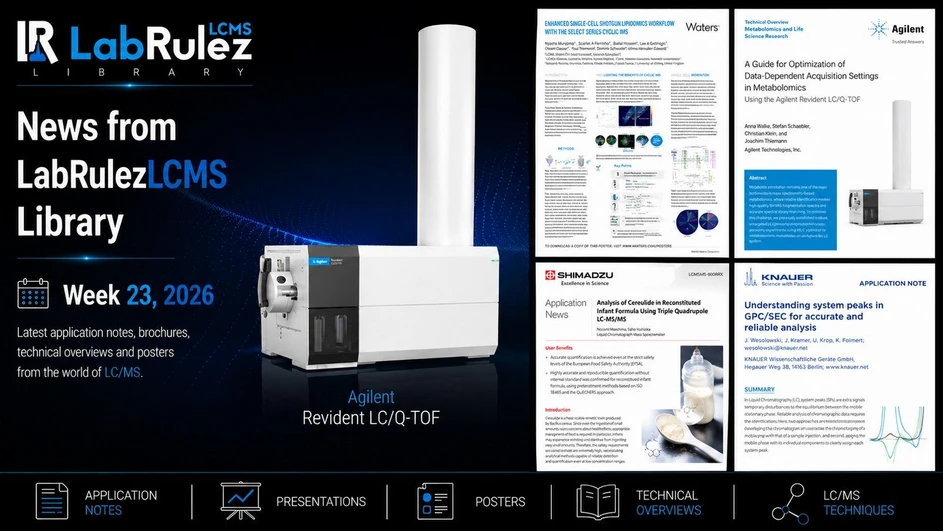
Our Library never stops expanding. What are the most recent contributions to LabRulezLCMS Library in the week of 1st June 2026? Check out new documents from the field of liquid phase, especially HPLC and LC/MS techniques!
👉 SEARCH THE LARGEST REPOSITORY OF DOCUMENTS ABOUT LCMS AND RELATED TECHNIQUES
👉 Need info about different analytical techniques? Peek into LabRulezGCMS or LabRulezICPMS libraries.
This week we bring you technical note by Agilent Technologies, application notes by KNAUER and Shimadzu, brochure by Thermo Fisher Scientific and poster by Waters Corporation!
1. Agilent Technologies: A Guide for Optimization of Data‑Dependent Acquisition Settings in Metabolomics
Using the Agilent Revident LC/Q-TOF
- Technical note
- Full PDF for download
Untargeted sample profiling and compound annotation
High-resolution mass spectrometry (HRMS)-based experiments for metabolomics profiling and biomarker discovery require high-quality data for reliable compound annotation. Measurement of accurate m/z, isotope pattern, and meaningful complementary MS/MS spectra with overall high MS/MS coverage is desired. This work demonstrates the capabilities of the Agilent Revident LC/Q-TOF to meet those needs and provides guidance for the development of robust data-dependent acquisition (DDA) methods.
The goal is to gain as much information as possible from a biological sample for statistical analysis and ultimately compound annotation or identification. DDA with Revident and other Agilent Q-TOFs running Agilent MassHunter Data Acquisition for TOF/Q-TOF LC/MS version 12.0 or later supports two acquisition modes: The established Auto MS/MS mode and the new Directed MS/MS mode. Auto MS/MS can optionally use preferred and exclusion lists. However, Directed MS/MS requires a dedicated precursor list. Directed MS/MS is therefore a "preferred list only" Auto MS/MS experiment on the Q-TOF.
For Directed MS/MS, precursors are exclusively selected from the user-defined list, focusing on the most relevant compounds while retaining decision criteria for precursor selection from the Auto MS/MS decision engine. Thus, Directed MS/MS focuses MS2 acquisition on only the most relevant metabolites, such as those that are statistically significant for group discrimination. Both Auto and Directed MS/MS acquisition modes can additionally be run as iterative MS/MS, enabled through the worklist as an intelligent reflex workflow.
This technical overview describes various parameters for Auto MS/MS, including MS1 and MS/MS acquisition rate, precursor selection threshold, number of precursors per cycle, and variable MS/MS acquisition rate. These parameters were first optimized for Auto MS/MS data acquisition, followed by a comparison to Directed MS/MS. Additionally, different strategies for building up an exclusion list in Auto MS/MS were tested, and the value that an iterative injection logic adds to untargeted experiments was demonstrated.
Conclusion
Auto and Directed MS/MS are powerful complementary data-dependent acquisition (DDA) modes for untargeted profiling experiments. For generation of high-quality data and to obtain the most information out of a sample, it is critical to understand how the decision engine for precursor selection works and which settings have the highest impact on the results. Any DDA method needs to be optimized according to the chromatographic conditions and overall purpose of the experiment. This technical overview highlights the most important method parameters and provides exemplary data from real sample measurements.
Depending on the purpose of the experiment, Directed MS/MS can be useful for obtaining MS2 information for compounds relevant to the biological question. For example, in semi-targeted discovery analysis, Directed MS/MS may be applied after feature finding and subsequent statistical analysis of an initial experimental batch. Directed MS/MS also demonstrated higher MS2 coverage for a single injection at low to medium MS2 acquisition rates. However, running optimized Auto MS/MS methods with iterative injection logic at the maximum MS2 acquisition rate of 50 Hz resulted in the highest MS2 coverage (~90%). Nevertheless, maximal MS2 coverage does not necessarily correspond to maximal information content, since a trade-off exists between the MS2 spectral acquisition rate and library scores.
The Agilent Revident LC/Q-TOF provides a range of features to assist users in method optimization for DDA. For example, the cycle time calculator assists in optimizing the duty cycle, thereby enabling straightforward collection of high-quality metabolomics data.
2. KNAUER: Understanding system peaks in GPC/SEC for accurate and reliable analysis
- Application note
- Full PDF for download
In Liquid Chromatography (LC), it is common that chromatograms show more peaks than can be directly assigned to the analytes [1] [2]. These additional signals, known as system peaks (SPs), occur when the equilibrium between the mobile and stationary phase is temporarily disrupted, for example during sample injection [1]. In Gel Permeation Chromatography/Size Exclusion Chromatography (GPC/SEC), system peaks typically appear at the end of the chromatogram, indicating the transition from size-based (entropy-driven) to interaction-based (enthalpy-driven) separation [3]. Universal detectors, such as the refractive index (RI) detector, make these effects clearly visible even when pure mobile phase is injected (Fig. 1) [3].
System peaks can appear as positive or negative signals, and while their retention time is generally constant, their peak shape, height and area depend strongly on the composition and amount of the injected sample [3]. Therefore, a system peak should not be used as a flow marker in GPC/SEC (see VTN0043 for more details about the use of a flow marker in GPC/SEC analysis). To minimise system peaks, samples should be dissolved in the mobile phase that is used for analysis, small injection volumes should be used, and adequate equilibration time before measurement should be ensured [3]. However, it is not possible to completely avoid system peaks. Therefore, it is essential to identify them to correctly analyse the data, as they can overlap with analyte peaks and alter their peak shape, which may lead to misinterpretation. Comparing a blank injection with a sample injection enables system peaks to be clearly identified [1] [2]. Furthermore, injecting the individual mobile phase components can help to assign the peaks [3].
CONCLUSION
System peaks are caused by temporary disturbances to the chromatographic equilibrium, typically appearing at the end of GPC/SEC chromatograms. They can be minimised through proper sample preparation, small injection volumes and stable system conditions, but they cannot be completely eliminated. Therefore, it is crucial to identify system peaks by comparing blank and sample measurements or by analysing the individual mobile phase components to ensure reliable evaluation of the chromatographic data.
MATERIAL AND METHODS
- Pump: AZURA® P 6.1L Pump Isocratic, Stainless Steel, 10 ml/min, without Degasser
- Detector
- AZURA® RID 2.1L Refractive Index Detector with Flow Cell, up to 10 ml/min
- AZURA® DAD 6.1L Diode Array Detector with Test Cell, without Flow Cell, 190 - 1000 nm
- UV Flow Cell Cartridge, PressureProof, Analytical, 10 mm, 10 µL, Titanium, 1/16”, 300 bar, up to 20 ml/min
- Autosampler: AZURA® AS 6.1L analytical Autosampler up to 1240 bar, without cool/heat option
- Thermostat: AZURA® CT 2.1 Column Thermostat for up to 8 HPLC columns with temperature range between 5 - 85 °C
- Column coupling
- AppliChrom SuperOH-P-150, 7 μm, 300 x 8 mm SEC Column, Separation range 100 - 5000 Da
- AppliChrom SuperOH-P-350, 10 µm, 300 x 8 mm SEC Column, Separation range 2500 Da - 1000k Da
- Capillaries: AZURA® Analytical MarvelXACTTM StartUp kit for HPLC Set of capillaries, adapters and connectors
- Software
- ClarityChrom® 9.1.0 station single instrument license one time base
- ClarityChrom® 9.1.0 GPC license for GPC data processing
3. Shimadzu: Analysis of Cereulide in Reconstituted Infant Formula Using Triple Quadrupole LC-MS/MS
- Application note
- Full PDF for download
User Benefits
- Accurate quantification is achieved even at the strict safety levels of the European Food Safety Authority (EFSA).
- Highly accurate and reproducible quantification without an internal standard was confirmed for reconstituted infant formula, using pretreatment methods based on ISO 18465 and the QuEChERS approach.
Cereulide is a heat-stable emetic toxin produced by Bacillus cereus. Since even the ingestion of small amounts raises concerns about health effects, appropriate management of food is required. In particular, infants may experience vomiting and diarrhea from ingesting very small amounts. Therefore, the safety requirements for infant formula are extremely high, necessitating analytical methods capable of reliable detection and quantification even at low concentration ranges.
The European Food Safety Authority (EFSA) proposed an acute reference dose (ARfD) of 0.014 µg/kg body weight for infants in a rapid risk assessment, indicating that cereulide concentrations exceeding 0.054 µg/L in reconstituted infant formula may surpass safety thresholds1). However, since infant formula is a complex matrix rich in lipids and proteins, selecting an appropriate sample preparation method is crucial.
This Application News introduces an example of analyzing cereulide in infant formula using triple quadrupole LC-MS/MS, comparing sample preparation methods based on ISO 18465 and the QuEChERS approach. Spike-and-recovery tests yielded good recoveries for both methods, but the QuEChERS approach demonstrated a higher recovery rate.
Analytical Conditions
Quantitative analysis was performed using a triple quadrupole mass spectrometer LCMS-8060RX coupled with a Nexera X3 UHPLC system. A Shim-pack Scepter was used as the analytical column, and the analysis was carried out with a 13-minute method including column washing and equilibration. The analytical conditions are shown in Table 1, and the MRM conditions in Table 2. The transitions recommended in ISO 18465 were used for quantification.
Conclusion
This Application News introduced methods capable of highly sensitive and accurate quantification of cereulide in reconstituted infant formula using a triple quadrupole LCMS/MS system. Spike-and-recovery tests conducted using a method based on ISO 18465 and the QuEChERS method yielded good recovery rates ranging from 90.6% to 100.1%. These methods enable the accurate quantification of cereulide even at the low concentration of 0.054 µg/L, which is the safety standard proposed by EFSA.
4. Thermo Fisher Scientific: Connected chromatography solutions: Low-flow columns and accessories
- Brochure
- Full PDF for download
This brochure presents Thermo Fisher Scientific's portfolio of low-flow chromatography solutions designed for high-sensitivity LC-MS applications in proteomics, biopharmaceutical characterization, metabolomics, and intact protein analysis. The portfolio includes three main product families: µPAC Neo Plus HPLC columns, EASY-Spray (U)HPLC columns, and nanoViper (U)HPLC columns, each optimized for different analytical requirements.
µPAC Neo Plus HPLC Columns
The µPAC Neo Plus platform uses a unique micromachined silicon pillar-array stationary phase rather than conventional packed particles. This design provides exceptional separation efficiency, reproducibility, sensitivity, and low backpressure. The columns are particularly suited for demanding bottom-up proteomics workflows, including single-cell proteomics and large-scale biomarker discovery studies where deep proteome coverage and quantitative precision are critical. Thermo Fisher highlights improved robustness, longer column lifetime, and enhanced column-to-column reproducibility compared with traditional packed-bed columns.
EASY-Spray (U)HPLC Columns
EASY-Spray columns integrate the analytical column, emitter, nanoViper connections, and temperature control into a single assembly. This design simplifies setup while minimizing dead volume and maximizing reproducibility. EASY-Spray columns support both nano-flow and capillary-flow LC-MS applications and are available for bottom-up proteomics using PepMap Neo columns as well as top-down proteomics and intact protein characterization using MAbPac reversed-phase capillary columns. The brochure demonstrates up to a 60% reduction in analysis time when using capillary-flow methods while maintaining high sensitivity.
nanoViper (U)HPLC Columns
The nanoViper range provides maximum flexibility by allowing columns and emitters to be selected independently. These columns use Thermo Scientific's nanoViper fingertight fittings, enabling virtually zero-dead-volume, tool-free connections across low-flow LC systems. PepMap Neo nanoViper columns support bottom-up proteomics with high pressure capability up to 1500 bar, while MAbPac capillary columns are intended for top-down proteomics, intact protein characterization, clinical research, and anti-doping applications where sample amounts are limited.
This brochure presents Thermo Fisher Scientific's portfolio of low-flow chromatography solutions designed for high-sensitivity LC-MS applications in proteomics, biopharmaceutical characterization, metabolomics, and intact protein analysis. The portfolio includes three main product families: µPAC Neo Plus HPLC columns, EASY-Spray (U)HPLC columns, and nanoViper (U)HPLC columns, each optimized for different analytical requirements.
µPAC Neo Plus HPLC Columns
The µPAC Neo Plus platform uses a unique micromachined silicon pillar-array stationary phase rather than conventional packed particles. This design provides exceptional separation efficiency, reproducibility, sensitivity, and low backpressure. The columns are particularly suited for demanding bottom-up proteomics workflows, including single-cell proteomics and large-scale biomarker discovery studies where deep proteome coverage and quantitative precision are critical. Thermo Fisher highlights improved robustness, longer column lifetime, and enhanced column-to-column reproducibility compared with traditional packed-bed columns.
EASY-Spray (U)HPLC Columns
EASY-Spray columns integrate the analytical column, emitter, nanoViper connections, and temperature control into a single assembly. This design simplifies setup while minimizing dead volume and maximizing reproducibility. EASY-Spray columns support both nano-flow and capillary-flow LC-MS applications and are available for bottom-up proteomics using PepMap Neo columns as well as top-down proteomics and intact protein characterization using MAbPac reversed-phase capillary columns. The brochure demonstrates up to a 60% reduction in analysis time when using capillary-flow methods while maintaining high sensitivity.
nanoViper (U)HPLC Columns
The nanoViper range provides maximum flexibility by allowing columns and emitters to be selected independently. These columns use Thermo Scientific's nanoViper fingertight fittings, enabling virtually zero-dead-volume, tool-free connections across low-flow LC systems. PepMap Neo nanoViper columns support bottom-up proteomics with high pressure capability up to 1500 bar, while MAbPac capillary columns are intended for top-down proteomics, intact protein characterization, clinical research, and anti-doping applications where sample amounts are limited.
Key Takeaway
The brochure serves as a selection guide for low-flow LC-MS users. Thermo Fisher positions:
- µPAC Neo Plus as the highest-performance option for maximum sensitivity and deepest proteome coverage.
- EASY-Spray as the easiest-to-use integrated solution with optimized reproducibility.
- nanoViper as the most flexible platform for laboratories requiring customizable low-flow LC-MS configurations.
These solutions target modern biopharmaceutical and proteomics laboratories seeking higher sensitivity, improved reproducibility, and efficient low-flow LC-MS workflows.
The brochure serves as a selection guide for low-flow LC-MS users. Thermo Fisher positions:
- µPAC Neo Plus as the highest-performance option for maximum sensitivity and deepest proteome coverage.
- EASY-Spray as the easiest-to-use integrated solution with optimized reproducibility.
- nanoViper as the most flexible platform for laboratories requiring customizable low-flow LC-MS configurations.
These solutions target modern biopharmaceutical and proteomics laboratories seeking higher sensitivity, improved reproducibility, and efficient low-flow LC-MS workflows.
5. Waters Corporation: Enhanced Single-Cell Shotgun Lipidomics Workflow with the SELECT SERIES Cyclic IMS
- Poster
- Full PDF for download
This poster presents an enhanced workflow for single-cell shotgun lipidomics using the Waters SELECT SERIES Cyclic IMS platform. Traditional lipidomics studies often analyze bulk cell populations and may overlook lipid heterogeneity at the single-cell level. The authors demonstrate how combining shotgun lipidomics with cyclic ion mobility spectrometry (IMS) enables the characterization of lipids from individual cells, providing deeper insight into cellular phenotypes, biological states, and cell-to-cell variability. The workflow integrates Cyclic IMS with LipidXplorer, creating aligned datasets suitable for quantitative and multivariate analyses across sample cohorts.
For the proof-of-concept study, THP-1 leukemia cells were analyzed using a nanospray infusion workflow. Lipid extracts were prepared from both bulk and single-cell-equivalent samples and analyzed on the Waters SELECT SERIES Cyclic IMS system operating in HDMSE mode. Data acquisition was performed using MassLynx, while data processing and lipid identification utilized waters_connect and LipidXplorer software. Accurate mass measurements and collision cross section (CCS) values were matched against the Waters Lipids CCS library to improve identification confidence.
A major advantage of the Cyclic IMS platform is its ability to separate lipid ions from common background contaminants. The study highlights how volatile polydimethylcyclosiloxanes, frequently encountered in nanospray mass spectrometry, can be separated from lipid signals based on drift time. This additional dimension of separation improves spectral clarity, reduces interference, and enables the resolution of isobaric lipid species that would otherwise overlap in conventional mass spectra. The authors show that even closely related phospholipids can be differentiated using ion mobility separation, with further resolution possible through multipass IMS experiments.
Using the new workflow, approximately 295 lipids were identified at the single-cell level while maintaining stable lipid class profiles across samples ranging from one to 200 cell equivalents. Incorporating blank subtraction and internal-standard-based quantification improved data quality and reduced false-positive identifications. The authors conclude that the combination of shotgun lipidomics, Cyclic IMS, CCS-based identification, and LipidXplorer processing provides a powerful platform for confident single-cell lipid analysis, enabling comprehensive characterization and quantification of endogenous lipids in highly limited biological samples.