News from LabRulezLCMS Library - Week 49, 2025
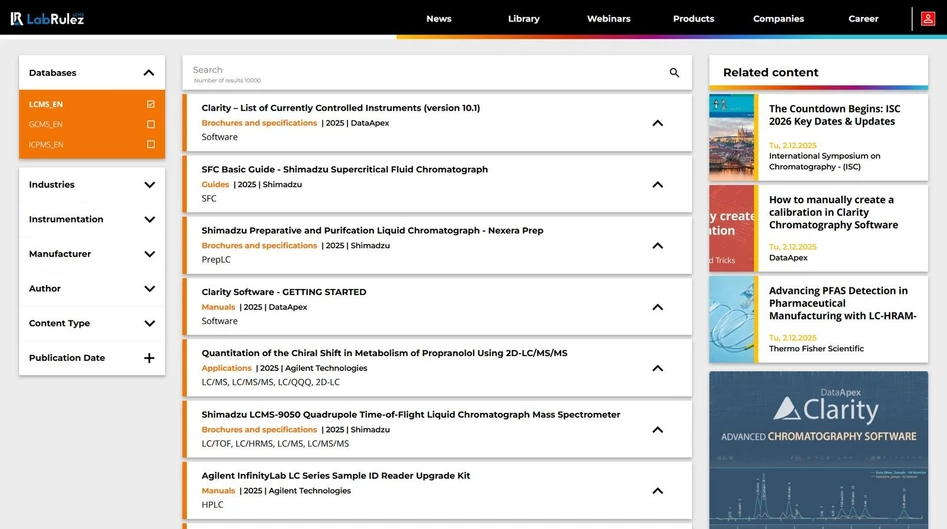
LabRulez: News from LabRulezLCMS Library - Week 49, 2025
Our Library never stops expanding. What are the most recent contributions to LabRulezLCMS Library in the week of 1st December 2025? Check out new documents from the field of liquid phase, especially HPLC and LC/MS techniques!
👉 SEARCH THE LARGEST REPOSITORY OF DOCUMENTS ABOUT LCMS AND RELATED TECHNIQUES
👉 Need info about different analytical techniques? Peek into LabRulezGCMS or LabRulezICPMS libraries.
This week we bring you application notes by Agilent Technologies, Shimadzu and Waters Corporation and poster by Thermo Fisher Scientific / HPLC!
1. Agilent Technologies: Quantitative Bioanalysis of Oligonucleotides Using a 6495D Triple Quadrupole LC/MS System Combined with an Automated SPE Workstation
- Application note
- Full PDF for download
In drug development, the quantitative analysis of oligonucleotides in biological samples is crucial for pharmacokinetics (PK), pharmacodynamics (PD), and toxicological safety evaluations. Due to the associated structural complexity of oligonucleotides and the unique nature of biological matrices, the corresponding sample preparation techniques are often complex. Liquid-liquid extraction (LLE) and solid-phase extraction (SPE) are commonly used sample preparation methods, with SPE being more suitable to meet lower limit of quantitation (LLOQ) requirements and complex matrices.2 However, traditional manual SPE methods are time consuming and prone to human error.
Liquid chromatography/tandem mass spectrometry (LC/MS/MS) is widely used in oligonucleotide bioanalysis due to its high sensitivity, low detection limits, high selectivity, and specificity. Methods using LC/MS/MS enable the rapid and accurate detection and quantification of low-concentration target compounds in complex matrices without the need for special reagents and probes.3
To address the challenges in sample preparation, Agilent developed an automated SPE workstation based on the Bravo liquid handling platform, combined with the next‑generation triple quadrupole LC/MS/MS system, the 6495D triple quadrupole LC/MS system, providing a complete solution from sample preparation to data analysis. The 6495D triple quadrupole LC/MS system excels in high sensitivity quantification and low detection limits from complex matrices, while the automated SPE workstation significantly reduces manual intervention time and improves operational consistency and reliability. This complete automated SPE bioanalysis workflow significantly enhances the efficiency and reliability of quantitative oligonucleotide bioanalysis.
Experimental
Instruments
- Agilent 1290 Infinity III Bio LC
- Agilent 6495D triple quadrupole LC/MS system
- Agilent Automated SPE workstation, including Bravo, BenchCel and MiniHub
Conclusion
This study verified the use of the automated Agilent SPE workstation combined with the Agilent 6495D triple quadrupole LC/MS system for oligonucleotide bioanalysis studies through the quantitative analysis of mipomersen in pig plasma. The experimental results showed that the system exhibited excellent linearity (R²=0.999) within the dynamic range of 2 to 1,000 ng/mL. The reproducibility and accuracy of the QC samples were within acceptable ranges, with most RSD values below 5%, QC low points below 10%, and back‑calculated concentration accuracy between 85 and 115%. Additionally, in the three-day repeatability experiment, the inter-batch reproducibility of the QC samples was good, with RSD values all below 10%. The back-calculated accuracies for QC samples at high, medium, and low concentration levels, as well as the LLOQ (2 ng/mL), remained stable between 80 and 120%.
By reducing manual intervention and improving operational consistency, the automated SPE workstation significantly enhances the efficiency and reliability of sample preparation. Combined with the high sensitivity and low detection limits of the 6495D triple quadrupole LC/MS system, this solution achieves efficient and accurate detection of low‑concentration oligonucleotides in complex matrices. Overall, this automated solution has broad application prospects in high-throughput oligonucleotide bioanalysis and meets the high requirements for quantitative analysis in drug development.
2. Shimadzu: Determination of N-Nitroso-Nebivolol in Nebivolol Drug Substance by LCMS-2050
- Application note
- Full PDF for download
User Benefits
- A new method for the determination of NDSRI impurity in nebivolol raw material was established using LCMS-2050.
- The method has high sensitivity, short analysis time and high accuracy, which can fully meet the FDA's AI limit for N-Nitrosonebivolol.
On September 4, 2024, the FDA issued the final guidance on the control of nitrosamine impurities in human drugs (Nitrosamine Guidance Version 2). The revised guidance describes two categories of nitrosamines: small-molecule nitrosamines and nitrosamine drug substance-related impurities (NDSRIs). Unlike small-molecule nitrosamine impurities that are structurally dissimilar to the active pharmaceutical ingredient (API), NDSRIs generally exhibit structural similarity to the API and may form through interactions between the API and nitrosating agents, such as nitrite impurities present in drug excipients.
Nebivolol is a potent and selective third-generation β-blocker clinically used for the treatment of patients with moderate-tosevere hypertension, as well as angina pectoris and congestive heart failure, with a recommended daily dose of 5 mg. Due to its structural characteristics, the synthesis of nebivolol may involve nitrosation reactions, leading to the introduction of the NDSRI impurity N-nitroso-nebivolol. According to the FDA's nitrosamine guidance, based on the Carcinogenic Potency Categorization Approach (CPCA), the acceptable intake (AI) limit for N-nitroso-nebivolol, a potential NDSRI in nebivolol, is set at 1500 ng/day.
This study established an LC-MS (LCMS-2050) method for the determination of N-nitroso-nebivolol in nebivolol drug substance. The method demonstrates high sensitivity, short analysis time, and accurate results, providing a reference for the detection of related nitrosamine impurities.
Separation Evaluation
To ensure high sensitivity in impurity analysis and prevent contamination of the mass spectrometer by high-concentration active pharmaceutical ingredient (API) components, flow path switching technology was employed. This method diverts the main nebivolol peak to waste, allowing only impurities to enter the mass spectrometer for detection. Under the optimized chromatographic conditions, The retention times of nebivolol and N-nitroso-nebivolol were 1.952 min and 3.408 min, respectively, so the mass spectrometry acquisition was initiated after 2.8 min, ensuring selective detection of the target impurity. This approach effectively enabled accurate and interferencefree analysis of trace-level impurities.
Conclusion
A novel method for determining the content of N-nitrosonebivolol in nebivolol drug substance was established by using the LCMS-2050. Within the concentration range of 1 - 180 ng/mL, the correlation coefficients of the N-nitroso-nebivolol was 0.9999. When the spiked concentration of 0.03 μg/mg and 0.3 μg/mg, the recovery rate of N-nitroso-nebivolol was 100.4 and 100.2, respectively, and the recovery rate was good and met the requirements of pharmacopoeia. The method has high sensitivity, linearity, precision and recovery rate can meet the detection requirements, and which can be used for the detection of nitrosamine impurity N-nitroso-nebivolol in nebivolol drug substance.
3. Thermo Fisher Scientific / HPLC: At the intersection between chromatographic performance, ESI efficiency and instrument productivity: nano to capillary flow LC/MS on long μPAC Columns
- Poster
- Full PDF for download
LC-MS-based proteomics commonly employs low-flow liquid chromatography (LC) to separate tryptic peptides, which helps reduce sample complexity before MS/MS detection and protein identification. This technique benefits from minimal dilution on miniaturized columns and increased ionization efficiency via nanoflow electrospray ionization (ESI). As mass spectrometry (MS) devices become more sensitive and faster, there is an increasing need to boost throughput. The challenge lies in maintaining or increasing proteome coverage while simultaneously reducing analysis time. Typically, higher flow rates improve instrument productivity but may compromise sensitivity. In this study, the impact of eluting flow rates was assessed across various throughput ranges to identify the optimal balance between productivity and proteome coverage. Additionally, the transition to a dual-column single emitter configuration was evaluated to determine its effects on productivity and coverage. This approach aims to enhance LC-MS performance, ensuring high throughput without sacrificing the depth of proteome analysis.
Methods
HeLa cell digests were resuspended in 0.1% TFA and 1% ACN to create a 200 ng/µL stock solution, sonicated, diluted in 0.1% TFA, and vortexed. A Thermo Scientific Vanquish Neo UHPLC instrument was configured for either a single analytical column in a trap-and-elute setup or two columns in tandem. For single column experiments, a Thermo Scientific PepMap Neo trap cartridge and a 110 cm µPAC Neo Plus column on a Thermo Scientific EASY-Spray source were used. LC methods with flow rates from 200 to 1000 nL/min were tested for throughputs ranging from 16 to 50 samples per day. The column was positioned in an external heating device mounted directly onto the ionization source and connected to an ESI emitter via a 20 µm ID voltage spacer. For tandem column experiments, two 110 cm µPAC Neo Plus columns were placed in the Vanquish Neo UHPLC column compartment between two low-dispersion 6-port switching valves. A 20 µm ID nanoViper line connected the eluents to an ESI emitter with an integrated liquid junction in an EASY-Spray source. Data were acquired using a Thermo Scientific Orbitrap Exploris 240/480 mass spectrometer in data-independent acquisition mode.
Data Analysis
LC-MS data were analyzed either using a trial version of Thermo Scientific Proteome Discoverer 3.3 software with Chimerys or with Spectronaut® 19. Results shown have been filtered to a 1% FDR
Conclusions
- Increasing the flow rate to 1 µL/min significantly increases instrument productivity. For gradient times below 30 minutes, 1 µL/min performs slightly better than lower flow methods, identifying up to 6679 protein groups at 50 SPD.
- For gradient lengths over 50 minutes, a 200 nL/min flow rate provides superior chromatographic metrics and proteome coverage, resulting into a maximum of 8556 protein groups identified at 16 SPD.
- The negative impact of a low-dispersion 6-port valve's impact scales inversely with flow rate. At 1 µL/min, peak width increases by 40%, yielding 5% lower proteome coverage but 26% higher productivity.
- Optimized dual column single-emitter methods identified up to 6947 protein groups at 50 SPD with 3-6% CVs for the same column and 4-8% between columns (n=6).
- Column reproducibility was shown across 5 columns, with an ID rate variation of 0.7% for HeLa digests and a median RT CV of 0.99% for spiked-in PRTC peptides.
4. Waters Corporation: Improving Sample Throughput of HPLC Methods Using CORTECS 5 μm Columns
- Application note
- Full PDF for download
Benefits
- Comparable chromatographic performance for abacavir impurities was achieved using a shorter CORTECS Premier C18 5 µm Column in place of a column packed with fully porous 5 µm particles
- 33% reduction in solvent usage and analysis time using a CORTECS Premier C18 5 µm Column compared to a fully porous 5 µm column
- 33% reduction in analytical method greenness score indicating improved sustainability for the new method
Improving validated HPLC methods can be challenging. Two of the approaches to increase analytical throughput, increasing mobile phase flow rate or using shorter columns, have drawbacks in higher pressures or reduced chromatographic performance. Typically, using a shorter column also requires decreasing the particle size to maintain a constant length to particle size (L/dp) ratio to ensure similar column efficiency. However, columns packed with smaller particles generate higher back pressures. Some labs may be able to migrate methods to shorter columns packed with smaller particles by transferring to a HPLC system capable of operating at higher pressures. However, if a laboratory lacks access to such systems, then their options may be limited. In those situations, finding appropriate columns to use to improve a method is not only a matter of chromatographic performance but also system compatibility, particularly from a pressure standpoint. Older HPLC systems are limited to lower pressures compared to more modern systems.
This application brief examines the improvement of a method for testing abacavir impurities by migrating the original method from a 4.6 x 150 mm 5 µm fully porous C18 column to a CORTECS Premier C18 4.6 x 100 mm 5 µm Column. Additionally, a fully porous 3.5 µm C18 column in 4.6 x 100 mm hardware was evaluated to determine if moving to a smaller particle size would have as much of a benefit as that provided by using a CORTECS Column. The separation conditions for method migration were obtained using the Waters Column Calculator. Along with examining throughput, solvent savings were calculated as well as analytical method greenness scores for each column tested.
Experimental
Method Conditions
- LC system: Alliance™ HPLC System with 2489 UV/Visible (UV/Vis) Detector
Data Management
- Chromatography software: Empower™ Chromatography Data System (CDS)
Results and Discussion
Previously, the impurity method for abacavir was migrated to a 2.7 µm CORTECS Column.1 While that work showed the benefits of scaling to a smaller particle size, not all laboratories are comfortable moving to such a small particle size. In those instances, moving from a 5 µm to a 3.5 µm particle column is a good first step. However, depending on the method, this migration might not be appropriate and could result not only in elevated system pressure but also performance loss. Figure 1 shows the chromatograms for abacavir impurities using the original method column, a 3.5 µm C18 column, and the CORTECS Premier C18 5 µm Column.
Conclusion
CORTECS Premier 5 µm Columns are suitable alternatives for fully porous 5 µm columns for improving validated HPLC methods. Using a CORTECS solid-core stationary phase can allow for a shorter column to be used because of their higher efficiency per unit length. To highlight this, the impurity method for abacavir was migrated from the original fully porous 5 µm, 4.6 x 150 mm column to a CORTECS Premier C18 5 µm, 4.6 x 100 mm Column, as well as a 4.6 x 100 mm 3.5 µm fully porous column. The use of the CORTECS Column achieved comparable separation performance as the original while also exhibiting a shorter analysis time, lower solvent usage, and a better AMGS value.