N‑Glycans, Whey Protein, and the Gut Microbiome: Mass Spec Insights with Matthew Bolino

- Photo: Concentrating on Chromatography: N‑Glycans, Whey Protein, and the Gut Microbiome: Mass Spec Insights with Matthew Bolino
- Video: Concentrating on Chromatography: N‑Glycans, Whey Protein, and the Gut Microbiome: Mass Spec Insights with Matthew Bolino
🎤Matthew Bolino
How do the hidden carbohydrate structures on your favorite protein powders shape the gut microbiome? In this episode of Concentrating on Chromatography, Matthew Bolino, M.S., from the University of Nevada, Reno, breaks down his latest research on N‑glycans from common dietary proteins (whey, egg white, soy, and pea) and how their structural diversity influences microbial fermentation and short‑chain fatty acid production.
Bolino explains what N‑glycans are, why they behave like fiber in the gut, and how his team isolates and characterizes them using ethanol washes, enzymatic release (PNGase F and gut‑derived endoglycosidases), and advanced MALDI‑TOF and HILIC‑QTOF workflows. He also discusses his 2025 work comparing synthetic versus bovine whey N‑glycomes and mapping N‑glycan profiles across dietary protein sources, revealing how glycan architecture can reshape community diversity in in vitro fecal fermentations.
Geared toward undergraduate and early‑career analytical chemists, this conversation dives into practical mass spec trade‑offs (MALDI vs QTOF vs LC/GC), real‑world troubleshooting in glycomics labs, and how microbiome‑targeted therapeutics and “symbiotic” designs may emerge from pairing specific microbes with preferred glycan structures. Bolino closes with career advice on building biomolecular analysis skills, understanding instrumentation fundamentals, and entering the rapidly growing field of glycomics and microbiome research.
Video Transcription
Introduction
Glycomics has emerged as a rapidly developing field within biomolecular science, expanding our understanding of post-translational modifications beyond well-known processes such as phosphorylation. Among these modifications, protein glycosylation—the covalent attachment of carbohydrate structures to proteins—plays a critical role in biological function, molecular recognition, and cellular communication.
This discussion focuses on N-glycans, a class of structurally complex carbohydrates linked to proteins, and their occurrence in common dietary protein sources such as whey, egg white, soy, and pea protein. Particular emphasis is placed on their structural diversity, analytical workflows, and emerging relevance in gut microbiome research.
Fundamentals of N-Glycans
N-glycans are oligosaccharide structures covalently attached to proteins via nitrogen atoms, typically at asparagine residues. They represent one of the two major classes of protein glycosylation, alongside O-glycans.
These glycans are characterized by:
- High structural diversity, arising from variations in monosaccharide composition and linkage patterns
- Large size, typically comprising 7–15 monosaccharide units
- Complex branching architectures, leading to a vast number of possible configurations
Common monosaccharide components include:
- Mannose
- Galactose
- N-acetylglucosamine
- N-acetylgalactosamine
- Sialic acids
Unlike free carbohydrates present in foods (e.g., glucose, lactose), N-glycans are protein-bound, which significantly influences their biological behavior.
Biological Function and Dietary Relevance
N-glycans play multiple roles in biological systems, including:
- Modulation of protein stability
- Regulation of protein trafficking and localization
- Facilitation of cell–cell communication and immune recognition
They are particularly abundant on membrane and surface proteins, where they contribute to molecular signaling processes.
From a dietary perspective, N-glycans exhibit unique behavior. Due to their size and protein-bound nature, they are not readily digested in the upper gastrointestinal tract. Instead, they can reach the colon, where they may function analogously to dietary fiber, interacting with the gut microbiota.
Research Motivation
The investigation of N-glycans in dietary proteins was initially driven by interest in protein nutrition and supplementation, particularly in the context of muscle growth and protein quality. However, this focus expanded upon recognition of the importance of glycosylation in biological systems.
The field of glycomics offers:
- Extensive structural variability, enabling diverse biological functions
- Relevance in disease mechanisms, including cancer, where glycosylation patterns can influence immune evasion
- Opportunities to explore diet–microbiome interactions
This combination of nutritional, biochemical, and biomedical relevance makes N-glycan research particularly compelling.
Experimental Workflow for N-Glycan Analysis
The analysis of N-glycans requires a multi-step workflow due to their covalent attachment to proteins.
1. Protein Purification
Dietary protein samples often contain:
- Free sugars
- Lipids
- Other matrix components
To isolate glycoproteins:
- Cold ethanol precipitation is used to remove free carbohydrates
- Multiple washing steps ensure removal of residual sugars
- A phenol–sulfuric acid assay is applied to confirm the absence of free sugars
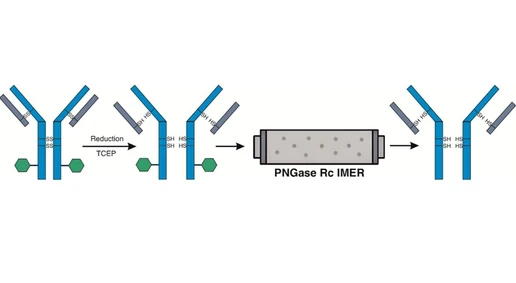
2. Enzymatic Release of N-Glycans
N-glycans are enzymatically cleaved from proteins using:
- PNGase F (Peptide-N-Glycosidase F)
This enzyme:
- Specifically cleaves the glycan from the protein backbone
- Preserves the intact glycan structure
Alternative approaches using gut-derived enzymes are being explored to improve accessibility and yield.
3. Glycan Purification and Labeling
Following release:
- Glycans are purified from the protein matrix
- Chemical labeling is performed (e.g., 2-AA or procainamide tagging)
Labeling enhances:
- Detection sensitivity
- Chromatographic behavior
4. Analytical Techniques
Two primary analytical platforms are employed:
- MALDI-TOF MS
- High sensitivity
- Broad structural coverage
- HILIC-LC-MS
- Improved reproducibility
- Enhanced chromatographic separation
These approaches provide semi-quantitative data, where signal intensity reflects relative abundance rather than absolute concentration.
Analytical Challenges
Several challenges are associated with N-glycan analysis:
Low Abundance
- Dietary proteins typically contain only 1–2% glycan content by weight
- This limits yield and complicates downstream applications
Sample Preparation Complexity
- Extensive purification is required to eliminate free sugars
- Contamination risks must be carefully managed
Instrumentation Trade-Offs
- Different analytical platforms offer complementary advantages
- No single technique provides complete structural and quantitative information
Differences Between Plant and Animal N-Glycans
Comparative analysis reveals distinct differences in glycan composition:
Plant-Derived Proteins (e.g., soy, pea)
- Predominantly high-mannose structures
- Lower monosaccharide diversity
- Simpler glycan architectures
Animal-Derived Proteins (e.g., whey, egg white)
- Greater structural complexity
- Inclusion of diverse monosaccharides (e.g., sialic acids)
- More elaborate branching patterns
These differences have important implications for biological function and microbial interactions.
Implications for Gut Microbiome Research
N-glycans represent a potential class of prebiotic substrates that can influence gut microbiota composition and activity.
Key findings suggest:
- Structural diversity of glycans affects microbial utilization patterns
- More complex glycans may promote greater microbiome diversity
- Specific glycan structures may selectively stimulate beneficial microbes
This has led to growing interest in:
- Synbiotic strategies, combining microbes with preferred substrates
- Tailored dietary interventions to enhance metabolic outputs, such as short-chain fatty acids
Methodological Considerations
A critical insight from this work is the importance of understanding analytical trade-offs:
- MALDI-TOF MS provides broader detection of glycan structures
- LC-MS approaches offer greater reproducibility
No single technique is universally optimal; instead, method selection should be guided by the specific research question.
Conclusion
N-glycans in dietary proteins represent a complex and biologically significant class of biomolecules with implications spanning nutrition, microbiology, and disease research. Advances in analytical methodologies continue to improve our ability to characterize these structures, despite challenges related to low abundance and structural diversity.
A deeper understanding of N-glycan composition and function may enable the development of targeted nutritional strategies and microbiome-based therapeutics, highlighting the growing importance of glycomics in modern life sciences.
This text has been automatically transcribed from a video presentation using AI technology. It may contain inaccuracies and is not guaranteed to be 100% correct.
Concentrating on Chromatography Podcast
Dive into the frontiers of chromatography, mass spectrometry, and sample preparation with host David Oliva. Each episode features candid conversations with leading researchers, industry innovators, and passionate scientists who are shaping the future of analytical chemistry. From decoding PFAS detection challenges to exploring the latest in AI-assisted liquid chromatography, this show uncovers practical workflows, sustainability breakthroughs, and the real-world impact of separation science. Whether you’re a chromatographer, lab professional, or researcher you'll discover inspiring content!
You can find Concentrating on Chromatography Podcast in podcast apps:
and on YouTube channel