The importance of temperature control in preparative liquid chromatography.
KNAUER: The importance of temperature control in preparative liquid chromatography.
Eluent Preheating in Preparative HPLC: Why It Matters and What It Improves
In preparative high-performance liquid chromatography (HPLC), where large-format columns and elevated flow rates are routinely used, temperature control becomes a decisive factor for achieving reliable separation performance. Although many HPLC systems are equipped with column ovens to regulate column temperature, heating the mobile phase before it reaches the column is often just as important. If the incoming eluent is significantly cooler than the column, thermal imbalance can occur, leading to temperature gradients, lower separation efficiency, and compromised peak shapes.
This article explains why eluent preheating is important in preparative HPLC and summarizes the practical advantages it offers. It also presents the role of KNAUER Heating Sleeves and the KNAUER High Flow Eluent Heater, both of which are designed to provide stable and controlled thermal conditions in preparative LC workflows.
Why Eluent Preheating Is Important in Preparative HPLC
Larger column dimensions and thermal gradients
Preparative HPLC columns usually have much larger inner diameters than analytical columns. As the column diameter increases, it becomes more difficult for a conventional column oven, which heats the column from the outside, to heat the full column cross-section evenly. This challenge becomes even more pronounced when room-temperature solvent continuously enters the column and cools its internal core.
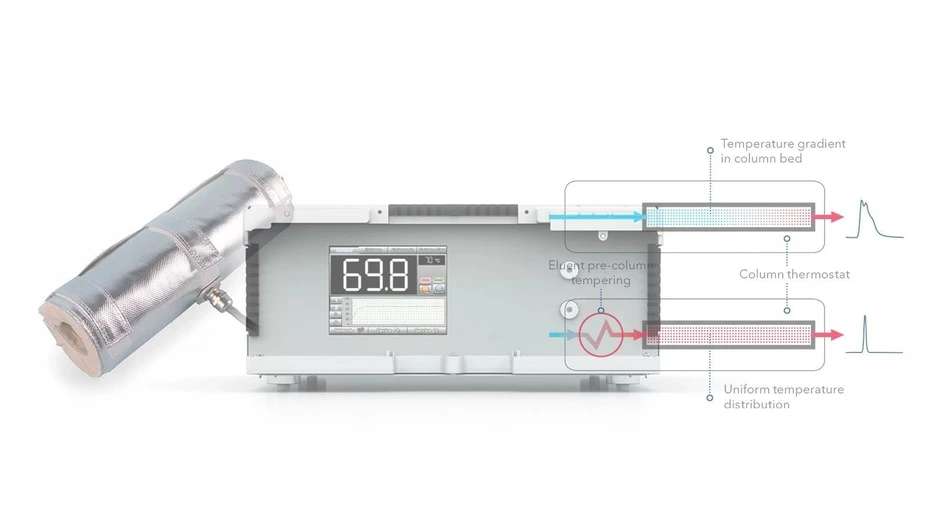
When a cold mobile phase enters a heated column, it can create a radial temperature gradient: the outer part of the column remains warmer, while the center stays cooler. As a result, different parts of the column operate under different temperature conditions. This affects solvent viscosity, retention behavior, and mass transfer, causing analytes to migrate unevenly through the column bed. The practical consequence is often peak broadening, distortion, or loss of resolution.
Effects on peak shape and chromatographic efficiency
If the eluent temperature does not match the column temperature, column performance can deteriorate substantially. In one reported example using a 4 mm ID column under fast UHPLC conditions, a radial thermal gradient reduced the effective plate count by more than 50%, severely affecting the separation.
In preparative HPLC, the risk is even greater because columns often have inner diameters of 20 mm, 50 mm, or even 100 mm. Experiments with a 20 mm ID preparative column showed that running at 40 °C without mobile phase preheating resulted in poor peak shapes. Only when the mobile phase was preconditioned to the same temperature as the column did the peaks become sharp and symmetric again.
This clearly shows that temperature mismatches can cause severe band broadening or even peak splitting, while proper preheating helps preserve peak integrity.
Frictional heating at high flow rates
Preparative HPLC also operates at much higher flow rates than analytical methods, which can generate significant frictional heat inside the column. The amount of heat generated is related to the product of pressure and flow rate. In practical terms, 800 bar at 1 mL/min can generate a similar heating effect as 400 bar at 2 mL/min.
In preparative chromatography, pressures may be lower, for example 100–200 bar, but flow rates can reach 10–50 mL/min or more. This means that frictional heating can still be considerable. If the incoming solvent is much cooler than the column, the internally generated heat may intensify temperature differences both along the column and across its radius. Therefore, even at moderate pressure, very high flow rates require careful thermal management.
Without eluent preheating, a preparative column operated at elevated temperature may suffer from:
- Radial temperature differences between the column core and the column wall, resulting in non-uniform separation conditions
- Lower efficiency and resolution due to thermally induced band broadening
- Poor peak shapes, including tailing, fronting, or peak splitting caused by uneven temperature distribution
- Variable retention times, because different regions of the column effectively operate at different temperatures
- Potentially increased backpressure, since colder solvent entering a heated column has higher viscosity until it reaches thermal equilibrium
These issues demonstrate why mobile phase preheating is often necessary in preparative HPLC. It ensures that the solvent enters the column at, or close to, the target column temperature, reducing thermal shock and minimizing temperature gradients.
Benefits of Eluent Preheating
Preheating the eluent helps establish stable and uniform thermal conditions throughout the chromatographic system. This provides several important advantages.
Sharper peaks and improved efficiency
When the mobile phase is heated to match the column temperature, the column operates under near-isothermal conditions. This minimizes radial thermal gradients and allows the entire sample band to travel through a consistent separation environment. As a result, peak shape improves, band broadening is reduced, and separation efficiency increases. This is especially important for large-diameter preparative columns.
Reproducible retention times
Retention times are sensitive to temperature. Preheating the mobile phase helps keep the entire column, from inlet to outlet, at a stable and defined temperature. This improves run-to-run reproducibility and supports reliable method transfer and scale-up.
Avoidance of thermal mismatch effects
A controlled thermal environment prevents problems that occur when cold solvent enters a hot column. These include distorted peak shapes, irregular peak profiles, and peak splitting. Optimal results require not only heating the column itself, but also equilibrating the complete flow path. A preheated eluent ensures that the conditions at the column inlet match the conditions inside the column.
Lower solvent viscosity and reduced backpressure
Heating the mobile phase reduces solvent viscosity. A warmer solvent flows more easily through the column, which can lower system backpressure. This is particularly useful in preparative HPLC, where high flow rates and viscous solvent mixtures may otherwise approach pump pressure limits. Reduced viscosity can also improve mass transfer kinetics and may support faster, more efficient separations.
Better performance and higher throughput
With improved peak shape, better resolution, and potentially higher flow rates, preparative productivity can increase. Larger sample amounts can be processed more efficiently without sacrificing separation quality. Stable temperature control also improves method robustness, which is especially valuable in regulated environments and scale-up workflows.
In short, eluent preheating is not only a convenient enhancement. In many preparative HPLC applications, it is essential for achieving stable, reproducible, and high-quality separations.
Preparative HPLC With and Without Eluent Preheating
Column temperature profile
- Without preheating: Significant radial and axial temperature gradients may form. The center of the column can remain cooler than the outer region.
- With eluent preheating: Temperature is more uniform throughout the column, with minimal radial gradients.
Peak shape and efficiency
- Without preheating: Peaks may become broadened, tailing, fronting, or split due to thermal mismatch and uneven analyte migration. Efficiency can be strongly reduced.
- With eluent preheating: Peaks remain sharper and more symmetric. Band broadening is minimized and the column can deliver its full efficiency potential.
Retention time stability
- Without preheating: Retention times can become less predictable because the solvent warms inside the column during the run.
- With eluent preheating: Retention times are highly reproducible due to stable isothermal conditions.
Backpressure
- Without preheating: Backpressure may initially be higher because cold solvent has greater viscosity when it enters the heated column.
- With eluent preheating: Backpressure is lower and more consistent because solvent viscosity is reduced before column entry.
Throughput and sample load
- Without preheating: Operating conditions may need to be more conservative to avoid thermal effects, limiting flow rate or loading.
- With eluent preheating: Higher flow rates and larger loads can often be used while maintaining chromatographic performance.
By solving these thermal challenges, eluent preheating helps protect separation quality and allows users to fully exploit the capabilities of preparative columns.
KNAUER Heating Sleeves for Uniform Column Temperature
KNAUER Heating Sleeves are designed to maintain stable column temperature across the full column body, particularly for large preparative columns that may not fit into standard column ovens. These flexible heaters wrap directly around the column and provide uniform heat along its length.
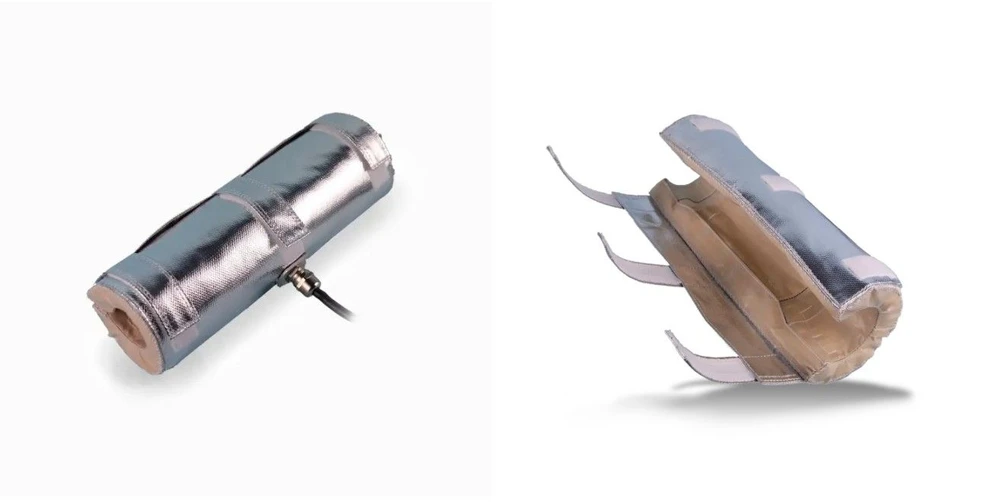 KNAUER: Column heating sleeves
They can thermostatically control column temperature up to 100 °C and are suitable for very large columns, up to 1000 mm in length and 100 mm ID. This makes them highly suitable for preparative applications, where column dimensions are often customized and difficult to accommodate in conventional thermostatted compartments.
Key features and advantages include:
- Direct and uniform heating for large columns: Heating sleeves transfer heat directly to the column wall, unlike air-based ovens that may struggle with larger column diameters. This helps eliminate cold spots and improves temperature consistency.
- Custom fit and broad compatibility: KNAUER Heating Sleeves are available in standard sizes and can also be manufactured for specific column dimensions. They can accommodate preparative columns up to 100 cm in length and 10 cm in diameter.
- Temperature range up to 100 °C: This covers the typical temperature range used in HPLC method development and preparative purification. Elevated temperatures, such as 50–80 °C, can improve separation behavior and reduce solvent viscosity.
- Improved chromatographic performance: By maintaining the column at the desired temperature, the sleeves help reduce solvent viscosity, lower backpressure, and improve mass transfer. This can support more efficient preparative separations.
- Easy installation and flexible setup: Heating sleeves are compact and easy to mount. They do not require bulky oven hardware and can be used in flexible system configurations.
When combined with an eluent preheater, a column heating sleeve helps ensure that both the mobile phase and column remain thermally equilibrated throughout the separation.
KNAUER High Flow Eluent Heater for Pre-Column Temperature Control
While the heating sleeve controls the temperature of the column itself, the KNAUER High Flow Eluent Heater heats the mobile phase before it reaches the column inlet. Devices such as the AZURA® ELH 2.1L Eluent Heater are specifically designed for the high flow rates used in preparative LC.
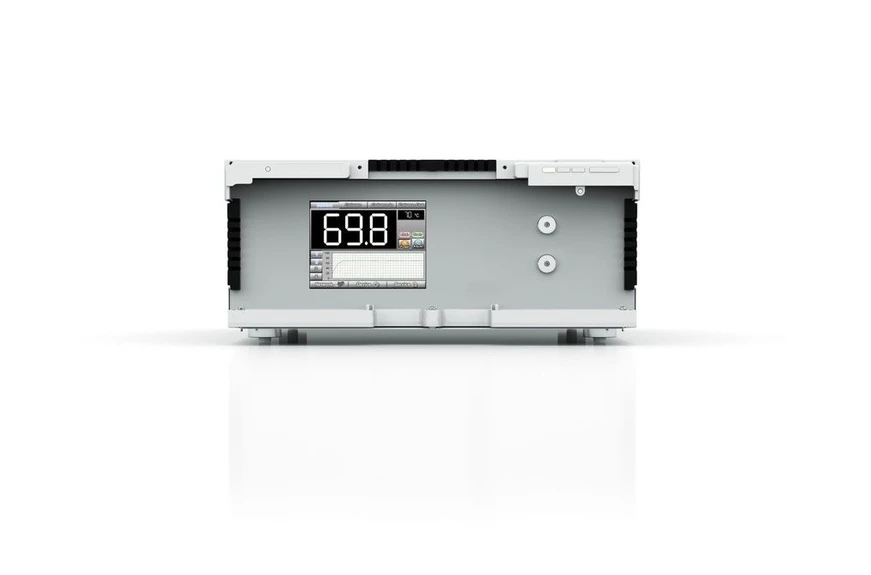 Knauer: AZURA® ELH 2.1L High-Flow Eluent Heater Single Channel, with One Column Heating Plug
The eluent heater is typically installed after the pump and injector. As the mobile phase passes through the heating coil, it is brought to the target temperature before entering the column. This prevents a cold solvent front from disturbing the thermal equilibrium of the column.
Important features and advantages include:
- Support for high flow rates: The device is designed for preparative-scale flow rates up to 300 mL/min, covering a wide range of semi-preparative and preparative applications.
- Wide temperature range: The heater can bring eluents up to 100 °C, providing flexibility for method optimization and viscosity reduction.
- Dual eluent channels: Depending on the configuration, the system can heat two solvent streams in parallel, which is useful for binary solvent systems or dual-column setups.
- Column sleeve integration: The AZURA ELH 2.1L can control the temperature of up to two eluents and support two column heating sleeves, allowing coordinated thermal management of both solvent and column.
- Precise temperature control with low dead volume: The device uses efficient heating coil cartridges designed to minimize dispersion. External PT100 sensors can monitor temperatures at key points, such as the column inlet and outlet.
- Software and touchscreen control: The heater integrates with KNAUER AZURA preparative HPLC systems and can be controlled via PurityChrom® software or through an integrated 5.7” color touchscreen.
- Cleanroom-compatible version: KNAUER also offers versions suitable for cleanroom environments, supporting eluent preheating and column sleeve control in one device.
By heating the mobile phase before it reaches the column, the High Flow Eluent Heater prevents sudden temperature drops at the column inlet and reduces the formation of thermal profiles inside the column.
Conclusion
Eluent preheating is a critical factor in preparative HPLC, where large column dimensions and high flow rates make temperature control more challenging than in analytical-scale separations. By reducing temperature differences between the mobile phase and the column, preheating helps preserve efficiency, resolution, and reproducibility.
In practice, this means sharper peaks, more stable retention times, lower and more consistent backpressure, and improved high-throughput purification performance.
KNAUER offers dedicated temperature-control solutions for preparative HPLC, including Heating Sleeves for large columns and the High Flow Eluent Heater for pre-column mobile phase conditioning. Together, these tools address common thermal problems such as radial gradients, cold solvent effects, and frictional heating.
For laboratories working with preparative HPLC, eluent preheating and column heating are straightforward but highly effective steps toward more reproducible, efficient, and high-performing separations.
For further information on this topic, please contact our author: [email protected]