News from LabRulezLCMS Library - Week 13, 2026
LabRulez: News from LabRulezLCMS Library - Week 13, 2026
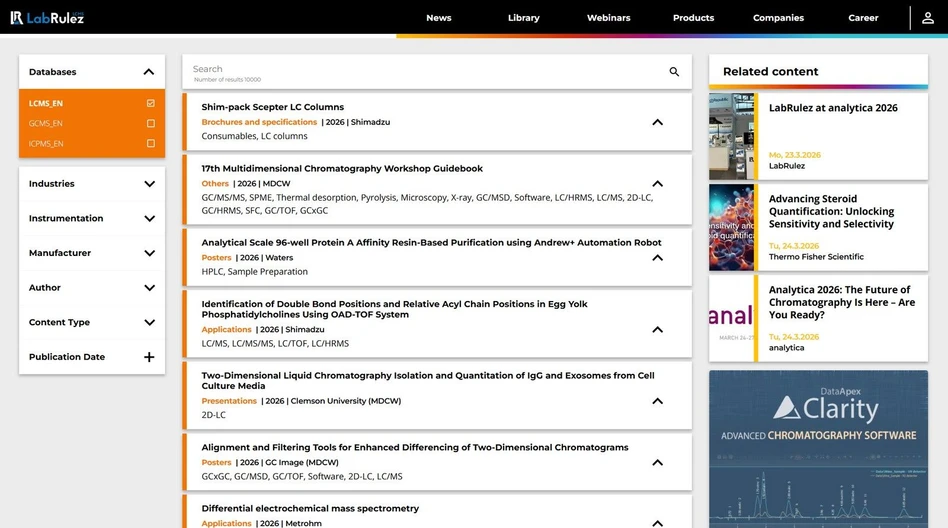
Our Library never stops expanding. What are the most recent contributions to LabRulezLCMS Library in the week of 23rd March 2026? Check out new documents from the field of liquid phase, especially HPLC and LC/MS techniques!
👉 SEARCH THE LARGEST REPOSITORY OF DOCUMENTS ABOUT LCMS AND RELATED TECHNIQUES
👉 Need info about different analytical techniques? Peek into LabRulezGCMS or LabRulezICPMS libraries.
This week we bring you application notes by Agilent Technologies, KNAUER and Shimadzu, brochure by Thermo Fisher Scientific and poster by Waters Corporation!
1. Agilent Technologies: Sensitive Detection of Aflatoxins by the Agilent 1290 Infinity III Fluorescence Detector
- Application note
- Full PDF for download
Aflatoxins are produced by mold fungus growing on crops under production and storage conditions. The typically naturally occurring aflatoxins are aflatoxin B1, B2, G1, and G2, and their degraded compounds aflatoxin M1 and M2. Since they are highly toxic and carcinogenic, they must be monitored due to government regulations with strict limits at the lowest possible concentration. Unfortunately, the determination of the concentration of aflatoxins by UV detection is not sensitive enough. However, aflatoxins are fluorescence active if excited at the right wavelength.
In the past, postcolumn derivatization (for example, by bromination) was required to enhance the fluorescent activity of the aflatoxins. With the highly sensitive 1290 Infinity III FLD, this step can be skipped, saving time and costs. This application note demonstrates the measurement of aflatoxins without postcolumn derivatization at high sensitivity for low LODs and LOQs.
Experimental
Instrument setup
- Agilent 1290 Infinity III High-Speed Pump (G7120A)
- Agilent 1290 Infinity III Multisampler (G7167B)
- Agilent 1290 Infinity III Multicolumn Thermostat (G7116B)
- Agilent 1290 Infinity III FLD (G7123B) equipped with a 13 μL flow cell (p/n G7123-60500)
Software
Column
- Agilent ZORBAX RRHD Eclipse Plus C18, 2.1 × 100 mm, 1.8 µm (p/n 959758-902)
Results and discussion
The naturally occurring aflatoxins G1, G2, B1, B2, and their degradation compounds aflatoxin M1 and M2 are highly potent toxic and carcinogenic compounds. Therefore, they require ultrasensitive detection in the lower single digit ng/L (fg/µL) range, especially in food stuffs like peanuts or dairy products. Advantageously, they are fluorescence active compounds, which enables detection with minimized matrix interaction at high sensitivity. To prove that the 1290 Infinity III FLD fulfills the requirements of highest sensitivity, calibration curves were measured for the mentioned aflatoxins over five decades starting at 100,000 down to 1 ng/L (fg/µL). Figure 1A displays an overlay of 1, 2, 10, and 20 ng/L and Figure 1B an overlay of 100,000, 50,000, 20,000, and 10,000 ng/L for all six aflatoxins measured by FLD. The measurement was done under UHPLC conditions with a 2.1 mm i.d. column and sub-2 micron material within a total run time of 5 minutes.
Conclusion
This application note proves that the Agilent 1290 Infinity III Fluorescence Detector is capable of measuring fluorescent‑active aflatoxins without post-column derivatization at high sensitivity down to the single-digit fg/µL level. All LODs for the aflatoxins G2, G1, B2, B1, M2, and M1 were below 1 fg/µL. Calibrations for quantification over five decades between 1 and 100,000 ng/L showed excellent linearity.
2. KNAUER: The Heat is On – Thermal optimization of HPLC systems with the KNAUER Eluent Preheating Cartridge
- Application note
- Full PDF for download
In HPLC method development temperature control is a factor that can decide between a fast and efficient separation or a poorly resolved chromatogram. It is in general not possible to reliably predict a direct correlation between a raised temperature and chromatographic performance increase. Though, many HPLC application use cases show positive improvements with a raised temperature. Oftentimes, narrower peaks with a better gaussian shape can be observed.
Another benefit of elevated column temperature can be the reduced viscosity of the eluent. It can positively improve the column efficiency since flow velocity and therefore the exchange of substances is increased. Thus, shorter analysis times and decreased system pressures are achievable. As a result, many UHPLC applications require a raised temperature to enable ultrashort runtimes. In most common reversed phased applications, the column temperature is situated above 30 °C.
It is important to keep in mind that all chromatographic equilibriums are temperature dependent. Therefore, this principle also applies for LC-modes besides reversed phase such as ion-exchange or normal phase applications. A fact that is often overlooked is the influence of eluent temperature. In most cases the eluent supply is stored in bottles on top of the HPLC system at ambient temperature. Therefore, the solvents are at best at a stable temperature provided that the laboratory environment is air conditioned. In any case when working with an elevated column temperature a significant difference to the eluent bottle temperature is unavoidable.
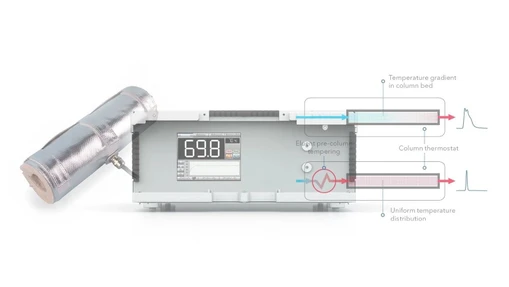
It is therefore crucial to normalize the eluent temperature before it enters the column. The KNAUER Eluent Preheating Cartridges available for the AZURA® CT 2.1 column thermostat are best suited for this task. They are combining minimal dead volume with maximum heat exchange capabilities. The Eluent Preheating Cartridges can be retrofitted to any CT 2.1 column thermostat within minutes.
The forced hot air column thermostat will heat up the heat exchanger within the cartridge to the target temperature. The eluent is now more efficiently tempered using heat conduction instead of heat convection. Eluent temperature is raised to target and is now entering the column with only a small difference.
In this TechNote the effect of the KNAUER Eluent Preheating Cartridge is showcased using a well-established USP application for the pharmaceutical quality control of citalopram.
MATERIAL AND METHODS
- System: AZURA® Analytical (U)HPLC 862 bar System
- Pump: AZURA® P 6.1L High Pressure Pump with 5 ml pump head, stainless steel
- Injection: AZURA® Autosampler AS 6.1L with 100 µl loop
- Column tempering:
- AZURA® CT 2.1
- Eluent Preheating Cartridge for CT 2.1
- Column:
- Detector: AZURA® DAD 6.1L
- Flow cell: High Sensitivity KNAUER LightGuide UV Flow Cell Cartridge
- Capillaries: AZURA® Analytical MarvelXACT™ StartUp kit for ULDC & UHPLC systems, Set of capillaries, connectors and adapters
- Software:
- ClarityChrom® 9.1.0 - Workstation, autosampler control included
- ClarityChrom® 9.1.0 - PDA extension
CONCLUSION
Whenever working with tempered columns, eluent temperature stabilization is key. If the target temperature differs from the room temperature by a large amount an eluent preheating cartridge should be considered. The eluent preheating cartridges available for the AZURA CT 2.1 column thermostat come in two different volume sizes for minimal overall dead volume. The internal diameter of the installed cartridge can be selected to suit the system configuration: 0.18 mm ID for HPLC and 0.1 mm ID for UHPLC and ULDC applications. They can be retrofitted to any CT 2.1 with minimal effort by the user. Since chromatographic performance may drastically increase, eluent tempering can in some cases make the difference between reaching LOD and failing system suitability. Therefore, the use of the AZURA Eluent Preheating Cartridge is highly recommended for all applications at raised column temperatures and flow rates greater than 0.5 ml/min.
3. Shimadzu: Performance Evaluation of Microbial Identification Using a Benchtop MALDI-TOF MS
- Application note
- Full PDF for download
User Benefits
- Microbial species can be identified with high accuracy using a database containing over 80,000 registered entries.
- Post-acquisition data are processed by a cloud-based identification algorithm, enabling simple and rapid result output.
- By using the MALDI-8020 / 8030 EasyCare with standardized measurement procedures, highly reproducible data acquisition is achieved
Microbial identification is a fundamental technology supporting research and development, quality control, and risk management across diverse fields, including human health, food, and environmental sciences. In recent years, MALDI-TOF MS has been increasingly adopted for on-site microbial testing because it enables rapid identification with simple sample preparation. However, conventional fingerprint-based methods relying on MALDI mass spectral pattern matching face challenges when reference spectra are unavailable, often requiring the construction of in-house spectral libraries.
MicrobialTrack, a MALDI-TOF MS–based microbial identification software, employs a proteomics-based approach*1 derived from genetic information of more than 80,000 taxonomically classified prokaryotic microorganisms. This method enables identification of prokaryotic microorganisms with higher discriminatory resolution than 16S rRNA gene sequence analysis, without the need to build in-house spectral libraries. In this application news, the identification performance of MicrobialTrack combined with the benchtop MALDI-TOF MS system MALDI-8030 EasyCare (Fig. 1) was evaluated using 50 bacterial strains with high analytical demand in research, food, and industrial applications.
*1 The proteomics-based approach refers to a class of methods in which theoretical protein mass patterns predicted from genomic information are compiled into a database and compared with experimentally acquired mass spectra of microbial proteins for microbial identification. In MicrobialTrack, a theoretical MS spectral database is constructed based on public nucleotide sequence databases, and microbial nomenclature and taxonomy follow the Genome Taxonomy Database (GTDB). Because new species registration and updates to taxonomic classification and nomenclature occur frequently, the database is regularly updated to reflect these changes.
MALDI-TOF MS measurement and microbial identification
MALDI-TOF MS spectra were acquired using the benchtop MALDI-TOF MS system MALDI-8030 EasyCare. Measurements were performed in linear positive ion mode over a mass range of m/z 3,500–20,000. Escherichia coli DH5α Electro-Cells (Takara Bio) were used for mass calibration. The acquired MALDI-TOF MS spectra were exported in ASCII format and analyzed for microbial identification with MicrobialTrack.
Conclusion
In this study, microbial identification performance was evaluated using the MALDI-8030 EasyCare in combination with MicrobialTrack for 50 bacterial strains with high analytical demand in research, food, and industrial fields. Using the DS method, agreement with the reference species name at an identification confidence of High or above was confirmed for 46 of the 50 strains. For three of the four strains that were difficult to identify using the DS method, switching the sample preparation method to the FA or EtOH method resulted in agreement with the reference species names, demonstrating that optimization of sample preparation methods is effective for improving identification performance.
MicrobialTrack is based on a predictive database comprising more than 80,000 entries and rapidly provides identification results by analyzing acquired MALDI-TOF MS cloud-based system. In cases where phylogenetically closely related species exist, MicrobialTrack does not present a potentially misleading single species name; instead, it reports candidates as a species complex, thereby providing practical identification results while maintaining taxonomic validity. MicrobialTrack is a useful microbial identification tool across a wide range of applications, from research to quality control and routine testing.
4. Thermo Fisher Scientific: Transcend LX UHPLC Systems
- Product specification
- Full PDF for download
The Thermo Scientific Transcend LX UHPLC systems are designed to significantly increase LC-MS productivity by enabling multichannel liquid chromatography, where up to four independent LC channels are connected to a single mass spectrometer. This approach maximizes instrument utilization, reduces idle time, and enhances return on investment by boosting throughput without requiring changes to validated analytical methods.
A key advantage of the system is its ability to run multiple methods simultaneously on separate channels, minimizing cross-contamination and downtime associated with method switching. By interleaving injections from different channels, laboratories can achieve up to four-fold higher sample throughput, while maintaining data quality and analytical sensitivity comparable to conventional single-channel LC setups.
The system integrates advanced UHPLC hardware, including Vanquish binary pumps, high-precision autosamplers, and temperature-controlled column compartments, ensuring accurate gradient formation, low carryover, and robust reproducibility. Supported software platforms such as Aria MX, Xcalibur, and TraceFinder provide flexible control and data processing capabilities, enabling efficient workflow automation and seamless integration with LC-MS environments.
With features such as high-pressure operation (up to ~1500 bar in selected configurations), wide flow ranges, and scalable sample capacity, the Transcend LX series is optimized for high-throughput analytical laboratories. These systems are particularly valuable in pharmaceutical, environmental, and bioanalytical applications where maximizing MS utilization and reducing cost per sample are critical operational goals.
5. Waters Corporation: Efficient Recovery and Analysis of Phosphopeptides using Improved Chromatographic Surface Chemistry and a New Multi-Reflecting-TOF Mass Spectrometer
- Poster
- Full PDF for download
Phosphopeptide analysis by LC-MS is analytically demanding due to strong interactions between phosphate groups and metallic LC system components. These interactions can lead to analyte adsorption, poor recovery, and distorted peak shapes, ultimately compromising sensitivity and reproducibility. Traditional mitigation strategies, such as pre-passivation of the LC flow path with metal-chelating agents, increase workflow complexity and may not always provide consistent improvements.
To address these limitations, improved chromatographic surface chemistries—specifically High-Performance Surfaces (HPS)—have been developed. HPS technology introduces an inorganic/organic barrier on wetted hardware surfaces to minimize analyte–metal interactions. In this study, prototype 300 µm columns incorporating HPS were compared with conventional stainless-steel hardware, demonstrating enhanced phosphopeptide recovery and improved chromatographic peak shapes without the need for pre-passivation steps.
The analytical workflow employed microflow LC (ACQUITY UPLC M-Class) coupled to a high-resolution multi-reflecting time-of-flight mass spectrometer (Xevo MRT Mass Spectrometer). Experiments using tryptic digests of model proteins such as enolase and casein confirmed significant gains in phosphopeptide detection performance. The combination of optimized column hardware and advanced MS instrumentation enabled improved sequence-informative fragmentation, highlighting the benefits of integrating advanced chromatographic materials with high-performance MS platforms.
Overall, the results demonstrate that HPS-modified microflow columns paired with high-resolution TOF-MS systems offer a robust, high-sensitivity solution for phosphoproteomics workflows. This approach simplifies method development by eliminating metal-passivation requirements while enhancing analyte recovery, chromatographic performance, and confidence in LC-MS-based phosphopeptide characterization.