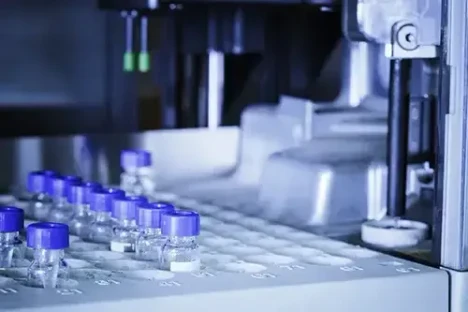
Flash Chromatography Columns: A Comprehensive Overview and Benefits of Santai SepaFlash

KNAUER: Flash Chromatography Columns: A Comprehensive Overview and Benefits of Santai SepaFlash
Flash chromatography has become one of the most widely used purification techniques in chemical and pharmaceutical laboratories. By combining speed, simplicity, and scalability, it enables researchers to isolate target compounds efficiently without the complexity and cost associated with high-pressure chromatographic systems. Applications range from synthetic chemistry and drug discovery to natural product purification and process development.
The technique utilizes pre-packed columns filled with a stationary phase—most commonly silica gel—through which compounds are transported using a pressurized solvent stream. Operating pressures are significantly lower than those used in HPLC, allowing rapid separations with straightforward instrumentation. This article explores the fundamentals of flash chromatography columns, compares them with HPLC columns, discusses sample loading considerations, and highlights the advantages offered by Santai SepaFlash columns available through KNAUER.
Flash Chromatography versus HPLC
Although both flash chromatography and HPLC are based on the same chromatographic principles, their practical roles and operating conditions differ considerably.
Operating Pressure and System Design
One of the most significant differences is pressure. Flash chromatography generally operates in the low- to medium-pressure range, typically around 10–20 bar, whereas HPLC systems routinely function at several hundred bar. As a result, flash systems can utilize simpler pumps or even compressed gas sources, reducing both system complexity and operating costs.
Particle Size and Separation Efficiency
HPLC columns are packed with very small stationary-phase particles, typically 3–15 μm in diameter, which maximize chromatographic efficiency and resolution. Flash chromatography columns use larger particles, usually between 25 and 50 μm. While this reduces separation efficiency somewhat, it also lowers backpressure and permits substantially faster flow rates.
Column Construction and Dimensions
Analytical HPLC columns are typically narrow-bore stainless-steel tubes designed to withstand high pressure. Flash columns are generally wider cartridges manufactured from polypropylene or similar materials. Their larger diameter allows significantly greater sample loading, making them particularly attractive for preparative purification.
Reusability and Operating Costs
HPLC columns are intended for long-term use and require careful maintenance to preserve performance. Flash cartridges are usually pre-packed disposable consumables, allowing users to replace the column after a purification rather than performing extensive cleaning and regeneration procedures.
Typical Applications
Flash chromatography is frequently employed for routine purification of reaction products, fractionation of natural extracts, and rapid preparative separations where throughput is more important than maximum chromatographic resolution. HPLC remains the preferred option for demanding analytical measurements and high-resolution separations of structurally similar compounds.
Understanding Column Volume and Sample Loading
Successful flash chromatography depends heavily on selecting an appropriate column size and loading the correct amount of sample.
Column Volume
Column volume (CV) represents the internal volume occupied by the packed stationary phase and associated pore space. For example, a typical 4 g silica cartridge has a volume of approximately 6 mL. This value serves as an important reference for determining suitable injection volumes and operating conditions.
Injection Volume Considerations
When samples are introduced as solutions, the injection volume should remain small relative to column volume. A commonly accepted guideline is to keep injections below approximately 1–3% of the total column volume.
Excessively large injection volumes can cause:
- Peak broadening
- Reduced resolution
- Premature analyte elution
- Loss of purification efficiency
Consequently, highly concentrated solutions or dry-loading approaches are often preferred when larger sample quantities must be processed.
Sample Capacity
Flash columns are generally categorized according to the amount of stationary phase they contain. Loading capacity depends on separation difficulty and purity requirements.
For conventional silica columns:
- Easy separations may tolerate loadings approaching 10–20% of silica mass
- Typical purifications are performed at approximately 5–10%
- Challenging separations often require loading levels closer to 1% or less
Lower loading levels generally produce superior chromatographic resolution and higher product purity.
Reversed-Phase Versus Normal-Phase Capacity
Sample capacity differs significantly between stationary-phase chemistries.
Standard silica columns provide the highest loading capacities. Reversed-phase materials such as C18 generally support only about 1–2% loading relative to media weight because a substantial portion of the silica surface is occupied by bonded ligands.
As a result, reversed-phase flash methods often require larger columns to process equivalent sample masses.
Dry Loading Strategies
Dry loading offers an effective solution when handling large sample quantities or poorly soluble materials.
In this approach:
- The sample is adsorbed onto a small quantity of sorbent.
- The sorbent is packed into a loading cartridge.
- The material is transferred onto the chromatographic column during solvent flow.
Advantages include:
- Elimination of large solvent plugs
- Improved peak shape
- Higher loading capacity
- Better chromatographic performance
Typical Flash Column Capacities
The amount of sample that can be purified increases approximately in proportion to column size.
Examples for silica-based flash columns include:
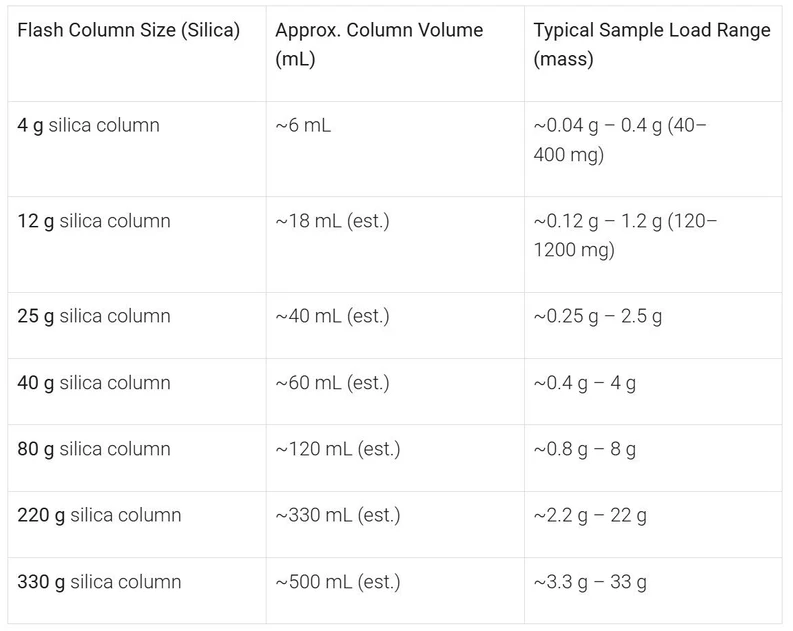 KNAUER: Table: Examples of flash column sizes and their typical sample loading capacity. Lower values in the range (~0.1% of media weight) would be used for very difficult separations requiring high purity, whereas the upper values (~10% of media weight) can be used for easier separations. These guidelines apply to normal-phase silica columns; reversed-phase columns would have much lower capacity (roughly one-tenth of the above, see text).
Actual loading capacity depends on compound complexity, required purity, and chromatographic selectivity.
Advantages of Santai SepaFlash Columns
High-quality columns can significantly improve purification performance. Santai SepaFlash columns have become well established due to their consistent packing quality, versatile design, and broad compatibility.
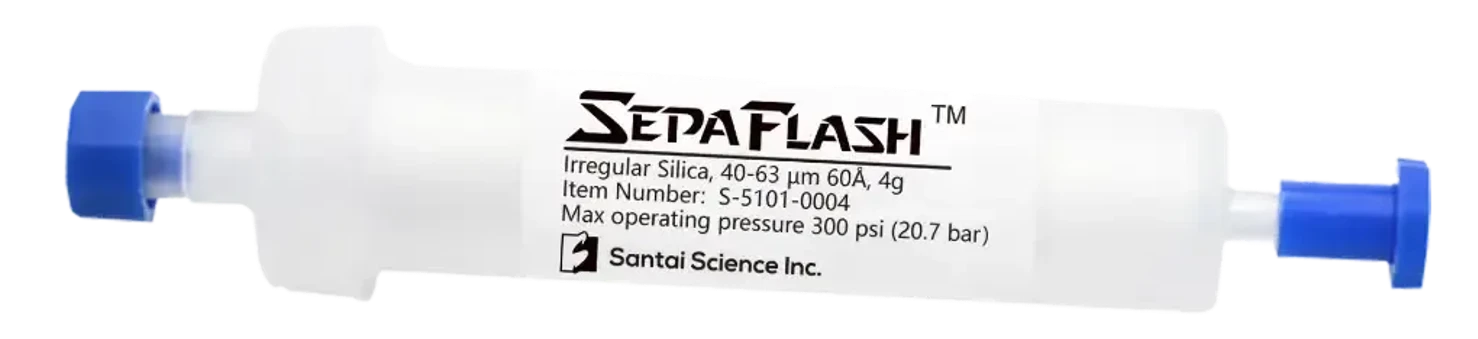 KNAUER: A Santai SepaFlash pre-packed flash column (4 g size). These disposable polypropylene cartridges are filled with high-purity silica and feature Luer-lock connectors for easy setup. They are compatible with common flash chromatography systems and designed for single or few-use purification runs.
Ultra-Pure Silica for Reproducible Separations
SepaFlash columns utilize highly purified silica with tightly controlled particle-size distribution and minimal fine-particle content.
Benefits include:
- Sharp peak profiles
- Reduced tailing
- Excellent batch-to-batch consistency
- Reliable chromatographic reproducibility
The stationary phase is carefully controlled with respect to pH neutrality and moisture content, minimizing variability between production lots.
Durable Cartridge Construction
The cartridges are manufactured from pharmaceutical-grade polypropylene and supplied pre-packed and ready for immediate use.
Key advantages include:
- Leak-free operation
- Chemical compatibility with common solvents
- Elimination of manual column packing
- Consistent performance from cartridge to cartridge
High-Pressure Capability
Different SepaFlash product families are available to address various purification requirements.
The SepaFlash HP series supports operating pressures up to approximately 400 psi (28 bar), enabling:
- Higher flow rates
- Improved productivity
- Enhanced separation performance
- More demanding preparative applications
Standard flash cartridges are rated for approximately 300 psi (20 bar), providing ample capability for routine work.
Flexible Sample Introduction with iLOK Technology
The SepaFlash iLOK™ platform offers a unique approach to sample loading.
Researchers can:
- Perform traditional liquid injections
- Utilize dry-loading techniques
- Reuse loading hardware
- Switch rapidly between loading approaches
This flexibility simplifies workflow development and increases overall laboratory productivity.
Broad Chemistry Portfolio
The SepaFlash product family includes numerous stationary phases, including:
- Silica
- C18
- C8
- Amino phases
- Specialized media for cannabinoid purification
This allows both normal-phase and reversed-phase purification strategies to be performed within a single product ecosystem.
Universal Instrument Compatibility
A major advantage is compatibility with virtually all leading flash chromatography platforms.
SepaFlash columns integrate seamlessly with systems from manufacturers such as:
- Biotage
- Teledyne ISCO
- Büchi
- Santai
- Other major flash chromatography suppliers
This enables laboratories to adopt the columns without modifying existing instrumentation.
Cost-Effective Performance
Despite their premium construction and performance characteristics, SepaFlash columns remain competitively priced. Many users report chromatographic performance comparable to more expensive alternatives, making them an attractive option for laboratories seeking both quality and cost efficiency.
Conclusion
Flash chromatography remains one of the most practical and efficient purification techniques available to modern laboratories. Compared with HPLC, it provides a highly attractive balance of speed, scalability, operational simplicity, and affordability, making it ideal for preparative separations ranging from milligram to multi-gram quantities.
Achieving optimal results requires careful consideration of column size, loading capacity, and sample introduction strategy. When these factors are properly managed, flash chromatography delivers rapid and reliable purification with excellent productivity.
Santai SepaFlash columns further enhance these capabilities through high-purity stationary phases, robust cartridge construction, flexible loading options, broad instrument compatibility, and excellent reproducibility. For scientists seeking dependable purification solutions, they provide a versatile platform capable of supporting a wide range of chromatographic applications while maintaining the efficiency and reliability required in modern research laboratories.
- Chrom Tech Inc., Flash Chromatography Explained: A Comprehensive Guide (2024) – Differences between flash and HPLC columns.
- Santai Science, SepaFlash Flash Columns – Product Advantages (2024) – Features of Santai SepaFlash columns (ultra-pure silica, tight particle size, controlled water content, etc.).
- Biotage Blog, B. Bickler, What is the Maximum Flash Column Sample Load Volume? – Guidance on injection volume (≤3% of column volume) for flash chromatography.
- Biotage Blog, B. Bickler, What is my C18 Flash Column’s Loading Capacity? – Loading capacity of normal-phase vs. C18 flash columns (up to 10–20% vs. ~1–2% of media weight).
- Velocity Scientific (Santai distributor), SepaFlash Standard Series Flash Columns – Specifications – Table of column sizes, volumes, and sample loading ranges for Santai columns.
- KNAUER Web Store – SepaFlash Column 4 g – Example technical data for a 4 g flash column (6 mL volume, 4–400 mg sample load, 20 bar max).
- Santai Science – Company information (Montreal-based manufacturer of flash chromatography systems and columns).