Oligos Made Easy - Part 8: Sepapure oliGO
KNAUER: Oligos Made Easy - Part 8: Sepapure oliGO
A Dedicated Solution for Oligonucleotide Analysis
Oligonucleotides have become key players in modern pharmaceutical and biological research, particularly in the development of highly targeted and personalized therapies. As increasing numbers of oligonucleotide-based drugs enter clinical trials or receive regulatory approval, analytical laboratories face growing demands for both throughput and data quality. These molecules present unique chromatographic challenges due to their long, highly polar structures and subtle variations in nucleobase sequence or functionalization.
Sepapure oliGO – Designed for Oligonucleotide Separations
Selecting the optimal chromatographic approach for oligonucleotide analysis can be complex. Many laboratories rely on ion-pair reversed-phase (IP-RP) chromatography because of its speed, robustness, and compatibility with mass spectrometry. However, commonly used ion-pair reagents can degrade conventional silica-based stationary phases.
Sepapure oliGO addresses this limitation through a hybrid silica matrix combined with specialized surface end-capping, ensuring resistance to aggressive IP-RP reagents. Its functionalized surface enables both strong reversed-phase interactions and controlled ionic contributions, effectively creating a mixed-mode separation mechanism. This design results in improved durability compared with standard mixed-mode columns, making Sepapure oliGO a robust choice for routine oligonucleotide workflows.
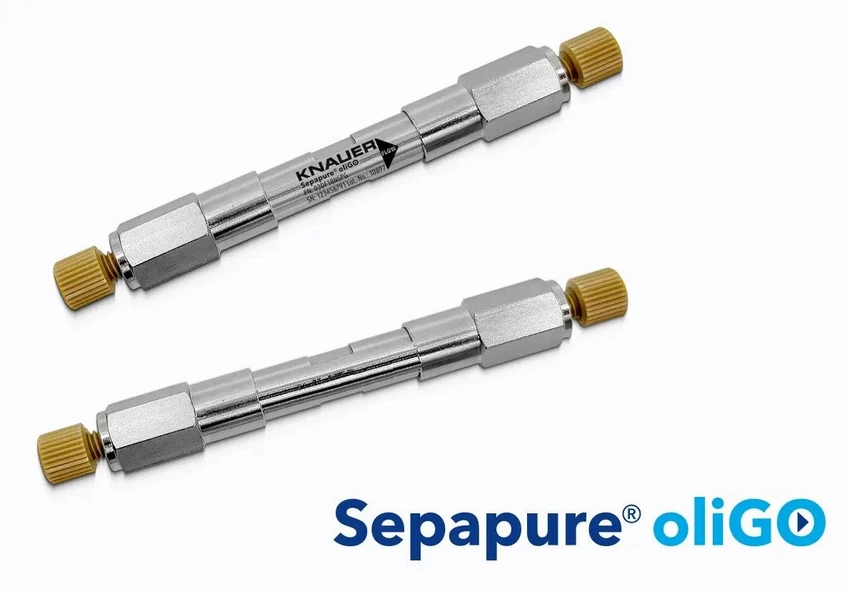 KNAUER: Figure 1 - Sepapure oliGO columns with laser-etched column information.
Method Transfer and Comparative Performance
In collaboration with BianoGMP GmbH, KNAUER’s application team evaluated Sepapure oliGO against a widely used reference column. The study compared oligonucleotides of varying lengths and purities, including a fully thiolated 43-mer DNA. Particular attention was paid to potential interactions between thiolated oligonucleotides and stainless-steel hardware, which have been reported to cause peak tailing.
The results demonstrated that direct method transfer between the reference column and Sepapure oliGO was generally feasible without significant adjustment. Chromatographic resolution remained comparable, while retention times were slightly shorter on Sepapure oliGO. Furthermore, the anticipated benefits of expensive bioinert hardware were not confirmed under the tested conditions, suggesting that such effects may primarily influence very fast (U)HPLC separations.
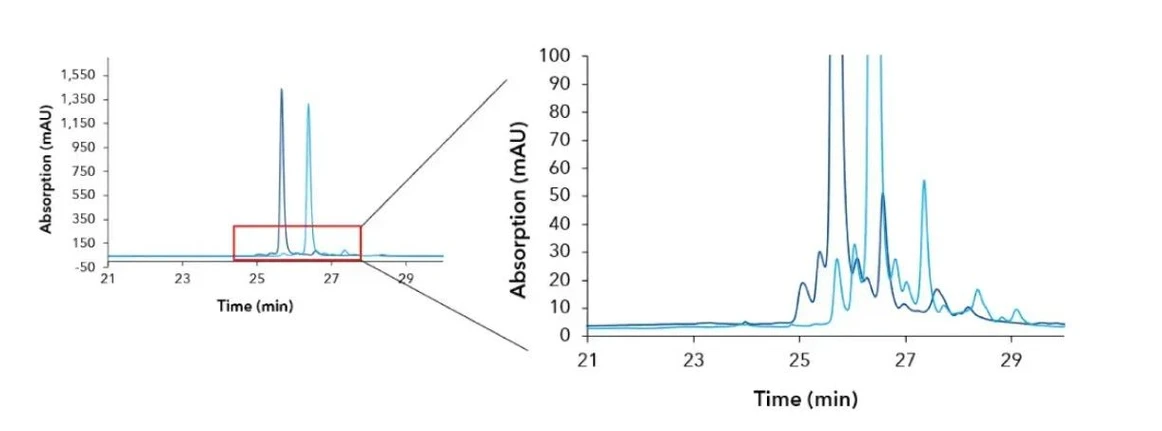 KNAUER: Figure 2: Overlayed chromatogram of crude product of a 43mer thiolate oligonucleotide. Light blue - reference column and dark blue – Sepapure oliGO.
Low Backpressure for Reliable Operation
Sepapure oliGO can be applied effectively in both HPLC and (U)HPLC workflows. Its low operating backpressure minimizes risks associated with clogging, excessive system wear, and performance deterioration over time. Typical IP-RP separations using 3 µm particles generated pressures around 200 bar, enabling laboratories without ultra-high-pressure systems to perform high-quality oligonucleotide analysis.
Best Practices for Column Performance
To maintain optimal performance, users should observe recommended operating conditions, including a broad pH range of 1.5–10 and temperatures up to 60 °C. Employing a guard column can prevent coarse synthesis by-products from reaching the analytical column. If pressure increases are observed, backflushing at low flow rates can restore performance.
When the system is idle, thorough flushing to remove salts is essential. For storage, the column should be kept in a 1:1 mixture of methanol–water or acetonitrile–water. Gradient transitions are recommended when switching between standard RP eluents and IP-RP reagents. Regeneration procedures developed for RP columns are also suitable for Sepapure oliGO.
Beyond Analytical Separations
For large-scale purification, ion-exchange chromatography (AEX) may offer advantages. Scalable preparative systems are available to support purification workflows, ranging from compact laboratory setups to pilot-scale platforms with flow rates up to 800 mL/min. Bioinert configurations can be integrated where required, allowing laboratories to tailor purification solutions to their specific oligonucleotide applications.
- If you're planning to set up or optimize your oligonucleotide workflow, feel free to contact us at [email protected]. Stay tuned for more exciting insights into the Oligonucleotide world in our “Oligos Made Easy” series.