Author
KNAUER
KNAUER
Based in Berlin, KNAUER is a medium-sized, owner-managed company that has been serving the sciences since 1962. We develop and manufacture scientific instruments of superior quality for liquid chromatography, including: Analytical HPLC/UHPLC, Preparative HPLC, Fast protein liquid chromatography (FPLC), Multi-column chromatography/Simulated moving bed (SMB) chromatography. High pressure dosing, in-line detection systems, and osmometry are additional business areas.
Tags
Article
Academy
Product
LinkedIn Logo

Oligos Made Easy - Part 9: 2D-LC
We, 1.4.2026
| Original article from: KNAUER
Discover how 2D-LC enhances oligonucleotide analysis by improving resolution, separating complex impurities, and enabling deeper insight beyond conventional 1D-LC methods.
<p>KNAUER: Oligos Made Easy - Part 9: 2D-LC</p>

KNAUER: Oligos Made Easy - Part 9: 2D-LC

Two Dimensions, One Solution: Advancing Oligonucleotide Analysis with 2D-LC

Why Consider 2D-LC for Oligonucleotide Analysis?

In oligonucleotide analytics, achieving reliable and precise results is not optional—it is fundamental. These biomolecules are inherently complex, often containing truncated sequences, structural variants, and a wide range of impurities. Such complexity frequently exceeds the separation capabilities of conventional one-dimensional liquid chromatography (1D-LC). As a result, critical components may coelute or remain unresolved, limiting analytical confidence.

Two-dimensional liquid chromatography (2D-LC) offers a powerful alternative by significantly enhancing separation performance. By combining two complementary separation mechanisms, 2D-LC improves resolution, sensitivity, and overall analytical reliability. This enables a much deeper understanding of oligonucleotide samples and their compositional intricacies.

Previous parts from the Oligos Made Easy series

Moving Beyond the Limits of 1D-LC

For many years, 1D-LC has served as a standard tool for biopharmaceutical characterization. However, its inherent limitations become apparent when dealing with highly complex mixtures. The selectivity of a single chromatographic dimension is restricted, and the lack of orthogonality in retention mechanisms often results in insufficient separation. As sample complexity increases, the resolving power of 1D-LC becomes inadequate.
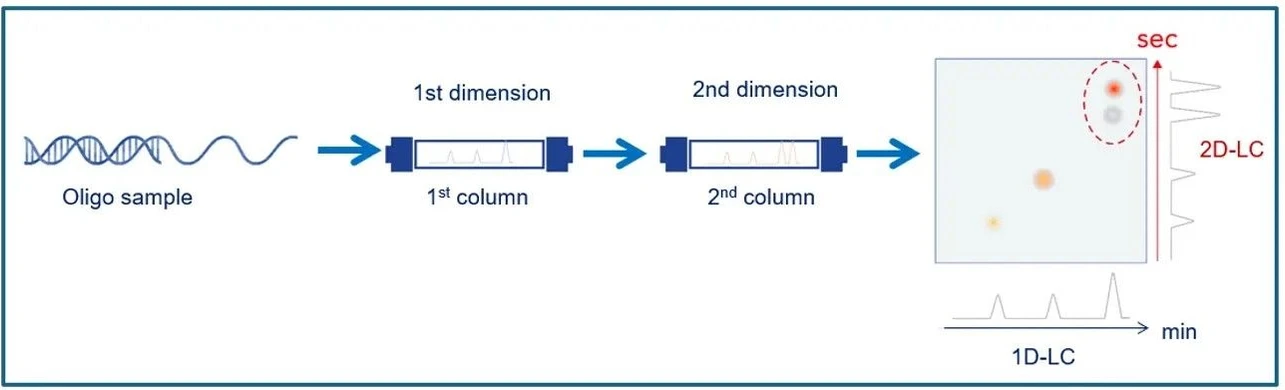
KNAUER: Figure 1 - 2D-LC Principle (Graphic by KNAUER).KNAUER: Figure 1 - 2D-LC Principle (Graphic by KNAUER).

Two-dimensional LC addresses these limitations by coupling two chromatographic separations, which can be either similar or fundamentally different. Each dimension targets different physicochemical properties of analytes, enabling the resolution of compounds that would otherwise overlap. In essence, 2D-LC introduces an additional level of separation capacity, allowing analysts to disentangle coeluting species that remain unresolved in a single dimension.

An important practical consideration is that the overall analysis time is governed by the second dimension. Because fractions from the first dimension must be processed sequentially, the second dimension must operate rapidly and efficiently. High-speed separations in the second dimension are therefore essential to maintain system performance and data quality.

Architecture of a 2D-LC System

At its core, a 2D-LC system relies on precise coordination between its components. The setup typically consists of two chromatographic columns, two pumping systems, and a switching valve that enables fraction transfer between dimensions. The sample is introduced through an autosampler and first separated on the primary column. Fractions of interest are then transferred into a loop via a switching valve and subsequently introduced into the second column for further separation.
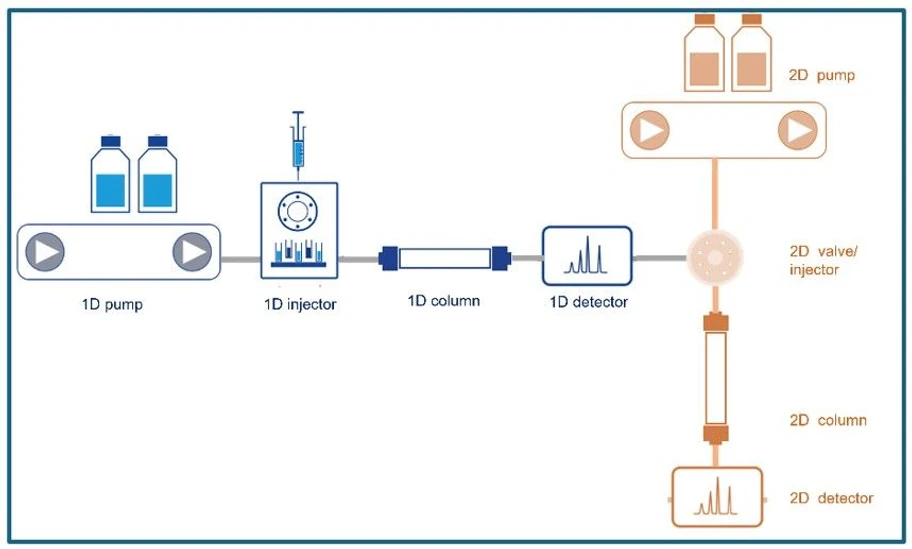
KNAUER: Figure 2 -  2D LC System Configuration Example (Graphic by KNAUER).KNAUER: Figure 2 - 2D LC System Configuration Example (Graphic by KNAUER).

The valve plays a crucial role in this process, acting as the interface between both chromatographic dimensions. Its function is to alternately collect fractions from the first dimension and inject them into the second dimension under high-pressure conditions. Various valve configurations can be employed, including ten-port or eight-port valves with dual-loop arrangements, or synchronized six-port valves. Regardless of configuration, the underlying principle remains the same: while one loop is being filled, the other is being flushed into the second dimension.
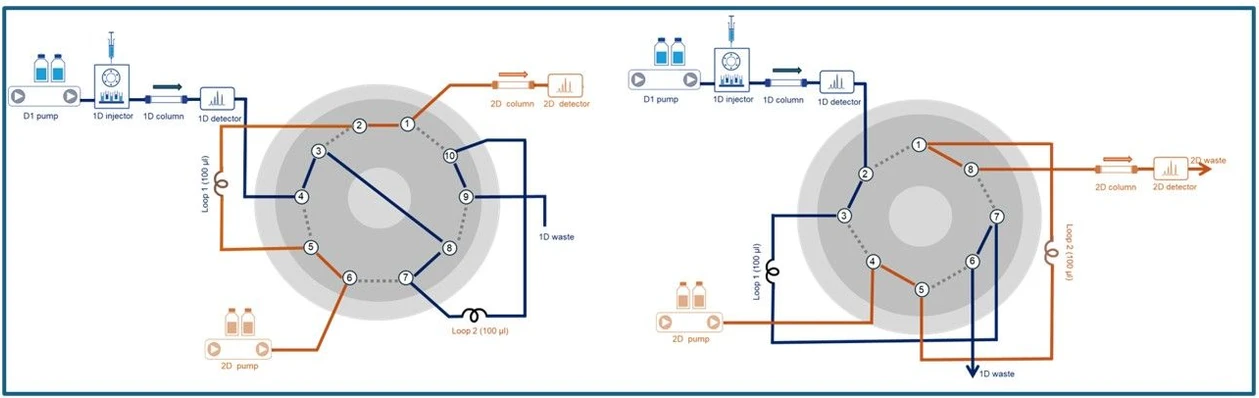
KNAUER: Figure 3 - Schematic figure of ten-port (left) and eight-port valve (right) 2-position setup for 2D-LC (Graphic by KNAUER).KNAUER: Figure 3 - Schematic figure of ten-port (left) and eight-port valve (right) 2-position setup for 2D-LC (Graphic by KNAUER).

This alternating process requires precise timing. The second-dimension separation must be completed before the next fraction is ready for transfer. Consequently, synchronization between flow rates, loop volumes, and switching intervals is essential for maintaining chromatographic integrity.
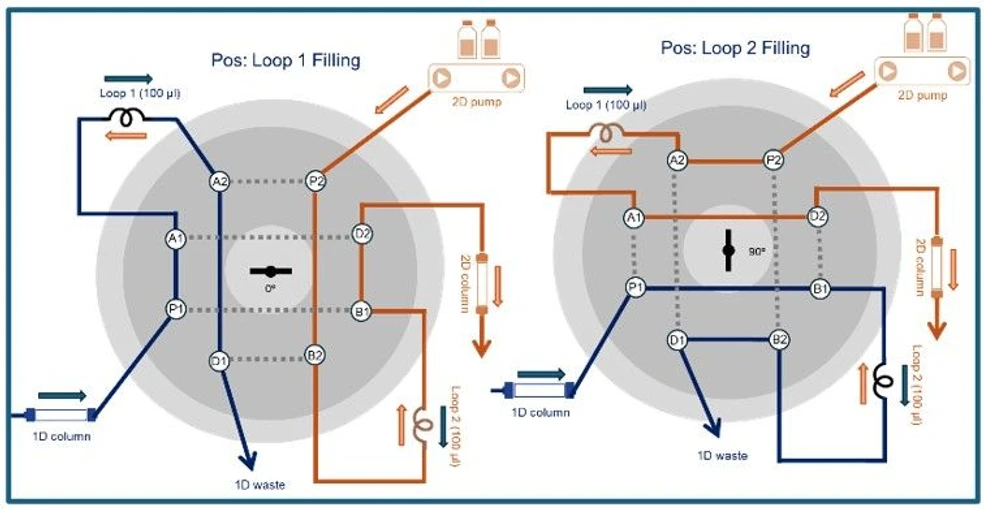
KNAUER: Figure 4 - Schematic figure KNAUER eight-port 2 position valve for 2D-LC (Graphic by KNAUER).KNAUER: Figure 4 - Schematic figure KNAUER eight-port 2 position valve for 2D-LC (Graphic by KNAUER).

Applying 2D-LC to Oligonucleotide Analysis

In oligonucleotide workflows, 2D-LC combines two complementary separation strategies to address sample complexity. The first dimension is typically used for bulk separation based on properties such as size, charge, or polarity. Techniques such as size-exclusion chromatography (SEC), anion-exchange chromatography (AEX), ion-pair reversed-phase chromatography (IP-RP), hydrophilic interaction chromatography (HILIC), or mixed-mode chromatography (MMC) are commonly applied. This step reduces sample complexity and can also serve as an online desalting stage, removing salts and buffer components that could interfere with downstream detection, particularly when mass spectrometry is used.

Following this initial separation, selected fractions are transferred to the second dimension. This transfer can be performed either selectively or comprehensively, depending on the analytical goal. The second dimension is typically optimized for high-resolution separation, allowing detailed characterization of closely related species such as truncated oligonucleotides, sequence variants, or chemically modified impurities. When coupled with mass spectrometry, this setup enables accurate identification and sequencing.

A key advantage of 2D-LC lies in the flexibility of combining different stationary phases and mobile phase conditions. 

Numerous separation combinations are possible, including:

  • SEC×AEX
  • HILIC×IP-RP
  • IEC×IP-RP
  • IP-RP×IP-RP
  • AEX×HIC
  • MMC×SEC,
  • and even chiral×RP systems. 

This adaptability allows tailored workflows for specific analytical challenges.

Heart-Cutting vs. Comprehensive 2D-LC

When implementing 2D-LC, two primary transfer strategies are commonly used: heart-cutting and comprehensive transfer. Each approach offers distinct advantages depending on the analytical objective.

Heart-cutting 2D-LC focuses on selected regions of interest from the first dimension. Only specific peaks or time windows are transferred to the second dimension for further analysis. This approach allows extended separation time and higher resolution in the second dimension, making it particularly suitable for targeted investigations of known critical compounds. However, because only selected fractions are analyzed, unexpected impurities outside the selected region may remain undetected.
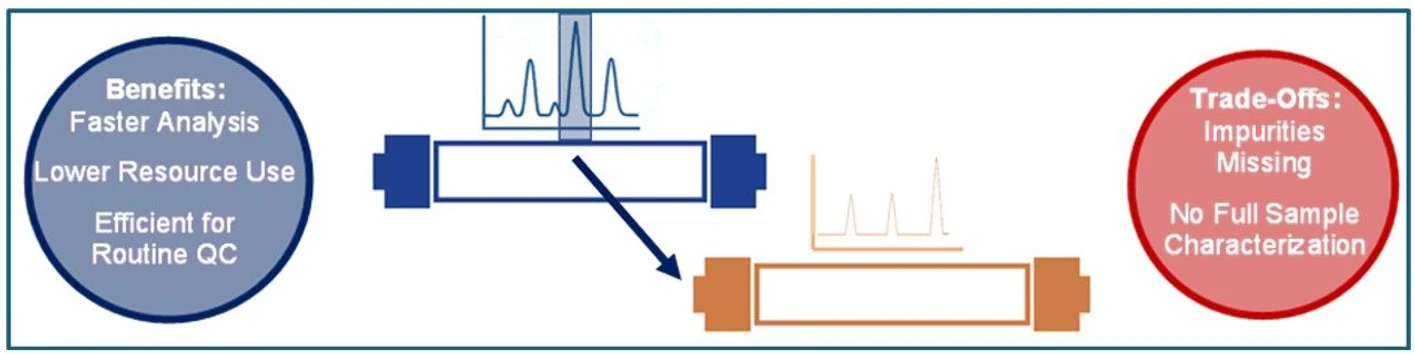
KNAUER: Figure 5 - 2D-LC Single Heart-Cut Principle (Graphic by KNAUER).KNAUER: Figure 5 - 2D-LC Single Heart-Cut Principle (Graphic by KNAUER).

In contrast, comprehensive 2D-LC transfers the entire eluate from the first dimension into the second dimension in a continuous manner. This approach provides a complete and detailed representation of the sample, making it ideal for research and development, impurity profiling, and regulatory applications. While more demanding in terms of speed and system performance, comprehensive 2D-LC ensures full sample coverage.
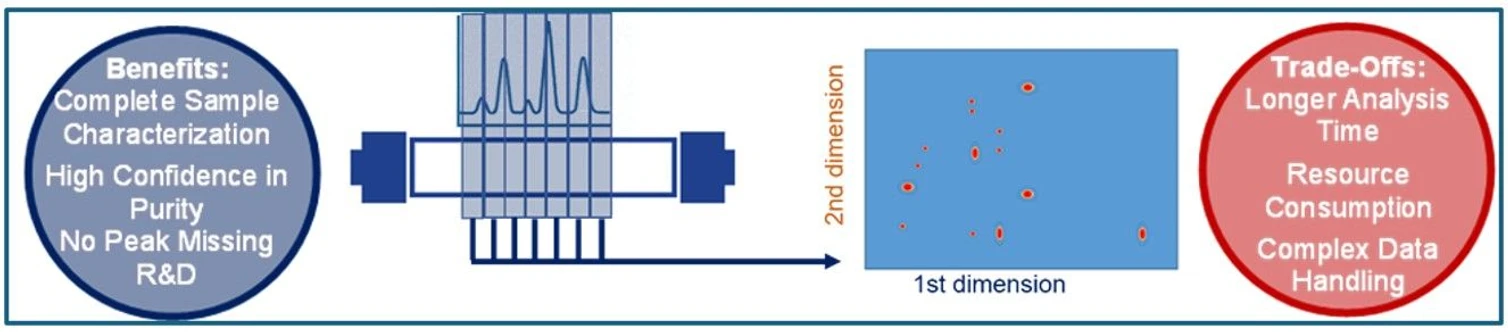
KNAUER: Figure 6 - Full Comprehensive  2D-LC Principle (Graphic by KNAUER).KNAUER: Figure 6 - Full Comprehensive 2D-LC Principle (Graphic by KNAUER).

In practice, hybrid approaches may also be employed, combining targeted heart-cutting with broader comprehensive analysis to balance resolution and coverage.

Practical Considerations for Method Development

Successful implementation of 2D-LC for oligonucleotide analysis requires careful method design. 

1. Column selection 

It is a critical starting point, as the combination of stationary phases must provide sufficient orthogonality while maintaining compatibility between mobile phases. Typically, the first dimension is optimized for general separation of oligonucleotide size or class, while the second dimension focuses on sequence-specific resolution and compatibility with mass spectrometry.

2. Mobile phase selection 

Differences in pH and organic modifiers can significantly influence separation behavior, but incompatibility between dimensions can compromise performance. Therefore, mobile phases must be designed as a coordinated system. The use of volatile buffers, such as ammonium acetate, is often preferred for MS-based detection.

3. Instrumentation 

The switching valve must operate reliably under high pressure, with precise timing to ensure accurate fraction transfer. Loop volumes must be carefully selected to avoid overfilling, as excessive loading can lead to sample loss and distortion due to flow profile effects. As a general guideline, loops should not be filled beyond approximately 70% of their capacity.

4. Method development 

Typically begins with optimization of the second dimension, as it dictates overall system timing. Fast separations using short columns and steep gradients are often required to maintain sufficient sampling frequency. Once the second dimension is established, the first dimension can be adjusted to achieve optimal resolution and compatibility.

Final Remarks

Two-dimensional liquid chromatography represents a powerful advancement in oligonucleotide analysis, enabling the resolution of complex mixtures that exceed the capabilities of conventional 1D approaches. By combining orthogonal separation mechanisms, 2D-LC reveals structural details and impurity profiles that would otherwise remain hidden.

However, achieving optimal performance requires careful balancing of multiple factors, including column chemistry, mobile phase compatibility, system timing, and data acquisition. When properly implemented, 2D-LC provides a robust and highly informative platform for modern oligonucleotide characterization.

  • If you're planning to set up or optimize your oligonucleotide workflow, feel free to contact us at [email protected]. Stay tuned for more exciting insights into the Oligonucleotide world in our “Oligos Made Easy” series.
  • For more in-depth discussion or questions, reach out to the author at [email protected]
This version of the article was adapted from the original text using AI-assisted rewriting and editorial review.
Resources

F. Hannauer, R. Black, A.D. ray, E. Stulz, G.J. Langley, S.W. Holman, “Advancements in the characterization of oligonucleotides by high performance liquid chromatography-mass spectrometry in 2021: A short review,” Anal Sci Adv., 3. 90–102 (2022)

[1] Sartorius BIA Separations (Poster): 2D-LC SEC-AEX Evaluation of Complex Samples Containing Extracellular Vesicles (2024)

[2] Q. Li, F. Lynen, J. Wang, H. Li, G. Xu, and P. Sandra, “Comprehensive Hydrophilic Interaction and Ion-Pair Reversed-Phase Liquid Chromatography for Analysis of Di- to Deca-Oligonucleotides,” Journal of Chromatography A 1255, 237–243 (2012)

[3] S. G. Roussis, I. Cedillo, and C. Rentel, “Two-Dimensional Liquid Chromatography-Mass Spectrometry for the Characterization of Modified Oligonucleotide Impurities,” Analytical Biochemistry 556, 45–52 (2018)

[4] D. Stoll, M. Sylvester, D. Meston, M. Sorensen, and T. D. Maloney, “Development of Multiple Heartcutting Two-Dimensional Liquid Chromatography With Ion-Pairing Reversed-Phase Separations in Both Dimensions for Analysis of Impurities in Therapeutic Oligonucleotides,” Journal of Chromatography A 1714, 464574 (2024)

[5] A. Kazarian, J. Lee, B. Mitasev, and H. Choi, “Mixed-Mode Separation of Antisense Oligonucleotides Using a Single Column With Complementary Anion-Exchange and Hydrophobic Interaction Chromatography Approaches,” Journal of Chromatography A 1740, 465581 (2025)

[6] F. Li, X. Su, S. Bäurer, and M. Lämmerhofer, “Multiple Heart-Cutting Mixed-Mode Chromatography-Reversed-Phase 2D-Liquid Chromatography Method for Separation and Mass Spectrometric Characterization of Synthetic Oligonucleotides,” Journal of Chromatography A 1625, 461338 (2020)

[7] F. Li, C. Knappe, N. Carstensen, et al., “Two-Dimensional Sequential Selective Comprehensive Chiral×Reversed-Phase Liquid Chromatography of Synthetic Phosphorothioate Oligonucleotide Diastereomers,” Journal of Chromatography A 1730, 465076 (2024)

KNAUER
LinkedIn Logo
 

Related content

Simultaneous Quantitation and Discovery analysis: Combining targeted and untargeted metabolomics on Orbitrap mass spectrometers

Applications
| 2026 | Thermo Fisher Scientific
Instrumentation
LC/MS, LC/MS/MS, LC/Orbitrap, LC/HRMS
Manufacturer
Thermo Fisher Scientific
Industries
Metabolomics

Analysis of Per- and Polyfluoroalkyl Substances (PFAS) in Wastewater

Applications
| 2026 | Agilent Technologies
Instrumentation
LC/MS, LC/MS/MS, LC/QQQ
Manufacturer
Agilent Technologies
Industries
Environmental

Non-Targeted Screening of Biosolids with the Xevo™ MRT Mass Spectrometer Reveals New Isoforms of PFAS

Applications
| 2026 | Waters
Instrumentation
LC/MS, LC/MS/MS, LC/TOF, LC/HRMS
Manufacturer
Waters
Industries
Environmental

High Resolution Characterization of Lipid Nanoparticles Using the Xevo™ Charge Detection Mass Spectrometry (CDMS) Instrument - Single Particle Mass Analysis of Intact LNP-mRNA Formulations

Applications
| 2026 | Waters
Instrumentation
LC/MS, LC/MS/MS, LC/HRMS, Particle characterization, LC/IT
Manufacturer
Waters
Industries
Lipidomics

Out-of-the-box workflow for PFAS quantitation using a fullscan high-resolution approach with the Orbitrap Exploris EFOX Mass Detector

Applications
| 2025 | Thermo Fisher Scientific
Instrumentation
LC/MS, LC/MS/MS, LC/Orbitrap, LC/HRMS
Manufacturer
Thermo Fisher Scientific
Industries
Environmental
 

Related articles

Improving the Accuracy of Predictive 2D-LC Optimization Strategies: Incorporation of Simulated Elution Profiles to Account for Injection Band Broadening in Online Comprehensive Two-Dimensional Liquid Chromatography
Article | Scientific article

Improving the Accuracy of Predictive 2D-LC Optimization Strategies: Incorporation of Simulated Elution Profiles to Account for Injection Band Broadening in Online Comprehensive Two-Dimensional Liquid Chromatography

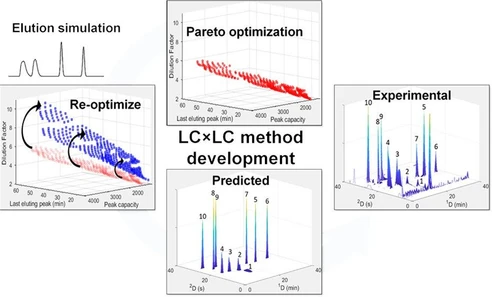
A novel approach for optimizing online comprehensive LC × LC methods, addressing the challenges posed by second-dimension injection band broadening under sample solvent mismatch or volume overload.
LabRulez
tag
share
more
Ion exchange chromatography of biotherapeutics: Fundamental principles and advanced approaches
Scientific article | Science and research

Ion exchange chromatography of biotherapeutics: Fundamental principles and advanced approaches

This review outlines IEX fundamentals and explores advanced strategies—like pH gradients, ultra-short columns, and coupling with MS—for characterizing complex biotherapeutics.
LabRulez
tag
share
more
Oligos Made Easy - Part 5: SEC
Article | Academy

Oligos Made Easy - Part 5: SEC

Learn how SEC streamlines oligonucleotide purification. From pore size selection to flow optimization, discover practical tips for desalting, buffer exchange, and clean size-based separation.
KNAUER
tag
share
more
Oligos Made Easy - Part 6: Column Navigator
Article | Academy

Oligos Made Easy - Part 6: Column Navigator

Choosing the right chromatographic column for oligonucleotides can be challenging. This guide explains key separation strategies, purification options, and analytical methods for reliable oligo analysis.
KNAUER
tag
share
more
 

Related content

Simultaneous Quantitation and Discovery analysis: Combining targeted and untargeted metabolomics on Orbitrap mass spectrometers

Applications
| 2026 | Thermo Fisher Scientific
Instrumentation
LC/MS, LC/MS/MS, LC/Orbitrap, LC/HRMS
Manufacturer
Thermo Fisher Scientific
Industries
Metabolomics

Analysis of Per- and Polyfluoroalkyl Substances (PFAS) in Wastewater

Applications
| 2026 | Agilent Technologies
Instrumentation
LC/MS, LC/MS/MS, LC/QQQ
Manufacturer
Agilent Technologies
Industries
Environmental

Non-Targeted Screening of Biosolids with the Xevo™ MRT Mass Spectrometer Reveals New Isoforms of PFAS

Applications
| 2026 | Waters
Instrumentation
LC/MS, LC/MS/MS, LC/TOF, LC/HRMS
Manufacturer
Waters
Industries
Environmental

High Resolution Characterization of Lipid Nanoparticles Using the Xevo™ Charge Detection Mass Spectrometry (CDMS) Instrument - Single Particle Mass Analysis of Intact LNP-mRNA Formulations

Applications
| 2026 | Waters
Instrumentation
LC/MS, LC/MS/MS, LC/HRMS, Particle characterization, LC/IT
Manufacturer
Waters
Industries
Lipidomics

Out-of-the-box workflow for PFAS quantitation using a fullscan high-resolution approach with the Orbitrap Exploris EFOX Mass Detector

Applications
| 2025 | Thermo Fisher Scientific
Instrumentation
LC/MS, LC/MS/MS, LC/Orbitrap, LC/HRMS
Manufacturer
Thermo Fisher Scientific
Industries
Environmental
 

Related articles

Improving the Accuracy of Predictive 2D-LC Optimization Strategies: Incorporation of Simulated Elution Profiles to Account for Injection Band Broadening in Online Comprehensive Two-Dimensional Liquid Chromatography
Article | Scientific article

Improving the Accuracy of Predictive 2D-LC Optimization Strategies: Incorporation of Simulated Elution Profiles to Account for Injection Band Broadening in Online Comprehensive Two-Dimensional Liquid Chromatography

A novel approach for optimizing online comprehensive LC × LC methods, addressing the challenges posed by second-dimension injection band broadening under sample solvent mismatch or volume overload.
LabRulez
tag
share
more
Ion exchange chromatography of biotherapeutics: Fundamental principles and advanced approaches
Scientific article | Science and research

Ion exchange chromatography of biotherapeutics: Fundamental principles and advanced approaches

This review outlines IEX fundamentals and explores advanced strategies—like pH gradients, ultra-short columns, and coupling with MS—for characterizing complex biotherapeutics.
LabRulez
tag
share
more
Oligos Made Easy - Part 5: SEC
Article | Academy

Oligos Made Easy - Part 5: SEC

Learn how SEC streamlines oligonucleotide purification. From pore size selection to flow optimization, discover practical tips for desalting, buffer exchange, and clean size-based separation.
KNAUER
tag
share
more
Oligos Made Easy - Part 6: Column Navigator
Article | Academy

Oligos Made Easy - Part 6: Column Navigator

Choosing the right chromatographic column for oligonucleotides can be challenging. This guide explains key separation strategies, purification options, and analytical methods for reliable oligo analysis.
KNAUER
tag
share
more
 

Related content

Simultaneous Quantitation and Discovery analysis: Combining targeted and untargeted metabolomics on Orbitrap mass spectrometers

Applications
| 2026 | Thermo Fisher Scientific
Instrumentation
LC/MS, LC/MS/MS, LC/Orbitrap, LC/HRMS
Manufacturer
Thermo Fisher Scientific
Industries
Metabolomics

Analysis of Per- and Polyfluoroalkyl Substances (PFAS) in Wastewater

Applications
| 2026 | Agilent Technologies
Instrumentation
LC/MS, LC/MS/MS, LC/QQQ
Manufacturer
Agilent Technologies
Industries
Environmental

Non-Targeted Screening of Biosolids with the Xevo™ MRT Mass Spectrometer Reveals New Isoforms of PFAS

Applications
| 2026 | Waters
Instrumentation
LC/MS, LC/MS/MS, LC/TOF, LC/HRMS
Manufacturer
Waters
Industries
Environmental

High Resolution Characterization of Lipid Nanoparticles Using the Xevo™ Charge Detection Mass Spectrometry (CDMS) Instrument - Single Particle Mass Analysis of Intact LNP-mRNA Formulations

Applications
| 2026 | Waters
Instrumentation
LC/MS, LC/MS/MS, LC/HRMS, Particle characterization, LC/IT
Manufacturer
Waters
Industries
Lipidomics

Out-of-the-box workflow for PFAS quantitation using a fullscan high-resolution approach with the Orbitrap Exploris EFOX Mass Detector

Applications
| 2025 | Thermo Fisher Scientific
Instrumentation
LC/MS, LC/MS/MS, LC/Orbitrap, LC/HRMS
Manufacturer
Thermo Fisher Scientific
Industries
Environmental
 

Related articles

Improving the Accuracy of Predictive 2D-LC Optimization Strategies: Incorporation of Simulated Elution Profiles to Account for Injection Band Broadening in Online Comprehensive Two-Dimensional Liquid Chromatography
Article | Scientific article

Improving the Accuracy of Predictive 2D-LC Optimization Strategies: Incorporation of Simulated Elution Profiles to Account for Injection Band Broadening in Online Comprehensive Two-Dimensional Liquid Chromatography

A novel approach for optimizing online comprehensive LC × LC methods, addressing the challenges posed by second-dimension injection band broadening under sample solvent mismatch or volume overload.
LabRulez
tag
share
more
Ion exchange chromatography of biotherapeutics: Fundamental principles and advanced approaches
Scientific article | Science and research

Ion exchange chromatography of biotherapeutics: Fundamental principles and advanced approaches

This review outlines IEX fundamentals and explores advanced strategies—like pH gradients, ultra-short columns, and coupling with MS—for characterizing complex biotherapeutics.
LabRulez
tag
share
more
Oligos Made Easy - Part 5: SEC
Article | Academy

Oligos Made Easy - Part 5: SEC

Learn how SEC streamlines oligonucleotide purification. From pore size selection to flow optimization, discover practical tips for desalting, buffer exchange, and clean size-based separation.
KNAUER
tag
share
more
Oligos Made Easy - Part 6: Column Navigator
Article | Academy

Oligos Made Easy - Part 6: Column Navigator

Choosing the right chromatographic column for oligonucleotides can be challenging. This guide explains key separation strategies, purification options, and analytical methods for reliable oligo analysis.
KNAUER
tag
share
more
 

Related content

Simultaneous Quantitation and Discovery analysis: Combining targeted and untargeted metabolomics on Orbitrap mass spectrometers

Applications
| 2026 | Thermo Fisher Scientific
Instrumentation
LC/MS, LC/MS/MS, LC/Orbitrap, LC/HRMS
Manufacturer
Thermo Fisher Scientific
Industries
Metabolomics

Analysis of Per- and Polyfluoroalkyl Substances (PFAS) in Wastewater

Applications
| 2026 | Agilent Technologies
Instrumentation
LC/MS, LC/MS/MS, LC/QQQ
Manufacturer
Agilent Technologies
Industries
Environmental

Non-Targeted Screening of Biosolids with the Xevo™ MRT Mass Spectrometer Reveals New Isoforms of PFAS

Applications
| 2026 | Waters
Instrumentation
LC/MS, LC/MS/MS, LC/TOF, LC/HRMS
Manufacturer
Waters
Industries
Environmental

High Resolution Characterization of Lipid Nanoparticles Using the Xevo™ Charge Detection Mass Spectrometry (CDMS) Instrument - Single Particle Mass Analysis of Intact LNP-mRNA Formulations

Applications
| 2026 | Waters
Instrumentation
LC/MS, LC/MS/MS, LC/HRMS, Particle characterization, LC/IT
Manufacturer
Waters
Industries
Lipidomics

Out-of-the-box workflow for PFAS quantitation using a fullscan high-resolution approach with the Orbitrap Exploris EFOX Mass Detector

Applications
| 2025 | Thermo Fisher Scientific
Instrumentation
LC/MS, LC/MS/MS, LC/Orbitrap, LC/HRMS
Manufacturer
Thermo Fisher Scientific
Industries
Environmental
 

Related articles

Improving the Accuracy of Predictive 2D-LC Optimization Strategies: Incorporation of Simulated Elution Profiles to Account for Injection Band Broadening in Online Comprehensive Two-Dimensional Liquid Chromatography
Article | Scientific article

Improving the Accuracy of Predictive 2D-LC Optimization Strategies: Incorporation of Simulated Elution Profiles to Account for Injection Band Broadening in Online Comprehensive Two-Dimensional Liquid Chromatography

A novel approach for optimizing online comprehensive LC × LC methods, addressing the challenges posed by second-dimension injection band broadening under sample solvent mismatch or volume overload.
LabRulez
tag
share
more
Ion exchange chromatography of biotherapeutics: Fundamental principles and advanced approaches
Scientific article | Science and research

Ion exchange chromatography of biotherapeutics: Fundamental principles and advanced approaches

This review outlines IEX fundamentals and explores advanced strategies—like pH gradients, ultra-short columns, and coupling with MS—for characterizing complex biotherapeutics.
LabRulez
tag
share
more
Oligos Made Easy - Part 5: SEC
Article | Academy

Oligos Made Easy - Part 5: SEC

Learn how SEC streamlines oligonucleotide purification. From pore size selection to flow optimization, discover practical tips for desalting, buffer exchange, and clean size-based separation.
KNAUER
tag
share
more
Oligos Made Easy - Part 6: Column Navigator
Article | Academy

Oligos Made Easy - Part 6: Column Navigator

Choosing the right chromatographic column for oligonucleotides can be challenging. This guide explains key separation strategies, purification options, and analytical methods for reliable oligo analysis.
KNAUER
tag
share
more
Other projects
GCMS
ICPMS
Follow us
FacebookX (Twitter)LinkedInYouTube
More information
WebinarsAbout usContact usTerms of use
LabRulez s.r.o. All rights reserved. Content available under a CC BY-SA 4.0 Attribution-ShareAlike