LCMS
More information
WebinarsAbout usContact usTerms of use
LabRulez s.r.o. All rights reserved. Content available under a CC BY-SA 4.0 Attribution-ShareAlike
Author
KNAUER
KNAUER
Based in Berlin, KNAUER is a medium-sized, owner-managed company that has been serving the sciences since 1962. We develop and manufacture scientific instruments of superior quality for liquid chromatography, including: Analytical HPLC/UHPLC, Preparative HPLC, Fast protein liquid chromatography (FPLC), Multi-column chromatography/Simulated moving bed (SMB) chromatography. High pressure dosing, in-line detection systems, and osmometry are additional business areas.
Tags
Article
Science and research
Video
LinkedIn Logo

Oligos Made Easy - Part 3: IP-RP

We, 18.2.2026
| Original article from: KNAUER
Discover how ion-pair reversed-phase (IP-RP) chromatography enables high-resolution oligonucleotide analysis. Learn about ion-pair selection, method setup, LC-MS compatibility, and robust separation strategies.
Video placeholder
  • Photo: KNAUER: Oligos Made Easy - Part 3: IP-RP
  • Video: KnauerHPLC: The OLIGOSCALER by KNAUER presented by Marvin Schäk

Mastering Ion-Pair Reversed-Phase Chromatography for Oligonucleotide Analysis

Why Purity Is Critical in the Oligonucleotide Era

Oligonucleotides — short, synthetic strands of DNA or RNA — are central to modern biotechnology. They power gene therapies, advanced diagnostics, and cutting-edge molecular research. However, before these molecules can be used in clinical or research settings, their purity and structural integrity must be thoroughly verified. High-resolution chromatographic analysis plays a crucial role in ensuring quality and safety.
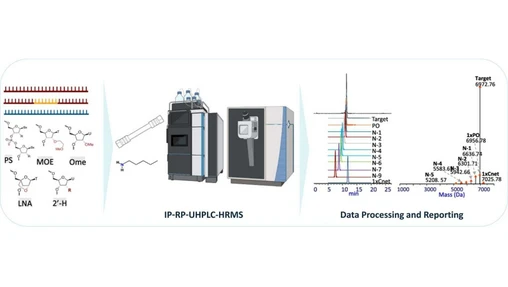
KNAUER: Figure 1 - Separation Example of Oligonucleotides.KNAUER: Figure 1 - Separation Example of Oligonucleotides.

Understanding Ion-Pair Reversed-Phase (IP-RP) Chromatography

For scientists involved in oligonucleotide synthesis and characterization, Ion-Pair Reversed-Phase Chromatography (IP-RP) is one of the most effective analytical tools available.

Unlike separation techniques that rely solely on charge differences, IP-RP combines:

  • Ionic interactions
  • Hydrophobic interactions

This dual retention mechanism enables exceptional resolution — even for oligonucleotides that differ by only a single nucleotide or subtle chemical modification. Whether assessing synthesis efficiency or purifying therapeutic-grade material, IP-RP provides reliable, reproducible separations.
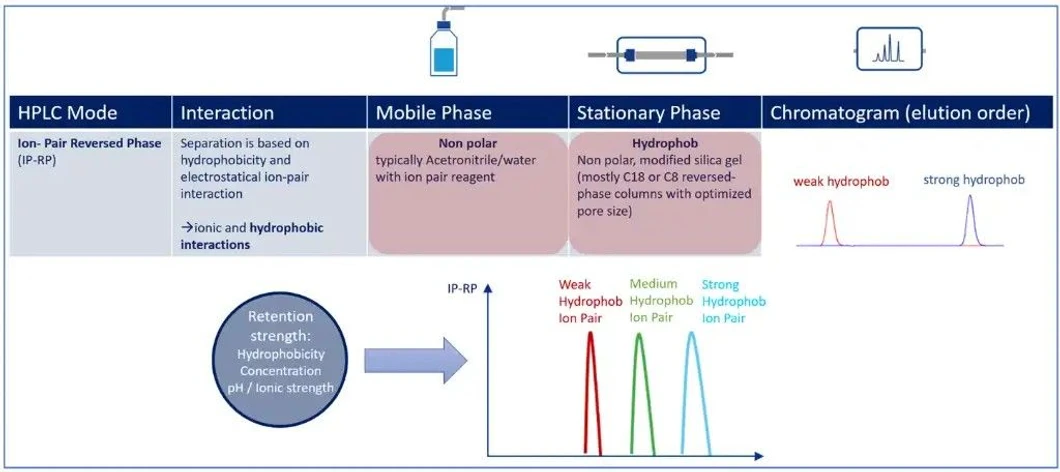
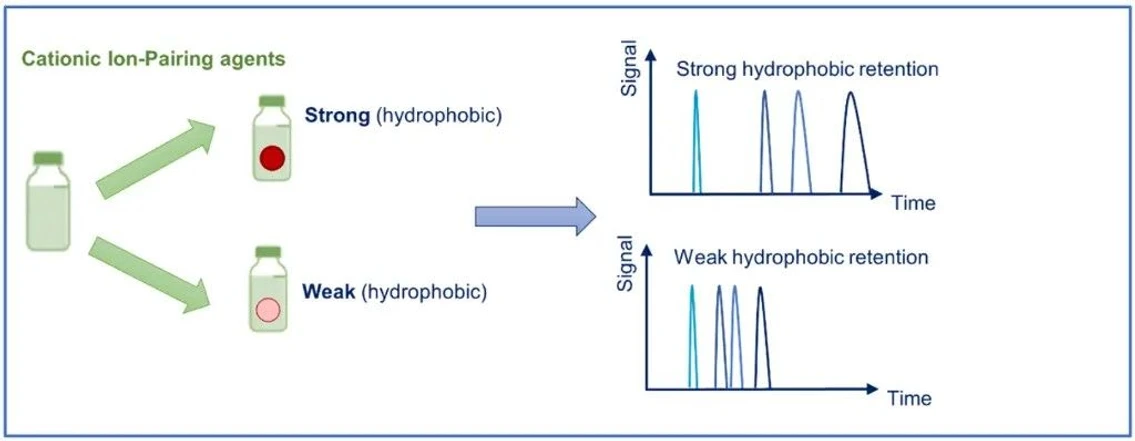
KNAUER: Figure 2 - Overview of IP-RP Mode prinicple.KNAUER: Figure 2 - Overview of IP-RP Mode prinicple.

The Principle Behind Ion-Pairing

Oligonucleotides possess a highly negatively charged phosphate backbone. In a traditional reversed-phase system, such hydrophilic, charged molecules would show little retention.

IP-RP overcomes this limitation by introducing a positively charged ion-pairing reagent into the mobile phase. The cation associates with the negatively charged oligonucleotide, forming a transient ion pair with increased hydrophobic character. This modified complex can now interact with the hydrophobic stationary phase.

Retention strength depends on:

  • The hydrophobicity of the ion-pair reagent
  • The strength of ionic interaction
  • The applied organic gradient

During gradient elution (commonly using acetonitrile), analytes are released in a controlled manner according to size, sequence, and chemical modifications.
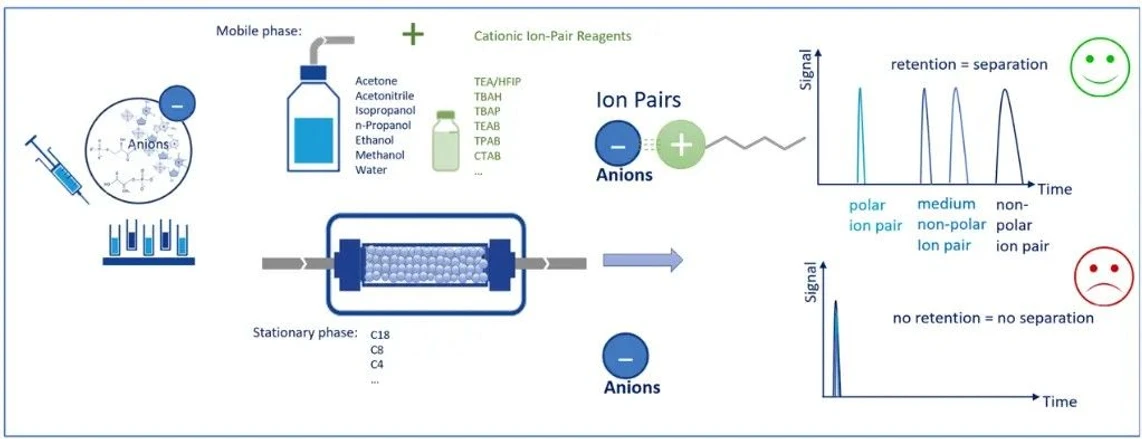
KNAUER: Figure 3 - Ion-Pair Reversed Phase Principle.KNAUER: Figure 3 - Ion-Pair Reversed Phase Principle.

Choosing the Right Ion-Pair Reagent

Successful IP-RP separation depends heavily on selecting an appropriate ion-pair reagent. Two key factors determine retention behavior:

  1. Alkyl chain length
  2. Charge density

KNAUER: Figure 4 - Ion-Pair Classification.KNAUER: Figure 4 - Ion-Pair Classification.

Strong Cationic Ion-Pair Reagents

Ion-pair reagents with longer alkyl chains provide stronger hydrophobic interactions and increased retention. A widely used example is tetrabutylammonium (TBA⁺), frequently applied for strongly retained anionic analytes.

These reagents are particularly useful when high retention strength is required.
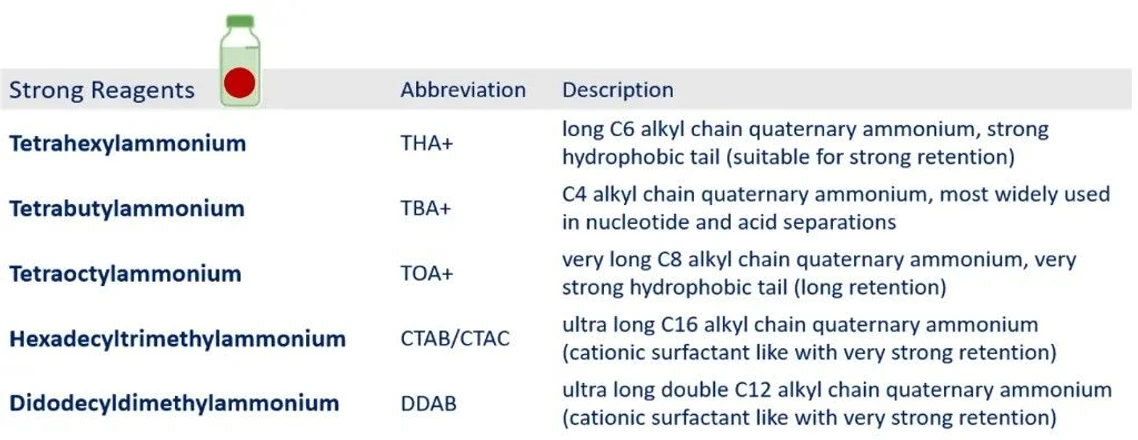
KNAUER: Table 1 - Strong Cationic Ion-Pair Reagents.KNAUER: Table 1 - Strong Cationic Ion-Pair Reagents.

Volatile (Weaker) Ion-Pair Reagents

Short-chain ion-pair reagents generate weaker retention but offer a significant advantage: compatibility with LC–MS detection.

Triethylammonium (TEA⁺) is among the most commonly used reagents for oligonucleotide analysis, particularly when mass spectrometric detection is involved. Other options, such as diisopropylethylammonium (DIEA⁺), are also widely applied, often combined with HFIP to enhance MS performance.
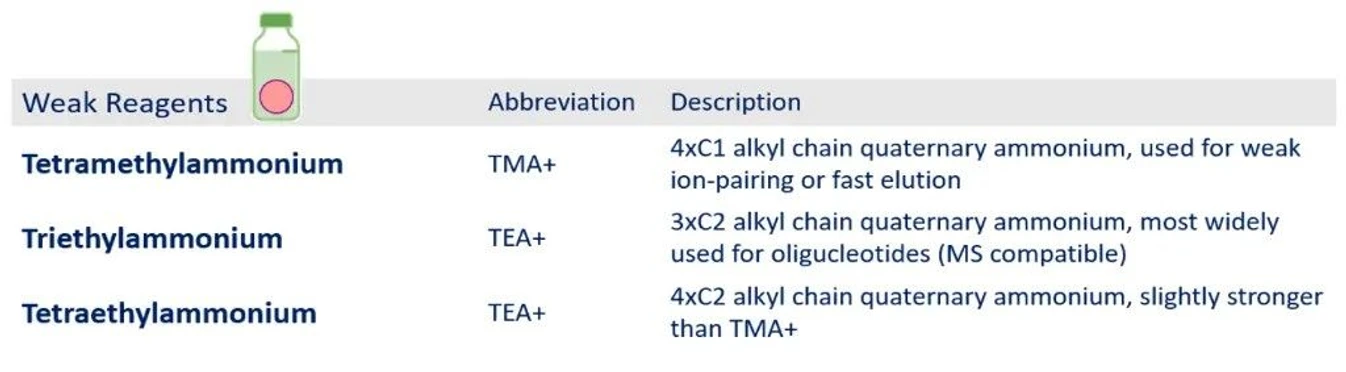
KNAUER: Table 2 - Weak Cationic Ion-Pair Reagents.KNAUER: Table 2 - Weak Cationic Ion-Pair Reagents.

Building an IP-RP Method for Oligonucleotides

Developing a robust IP-RP method follows a logical sequence:
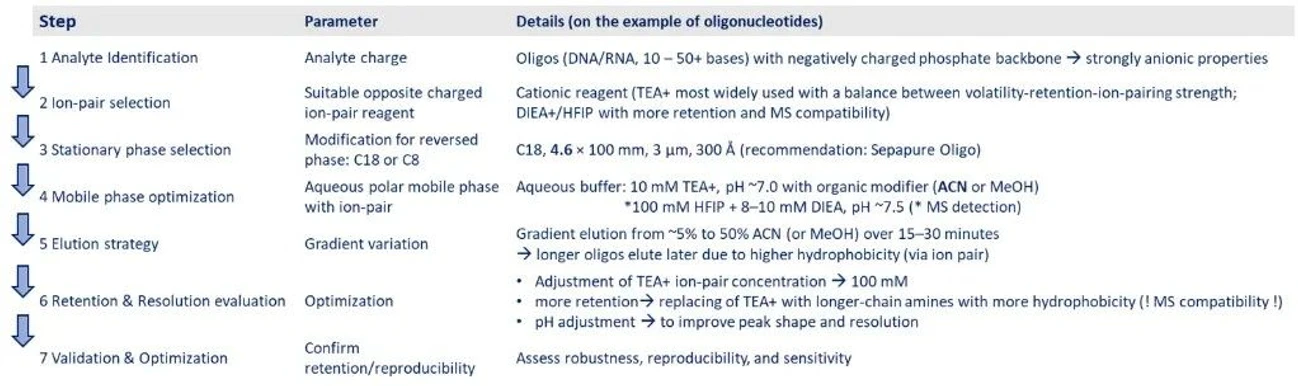
KNAUER: Table 3 - IP-RP Method Step Procedure for Oligos.KNAUER: Table 3 - IP-RP Method Step Procedure for Oligos.

1. Characterize the Analyte

Oligonucleotides typically contain 10–50+ nucleotides and exhibit high negative charge density. This necessitates a suitable cationic partner such as TEA⁺ or DIEA⁺.
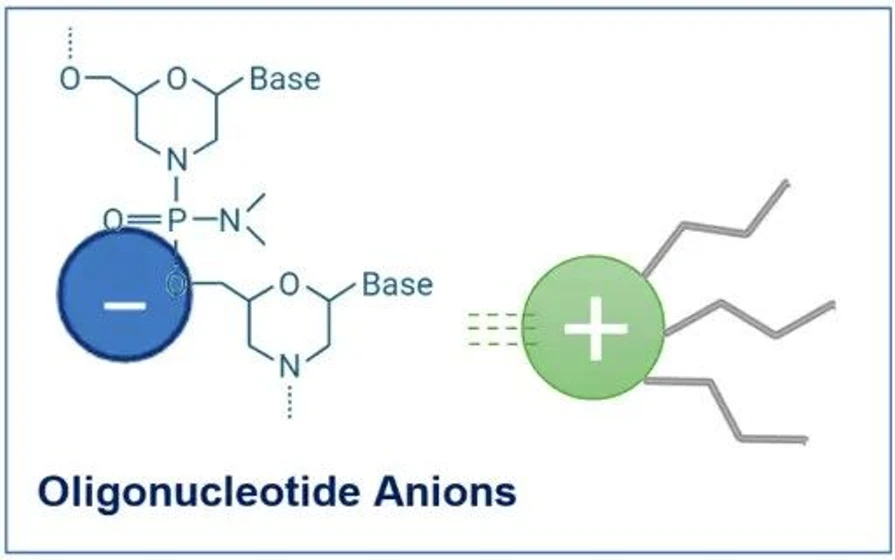
KNAUER: Figure 5 - Cationic Ion-Pair Principle for Oligonucleotides.KNAUER: Figure 5 - Cationic Ion-Pair Principle for Oligonucleotides.

2. Select the Column

Use a reversed-phase column with:

  • Large pore size (≈300 Å)
  • Appropriate internal diameter

These parameters support the so-called “ON–OFF” retention mechanism — a bind-and-elute behavior where analytes are strongly retained until the gradient triggers rapid elution.

3. Optimize the Mobile Phase

A typical starting condition includes:

  • 10 mM TEA buffer at pH ~7
  • Acetonitrile as organic modifier

Gradient programs from approximately 5% to 50% organic solvent over 15–30 minutes are commonly effective for complex oligonucleotide mixtures.

4. Adjust Retention Strength if Needed

To increase retention:

  • Raise ion-pair concentration (up to ~100 mM if required)
  • Select a more hydrophobic ion-pair reagent
5. Validate the Method

Ensure robustness, sensitivity, and reproducibility by carefully evaluating:

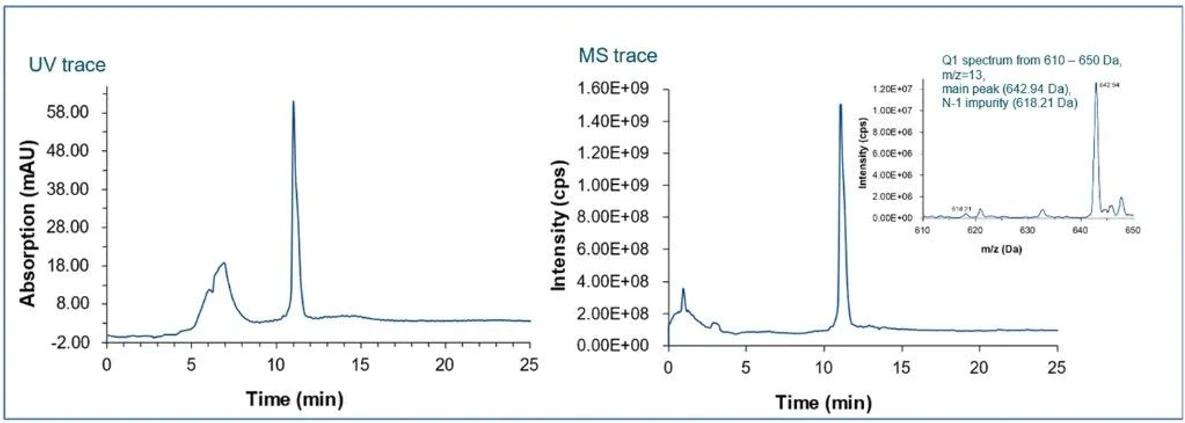
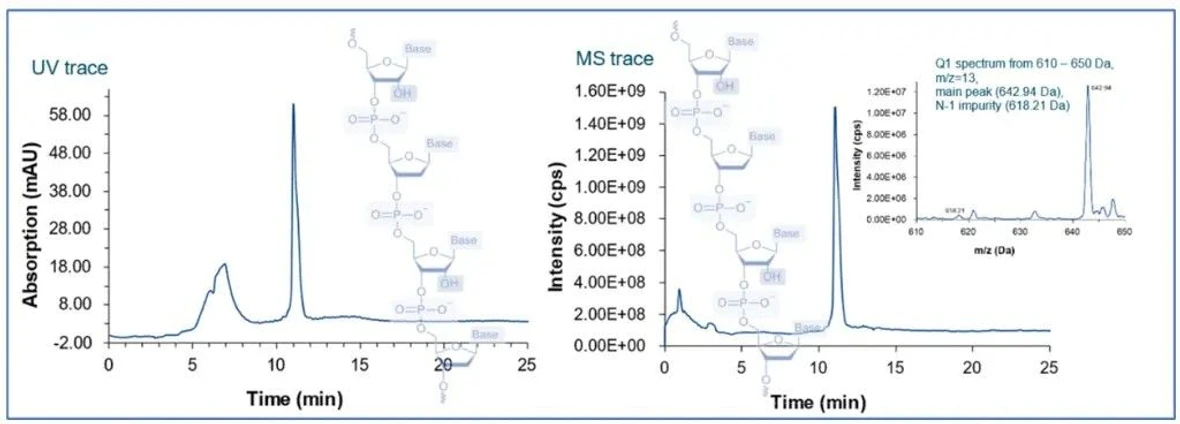
  • UV chromatograms
  • MS traces
  • Peak shape and resolution

KNAUER: Figure 6 - UV-MS traces of IP-RP Oligonucleotide Analysis.KNAUER: Figure 6 - UV-MS traces of IP-RP Oligonucleotide Analysis.

Why IP-RP Is Considered the Gold Standard

Ion-Pair Reversed-Phase Chromatography uniquely combines the resolving power of reversed-phase LC with the ability to retain highly polar, charged biomolecules.

Its advantages include:

  • Tunable selectivity
  • Compatibility with UV and MS detection
  • Scalability from analytical to preparative workflows
  • Applicability from research to pharmaceutical production

By transforming highly charged oligonucleotides into hydrophobic ion-pair complexes, IP-RP enables precise and reproducible separations that would otherwise be impossible in conventional reversed-phase systems.

For these reasons, IP-RP is widely regarded as the benchmark technique for oligonucleotide analysis.

Final Thoughts

Mastering IP-RP is less intimidating than it may seem. A successful method comes down to:

  • Selecting the right ion-pair reagent
  • Choosing a suitable column
  • Optimizing gradient conditions
  • Fine-tuning temperature and concentration parameters

With thoughtful method development, IP-RP delivers sharp peaks, clean separations, and reliable performance — fully compatible with modern mass spectrometry workflows and ready to meet the demands of advanced oligonucleotide analysis.

This version of the article was adapted from the original text using AI-assisted rewriting and editorial review.
KNAUER
LinkedIn Logo
 

Related content

Overcoming Strong Solvent Effects in the Analysis of Vepdegestrant

Applications
| 2026 | Agilent Technologies
Instrumentation
HPLC
Manufacturer
Agilent Technologies
Industries
Pharma & Biopharma

Identification of Double Bond Positions and Relative Acyl Chain Positions in Egg Yolk Phosphatidylcholines Using OAD-TOF System

Applications
| 2026 | Shimadzu
Instrumentation
LC/MS, LC/MS/MS, LC/TOF, LC/HRMS
Manufacturer
Shimadzu
Industries
Food & Agriculture

High Molecular-Weight Polysaccharide Characterization by SEC-MALS Using GTxResolve™ 1000 and 2000 Å SEC Columns

Applications
| 2026 | Waters
Instrumentation
GPC/SEC, Consumables, LC columns
Manufacturer
Waters
Industries
Pharma & Biopharma, Food & Agriculture

Development and Optimization for a Comprehensive LC/MS/MS Method for the Detection of 74 PFAS Compounds

Applications
| 2026 | Agilent Technologies
Instrumentation
LC/MS, LC/MS/MS, LC/QQQ
Manufacturer
Agilent Technologies
Industries
Food & Agriculture

PFAS in Biota: Risk Context & Robust Analytical Solutions

Others
| 2026 | ALS Europe
Instrumentation
Laboratory analysis, LC/MS, LC/MS/MS
Manufacturer
Industries
Environmental
 

Related articles

Unlock High-Performance LC-MS with Factory-Certified Systems from Thermo Fisher Scientific
Article | Product

Unlock High-Performance LC-MS with Factory-Certified Systems from Thermo Fisher Scientific

Get legendary Thermo Scientific LC-MS performance at a fraction of the cost. Factory-certified pre-owned systems deliver reliability, full warranty, expert support, and a smarter, sustainable investment.
Thermo Fisher Scientific
tag
share
more
Why Is It Necessary to Dry the SPE Sorbent Before Elution?
Article | Academy

Why Is It Necessary to Dry the SPE Sorbent Before Elution?

Proper drying of the SPE sorbent is a critical step to achieve high sensitivity, good reproducibility, and maximum analyte recovery, especially for complex sample matrices.
Phenomenex
tag
share
more
ISC 2026 Short Course 4 - Hydrophilic Interaction Liquid Chromatography
Article | Events

ISC 2026 Short Course 4 - Hydrophilic Interaction Liquid Chromatography

Master HILIC at ISC 2026: understand retention mechanisms, improve gradient repeatability, optimize LC–MS sensitivity, and choose phases for robust separations of polar analytes and biopolymers.
International Symposium on Chromatography - (ISC)
tag
share
more
News from LabRulezLCMS Library - Week 08, 2026
Article | Application

News from LabRulezLCMS Library - Week 08, 2026

This week we bring you application notes by Agilent Technologies, KNAUER, Shimadzu and Waters Corporation and presentation by MDCW / Clemson University!
LabRulez
tag
share
more
 

Related content

Overcoming Strong Solvent Effects in the Analysis of Vepdegestrant

Applications
| 2026 | Agilent Technologies
Instrumentation
HPLC
Manufacturer
Agilent Technologies
Industries
Pharma & Biopharma

Identification of Double Bond Positions and Relative Acyl Chain Positions in Egg Yolk Phosphatidylcholines Using OAD-TOF System

Applications
| 2026 | Shimadzu
Instrumentation
LC/MS, LC/MS/MS, LC/TOF, LC/HRMS
Manufacturer
Shimadzu
Industries
Food & Agriculture

High Molecular-Weight Polysaccharide Characterization by SEC-MALS Using GTxResolve™ 1000 and 2000 Å SEC Columns

Applications
| 2026 | Waters
Instrumentation
GPC/SEC, Consumables, LC columns
Manufacturer
Waters
Industries
Pharma & Biopharma, Food & Agriculture

Development and Optimization for a Comprehensive LC/MS/MS Method for the Detection of 74 PFAS Compounds

Applications
| 2026 | Agilent Technologies
Instrumentation
LC/MS, LC/MS/MS, LC/QQQ
Manufacturer
Agilent Technologies
Industries
Food & Agriculture

PFAS in Biota: Risk Context & Robust Analytical Solutions

Others
| 2026 | ALS Europe
Instrumentation
Laboratory analysis, LC/MS, LC/MS/MS
Manufacturer
Industries
Environmental
 

Related articles

Unlock High-Performance LC-MS with Factory-Certified Systems from Thermo Fisher Scientific
Article | Product

Unlock High-Performance LC-MS with Factory-Certified Systems from Thermo Fisher Scientific

Get legendary Thermo Scientific LC-MS performance at a fraction of the cost. Factory-certified pre-owned systems deliver reliability, full warranty, expert support, and a smarter, sustainable investment.
Thermo Fisher Scientific
tag
share
more
Why Is It Necessary to Dry the SPE Sorbent Before Elution?
Article | Academy

Why Is It Necessary to Dry the SPE Sorbent Before Elution?

Proper drying of the SPE sorbent is a critical step to achieve high sensitivity, good reproducibility, and maximum analyte recovery, especially for complex sample matrices.
Phenomenex
tag
share
more
ISC 2026 Short Course 4 - Hydrophilic Interaction Liquid Chromatography
Article | Events

ISC 2026 Short Course 4 - Hydrophilic Interaction Liquid Chromatography

Master HILIC at ISC 2026: understand retention mechanisms, improve gradient repeatability, optimize LC–MS sensitivity, and choose phases for robust separations of polar analytes and biopolymers.
International Symposium on Chromatography - (ISC)
tag
share
more
News from LabRulezLCMS Library - Week 08, 2026
Article | Application

News from LabRulezLCMS Library - Week 08, 2026

This week we bring you application notes by Agilent Technologies, KNAUER, Shimadzu and Waters Corporation and presentation by MDCW / Clemson University!
LabRulez
tag
share
more
 

Related content

Overcoming Strong Solvent Effects in the Analysis of Vepdegestrant

Applications
| 2026 | Agilent Technologies
Instrumentation
HPLC
Manufacturer
Agilent Technologies
Industries
Pharma & Biopharma

Identification of Double Bond Positions and Relative Acyl Chain Positions in Egg Yolk Phosphatidylcholines Using OAD-TOF System

Applications
| 2026 | Shimadzu
Instrumentation
LC/MS, LC/MS/MS, LC/TOF, LC/HRMS
Manufacturer
Shimadzu
Industries
Food & Agriculture

High Molecular-Weight Polysaccharide Characterization by SEC-MALS Using GTxResolve™ 1000 and 2000 Å SEC Columns

Applications
| 2026 | Waters
Instrumentation
GPC/SEC, Consumables, LC columns
Manufacturer
Waters
Industries
Pharma & Biopharma, Food & Agriculture

Development and Optimization for a Comprehensive LC/MS/MS Method for the Detection of 74 PFAS Compounds

Applications
| 2026 | Agilent Technologies
Instrumentation
LC/MS, LC/MS/MS, LC/QQQ
Manufacturer
Agilent Technologies
Industries
Food & Agriculture

PFAS in Biota: Risk Context & Robust Analytical Solutions

Others
| 2026 | ALS Europe
Instrumentation
Laboratory analysis, LC/MS, LC/MS/MS
Manufacturer
Industries
Environmental
 

Related articles

Unlock High-Performance LC-MS with Factory-Certified Systems from Thermo Fisher Scientific
Article | Product

Unlock High-Performance LC-MS with Factory-Certified Systems from Thermo Fisher Scientific

Get legendary Thermo Scientific LC-MS performance at a fraction of the cost. Factory-certified pre-owned systems deliver reliability, full warranty, expert support, and a smarter, sustainable investment.
Thermo Fisher Scientific
tag
share
more
Why Is It Necessary to Dry the SPE Sorbent Before Elution?
Article | Academy

Why Is It Necessary to Dry the SPE Sorbent Before Elution?

Proper drying of the SPE sorbent is a critical step to achieve high sensitivity, good reproducibility, and maximum analyte recovery, especially for complex sample matrices.
Phenomenex
tag
share
more
ISC 2026 Short Course 4 - Hydrophilic Interaction Liquid Chromatography
Article | Events

ISC 2026 Short Course 4 - Hydrophilic Interaction Liquid Chromatography

Master HILIC at ISC 2026: understand retention mechanisms, improve gradient repeatability, optimize LC–MS sensitivity, and choose phases for robust separations of polar analytes and biopolymers.
International Symposium on Chromatography - (ISC)
tag
share
more
News from LabRulezLCMS Library - Week 08, 2026
Article | Application

News from LabRulezLCMS Library - Week 08, 2026

This week we bring you application notes by Agilent Technologies, KNAUER, Shimadzu and Waters Corporation and presentation by MDCW / Clemson University!
LabRulez
tag
share
more
 

Related content

Overcoming Strong Solvent Effects in the Analysis of Vepdegestrant

Applications
| 2026 | Agilent Technologies
Instrumentation
HPLC
Manufacturer
Agilent Technologies
Industries
Pharma & Biopharma

Identification of Double Bond Positions and Relative Acyl Chain Positions in Egg Yolk Phosphatidylcholines Using OAD-TOF System

Applications
| 2026 | Shimadzu
Instrumentation
LC/MS, LC/MS/MS, LC/TOF, LC/HRMS
Manufacturer
Shimadzu
Industries
Food & Agriculture

High Molecular-Weight Polysaccharide Characterization by SEC-MALS Using GTxResolve™ 1000 and 2000 Å SEC Columns

Applications
| 2026 | Waters
Instrumentation
GPC/SEC, Consumables, LC columns
Manufacturer
Waters
Industries
Pharma & Biopharma, Food & Agriculture

Development and Optimization for a Comprehensive LC/MS/MS Method for the Detection of 74 PFAS Compounds

Applications
| 2026 | Agilent Technologies
Instrumentation
LC/MS, LC/MS/MS, LC/QQQ
Manufacturer
Agilent Technologies
Industries
Food & Agriculture

PFAS in Biota: Risk Context & Robust Analytical Solutions

Others
| 2026 | ALS Europe
Instrumentation
Laboratory analysis, LC/MS, LC/MS/MS
Manufacturer
Industries
Environmental
 

Related articles

Unlock High-Performance LC-MS with Factory-Certified Systems from Thermo Fisher Scientific
Article | Product

Unlock High-Performance LC-MS with Factory-Certified Systems from Thermo Fisher Scientific

Get legendary Thermo Scientific LC-MS performance at a fraction of the cost. Factory-certified pre-owned systems deliver reliability, full warranty, expert support, and a smarter, sustainable investment.
Thermo Fisher Scientific
tag
share
more
Why Is It Necessary to Dry the SPE Sorbent Before Elution?
Article | Academy

Why Is It Necessary to Dry the SPE Sorbent Before Elution?

Proper drying of the SPE sorbent is a critical step to achieve high sensitivity, good reproducibility, and maximum analyte recovery, especially for complex sample matrices.
Phenomenex
tag
share
more
ISC 2026 Short Course 4 - Hydrophilic Interaction Liquid Chromatography
Article | Events

ISC 2026 Short Course 4 - Hydrophilic Interaction Liquid Chromatography

Master HILIC at ISC 2026: understand retention mechanisms, improve gradient repeatability, optimize LC–MS sensitivity, and choose phases for robust separations of polar analytes and biopolymers.
International Symposium on Chromatography - (ISC)
tag
share
more
News from LabRulezLCMS Library - Week 08, 2026
Article | Application

News from LabRulezLCMS Library - Week 08, 2026

This week we bring you application notes by Agilent Technologies, KNAUER, Shimadzu and Waters Corporation and presentation by MDCW / Clemson University!
LabRulez
tag
share
more
Other projects
GCMS
ICPMS
Follow us
FacebookX (Twitter)LinkedInYouTube
More information
WebinarsAbout usContact usTerms of use
LabRulez s.r.o. All rights reserved. Content available under a CC BY-SA 4.0 Attribution-ShareAlike