Avoiding Common Syringe Filter Mistakes

KNAUER: Avoiding Common Syringe Filter Mistakes
A Practical Guide to Getting the Most from Syringe Filters: Tips, Tricks, and Common Pitfalls
Syringe filters play a crucial role in chromatography and many other laboratory applications by removing particulate matter before analysis. Proper sample filtration helps protect analytical instruments, extends column lifetime, and improves data quality. However, selecting an unsuitable filter—or using one incorrectly—can introduce contamination, reduce filtration efficiency, or even compromise analytical results. The following recommendations will help you avoid common mistakes and ensure reliable filtration every time.
 KNAUER: Avoiding Common Syringe Filter Mistakes
1. Improper Filter Handling
Using excessive force during filtration or attempting to reuse disposable syringe filters can damage the membrane and increase the risk of sample contamination.
- Solution: Apply slow, even pressure throughout the filtration process and always dispose of single-use filters after one use. If the flow rate decreases noticeably, replace the filter instead of applying additional force.
2. Selecting an Inappropriate Pore Size
Using the wrong pore size may either fail to remove unwanted particles or cause the membrane to clog prematurely, reducing filtration efficiency.
- Solution: A 0.45 µm membrane is generally suitable for routine particulate removal, while a 0.22 µm membrane is recommended for finer filtration and bacterial removal. Samples with higher viscosity may require a pre-filter to prevent rapid clogging. It is also important to consider the intended analytical technique. For example, 0.22 µm filters are typically preferred for UHPLC and LC-MS applications, whereas 0.45 µm filters are often sufficient for conventional HPLC analyses.
3. Choosing the Wrong Membrane Material
Different membrane materials exhibit different chemical resistance. Using an incompatible membrane may lead to degradation of the filter, sample contamination, or complete filtration failure.
- Solution: Always verify solvent compatibility before filtration. PTFE membranes are an excellent choice for organic solvents, while PES and nylon membranes are better suited to aqueous samples. If compatibility is uncertain, perform a small-scale trial before filtering valuable samples.
- Pro Tip: For additional guidance, see our blog article "How to Choose the Right Membrane for your Syringe Filter", which provides a detailed comparison of membrane materials and their recommended applications.
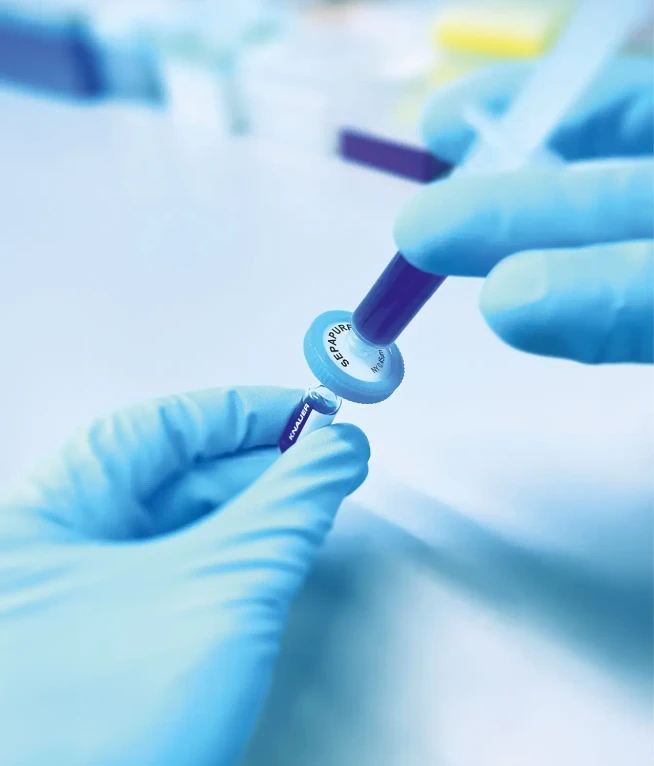
KNAUER Sepapure® Syringe Filters are available with multiple membrane materials, each identified by a dedicated color code for quick and reliable selection.
4. Ignoring Filter Capacity
Using a filter with insufficient capacity can result in rapid membrane blockage, increasing filtration time and reducing laboratory productivity.
- Solution: When filtering larger sample volumes, choose high-capacity syringe filters or introduce a pre-filtration step. Never force liquid through a clogged membrane, as doing so may damage the filter and negatively affect sample quality.
5. Overlooking Sample Adsorption
Certain membrane materials may adsorb analytes of interest, leading to lower recoveries and potentially affecting quantitative results.
- Solution: For protein samples or other adsorption-sensitive analytes, select membranes with low binding characteristics, such as nylon or glass fiber, whenever appropriate. Performing a small recovery test before routine analysis can help identify potential analyte losses.
6. Failing to Optimize Filtration Performance
Slow filtration is more than just an inconvenience—it often indicates that the filtration conditions are not optimal.
- Solution: If filtration becomes unusually slow, investigate possible causes such as membrane clogging, excessive sample viscosity, or an unnecessarily small pore size. Depending on the sample, dilution or sequential filtration using progressively finer filters may significantly improve performance.
Final Thoughts
Selecting the appropriate syringe filter is a straightforward process, but overlooking small details can have a significant impact on analytical performance. Choosing the correct membrane material, pore size, and filtration strategy helps improve laboratory efficiency, protects chromatography systems and columns, and contributes to accurate, reproducible analytical results.
With the right syringe filter and proper filtration technique, you can minimize sample preparation problems and maximize confidence in every analysis.
 KNAUER: Sepapure® Syringe Filter Selection
Happy filtering!