Author
KNAUER
KNAUER
Based in Berlin, KNAUER is a medium-sized, owner-managed company that has been serving the sciences since 1962. We develop and manufacture scientific instruments of superior quality for liquid chromatography, including: Analytical HPLC/UHPLC, Preparative HPLC, Fast protein liquid chromatography (FPLC), Multi-column chromatography/Simulated moving bed (SMB) chromatography. High pressure dosing, in-line detection systems, and osmometry are additional business areas.
Tags
Article
Product
LinkedIn Logo

How to Choose the Right Membrane for Your Syringe Filter

We, 24.6.2026
| Original article from: KNAUER
Learn how to select the optimal syringe filter membrane for HPLC and laboratory applications. Compare Nylon, CA, hPTFE, and PTFE membranes, pore sizes, compatibility, and best practices.
<p>KNAUER: How to Choose the Right Membrane for Your Syringe Filter</p>

KNAUER: How to Choose the Right Membrane for Your Syringe Filter

Choosing the correct membrane for a syringe filter is an important step in achieving dependable and reproducible analytical results. Whether you work with nylon, PTFE, hydrophilic PTFE, or cellulose acetate filters, the membrane material directly influences filtration efficiency, sample integrity, and overall method performance. In this article, we explore why membrane selection matters, review the characteristics of common membrane materials, and provide practical guidance for choosing the best option for your application.

Why Are Syringe Filters Important?

Syringe filters are routinely used to remove particulate matter from samples prior to analysis. Unfiltered samples can introduce contaminants into chromatographic systems, leading to clogged columns, increased system backpressure, reduced instrument lifetime, and compromised analytical performance.

Selecting an appropriate membrane is therefore essential for developing a robust and reliable HPLC workflow. An ideal membrane effectively removes particles while preserving the original composition of the sample. Since the membrane comes into direct contact with both the analyte and the sample solvent, compatibility must always be carefully considered.
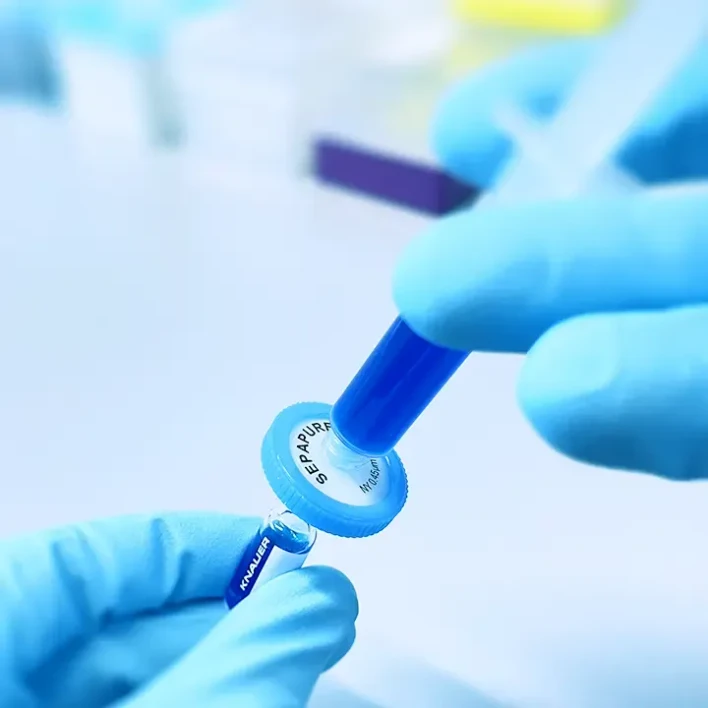
KNAUER: Syringe filtersKNAUER: Syringe filters

Let’s examine the key factors involved in choosing the most suitable membrane.

Step 1: Consider the Nature of Your Sample

The first and most important factor is the chemical composition of the sample and the solvents involved. Different membrane materials offer different chemical resistance and sample interaction characteristics.

Nylon Membranes

Nylon is one of the most commonly used membrane materials in HPLC laboratories because of its broad compatibility with aqueous solutions and many organic solvents.

Recommended applications:

  • Routine filtration of HPLC samples containing aqueous solvents, organic solvents, or mixed mobile phases.
  • Removal of suspended particles prior to chromatographic injection.
  • General-purpose laboratory filtration where versatility is required.

Avoid using Nylon when:

  • Working with strongly acidic solutions or samples with pH values below 3.
  • Filtering protein-containing samples, since proteins can adsorb to the membrane surface and reduce recovery.
Cellulose Acetate (CA) Membranes

Cellulose acetate membranes exhibit very low protein binding and are widely used for biological and biochemical applications.

Recommended applications:

  • Filtration of biological fluids such as serum, plasma, and cell culture media.
  • Applications where protein recovery must be maximized.
  • Aqueous laboratory procedures involving enzymes or other sensitive biomolecules.

Avoid using CA when:

  • Filtering samples containing organic solvents that may damage the membrane.
  • Working under highly acidic or highly alkaline conditions that could degrade the material.
Hydrophilic PTFE (hPTFE) Membranes

Hydrophilic PTFE combines the exceptional chemical resistance of PTFE with the ability to process aqueous samples without pre-wetting.

Recommended applications:

  • Filtration of both aqueous and organic solutions.
  • HPLC sample preparation involving mixed solvent systems.
  • Applications requiring compatibility across a broad pH range.

Avoid using hPTFE when:

  • Processing highly viscous samples that may rapidly clog the membrane.
  • Performing PFAS analysis, where fluorinated materials may introduce unwanted contamination.
PTFE Membranes

PTFE membranes provide excellent resistance to aggressive chemicals and are especially suitable for demanding solvent environments.

Recommended applications:

  • Samples containing strong acids, strong bases, or aggressive organic solvents.
  • Environmental, industrial, and chemical analyses involving non-polar solvents such as hexane, toluene, or acetone.
  • Filtration of predominantly organic solvent-based samples.

Avoid using PTFE when:

  • Filtering aqueous solutions without first wetting the membrane or using a hydrophilic PTFE alternative.
  • Working with protein-rich or highly hydrophilic samples where adsorption or poor wetting may occur.

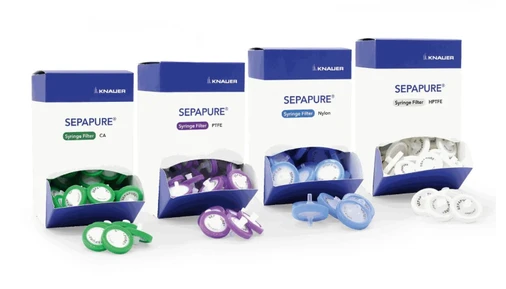
KNAUER: Fig. 1–4 Nylon (top left), CA (top, right), hPTFE (bottom, left), and PTFE (bottom, right)KNAUER: Fig. 1–4 Nylon (top left), CA (top, right), hPTFE (bottom, left), and PTFE (bottom, right)

Step 2: Select an Appropriate Pore Size

The membrane pore size determines the level of particulate removal and should be selected according to the requirements of the analytical method.

Common pore sizes include:

  • 0.2 µm – Suitable for removing very fine particles and for sterile filtration. Frequently used in UHPLC and LC-MS workflows.
  • 0.45 µm – The standard choice for most routine HPLC applications.
  • 1.0 µm and larger – Often used for coarse filtration or as a pre-filtration step for heavily contaminated samples.

Choosing the correct pore size helps protect instrumentation while minimizing unnecessary sample loss.
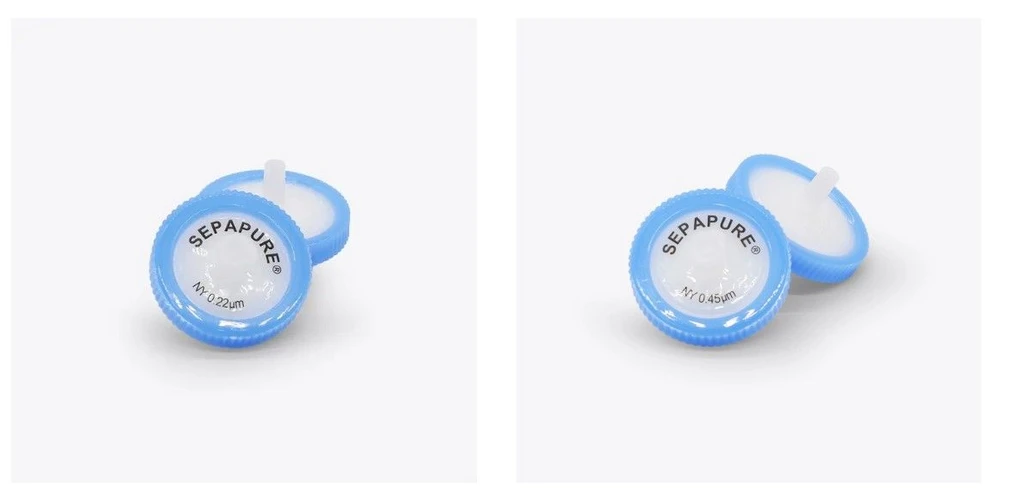
KNAUER: Fig. 1–2 0.22 µm (left), and 0.45 µm (right) Nylon Syringe FilterKNAUER: Fig. 1–2 0.22 µm (left), and 0.45 µm (right) Nylon Syringe Filter

Step 3: Verify Chemical Compatibility

Before selecting a membrane, confirm that it is compatible with both the sample matrix and the solvents present. Incompatible materials may swell, degrade, release extractables, or alter the composition of the sample.

Consulting a solvent compatibility chart is highly recommended whenever unfamiliar solvents or mixtures are involved.

Step 4: Match the Membrane to the Application

Different analytical applications often benefit from specific membrane types.

HPLC Analysis
  • Nylon and PTFE membranes are among the most frequently used options due to their broad chemical compatibility and excellent filtration performance.
Protein and Biomolecule Analysis
  • CA, PVDF, and PES membranes are generally preferred because they exhibit low protein binding and help preserve sample recovery.
Microbiological Testing
  • Mixed cellulose ester (MCE) membranes are commonly employed for microbial monitoring and microbiological quality control procedures.

Selecting a membrane tailored to the analytical objective can significantly improve data quality and method reliability.

Step 5: Evaluate Product Quality and Certification

Not all syringe filters are manufactured to the same standards. For critical applications, select products that comply with recognized quality systems and certifications such as ISO standards or CE requirements.

This becomes particularly important in regulated industries, where traceability, consistency, and documented performance are essential.

Practical Recommendations for Using Syringe Filters

Following good filtration practices can further improve analytical performance.

  • Pre-Wet Hydrophobic Membranes: Hydrophobic materials such as PTFE often require pre-wetting with a compatible organic solvent before filtering aqueous samples.
  • Avoid Excessive Pressure: Applying excessive force may rupture the membrane or cause leakage. Luer-lock syringes are recommended to provide secure connections and controlled pressure.
  • Use Filters Only Once: Syringe filters are intended for single-use operation. Reusing filters increases the risk of carryover and cross-contamination.
  • Dispose of Filters Properly: Used syringe filters should be discarded according to laboratory safety procedures and local waste disposal regulations.

Final Thoughts

Selecting the right syringe filter membrane is a key factor in obtaining accurate, reproducible, and reliable analytical results. By considering sample composition, solvent compatibility, pore size, and application requirements, laboratories can choose filtration solutions that protect instruments, preserve sample integrity, and improve overall analytical performance.

A carefully selected membrane may seem like a small detail, but it can have a substantial impact on the quality and robustness of your entire analytical workflow.

If you want to optimize your HPLC workflow, check out our brand-new SEPAPURE Syringe Filter.

This version of the article was adapted from the original text using AI-assisted rewriting and editorial review.
KNAUER
LinkedIn Logo
 

Related content

Two-Step Matrix Deposition for Improved MS Imaging Resolution

Posters
| 2026 | Shimadzu (ASMS)
Instrumentation
LC/MS, LC/MS/MS, LC/TOF, LC/HRMS, MALDI, MS Imaging
Manufacturer
Shimadzu
Industries
Pharma & Biopharma

Smart Monitoring & Optimization Solutions for SMB Processes: In-Line and Off-Line Tools for SMB Systems

Technical notes
| 2026 | KNAUER
Instrumentation
HPLC
Manufacturer
KNAUER
Industries
Pharma & Biopharma

Xevo MRT P10 Mass Spectrometer

Brochures and specifications
| 2026 | Waters
Instrumentation
LC/MS, LC/MS/MS, LC/TOF, LC/HRMS
Manufacturer
Waters
Industries
Metabolomics, Proteomics , Lipidomics

Large-Volume Dilute-and-Shoot Analysis of PFAS in Drinking Water Using the Altura PFAS Column

Applications
| 2026 | Agilent Technologies
Instrumentation
Consumables, LC columns, LC/MS, LC/MS/MS, LC/QQQ
Manufacturer
Agilent Technologies
Industries
Environmental

Hey, ho, oliGO – Comparison of ion-pairing systems for oligonucleotide analysis with HPLC-UV

Applications
| 2026 | KNAUER
Instrumentation
Consumables, LC columns, HPLC
Manufacturer
KNAUER
Industries
Pharma & Biopharma
 

Related articles

Small but Essential Laboratory Helpers: Syringe Filters
Article | Product

Small but Essential Laboratory Helpers: Syringe Filters

Small but essential: syringe filters ensure clean samples, instrument protection and sterile solutions. Watrex Praha offers Nylon, PTFE, PES, MCE, PVDF (4–30 mm; 0.22/0.45 µm) plus tips for HPLC/LC-MS.
Watrex Praha
tag
share
more
Mastering Filtration in Chromatography: Expert Tips on Syringe Filters
Interview | Science and research

Mastering Filtration in Chromatography: Expert Tips on Syringe Filters

Jim Averso explains why syringe filtration is critical for chromatography, how to choose membranes and pore sizes, avoid common mistakes, cut backpressure, and streamline sample prep with prefiltration.
Organomation
tag
share
more
Efficient Sample Concentration for Micropollutant Surveillance Under EU Directive 2024/3019
Article | Environment

Efficient Sample Concentration for Micropollutant Surveillance Under EU Directive 2024/3019

How the EU’s revised Urban Wastewater Treatment Directive is driving demand for ultra-sensitive LC-MS/MS workflows—and why nitrogen evaporation is critical for reliable micropollutant monitoring.
Organomation
tag
share
more
Oligos Made Easy - Part 5: SEC
Article | Academy

Oligos Made Easy - Part 5: SEC

Learn how SEC streamlines oligonucleotide purification. From pore size selection to flow optimization, discover practical tips for desalting, buffer exchange, and clean size-based separation.
KNAUER
tag
share
more
 

Related content

Two-Step Matrix Deposition for Improved MS Imaging Resolution

Posters
| 2026 | Shimadzu (ASMS)
Instrumentation
LC/MS, LC/MS/MS, LC/TOF, LC/HRMS, MALDI, MS Imaging
Manufacturer
Shimadzu
Industries
Pharma & Biopharma

Smart Monitoring & Optimization Solutions for SMB Processes: In-Line and Off-Line Tools for SMB Systems

Technical notes
| 2026 | KNAUER
Instrumentation
HPLC
Manufacturer
KNAUER
Industries
Pharma & Biopharma

Xevo MRT P10 Mass Spectrometer

Brochures and specifications
| 2026 | Waters
Instrumentation
LC/MS, LC/MS/MS, LC/TOF, LC/HRMS
Manufacturer
Waters
Industries
Metabolomics, Proteomics , Lipidomics

Large-Volume Dilute-and-Shoot Analysis of PFAS in Drinking Water Using the Altura PFAS Column

Applications
| 2026 | Agilent Technologies
Instrumentation
Consumables, LC columns, LC/MS, LC/MS/MS, LC/QQQ
Manufacturer
Agilent Technologies
Industries
Environmental

Hey, ho, oliGO – Comparison of ion-pairing systems for oligonucleotide analysis with HPLC-UV

Applications
| 2026 | KNAUER
Instrumentation
Consumables, LC columns, HPLC
Manufacturer
KNAUER
Industries
Pharma & Biopharma
 

Related articles

Small but Essential Laboratory Helpers: Syringe Filters
Article | Product

Small but Essential Laboratory Helpers: Syringe Filters

Small but essential: syringe filters ensure clean samples, instrument protection and sterile solutions. Watrex Praha offers Nylon, PTFE, PES, MCE, PVDF (4–30 mm; 0.22/0.45 µm) plus tips for HPLC/LC-MS.
Watrex Praha
tag
share
more
Mastering Filtration in Chromatography: Expert Tips on Syringe Filters
Interview | Science and research

Mastering Filtration in Chromatography: Expert Tips on Syringe Filters

Jim Averso explains why syringe filtration is critical for chromatography, how to choose membranes and pore sizes, avoid common mistakes, cut backpressure, and streamline sample prep with prefiltration.
Organomation
tag
share
more
Efficient Sample Concentration for Micropollutant Surveillance Under EU Directive 2024/3019
Article | Environment

Efficient Sample Concentration for Micropollutant Surveillance Under EU Directive 2024/3019

How the EU’s revised Urban Wastewater Treatment Directive is driving demand for ultra-sensitive LC-MS/MS workflows—and why nitrogen evaporation is critical for reliable micropollutant monitoring.
Organomation
tag
share
more
Oligos Made Easy - Part 5: SEC
Article | Academy

Oligos Made Easy - Part 5: SEC

Learn how SEC streamlines oligonucleotide purification. From pore size selection to flow optimization, discover practical tips for desalting, buffer exchange, and clean size-based separation.
KNAUER
tag
share
more
 

Related content

Two-Step Matrix Deposition for Improved MS Imaging Resolution

Posters
| 2026 | Shimadzu (ASMS)
Instrumentation
LC/MS, LC/MS/MS, LC/TOF, LC/HRMS, MALDI, MS Imaging
Manufacturer
Shimadzu
Industries
Pharma & Biopharma

Smart Monitoring & Optimization Solutions for SMB Processes: In-Line and Off-Line Tools for SMB Systems

Technical notes
| 2026 | KNAUER
Instrumentation
HPLC
Manufacturer
KNAUER
Industries
Pharma & Biopharma

Xevo MRT P10 Mass Spectrometer

Brochures and specifications
| 2026 | Waters
Instrumentation
LC/MS, LC/MS/MS, LC/TOF, LC/HRMS
Manufacturer
Waters
Industries
Metabolomics, Proteomics , Lipidomics

Large-Volume Dilute-and-Shoot Analysis of PFAS in Drinking Water Using the Altura PFAS Column

Applications
| 2026 | Agilent Technologies
Instrumentation
Consumables, LC columns, LC/MS, LC/MS/MS, LC/QQQ
Manufacturer
Agilent Technologies
Industries
Environmental

Hey, ho, oliGO – Comparison of ion-pairing systems for oligonucleotide analysis with HPLC-UV

Applications
| 2026 | KNAUER
Instrumentation
Consumables, LC columns, HPLC
Manufacturer
KNAUER
Industries
Pharma & Biopharma
 

Related articles

Small but Essential Laboratory Helpers: Syringe Filters
Article | Product

Small but Essential Laboratory Helpers: Syringe Filters

Small but essential: syringe filters ensure clean samples, instrument protection and sterile solutions. Watrex Praha offers Nylon, PTFE, PES, MCE, PVDF (4–30 mm; 0.22/0.45 µm) plus tips for HPLC/LC-MS.
Watrex Praha
tag
share
more
Mastering Filtration in Chromatography: Expert Tips on Syringe Filters
Interview | Science and research

Mastering Filtration in Chromatography: Expert Tips on Syringe Filters

Jim Averso explains why syringe filtration is critical for chromatography, how to choose membranes and pore sizes, avoid common mistakes, cut backpressure, and streamline sample prep with prefiltration.
Organomation
tag
share
more
Efficient Sample Concentration for Micropollutant Surveillance Under EU Directive 2024/3019
Article | Environment

Efficient Sample Concentration for Micropollutant Surveillance Under EU Directive 2024/3019

How the EU’s revised Urban Wastewater Treatment Directive is driving demand for ultra-sensitive LC-MS/MS workflows—and why nitrogen evaporation is critical for reliable micropollutant monitoring.
Organomation
tag
share
more
Oligos Made Easy - Part 5: SEC
Article | Academy

Oligos Made Easy - Part 5: SEC

Learn how SEC streamlines oligonucleotide purification. From pore size selection to flow optimization, discover practical tips for desalting, buffer exchange, and clean size-based separation.
KNAUER
tag
share
more
 

Related content

Two-Step Matrix Deposition for Improved MS Imaging Resolution

Posters
| 2026 | Shimadzu (ASMS)
Instrumentation
LC/MS, LC/MS/MS, LC/TOF, LC/HRMS, MALDI, MS Imaging
Manufacturer
Shimadzu
Industries
Pharma & Biopharma

Smart Monitoring & Optimization Solutions for SMB Processes: In-Line and Off-Line Tools for SMB Systems

Technical notes
| 2026 | KNAUER
Instrumentation
HPLC
Manufacturer
KNAUER
Industries
Pharma & Biopharma

Xevo MRT P10 Mass Spectrometer

Brochures and specifications
| 2026 | Waters
Instrumentation
LC/MS, LC/MS/MS, LC/TOF, LC/HRMS
Manufacturer
Waters
Industries
Metabolomics, Proteomics , Lipidomics

Large-Volume Dilute-and-Shoot Analysis of PFAS in Drinking Water Using the Altura PFAS Column

Applications
| 2026 | Agilent Technologies
Instrumentation
Consumables, LC columns, LC/MS, LC/MS/MS, LC/QQQ
Manufacturer
Agilent Technologies
Industries
Environmental

Hey, ho, oliGO – Comparison of ion-pairing systems for oligonucleotide analysis with HPLC-UV

Applications
| 2026 | KNAUER
Instrumentation
Consumables, LC columns, HPLC
Manufacturer
KNAUER
Industries
Pharma & Biopharma
 

Related articles

Small but Essential Laboratory Helpers: Syringe Filters
Article | Product

Small but Essential Laboratory Helpers: Syringe Filters

Small but essential: syringe filters ensure clean samples, instrument protection and sterile solutions. Watrex Praha offers Nylon, PTFE, PES, MCE, PVDF (4–30 mm; 0.22/0.45 µm) plus tips for HPLC/LC-MS.
Watrex Praha
tag
share
more
Mastering Filtration in Chromatography: Expert Tips on Syringe Filters
Interview | Science and research

Mastering Filtration in Chromatography: Expert Tips on Syringe Filters

Jim Averso explains why syringe filtration is critical for chromatography, how to choose membranes and pore sizes, avoid common mistakes, cut backpressure, and streamline sample prep with prefiltration.
Organomation
tag
share
more
Efficient Sample Concentration for Micropollutant Surveillance Under EU Directive 2024/3019
Article | Environment

Efficient Sample Concentration for Micropollutant Surveillance Under EU Directive 2024/3019

How the EU’s revised Urban Wastewater Treatment Directive is driving demand for ultra-sensitive LC-MS/MS workflows—and why nitrogen evaporation is critical for reliable micropollutant monitoring.
Organomation
tag
share
more
Oligos Made Easy - Part 5: SEC
Article | Academy

Oligos Made Easy - Part 5: SEC

Learn how SEC streamlines oligonucleotide purification. From pore size selection to flow optimization, discover practical tips for desalting, buffer exchange, and clean size-based separation.
KNAUER
tag
share
more
Other projects
GCMS
ICPMS
Follow us
FacebookX (Twitter)LinkedInYouTube
More information
WebinarsAbout usContact usTerms of use
LabRulez s.r.o. All rights reserved. Content available under a CC BY-SA 4.0 Attribution-ShareAlike