Separation Sciences in the Czech Republic: From Historical Foundations to Recent Advances
![<p>Separations 2026, 13(7), 188: Figure 2. Poster presentation of in-laboratory built early HPLC chromatograph in the laboratory of P. Jandera (Pardubice), displayed at the exposition of technical innovations in 1970 in Brno (left), and photo of the real set (right), year ca. 1970 [16].</p>](https://lcms.labrulez.com/labrulez-bucket-strapi-h3hsga3/Separations_2026_13_7_188_Figure_2_Poster_presentation_of_in_laboratory_built_early_HPLC_chromatograph_af3a304894_l.webp)
Separations 2026, 13(7), 188: Figure 2. Poster presentation of in-laboratory built early HPLC chromatograph in the laboratory of P. Jandera (Pardubice), displayed at the exposition of technical innovations in 1970 in Brno (left), and photo of the real set (right), year ca. 1970 [16].
This review highlights important but less widely recognized contributions of Czech scientists to the development of chromatography and electrophoresis. Building on a long tradition of separation science in the Czech Republic and former Czechoslovakia, it covers advances ranging from fundamental research to patented innovations and successful commercialization.
Particular attention is given to developments that have emerged since earlier comprehensive historical reviews, providing an updated perspective on the Czech chromatographic and electrophoretic community and its role in advancing modern separation science.
The original article
Separation Sciences in the Czech Republic: From Historical Foundations to Recent Advances
Separations 2026, 13(7), 188
https://doi.org/10.3390/separations13070188
licensed under CC-BY 4.0
Selected sections from the article follow. Formats and hyperlinks were adapted from the original.
Separation science involving chromatographic, electromigration, and related methods is one of the most important disciplines in the field of chemical sciences because both natural and synthetic chemical substances are usually present in more or less complex mixtures, but for investigation of their properties and applications, they have to first be isolated in a pure form. In other words, they must be separated from the other substances in the usually rather complex matrices. For this purpose, various separation methods are necessary. Czech chemists were aware of this fact and had already started research, development, and application of then new separation methods, chromatography, and electrophoresis, in the 1940s [1,2,3]. These years correspond to the period when separation methods started to slowly gain wider scientific recognition.
The comprehensive history of Czech chromatographic achievements and the impact of Czech scientists on national and international journals and conferences can be found in many sources. Among English-written materials, the traces of Czech scientists can be found in the book published on the occasion of the 75th chromatography anniversary [4], the personal remarks of Zdeněk Deyl [5], or, in the historical overview addressed by Pavel Jandera, one of the pioneers of high-performance liquid chromatography in the Czech Republic [6]. Therefore, the current article focuses on a brief review of the lesser-known yet important information which may have been published only in the Czech language. Moreover, the contribution of Czech scientists to the development of chromatographic and electrophoretic methods in the last twenty years, not yet covered in previous reports [6], is briefly summarized. The description of the development and application of separation methods is divided into two sections: chromatographic methods, which mainly cover high-performance liquid chromatography, and electromigration methods.
2. Chromatographic Methods
2.1. Historical Introduction
For Czech scientists (or Czechoslovak, as both countries were united between 1918 and 1992 with a six-year break during the Second World War), the introduction of chromatography started with two major events. The first was the series of review articles in the historical Czech journals of the 1940s written by Josef Koštíř [1,2,3], and the second was the organization of the first national conference on chromatographic techniques in 1950, organized by František Šorm (later director of the Institute of Organic Chemistry and Biochemistry, and president of the Czechoslovak Academy of Sciences, Prague), with the aim of transferring the ideas of the Faraday Society Discussion on Chromatographic Analysis held at the University of Reading (22–24 September 1949) to the national environment [4,9].
As noted by Jandera [6], the further development of chromatographic techniques in Czechoslovakia in the following decades was strongly driven by numerous chemists, most notably Jaroslav Janák, Ivo Hais, and Karel Macek. Jaroslav Janák later developed gas chromatographs for the analysis of natural gases and gases of similar composition with volumetric detection. This was the origin of the first world patent on gas chromatographs (Figure 1) [10], patented only three years after the pioneering work by A.T. James and A.J.P. Martin [11]. In the early 1950s, gas chromatography started to be adopted across several Czechoslovak laboratories, particularly in Brno (J. Janák, with M. Rusek, K. Tesařík and others), Prague (E. Smolková-Keulemansová, L. Feltl, and V. Pacáková), and Pardubice (J. Franc, J. Churáček). Within a short period, a scientific community was established mainly around the above laboratories, and intensive development of both instrumentation and methodology mainly for industrial applications followed. Czechoslovak scientists were also very active through organization and participation in national chromatographic meetings, and, despite political constraints, more limitedly in international conferences.
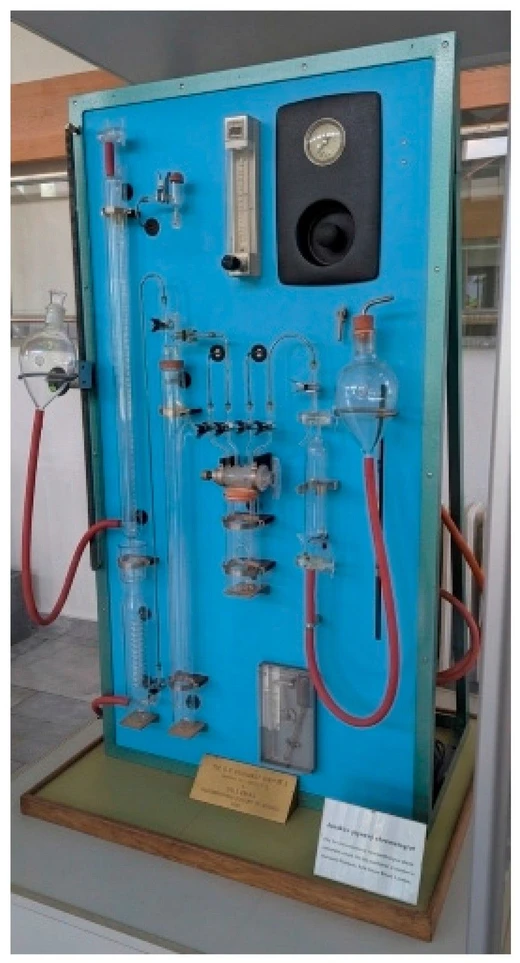 Separations 2026, 13(7), 188: Figure 1. Janak’s volumetric gas chromatograph—the instrument is displayed in the vestibule of the building of the Institute of Analytical Chemistry, Czech Academy of Sciences, in Brno.
In the field of liquid chromatography, the early period was characterized by the introduction of classical column liquid chromatography and, simultaneously, by the implementation of paper and later thin layer chromatography. In 1954, Hais and Macek published a comprehensive monograph on paper chromatography [12], representing one of the earliest systematic treatments of this rapidly developing technique. The work appeared only two years after one of the earliest books in this field had been published by Block, LeStrange, and Zweig in 1952 [13].
Another strong Czechoslovak contribution to the advances of planar chromatography is attributable to the research group of J. Gasparič (Pardubice), who systematically investigated retention mechanisms and the identification of various groups of compounds. In cooperation with M. Večeřa and M. Jureček, a series of articles were published in Czechoslovak journals in the 1950s and early 1960s, the monograph including a complex laboratory manual of identification of organic compounds using chemical reactions. Thus, the methods of paper and gas chromatography were published [14].
In the 1950s and 1960s, gas chromatography underwent systematic expansion in both experimental and theoretical aspects. Advanced techniques were developed, including high-temperature and pyrolysis gas chromatography (i.e., in Janák’s group in Brno, and in Pardubice by J. Franc; the in-house laboratory developed a high-temperature gas chromatograph built by J. Franc, which was later manufactured by Dioptra Turnov and sold within Eastern Bloc countries). In Brno, thermodynamic interpretation of chromatographic retention data was extensively studied by J. Novák and J. Drozd as well. During this period, the field of planar chromatography started to orient toward biochemical and pharmaceutical applications, especially for the studies of drug metabolisms [5].
Not surprisingly, in the late 1960s, the chromatographic community in Czechoslovakia was quite strong and well-established, with a good reputation abroad. Thus, the introduction of high-performance liquid chromatography by C. Horváth and S. Lipsky [15] made the research groups in Czechoslovakia well-prepared for the upcoming boom of the technique. Research groups in Prague (M. Popl, L. Vodička, J. Kříž) and Pardubice (J. Churáček, P. Jandera) contributed to the development of in-house HPLC instrumentation and column-packing technologies using fine silica-based sorbent particles since the beginning of HPLC era. The schematic picture of the instrumentation developed by P. Jandera for HPLC analyses using in-laboratory packed columns with adoption of the in-laboratory built flow-through detection cell on a Spekol spectrophotometer (Carl Zeiss Jena) is shown in Figure 2.
Separations 2026, 13(7), 188: Figure 2. Poster presentation of in-laboratory built early HPLC chromatograph in the laboratory of P. Jandera (Pardubice), displayed at the exposition of technical innovations in 1970 in Brno (left), and photo of the real set (right), year ca. 1970 [16].
3. Electromigration Methods
3.2. Development of Electromigration Methods in Various Research Centers
3.2.1. Faculty of Science at Charles University in Prague
The first center, where the instrumentation and methodology of CITP were developed, is the Department of Physical Chemistry, located in the Faculty of Science at the Charles University in Prague, and linked to the group of J. Vacík. He and his skillful electrotechnical assistant, J. Zuska, began collaborating with the “father of CITP”, F. Everaerts, and his technical assistant, T. Verheggen, from the Technical University of Eindhoven in 1969. Within this cooperation, a new lab-made CITP apparatus was constructed, and some papers were published. In the first of them, the application of counterflow in CITP was described in 1970 [101]. It is worth mentioning that the major components of the lab-made CITP device, including the hydrodynamic system, dosing valve, high-voltage power supply providing constant electric current, and thermocouple-based temperature detector, were also lab-made from home and imported components. This device was later improved by the construction of the universal contact conductivity detector and then by the capacitively coupled contactless conductivity detector (C4D) developed by then Ph.D. student, B. Gaš [102]. This detector was later improved and adapted for application in capillary zone electrophoresis (CZE) [103] and produced by J. Zuska’s company ADMET. It is still frequently used as a universal detector in commercial CE devices. In the 1980s, J. Vacík continued in his theoretical study of electrophoresis. Together with V. Fidler and Z. Fidler, they published the results of the solution to the continuity equation in ITP using the hybrid computer [104]. Although the described system was composed of only four strong electrolytes, it demonstrated well the dynamics of the separation–adjustment of analyte concentration in the ITP steady state following the Kohlrausch regulation function.
A very successful successor of J. Vacík was B. Gaš, later Dean of the Faculty and Vice-Rector of Charles University. He was engaged mainly in the study of theoretical principles of electromigration processes. Together with V. Hruška, they have in detail described the role of the Kohlrausch regulation function and other conservation laws in electrophoresis and isotachophoresis [105]. He created new theoretical models of electrophoresis based on a series of nonlinear or linearized partial differential equations and, found their numerical solutions [106]. Together with his Ph.D. students (M. Jaroš, V. Hruška, P. Dubský) and coworkers (E. Tesařová, K. Včeláková-Ušelová, I. Zusková, L. Mullerová, M. Riesová, and J. Svobodová), he developed and experimentally verified the advanced programs for the simulation of electromigration processes, PeakMaster [107] and Simul [108]. The latest versions of these programs, PeakMaster 6 and Simul 6, are freely available at https://echmet.natur.cuni.cz/#portfolio (accessed on 10 Aril 2026).
These programs represent powerful tools for the simulation and optimization of experimental conditions of all major CE methods: CZE, CITP, capillary isoelectric focusing (CIEF), affinity capillary electrophoresis (ACE), and capillary electrokinetic chromatography (CEKC). PeakMaster was originally based on linearized, and later, on nonlinear models of CZE and CEKC. It enables the calculation of positions and shapes of analyte and system peaks without restricting the number of analytes, selectors, the complexation stoichiometry, or simultaneous acid–base equilibria. It performs all calculations and shows the properties of the background electrolyte (BGE) and the expected electropherograms or electrokinetic chromatograms within a few seconds.
3.2.3. Institute of Organic Chemistry and Biochemistry at the Czech Academy of Sciences in Prague
In addition to the aforementioned high-voltage paper electrophoresis [96], Z. Prusík and coworkers developed a unique device for continuous carrierless free-flow electrophoresis (Figure 3) [167].
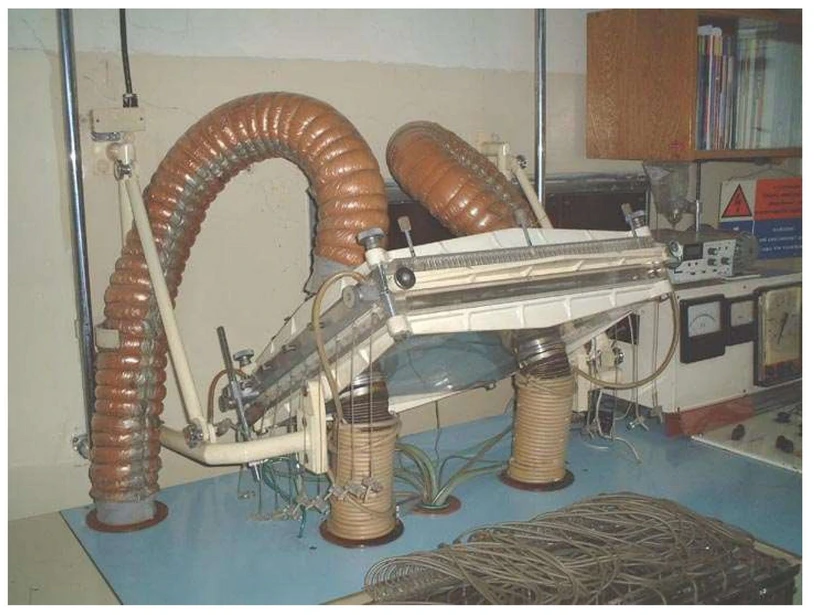 Separations 2026, 13(7), 188: Figure 3. Apparatus for continuous free-flow electrophoresis.
It consisted of two parallel glass plates with dimensions of 500 × 500 × 4 mm with a narrow (0.5 mm) gap between them. Separation voltage (up to 3 kV) was oriented perpendicularly to the laminar flow of the background electrolyte in the gap between the glass plates that were maintained at 4 °C by fast circulating cold air. The sample was introduced as a narrow stream in the center of the inlet side of the flow-through chamber. During the flow-through inside the chamber, positively charged sample components migrated to the cathode and negatively charged components to the anode, whereas non-charged components moved in a straight direction. At the outlet side of the chamber, the sample components were collected in 48 fractions. In this apparatus, different electrophoretic methods could be performed: zone electrophoresis, affinity electrophoresis, ITP, and IEF in a continuous flow-through arrangement. This apparatus has been applied for purification of peptides and proteins (hormones, enzymes, and enzyme inhibitors) with a preparative capacity of 50–100 mg per hour.
In the late 1970s and early 1980s, Z. Prusík and his then Ph.D. student, V. Kašička, developed a lab-made apparatus for CITP. It was equipped with a PTFE capillary (0.45/0.70 mm ID/OD, 25–40 cm length) and a universal electric potential gradient detector and specific UV-absorption detector operating at fixed wavelengths, 206 or 254 nm. The apparatus was widely used for the determination of the CITP purity degree of synthetic peptides purified by chromatographic methods [168]. This apparatus was modified by online coupling with a sorption element containing immobilized transferrin. This setup represented the first online coupling of solid-phase extraction with a CE method. It was used for the capture and concentration of monoclonal antibodies (mAbs) against transferrin from the ascitic fluid, with subsequent mild electrodesorption, reconcentration, and analysis of the released mAbs by CITP [169].
In 1987, a new lab-made CE device with UV-absorption detection was developed [170]. Utilizing the advantage of possessing apparatuses for both analytical CZE and preparative free-flow zone electrophoresis (FFZE), a model of correlation between CZE and FFZE was developed and applied for the conversion of analytical capillary separations of peptides into a preparative process with a capacity of several tens of milligrams of peptides per hour [171].
In the area of instrumentation, the advanced version of the home-made CE device was equipped with an external electric field control of electroosmotic flow, which allowed optimization of the separation conditions of CE analyses of peptides [172]. Recently, two types of interfaces for online coupling of the home-made CE device with ESI-MS detection were constructed [173].
In the last 25 years, V. Kašička and coworkers (D. Koval, P. Sázelová, V. Šolínová, S. Ehala-Štěpánová, and R. Konášová) have developed several CE methods for the separation, analysis, and physicochemical characterization of biomolecules and functional organic molecules. For example, CZE was used for the determination of acidity constants, actual and limiting ionic mobilities and ionic radii of nucleotides [174], and peptides [175]. ACE was employed for investigation into the noncovalent interactions of biomolecules, and for the separation of enantiomers of various organic molecules and drugs [176,177]. In addition, during this period, V. Kašička chaired the Chromatography and Electrophoresis Group of the Czech Chemical Society, and served as the Associate Editor of the Journal of Separation Science and Separation Science Plus. Since 2026, he is a member of the Editorial Advisory Board of the Journal of Chromatography A.
4. Conclusions
Considering their relatively small population, we believe we can conclude that Czech scientists significantly contributed to the theory of chromatographic and electromigration methods as well as to instrumentation and methodology developments. They applied developed methods for highly efficient separation, highly sensitive analysis, isolation, purification, and physicochemical and biochemical characterization of various low- and high-molecular-mass compounds and (bio)particles.
LC and CE methods developed by Czech scientists have significantly contributed to the knowledge of the chemical and physical properties and biological functions of (bio)molecules and (bio)particles, and to the better understanding of processes occurring in living organisms and non-living systems. Overall, research by Czech scientists has significantly advanced LC and CE methods toward faster separations, higher separation efficiencies and sensitivities, and wider use of these methods for analytical and preparative purposes in many areas of research, as well as in industrial and agricultural practice.
The successful development and application of these methods in the Czech Republic can also be assumed in the coming years since, in most of the aforementioned institutions, many clever and skillful young scientists are ready to continue the top-quality research and development of LC and CE methods. Progress can be expected especially in the development of multidimensional LC and CE methods and their coupling with high-resolution MS detection. Moreover, new microfluidic and lab-on-a-chip micro-total analytical systems (μTAS) will be designed to achieve higher separation efficiency, higher sensitivity, and higher speed analyses of a wide spectrum of (bio)molecules and (bio)particles in complex (bio)matrices. In all these developments, undoubtedly, artificial intelligence will be utilized.