A Liquid–Liquid Extraction Method for Measuring Ultrashort PFCAs and Longer-Chain PFAS in Water
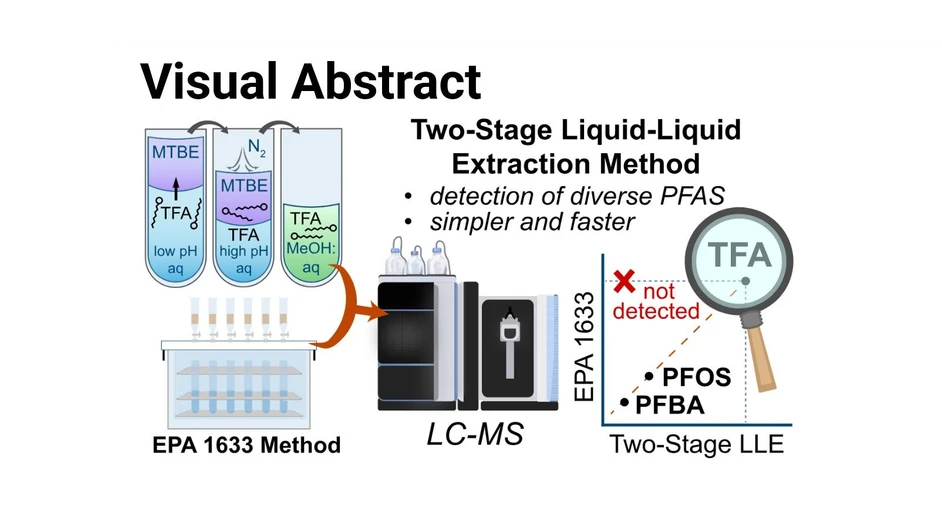
Anal. Chem. (2026) 98 (22): 16653–16661: Visual abstract
This study presents a two-stage liquid–liquid extraction method for simultaneous analysis of ultrashort perfluorocarboxylic acids, including trifluoroacetic acid (TFA), and longer-chain PFAS in water. The workflow combines acidic extraction into MTBE with pH-programmed back-transfer and evaporative transfer to improve recoveries across PFAS with widely different chemical properties.
The method achieved acceptable recoveries for most of the 61 targeted PFAS and a detection limit of 6.67 ng L⁻¹ for TFA, while regulated longer-chain PFAS were detected at sub-ng L⁻¹ levels. The approach provides a sensitive and reproducible alternative to conventional SPE for broad PFAS analysis in natural waters.
The original article
A Liquid–Liquid Extraction Method for Measuring Ultrashort PFCAs and Longer-Chain PFAS in Water
Euna Kim* ; Ethan J. Sontarp; Elsie M. Sunderland
Anal. Chem. (2026) 98 (22): 16653–16661.
licensed under CC-BY 4.0
Selected sections from the article follow. Formats and hyperlinks were adapted from the original.
Per- and polyfluoroalkyl substances (PFAS) are a large class of highly fluorinated anthropogenic chemicals containing diverse structures and physicochemical properties. (1, 2) Exposures to some PFAS have been associated with adverse effects on the health of humans and wildlife. (3−5) Most PFAS research has focused on perfluoroalkyl acids (PFAAs) (6) and protocols for measuring these compounds have been established by regulatory agencies (e.g., method 1633 by the United States Environmental Protection Agency [U.S. EPA]). (7) However, PFAS production has shifted over time, and recent work has highlighted concerns about growing concentrations of trifluoroacetic acid (TFA), an ultrashort PFAS containing a single perfluorinated carbon, in the global environment. (8−10) Measurements of ultrashort-chain PFAS are still limited, in part, because their polarity excludes efficient extraction by established methods for long-chain PFAAs. (11) Here we present a novel analytical method that captures both ultrashort perfluorocarboxylic acids (PFCAs) and longer carbon-chain length PFAS from aqueous samples (two-stage liquid–liquid extraction (LLE)) and evaluate its performance.
PFAS measurement methods in aqueous phase samples that leverage weak anion-exchange (WAX) solid-phase extraction (SPE) face several limitations. (12, 13) Recovery of ultrashort-chain PFAS such as TFA requires acidic conditions (pH ≈ 3–4) to protonate WAX sorbents and minimize inorganic anion competition. (14, 15) Such strongly acidic conditions can reduce recovery of longer-chain PFAS due to decreased solubility and adsorption to container surfaces. Most importantly, ultrashort PFAS may be poorly retained by the highly acidified WAX sorbent and wash through the cartridge prematurely. (16) Isotopically labeled internal standards for structurally matched PFAS help to mitigate quantitation bias due to low recoveries but low absolute recoveries elevate method detection limits and reduce precision.
Analytical constraints also limit quantification across the PFAS classes. Standard reverse-phase octadecylsilane (C18) columns for liquid chromatography (LC) effectively separate moderately to highly retained PFAS that typically contain between 4 and 18 carbons but insufficiently retain more polar ultrashort-chain PFAAs with three or fewer carbons. (17, 18) Ion chromatography (IC) and supercritical fluid chromatography (SFC) coupled to mass spectrometry (MS) have been used for sensitive quantification of the ultrashort-chain PFAS, (15, 19, 20) but many laboratories do not operate both instruments. Mixed-mode LC columns have been used to improve ultrashort-chain PFAS retention and broaden coverage across PFAS classes by integrating reversed-phase and weak anion-exchange interactions on a single stationary phase. (18, 21) However, this method requires rigorous optimization because coeluting salts and organic matter can suppress ionization of ultrashort-chain PFASs. (22, 23)
The main objective of this work was to develop and evaluate the performance of a two-stage LLE workflow for extracting ultrashort PFCAs and longer carbon-chain length PFAS. The extraction method leverages pH-programmed partitioning to improve recovery of polar acids (including TFA) and evaporative transfer of MTBE-retained PFAS to the aqueous residue to maintain recovery of longer carbon-chain length PFAS. We use isotope-dilution with a matched extracted internal standard (EIS) to normalize procedural and ionization variability during analysis and outline diagnostics for identifying steps in the extraction and analysis procedures that affect recoveries. This technique allows the use of a single extraction for some ultrashort PFAS and other longer carbon-chain length PFAS.
Materials and Methods
Targeted PFAS Analysis on LC-Orbitrap
Targeted analysis included 61 PFAS, covering a broad range of perfluorinated carbon-chain lengths and functional groups. A full list of the 61 analytes is provided in Table S2. Analyte separation was performed using an Atlantis Premier BEH C18 AX column (1.7 μm, 2.1 mm × 100 mm) in an ultrahigh-performance liquid chromatography system (Vanquish Flex UHPLC, Thermo Fisher Scientific, U.S). The stationary phase incorporates a permanently bonded amine functionality on the bridged ethyl hybrid (BEH) silica, imparting a stable positive surface charge that enables weak anion-exchange interactions with anionic analytes. We injected 10 μL of the sample on an injector loop, with all solvent lines and mobile phase filters replaced with PolyEtherEtherKetone (PEEK) components. The mobile phase gradient was initiated at 100% of 2 mM ammonium acetate in water (solvent A) and held for 1 min (min), followed by a linear increase to 30% of 0.1% (w/w) ammonium hydroxide in methanol (solvent B) at 1.5 min. The proportion of solvent B was then increased to 100% over the next 8.5 min and held for 2 min. At 12.01 min, the gradient was returned to the initial condition of 100% solvent A and equilibrated until 16.5 min. The flow rate was maintained at 0.3 mL min–1 throughout the run, and the column temperature was set to 40 °C.
Analytes were detected using a high-resolution quadrupole-Orbitrap mass spectrometer (Orbitrap Exploris 120, Thermo Fisher Scientific, U.S.) in negative electrospray (ESI–) mode at 1000 V, with ion transfer tube and vaporizer temperatures at 225 and 300 °C, respectively. Data were acquired in full scan mode with a resolution of 60,000 over a scan range of 100–1250 m/z. Data processing was performed using Thermo TraceFinder software with a mass tolerance of 5 ppm applied for peak integration and identification. Twelve calibration points (50–250,000 ng L–1 for TFA and 5–25,000 ng L–1 for other PFAS) were fitted using least-squares regression with 1/X weighting. Isotopically labeled standards were used for quantification whenever available. For analytes without a direct isotopically labeled analogue (e.g., 3-perfluoroheptylheptanoic acid: 7:3 FTCA), the internal standard with the closest retention time and ionization characteristics was selected (e.g., perfluoro((13C8)octane)sulfonamide ([13C8]FOSA)), which is a convention in this field. (28)
Results and Discussion
LLE Method Performs Well for Ultrashort PFCAs but Not Ultrashort PFSAs
Results show the two-stage LLE method performs well for TFA and PFPrA, but extraction recoveries were low for ultrashort PFSAs, which include trifluoromethanesulfonic acid (TFMS), pefluoroethanesulfonic acid (PFEtS), and PFPrS (Figure 2). This was expected because extremely low pKa values (≈–14) (29) for the ultrashort PFSAs mean they are fully ionized, even at the highly acidic extraction pH of −0.5, which limits partitioning into the organic phase (MTBE). Extraction efficiencies for TFA were 96% before correction for instrumental and procedural variability using EIS, and 105% after correction (Figure 2). No matched EIS was available for PFPrA, so isotopically labeled perfluorobutanoic acid (PFBA) was used instead. Recoveries for PFPrA were 109% after correction using the isotopically labeled extracted PFBA standard (Figure S1). By contrast, absolute recoveries for the three ultrashort PFSAs were low (range 2–53%) and matched isotopically labeled EIS were unavailable (Figure S1).
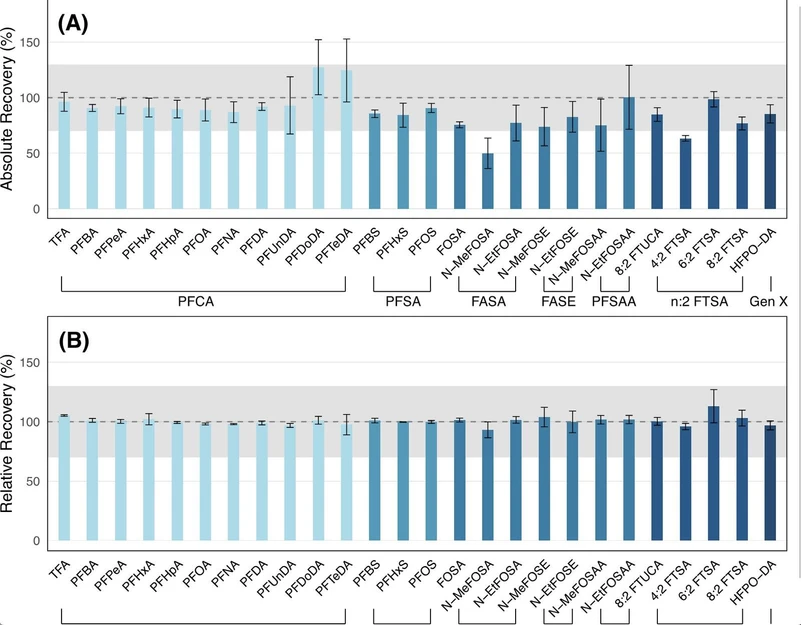 Anal. Chem. (2026) 98 (22): 16653–16661: Figure 2. Absolute (A) and relative (B) recoveries of native PFAS spiked prior to the two-stage LLE developed in this study, evaluated against matrix extracts spiked after the extraction step. Absolute recovery is calculated based on peak area (representing the raw instrumental response before internal-standard correction), and relative recovery is based on calculated PFAS concentration (representing the response normalized by the internal standard). The shaded gray area highlights the ±30% acceptable recovery criterion (70–130%), based on U.S. EPA standard guidelines for trace analysis. (27) This figure shows analytes quantified using a structurally matched EIS; other analytes are presented in Figure S1. Error bars indicate the standard deviation from triplicate sample extractions.
Efficient extraction of TFA is driven by preferentially partitioning of the protonated (neutral) species into the organic phase. With a pKa of approximately 0.23, (30) over 84% of TFA exists in the protonated, neutral form at the extraction pH of −0.5 in the aqueous solution. Protonated perfluorinated acids are more soluble in organic solvents than their ionized forms, and TFA is fully miscible with ethers. (28) The predicted log P value for protonated TFA is 1.24, (31) which corresponds to a partition coefficient (Kow) of approximately 17.4. Using a distribution ratio of 14.6 for the neutral species, a theoretical calculation (Text S2) predicts high extraction efficiency (79%) of TFA in a single extraction. Importantly, the theoretical Kow reflects partitioning into octanol. Our extraction system utilizes MTBE. Compared to octanol, MTBE acts as a superior hydrogen bond acceptor for the carboxylic acid, which results in a higher effective partition coefficient (KMTBE/water > Kow). Furthermore, the addition of strong acid substantially increased the aqueous ionic strength, driving additional neutral TFA into the organic phase via the salting-out (Setschenow) effect. (32) Thus, greater affinity of TFA for MTBE than octanol combined with a strong salting-out effect explains why the observed extraction efficiency for TFA (96%) surpasses standard thermodynamic estimates (79%).
Strengths and Weaknesses of the LLE Method Compared to SPE
We applied the two-stage LLE method developed here to natural waters from three different locations containing diverse PFAS composition (Figure 3). (26) Results from the LLE method were compared to those obtained using a slightly modified version of the standard SPE method (EPA Method 1633). (7, 34, 35) To minimize bias from internal-standard selection, comparisons were restricted to analytes with a structurally matched EIS.
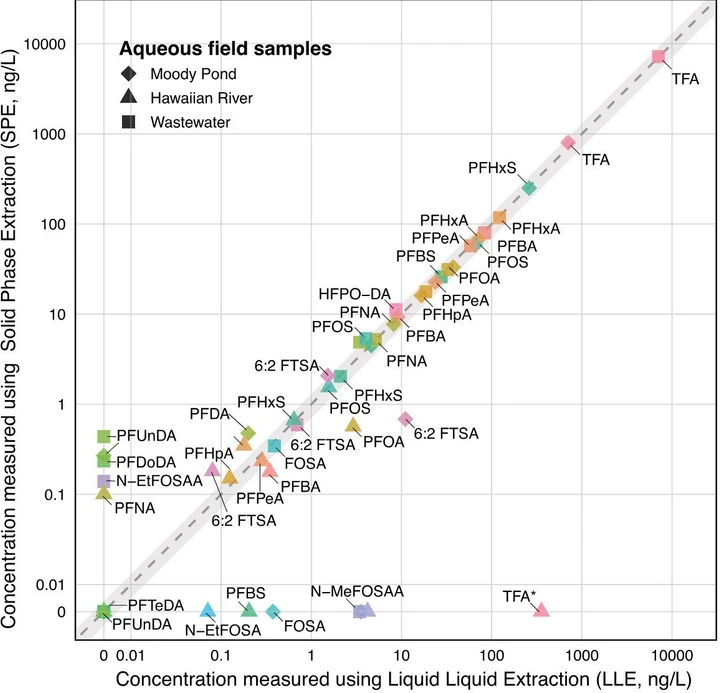 Anal. Chem. (2026) 98 (22): 16653–16661: Figure 3. Comparison of PFAS concentrations obtained using the two-stage liquid–liquid extraction (LLE) method developed in this study (x-axis) and solid-phase extraction (SPE) based on a previously published, slightly modified version of EPA method 1633 (7, 34, 35) (y-axis). Different PFAS are distinguished by color, and sample matrices are denoted by symbol shape (Moody Pond, Hawaiian River, and Wastewater). The dashed line represents a 1:1 concentration ratio. The shaded gray area highlights the ±30% acceptable recovery criterion (70–130%), based on U.S. EPA standard guidelines for trace analysis. (27) Data points represent the mean concentration estimated from duplicate sample extractions. *TFA was not detected in the SPE extracts for the Hawaiian River sample, likely due to interference and poor retention caused by the complex matrix, resulting in lower recoveries.
Results showed good agreement between the LLE and SPE extractions for some compounds and strengths and weaknesses for each method for specific compounds (Figure 3). For the Moody Pond, MA samples, 10 of 12 (83%) analytes detected using both methods fell within ±30%, including TFA. For the samples from HI, seven analytes were detected by both methods, and 4 of 8 (50%) fell within ±30%. In the wastewater influent, 14 analytes were quantified by both methods, and all were within ±30%.
Observed agreement between the two methods suggests that acid-catalyzed PFAS precursor degradation resulting from the LLE extraction conditions is unlikely. While the pH is low (−0.5) for the LLE method, the extraction was conducted at 40 °C for only 15 min. Breaking down fluorinated precursors into terminal or intermediate PFAAs typically requires more aggressive conditions, such as the heat and strong oxidants used in the Total Oxidizable Precursor (TOP) assay (e.g., reaction with potassium persulfate at elevated pH and 85 °C for 6 h). (36) The relatively mild thermal and temporal conditions of the LLE method are kinetically insufficient to generate artifactual TFA or complex intermediates like N-MeFOSAA in 15 min. Comparison of the LLE and SPE extraction methods highlights strengths and weaknesses for different compounds, including greater recoveries of some more neutral precursors using the LLE method. Further, TFA concentrations agree well with SPE for two of the three samples tested (Figure 3). If acid-catalyzed breakdown into TFA were a systemic issue for the LLE method, we would expect an overestimate in all samples and other terminal acids.
The LLE method uniquely detected some PFAS that were missed by the SPE method in some natural water samples and vice versa (Figure 3). The LLE method allowed detection of N-methyl perfluorooctanesulfonamidoacetic acid (N-MeFOSAA) at all three field sites, FOSA in Moody Pond, and TFA, PFBS, and N-EtFOSA in the Hawaiian river. The SPE method allowed detection of PFUnDA in Moody Pond, PFNA in HI samples, and PFUnDA, perfluorododecanoic acid (PFDoDA), and N-ethyl perfluorooctanesulfonamidoacetic acid (N-EtFOSAA) in wastewater influent (Figure 3).
The LLE method and SPE exhibit complementary retention mechanisms that explain the selective detection of specific compounds. The WAX sorbent used in the SPE method was optimized for anionic PFASs and tends to show lower retention than LLE for the more neutral sulfonamides. This is consistent with LLE-only detections of these compounds (e.g., FOSA, N-ethylperfluorooctanesulfonamide (N-EtFOSA)). Relative to the LLE method, peak areas for native PFAS spike recoveries following SPE were greatest for N-MeFOSE, N-EtFOSE, N-EtFOSA, N-methylperfluorooctanesulfonamide (N-MeFOSA), and FOSA were <6%, 50% the N-MeFOSAA, and 39% for the N-EtFOSAA. Using the SPE method, native PFAS spike recoveries for 15 of 26 analytes were <70%, explaining frequent nondetects for sulfonamides near method detection limits.
The SPE method produced higher concentrations than two-stage LLE for some long-chain PFCAs (e.g., PFUnDA, PFDoDA), and in some cases was the only method to produce quantifiable concentrations. EIS absolute recoveries of natural water samples with SPE were low (48% for perfluoro(1,2,3,4,5,6,7-13C7)undecanoic acid ([13C7]PFUnDA) and 22% for perfluoro(1,2-13C2)dodecanoic acid ([13C2]PFDoDA)). However, the corresponding native analytes were measured at higher concentrations by SPE than by two-stage LLE. We posit that this occurred because a substantial fraction was associated with colloids or large suspended particles in the unfiltered samples. (35, 37) SPE passes the entire sample volume through a solid sorbent bed that can physically trap suspended particulate matter and colloids, potentially leading to the coextraction of particle-bound PFAS during elution. In contrast, the LLE method relies on liquid–liquid partitioning rather than physical filtration or forced flow through a packed bed. While accessible surface-bound PFAS may partition into the MTBE phase, the LLE process is therefore less likely to fully extract PFAS sequestered by suspended particulates.
Overall, the results of this study show that the two-stage LLE method developed here can quantify diverse aqueous phase PFAS, including neutral sulfonamide-derived compounds that may have poor recovery by SPE. By contrast, SPE can be advantageous for specific long-chain PFCAs in unfiltered natural waters and fluorotelomer sulfonates. Aqueous field samples from different locations with varying concentrations and PFAS profiles agreed within ± 30% for most overlapping targets. Beyond analytical performance, the two-stage LLE method eliminates the need for vacuum manifolds and the expensive single-use cartridges used by the SPE method and reduces overall sample preparation time. Practically, these findings support the use of the two-stage LLE method developed here as a useful new workflow for routine monitoring.
Conclusions
This study presents a single, two-stage LLE workflow that allows detection and quantification of ultrashort PFCAs and diverse longer carbon-chain-length PFAS. The method balances some competing analytical requirements by capturing highly polar PFCAs, alongside hydrophobic targets. Our approach uses pH-programmed partitioning to extract polar acids, including TFA. Evaporative transfer drives the recovery of longer carbon-chain PFAS held in MTBE to the aqueous residue. Conversely, diagnostic evaluations revealed that the LLE method is not suitable for analytes with extremely low pKa values, such as ultrashort PFSAs and fluorotelomer sulfonic acids (FTSAs), because full ionization limits partitioning into MTBE.
Method reporting limits were 6.67 ng/L for TFA and ranged from 0.03 to 0.22 ng/L for the six federally regulated PFAS in drinking water in the United States in 2024. Comparisons to traditional SPE using a slightly adapted version of EPA Method 1633 (7, 34, 35) demonstrated that the two-stage LLE method yielded concentrations within ±30% for most of the 26 analytes with structurally matched EIS across natural waters from three different field sites with diverse source composition. The LLE method better captured neutral sulfonamide precursors that were frequently missed by the SPE method, whereas SPE provided better detection of specific longer-chain PFCAs (PFUnDA and PFDoDA). These distinct retention mechanisms indicate that two-stage LLE and SPE offer complementary capabilities, supporting the paired use of both methods for comprehensive environmental monitoring.