Author
The journal Kvasny Prumysl
Vědecký recenzovaný online časopis Kvasný průmysl (eISSN 2570-8619), vychází jako samostatné periodikum v angličtině. Od ročníku 2015 je obsah indexovaný databází Web of Science (edice ESCI), dále je indexován v databázích CAS, CAB Abstracts, DOAJ. Časopis je publikovaný v režimu otevřeného přístupu Platinum Open Access s licencí Creative Commons.
Tags
Scientific article
Food
LinkedIn Logo

Hops - an abundant source of antioxidants. Methods to assessment of antioxidant activity of hop matrix

Th, 29.10.2020
| Original article from: Kvasny Prumysl / DOI: 10.18832/kp2011039
The contribution of individual hop compounds to the total antioxidant activity was studied by HPLC method with CoulArray detection in broad scale of the potentials 250-900 mV.
<p>Pixabay/klickblick: Hops - an abundant source of antioxidants. Methods to assessment of antioxidant activity of hop matrix</p>

Pixabay/klickblick: Hops - an abundant source of antioxidants. Methods to assessment of antioxidant activity of hop matrix

The compounds with the same electrochemical manners as epicatechin and catechin and oligomeric proanthocyanogens (OPCs) related to catechin were distinguished from the other compounds according to their electrochemical responses on lower potential (500 mV). The total content of these OPCs including catechin and epicatechin was determined as an equivalent of concentration of the catechin used as an external standard. The results were correlated partly with the results obtained by using of the group analysis for determination of the total polyphenol and for the determination of the anthocyanogens, partly with results obtained by using of the modern method electron spin resonance (ESR) for determination of the antioxidant activity.

1 INTRODUCTION

The hop plant (Humulus lupulus L.) from Cannabinaceae family contains beside primary compounds responsible for basic sensory features (bitterness, fragrance and fullness) also many compounds of health importance. There are especially a group of dimers and trimers, antioxidants (1) derived from catechin and epicatechin, socalled oligomeric proanthocyanogens (OPCs) and a group of prenylated flavonoids in hops (2.3), of which xanthohumol is the most abundant 0.5–1.1 %).

The both groups of these compounds have healing ability and protect human organism against development of many civilization diseases. The group of antioxidants OPCs with lower potentials to their oxidation shields the organism against oxidation of DNA and so protect human organism against tumor diseases (4). Flavonoids are perceived by human receptors like hormon oestrogen, thus these compounds show the oestrogenic effect (5,6). The oestrogenic activity of these compounds is using to the menopause anesis and thus return the organism to normal state. These compounds are also very effective for osteoporosis therapy. Prenylflavonoids are oxidized by higher potential (daidzein, genistein) so their contribution to antioxidant processes is lower and their main activities are interactions with tissue receptors influencing the oestrogenic activities and regulation of cell division (7).

The electrochemical detection of CoulArray detector enables a resolution of the electrochemically different groups of compounds based on their voltametric behavior.

The selectivity of this detection enables to analyze the target group of compounds (8) and we can distinguish analytes with lower oxidative potential 400–500 mV ( catechin and from it derived OPCs) from analytes with higher oxidative potential, e.g. ferulic acid (700 mV) or 4-hydroxybenzoic acid or 4-hydroxyphenylacetic acid (900 mV) (9).

The aim of this study was the determination of antioxidant activity of hop oligomeric proanthocyanogens by the method of liquid chromatography with CoulArray detection and comparison with results obtained partly by modern method electron spin reverberation (ERS), partly by classical methods for determination of total polyphenols and determination of anthocyanogens.

2 MATERIAL AND METHODS

The objects of this study were hop varieties Harmonie, Rubín and new varieties code-named 4816, 4849 and 5008.

With regard to sufficient polarity of oligomeric proanthocyanogens and good water solubility, we used the cold hop leaches in this study.

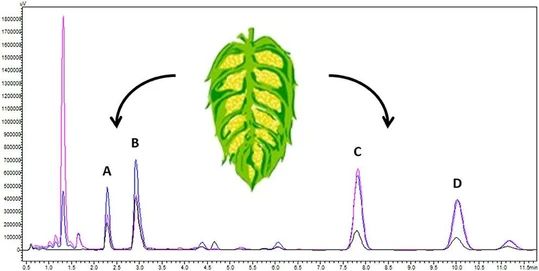
Due to complexity and unknown chemical structures of particular components of hop oligomeric proanthocyanogens so far, the fingerprint technique was chosen for evaluation. All OPCs components eluated in range from 20 to 40 min. were evaluated on potential 500 mV (Fig. 1). The sum of concentrations of all OPCs was expressed using of the concentration of the catechin used for the calibration. The values obtained in this way were correlated with values obtained by other methods: modern ESR-DPPH and classical methods for determination of total polyphenols and determination of anthocyanogens.

Fig. 1 Chromatogram of measured fraction of OPCsFig. 1 Chromatogram of measured fraction of OPCs

The samples for all analytical methods were prepared by cold leaching: 5 g of milled hops were agitated in 250 ml of distilled water at laboratory temperature for 30 minutes. The leach was centrifuged (15 minutes, 10 000 rpm) and stored by freezing before analysis.

HPLC

Sample preparation

Hop leach was diluted in ratio of 1:1 with mobile phase A used for chromatography separation and filtrated through cellulose syringe filter 0.20 μm (Chromafil RC-20/25, Macherey Nagel) into chromatographic vials.

Chromatographic conditions

The buffer 0.005 M ammonium acetate in ultraclean water, TOC < 5ppb was used for preparation of both phases A and B. The phase A contained 5 % acetonitrile (gradient grade, Sigma Aldrich), the phase B contained 50 % acetonitrile of the same quality. Both phases were filtered through membrane filter Nylon 66, 0,2 μm (Supelco) and pH was adjusted to 3.00 by formic acid (Fluka). All chemicals were for MS application.

Column

Purospher STAR RP-18e (5 μm) 250 x 4.6 mm (Merck) Gradient: 0–10 min. 0% B, 10–18 min. 0–8 % B, 18–40 min. 8–10 % B, 40–77 min. 10–21 % B, 77–120 min 21–85 % B. The content of mobile phase B was increased to 100 %. The measuring cells were cleaned and the 15 min equlibration by phase A was applied afterwards.

  • Temperature of column: 35 °C.
  • Flow: 0.8 ml/min.
  • Injection of the sample: 10 μl.
  • The measuring potentials setting in turn 250, 300, 400, 500, 600, 700, 800 and 900 mV.
Calibration

The catechin was chosen as the equivalent to express the concentration of all compounds with the same antioxidant activity on reaction potential 500 mV The standard solutions of catechin 0.01; 0.1; 0.5; 1.0 and 5.0 mg/l were used for the external calibration. The determination of all OPCs was realized by the measuring and checking-out of heights of all peaks with the same electrochemical features like catechin. The concentration of OPCs was expressed as catechin (mg/l) according to external calibration.

Determination of the antioxidant activity DPPH

The antioxidant activity of individual hops was determined using the technique of electron spin resonance (ESR). The method is based on the reaction of the stable radical of the 2,2-diphenyl-1-picrylhydrazyl (DPPH) with antioxidants present in the sample.

The antioxidant activity of samples (ARA 2) is expressed as the decline of the concentration of DPPH after 10 minutes of the reaction.

All the measurements of the free radicals were performed on the Spectrometer MiniScope MS 200, Magnettech GmbH, Germany.

The assay: the aliquot of 14 ml of the DPPH stock solution is mixed with 1 ml of the sample in the test tube without delay. The tube is then inserted into the autosampler which is tempered to 30 °C. The measuring program controlling the transport of the reaction mixture in the interval of 1 minute is then immediately triggered. The value of the free radical DPPH signal is then monitored during the following 10 minute interval. After completion of the analysis the measured values are processed by the particular analytical software of the spectrometer. The result of these calculations is a dependence of the value of the DPPH signal of the sample on time. The antioxidant activity ARA2 is expressed in the percent proportion of the DPPH value decline after the 10 minute reaction.

Determination of the total polyphenol

Total polyphenols were determined according to EBCAnalytica (10).

Determination of the anthocyanogens

Anthocyanogens were determined according to „Pivovarskosladařská analytika“ (11]).

3 RESULTS AND DISCUSSION

The correlations of results obtained by described electrochemical method with CoulArray detection and results obtained using methods: ESR – DPPH (R 2 = 0,9412), determination of total polyphenols (R2 = 0,9867) and determination of anthocyanogens (R2 = 0,991) were found. These correlations are shown in Fig. 2, 3, 4. Coefficients of determination were calculated using of statistical programme Microsoft Office Excel 2003.

Fig. 2 Comparison of electrochemical method with CoulArray detection and ESR-DPPH method for quantification of antioxidative
activity of hop matrixFig. 2 Comparison of electrochemical method with CoulArray detection and ESR-DPPH method for quantification of antioxidative activity of hop matrix

Fig. 3 Comparison of electrochemical method with CoulArray detection and method for determination of total
polyphenols as a rate of antioxidative potential hop matrixFig. 3 Comparison of electrochemical method with CoulArray detection and method for determination of total polyphenols as a rate of antioxidative potential hop matrix

Fig. 4 Comparison of electrochemical method with CoulArray detection and method for determination anthocyanogens
as a rate of antioxidative potential hop matrixFig. 4 Comparison of electrochemical method with CoulArray detection and method for determination anthocyanogens as a rate of antioxidative potential hop matrix

The newly developed chromatographic method with electrochemical detection can be used to comparison of hops and similar materials with antioxidant activity. This method can be used for evaluation of antioxidant activity like the modern ESR-DPPH method and the classical methods for determination of total polyphenols and for determination of anthocyanogens.

But the best match (R2 = 0,991) was achieved with the method for determination of anthocyanogens, this group of compounds is similar to catechins and their oligomers due to structures and substituents on benzene ring. The correlative coefficients with other methods reflect the enforcement other compounds with antioxidant activity, nevertheless their values 0.9867 and 0.9412 confirm a good agreement. It can be concluded that the main groups responsible for the hop antioxidant features are catechins, their oligomers and anthocyanogens. Other structures like ferulic acid, p-hydroxybenzoic and 4-hydroxy - phenylacetic acids have the lower contribution to the antioxidant activity due to their higher oxidative potentials.

The journal Kvasny Prumysl
LinkedIn Logo
 

Related content

Early-stage drug metabolite quantitation without radiolabels

Applications
| 2026 | Thermo Fisher Scientific
Instrumentation
HPLC, LC/MS, LC/SQ
Manufacturer
Thermo Fisher Scientific
Industries
Pharma & Biopharma, Metabolomics

Oligonucleotide Analysis Using the Agilent InfinityLab Pro iQ and Altura Oligo HPH-C18 Column

Applications
| 2026 | Agilent Technologies
Instrumentation
LC/MS, LC/SQ, Consumables, LC columns
Manufacturer
Agilent Technologies
Industries
Pharma & Biopharma

Simultaneous Quantitation and Discovery analysis: Combining targeted and untargeted metabolomics on Orbitrap mass spectrometers

Applications
| 2026 | Thermo Fisher Scientific
Instrumentation
LC/MS, LC/MS/MS, LC/Orbitrap, LC/HRMS
Manufacturer
Thermo Fisher Scientific
Industries
Metabolomics

Analysis of Per- and Polyfluoroalkyl Substances (PFAS) in Wastewater

Applications
| 2026 | Agilent Technologies
Instrumentation
LC/MS, LC/MS/MS, LC/QQQ
Manufacturer
Agilent Technologies
Industries
Environmental

Non-Targeted Screening of Biosolids with the Xevo™ MRT Mass Spectrometer Reveals New Isoforms of PFAS

Applications
| 2026 | Waters
Instrumentation
LC/MS, LC/MS/MS, LC/TOF, LC/HRMS
Manufacturer
Waters
Industries
Environmental
 

Related articles

New Trends in Liquid Chromatography and Their Utilization in Analysis of Beer and Brewery Raw Materials. Part 3. Comparison of HPLC and UHPLC Determination of α- and β -Acids
Scientific article | Food

New Trends in Liquid Chromatography and Their Utilization in Analysis of Beer and Brewery Raw Materials. Part 3. Comparison of HPLC and UHPLC Determination of α- and β -Acids

The traditional method of High Performance LC (HPLC) was compared with the currently increasingly used Ultra- High Performance LC (UHPLC) on a representative group of 11 hop samples.
The journal Kvasny Prumysl
tag
share
more
Folin-Ciocâlteu, RP-HPLC (reverse phase-high performance liquid chromatography), and LC-MS (liquid chromatography-mass spectrometry) provide complementary information for describing cider (Malus spp.) apple juice
Scientific article | Science and research

Folin-Ciocâlteu, RP-HPLC (reverse phase-high performance liquid chromatography), and LC-MS (liquid chromatography-mass spectrometry) provide complementary information for describing cider (Malus spp.) apple juice

The study analyzes polyphenol profiles in 14 apple genotypes using Folin, RP-HPLC, and LC-MS to identify apples with potential for cider production, breeding, and health-related applications.
LabRulez
tag
share
more
Effect of Harvest Time on the Biofunctional Properties of Schizonepeta tenuifolia Briq
Scientific article | Science and research

Effect of Harvest Time on the Biofunctional Properties of Schizonepeta tenuifolia Briq

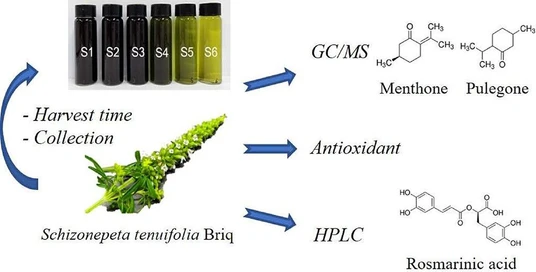
This study evaluates how harvest time influences bioactive compounds and antioxidant activity in Schizonepeta tenuifolia, identifying optimal stages for maximum biofunctionality.
LabRulez
tag
share
more
Hop (Humulus lupulus L.) Phytochemical Profiles as a Function of Growth Region by HPLC and GC-MS Analysis
Scientific article | Science and research

Hop (Humulus lupulus L.) Phytochemical Profiles as a Function of Growth Region by HPLC and GC-MS Analysis

This study compares phytochemical profiles of Cascade hops from two U.S. regions using HPLC-DAD and HS-GC-MS, supporting evidence of hop terroir.
LabRulez
tag
share
more
 

Related content

Early-stage drug metabolite quantitation without radiolabels

Applications
| 2026 | Thermo Fisher Scientific
Instrumentation
HPLC, LC/MS, LC/SQ
Manufacturer
Thermo Fisher Scientific
Industries
Pharma & Biopharma, Metabolomics

Oligonucleotide Analysis Using the Agilent InfinityLab Pro iQ and Altura Oligo HPH-C18 Column

Applications
| 2026 | Agilent Technologies
Instrumentation
LC/MS, LC/SQ, Consumables, LC columns
Manufacturer
Agilent Technologies
Industries
Pharma & Biopharma

Simultaneous Quantitation and Discovery analysis: Combining targeted and untargeted metabolomics on Orbitrap mass spectrometers

Applications
| 2026 | Thermo Fisher Scientific
Instrumentation
LC/MS, LC/MS/MS, LC/Orbitrap, LC/HRMS
Manufacturer
Thermo Fisher Scientific
Industries
Metabolomics

Analysis of Per- and Polyfluoroalkyl Substances (PFAS) in Wastewater

Applications
| 2026 | Agilent Technologies
Instrumentation
LC/MS, LC/MS/MS, LC/QQQ
Manufacturer
Agilent Technologies
Industries
Environmental

Non-Targeted Screening of Biosolids with the Xevo™ MRT Mass Spectrometer Reveals New Isoforms of PFAS

Applications
| 2026 | Waters
Instrumentation
LC/MS, LC/MS/MS, LC/TOF, LC/HRMS
Manufacturer
Waters
Industries
Environmental
 

Related articles

New Trends in Liquid Chromatography and Their Utilization in Analysis of Beer and Brewery Raw Materials. Part 3. Comparison of HPLC and UHPLC Determination of α- and β -Acids
Scientific article | Food

New Trends in Liquid Chromatography and Their Utilization in Analysis of Beer and Brewery Raw Materials. Part 3. Comparison of HPLC and UHPLC Determination of α- and β -Acids

The traditional method of High Performance LC (HPLC) was compared with the currently increasingly used Ultra- High Performance LC (UHPLC) on a representative group of 11 hop samples.
The journal Kvasny Prumysl
tag
share
more
Folin-Ciocâlteu, RP-HPLC (reverse phase-high performance liquid chromatography), and LC-MS (liquid chromatography-mass spectrometry) provide complementary information for describing cider (Malus spp.) apple juice
Scientific article | Science and research

Folin-Ciocâlteu, RP-HPLC (reverse phase-high performance liquid chromatography), and LC-MS (liquid chromatography-mass spectrometry) provide complementary information for describing cider (Malus spp.) apple juice

The study analyzes polyphenol profiles in 14 apple genotypes using Folin, RP-HPLC, and LC-MS to identify apples with potential for cider production, breeding, and health-related applications.
LabRulez
tag
share
more
Effect of Harvest Time on the Biofunctional Properties of Schizonepeta tenuifolia Briq
Scientific article | Science and research

Effect of Harvest Time on the Biofunctional Properties of Schizonepeta tenuifolia Briq

This study evaluates how harvest time influences bioactive compounds and antioxidant activity in Schizonepeta tenuifolia, identifying optimal stages for maximum biofunctionality.
LabRulez
tag
share
more
Hop (Humulus lupulus L.) Phytochemical Profiles as a Function of Growth Region by HPLC and GC-MS Analysis
Scientific article | Science and research

Hop (Humulus lupulus L.) Phytochemical Profiles as a Function of Growth Region by HPLC and GC-MS Analysis

This study compares phytochemical profiles of Cascade hops from two U.S. regions using HPLC-DAD and HS-GC-MS, supporting evidence of hop terroir.
LabRulez
tag
share
more
 

Related content

Early-stage drug metabolite quantitation without radiolabels

Applications
| 2026 | Thermo Fisher Scientific
Instrumentation
HPLC, LC/MS, LC/SQ
Manufacturer
Thermo Fisher Scientific
Industries
Pharma & Biopharma, Metabolomics

Oligonucleotide Analysis Using the Agilent InfinityLab Pro iQ and Altura Oligo HPH-C18 Column

Applications
| 2026 | Agilent Technologies
Instrumentation
LC/MS, LC/SQ, Consumables, LC columns
Manufacturer
Agilent Technologies
Industries
Pharma & Biopharma

Simultaneous Quantitation and Discovery analysis: Combining targeted and untargeted metabolomics on Orbitrap mass spectrometers

Applications
| 2026 | Thermo Fisher Scientific
Instrumentation
LC/MS, LC/MS/MS, LC/Orbitrap, LC/HRMS
Manufacturer
Thermo Fisher Scientific
Industries
Metabolomics

Analysis of Per- and Polyfluoroalkyl Substances (PFAS) in Wastewater

Applications
| 2026 | Agilent Technologies
Instrumentation
LC/MS, LC/MS/MS, LC/QQQ
Manufacturer
Agilent Technologies
Industries
Environmental

Non-Targeted Screening of Biosolids with the Xevo™ MRT Mass Spectrometer Reveals New Isoforms of PFAS

Applications
| 2026 | Waters
Instrumentation
LC/MS, LC/MS/MS, LC/TOF, LC/HRMS
Manufacturer
Waters
Industries
Environmental
 

Related articles

New Trends in Liquid Chromatography and Their Utilization in Analysis of Beer and Brewery Raw Materials. Part 3. Comparison of HPLC and UHPLC Determination of α- and β -Acids
Scientific article | Food

New Trends in Liquid Chromatography and Their Utilization in Analysis of Beer and Brewery Raw Materials. Part 3. Comparison of HPLC and UHPLC Determination of α- and β -Acids

The traditional method of High Performance LC (HPLC) was compared with the currently increasingly used Ultra- High Performance LC (UHPLC) on a representative group of 11 hop samples.
The journal Kvasny Prumysl
tag
share
more
Folin-Ciocâlteu, RP-HPLC (reverse phase-high performance liquid chromatography), and LC-MS (liquid chromatography-mass spectrometry) provide complementary information for describing cider (Malus spp.) apple juice
Scientific article | Science and research

Folin-Ciocâlteu, RP-HPLC (reverse phase-high performance liquid chromatography), and LC-MS (liquid chromatography-mass spectrometry) provide complementary information for describing cider (Malus spp.) apple juice

The study analyzes polyphenol profiles in 14 apple genotypes using Folin, RP-HPLC, and LC-MS to identify apples with potential for cider production, breeding, and health-related applications.
LabRulez
tag
share
more
Effect of Harvest Time on the Biofunctional Properties of Schizonepeta tenuifolia Briq
Scientific article | Science and research

Effect of Harvest Time on the Biofunctional Properties of Schizonepeta tenuifolia Briq

This study evaluates how harvest time influences bioactive compounds and antioxidant activity in Schizonepeta tenuifolia, identifying optimal stages for maximum biofunctionality.
LabRulez
tag
share
more
Hop (Humulus lupulus L.) Phytochemical Profiles as a Function of Growth Region by HPLC and GC-MS Analysis
Scientific article | Science and research

Hop (Humulus lupulus L.) Phytochemical Profiles as a Function of Growth Region by HPLC and GC-MS Analysis

This study compares phytochemical profiles of Cascade hops from two U.S. regions using HPLC-DAD and HS-GC-MS, supporting evidence of hop terroir.
LabRulez
tag
share
more
 

Related content

Early-stage drug metabolite quantitation without radiolabels

Applications
| 2026 | Thermo Fisher Scientific
Instrumentation
HPLC, LC/MS, LC/SQ
Manufacturer
Thermo Fisher Scientific
Industries
Pharma & Biopharma, Metabolomics

Oligonucleotide Analysis Using the Agilent InfinityLab Pro iQ and Altura Oligo HPH-C18 Column

Applications
| 2026 | Agilent Technologies
Instrumentation
LC/MS, LC/SQ, Consumables, LC columns
Manufacturer
Agilent Technologies
Industries
Pharma & Biopharma

Simultaneous Quantitation and Discovery analysis: Combining targeted and untargeted metabolomics on Orbitrap mass spectrometers

Applications
| 2026 | Thermo Fisher Scientific
Instrumentation
LC/MS, LC/MS/MS, LC/Orbitrap, LC/HRMS
Manufacturer
Thermo Fisher Scientific
Industries
Metabolomics

Analysis of Per- and Polyfluoroalkyl Substances (PFAS) in Wastewater

Applications
| 2026 | Agilent Technologies
Instrumentation
LC/MS, LC/MS/MS, LC/QQQ
Manufacturer
Agilent Technologies
Industries
Environmental

Non-Targeted Screening of Biosolids with the Xevo™ MRT Mass Spectrometer Reveals New Isoforms of PFAS

Applications
| 2026 | Waters
Instrumentation
LC/MS, LC/MS/MS, LC/TOF, LC/HRMS
Manufacturer
Waters
Industries
Environmental
 

Related articles

New Trends in Liquid Chromatography and Their Utilization in Analysis of Beer and Brewery Raw Materials. Part 3. Comparison of HPLC and UHPLC Determination of α- and β -Acids
Scientific article | Food

New Trends in Liquid Chromatography and Their Utilization in Analysis of Beer and Brewery Raw Materials. Part 3. Comparison of HPLC and UHPLC Determination of α- and β -Acids

The traditional method of High Performance LC (HPLC) was compared with the currently increasingly used Ultra- High Performance LC (UHPLC) on a representative group of 11 hop samples.
The journal Kvasny Prumysl
tag
share
more
Folin-Ciocâlteu, RP-HPLC (reverse phase-high performance liquid chromatography), and LC-MS (liquid chromatography-mass spectrometry) provide complementary information for describing cider (Malus spp.) apple juice
Scientific article | Science and research

Folin-Ciocâlteu, RP-HPLC (reverse phase-high performance liquid chromatography), and LC-MS (liquid chromatography-mass spectrometry) provide complementary information for describing cider (Malus spp.) apple juice

The study analyzes polyphenol profiles in 14 apple genotypes using Folin, RP-HPLC, and LC-MS to identify apples with potential for cider production, breeding, and health-related applications.
LabRulez
tag
share
more
Effect of Harvest Time on the Biofunctional Properties of Schizonepeta tenuifolia Briq
Scientific article | Science and research

Effect of Harvest Time on the Biofunctional Properties of Schizonepeta tenuifolia Briq

This study evaluates how harvest time influences bioactive compounds and antioxidant activity in Schizonepeta tenuifolia, identifying optimal stages for maximum biofunctionality.
LabRulez
tag
share
more
Hop (Humulus lupulus L.) Phytochemical Profiles as a Function of Growth Region by HPLC and GC-MS Analysis
Scientific article | Science and research

Hop (Humulus lupulus L.) Phytochemical Profiles as a Function of Growth Region by HPLC and GC-MS Analysis

This study compares phytochemical profiles of Cascade hops from two U.S. regions using HPLC-DAD and HS-GC-MS, supporting evidence of hop terroir.
LabRulez
tag
share
more
Other projects
GCMS
ICPMS
Follow us
FacebookX (Twitter)LinkedInYouTube
More information
WebinarsAbout usContact usTerms of use
LabRulez s.r.o. All rights reserved. Content available under a CC BY-SA 4.0 Attribution-ShareAlike