LCMS
More information
WebinarsAbout usContact usTerms of use
LabRulez s.r.o. All rights reserved. Content available under a CC BY-SA 4.0 Attribution-ShareAlike
What is the most appropriate way to approach scaling up your analytical method when transferring it to preparative chromatography scale? Part 1
Article | Academy

What is the most appropriate way to approach scaling up your analytical method when transferring it to preparative chromatography scale? Part 1

Learn how to balance purity, yield, and throughput when scaling analytical HPLC methods to preparative chromatography.
We, 19.11.2025
Phenomenex
tag
share
more
What is the most appropriate way to approach scaling up your analytical method when transferring it to preparative chromatography scale? Part 1
Basic Analytes and the Use of High pH Stable Stationary Phases
Article | Academy

Basic Analytes and the Use of High pH Stable Stationary Phases

Discover how hybrid HPLC materials extend pH stability up to 12, improving retention and peak shape for basic compounds. Learn how Gemini™ and Kinetex™ EVO columns enhance LC-MS/MS performance.
We, 12.11.2025
Phenomenex
tag
share
more
Basic Analytes and the Use of High pH Stable Stationary Phases
Overcoming Peak Tailing of Basic Analytes: Silica Type A Stationary Phases RP
Article | Academy

Overcoming Peak Tailing of Basic Analytes: Silica Type A Stationary Phases RP

Learn how to minimize peak tailing when analyzing basic compounds on type A silicas. Explore pH adjustment, mobile phase modifiers, and modern type B silica columns for sharper, more symmetrical peaks.
We, 5.11.2025
Phenomenex
tag
share
more
Overcoming Peak Tailing of Basic Analytes: Silica Type A Stationary Phases RP
The Role of End-Capping in Reversed-Phase
Article | Academy

The Role of End-Capping in Reversed-Phase

Learn how silica end-capping improves HPLC column performance. Discover how C18, PS-C18, Polar C18, and XB-C18 chemistries enhance retention, peak shape, and selectivity for various analytes.
We, 29.10.2025
Phenomenex
tag
share
more
The Role of End-Capping in Reversed-Phase
The Use of Bio-Inert Hardware in the Analysis of Oligonucleotides
Article | Academy

The Use of Bio-Inert Hardware in the Analysis of Oligonucleotides

Discover how bio-inert HPLC hardware enhances oligonucleotide analysis. Learn how BioTi™ columns improve resolution, sensitivity, and reduce adduct formation compared to stainless steel.
We, 22.10.2025
Phenomenex
tag
share
more
The Use of Bio-Inert Hardware in the Analysis of Oligonucleotides
Method Development Strategies for Oligonucleotides
Article | Academy

Method Development Strategies for Oligonucleotides

Learn how the choice and concentration of alkylamine ion-pair agents affect oligonucleotide retention and detection in HPLC. Explore method optimization with Phenomenex Biozen™ Oligo columns.
We, 15.10.2025
Phenomenex
tag
share
more
Method Development Strategies for Oligonucleotides
A Systematic Approach to HPLC Peptide Analysis
Article | Academy

A Systematic Approach to HPLC Peptide Analysis

Learn how to develop robust HPLC methods for peptide analysis using systematic screening of column chemistry, pH, and gradients for optimal selectivity and reproducibility.
We, 8.10.2025
Phenomenex
tag
share
more
A Systematic Approach to HPLC Peptide Analysis
LC System Optimisation for UHPLC Performance on any HPLC
Article | Academy

LC System Optimisation for UHPLC Performance on any HPLC

Discover practical tips to optimise LC systems for UHPLC performance on any HPLC. Learn how to reduce peak broadening, improve efficiency, and shorten runtimes.
We, 1.10.2025
Phenomenex
tag
share
more
LC System Optimisation for UHPLC Performance on any HPLC
The danger of mobile phase mismatch
Article | Academy

The danger of mobile phase mismatch

After SPE, samples may not be ready for direct LC injection. Solvent mismatch with the mobile phase can distort peak shapes—proper solvent choice is essential.
We, 24.9.2025
Phenomenex
tag
share
more
The danger of mobile phase mismatch
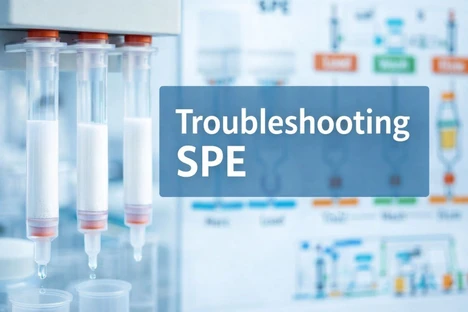
I am getting low recovery in my SPE method, how do I fix the problem?
Article | Academy

I am getting low recovery in my SPE method, how do I fix the problem?

Practical troubleshooting guide for low recovery in SPE methods. Learn how to identify problems with solvents, flow rate, pH, or sorbent choice step by step.
We, 17.9.2025
Phenomenex
tag
share
more
I am getting low recovery in my SPE method, how do I fix the problem?
Other projects
GCMS
ICPMS
Follow us
More information
WebinarsAbout usContact usTerms of use
LabRulez s.r.o. All rights reserved. Content available under a CC BY-SA 4.0 Attribution-ShareAlike