

Waters ASMS Breakfast Seminars 2026
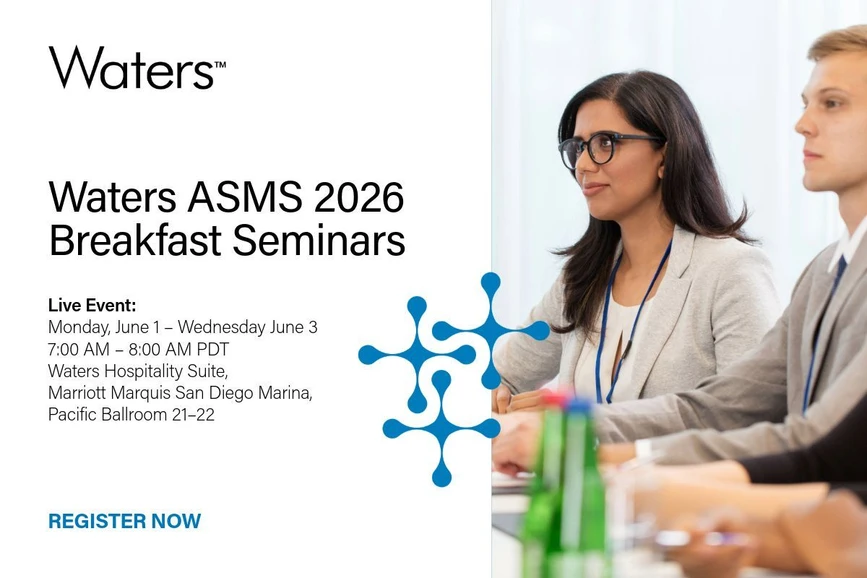
Waters ASMS Breakfast Seminars 2026
June 1, 2026
7:00 AM-8:00 AM
The Next Revolution: Advancing Cyclic Ion Mobility MS
- Waters Hospitality Suite, Marriott Marquis San Diego Marina, Pacific Ballroom 21-22
Join the Cyclic IMS team as we showcase the latest advances in Cyclic Ion Mobility spectrometry and what they unlock for modern MS workflows. This seminar will explore how new Cyclic IMS capabilities enhance structural resolution, analytical depth, and experimental flexibility across native MS and structural biology applications.
Rohith Krishna from Sheffield Hallam University will describe how adding ion mobility separation to MALDI‑MSI, enables trace‑level drugs to be resolved from chemical noise and isobaric interferences while preserving the spatial and forensic integrity of molecular fingerprints.
Together, these perspectives show how the next evolution of Cyclic IMS enables molecular insight to be revealed through direct measurement, rather than inferred.
Guest Presentation - MALDI Imaging for Forensic Analysis of Drug-Contaminated Fingerprints
This study utilizes an advanced MALDI-MSI workflow featuring a research system comprising of a prototype QTof and a MALDI source for the exemplar application to forensic “molecular fingerprinting” from drug contaminated fingerprints.
High-resolution imaging at 25 µm successfully visualized Level 2 and Level 3 forensic features, including identifying level 2 minutiae such as bifurcations, bridges, and sweat pores. The system achieved high sensitivity, detecting substances like clozapine and benzodiazepines at concentrations as low as 0.1 ng/mL in imaging modality, while maintaining forensic integrity.
By further leveraging the benefits of high-resolution ion mobility, trace-level flunitrazepam were recovered from complex chemical noise and isobaric interferences that typically obscure standard results in the forensic context. These capabilities afford important forensic opportunities in supporting evidence in drug facilitated sexual facilitated assaults as well as opening a new avenue in monitoring drug adherence.
- Presented by Rohith Krishna, Doctoral Researcher, Biomolecular Sciences Research Centre, Sheffield Hallam University, Sheffield, UK
Powerful Quan Starts with Better Workflows, Not Workarounds
- San Diego Convention Center Room 10
Get More from Your Quantitation—Faster Insights, Smarter Workflows, Better Decisions.
Discover how you can improve sensitivity, accelerate insights, and simplify your quantitation workflows with the latest innovations from Waters.
In this session, you will:
- Gain confidence in your data with next-generation Xevo TQ Absolute XR performance
- Learn how to turn data into actionable insights faster using a fully connected quantitation ecosystem
- Apply AI/ML-powered capabilities to enhance data processing, improve accuracy, and reduce manual effort in quant workflows
See it in action: a live waters_connect for Quan demonstration, showcasing how integrated workflows, intelligent automation, and AI-driven insights come together to deliver faster, more reliable quantitation at scale.
- Dr. Robert Plumb (Scientific Advisor, Waters Corporation)
- Neil Walsh (Director and Pharma Program Lead for the LC‑MS Business Segment, Waters Corporation)
- Nathaniel Martin (Principal Consulting Product Owner, Waters Corporation)
- Doug Stevens (Principal Scientist, Waters Corporation)
June 2, 2026
7:00 AM-8:00 AM
Transforming Omics Research: What's New in MRT
- Waters Hospitality Suite, Marriott Marquis San Diego Marina, Pacific Ballroom 21-22
Part 1. Comprehensive multi-OMICS Approach Using a Multi-Reflecting Time of Flight Mass Spectrometer
Neurological conditions such as schizophrenia and bipolar disorder are complex psychiatric conditions with diverse clinical features and limited understanding of their underlying biology.
Using a multi-OMIC approach comprised of lipidomics and proteomics, highlights the utilization of a stepped quadrupole data independent (DIA) approach for optimal characterization and quantification. This strategy allows for distinct disease associated alterations to be observed in circulating glycopeptides across the clinical cohorts. Presented by Matt Daly, Waters Corporation
Part 2. Optimizing DDA Parameters on the Xevo MRT for Untargeted Metabolomics
- Presented by Dr. Corey Broeckling, Director – Analytical Resources Core: Bioanalysis and Omics , Colorado State University
- Matthew Daly (Senior Applications Scientist, Waters Corporation)
From Commercial Launch to Scientific Impact: The Evolving Xevo CDMS Platform
- San Diego Convention Center Room 10
This session will consider the role of CDMS for addressing old and new analytical challenges surrounding the analysis of complex and mega molecules. We will showcase the latest and most exciting data from the Xevo CDMS systCharge
Detection Mass Spectrometry (CDMS) is rapidly reshaping how scientists characterize megadalton scale biomolecules. This breakfast seminar marks the first commercial appearance of Xevo™ CDMS at ASMS, showcasing how CDMS has progressed from an emerging technology to a powerful, application ready platform.
Steve McDonald (CDMS Program Lead, Waters Corporation) will kick off the session by formally introducing commercial Xevo™ CDMS, sharing the latest product enhancements, newly released capabilities, and an outlook on what’s coming next for the platform.
Dr. Ben Draper (Megadalton Solutions) will follow with real world application examples, demonstrating how Xevo™ CDMS is being used in practice to address analytical challenges associated with large proteins, complexes, and other megadalton analytes.
The seminar will conclude with Professor Susumu Uchiyama (Osaka University), who will share current understanding of viral vector quality attributes using AAV characterization as a case study, and provide technology comparisons.
The session will end with a brief Q&A and discussion.
- Benjamin Draper PhD (Co-founder, Sr. Scientist, Megadalton Solutions)
- Prof. Susumu Uchiyama (Professor, Department Biotechnology, Graduate School of Engineering, Founder and CSO, U-Medico Inc., a Biotechnology company)
- Stephen McDonald (Sr. Director, CDMS Program, Waters Corporation)
Beyond C18 and Phenyl: Expanding Selectivity with Biphenyl Columns Built for UV and pH Robustness
- San Diego Convention Center Room 33B
Biphenyl stationary phases are increasingly used in method development to address separations that challenge conventional C18 and phenyl chemistries, particularly for aromatic analytes and positional isomers. However, traditional biphenyl columns often introduce limitations including elevated UV-detected column bleed, restricted pH stability, and inconsistent batch-to-batch performance, factors that can negatively impact method robustness and quantitative reliability.
This presentation explores how modern biphenyl column design can overcome these challenges. Attendees will learn how a trifunctionally bonded biphenyl stationary phase built on a hybrid ethylene-bridged particle enables balanced hydrophobic and aromatic selectivity while delivering stable performance from pH 1.5 to 10. Data will demonstrate ≥10× lower UV-detected bleed compared to conventional biphenyl phases, supporting improved baseline stability, accurate UV quantitation, and reproducible results across method conditions.
In addition, the integration of inert column hardware engineered to minimize analyte–surface interactions is discussed, showing out-of-box performance and recovery of metal-sensitive analytes. Real-world application examples from pharmaceutical, bioanalytical, and food/environmental workflows illustrate how biphenyl selectivity expands the chromatographer’s toolbox for resolving difficult separations with confidence.
- Christopher Collins (Principal Product Manager, Waters Corporation)
June 3, 2026
7:00 AM-8:00 AM
[Panel Discussion] Leave No Detail to Chance: Resolving Development Challenges in Next-Gen Biotherapeutics
- Waters Hospitality Suite, Marriott Marquis San Diego Marina, Pacific Ballroom 21-22
The increasing complexity of protein therapeutics and genetic medicines has introduced a new era of analytical challenges: move beyond fragmented methods toward integrated, high-confidence workflows that provide total clarity.
Join our panel of leading industry scientists for a fast-paced 60-minute discussion on overcoming the technical barriers in modern biotherapeutic characterization. From resolving protein micro-heterogeneity to mastering 1,000+ base mRNA quality attributes, peer experts will share real-world strategies to:
- Eliminate Analytical Uncertainty: Deploying advanced MS workflows to characterize and monitor critical quality
attributes - Bridge the Gap: Transitioning sophisticated characterization from R&D into routine, compliant-ready environments
- Reduce Bottlenecks: Leveraging automation—from sample preparation to data reporting—to overcome manual operations and accelerate time-to-market.
Panellists
- Adam Evans - J&J Innovative MedicineDiego Bertaccini PhD - Merck KGgA Darmstadt, Germany
- Alex Gomes - Waters Corporation
Discover how your peers are leaving no detail to chance in the race to deliver safe, high-quality therapeutics.
- Adam Evans (Senior Principal Scientist, J&J Innovative Medicine, Biologics Analytical Development)
- Diego Bertaccini PhD (High Throughput Analytical Lead Scientist, Merck KGgA Darmstadt, Germany)
- Kristine Parson, PhD (Senior Scientist, Analytical Development, FUJIFILM Biotechnologies)
- Alex Gomes (Principal Sales Applications Chemist, Waters Corporation)
- Emma Marsden Edwards PhD (Director, MS Discovery Program, Waters Corporation)
- Guillaume Béchade PhD (Senior Principal, Global Biologics Marketing, Waters Corporation)
Enhanced Sensitivity and Reproducibility of Capillary and Microflow LC-MS Workflows Using Waters 1 mm and 300 µm ID Columns with MaxPeak™ Premier Technology
- San Diego Convention Center Room 10
Introduction: Microflow LC-MS has become a preferred strategy for high‑sensitivity analysis across proteomics, metabolomics, and nucleic acid-based workflows. However, acidic and metal‑sensitive analytes, including phosphopeptides, acidic small molecules, and oligonucleotides, often suffer from poor recovery, distorted peak shape, and reduced MS response due to adsorption to stainless‑steel column hardware. MaxPeak Premier Technology incorporates High Performance Surfaces (HPS) to mitigate these interactions, improving analyte recovery and peak shape. While the benefits of HPS are well established at analytical scale, this work evaluates their impact in microflow formats using MaxPeak Premier 1 mm and 300 µm ID Columns.
Methods: Representative standards were analyzed, including acidic and phosphorylated peptides, acidic small molecules, and synthetic oligonucleotides. 1 mm and 300 µm ID MaxPeak Premier columns were compared to conventional stainless‑steel microflow and capillary columns under matched LC-MS conditions. Performance metrics include MS signal intensity, peak shape, recovery, and injection‑to‑injection reproducibility.
Preliminary Data: Both the 1 mm and 300 µm MaxPeak Premier columns delivered higher MS signal intensity and improved peak shape for acidic and m etal‑sensitive analytes from the first injection, reducing the need for extensive column conditioning. The superior separation of acidic analytes on the MaxPeak Premier Columns significantly improved MS data quality by increasing MS signal-to-noise, enhancing confidence in peptide identification. Additionally, the reduced solvent usage relative to 2.1 mm ID columns supports more sustainable LC-MS operation.
Novel Aspect: The first 1 mm and 300 µm ID columns specially designed to mitigate unwanted interactions between acidic analytes and column hardware.
- Caitlin Hanna (Principal Scientist, Waters Corporation)


