News from LabRulezLCMS Library - Week 37, 2025
LabRulez: News from LabRulezLCMS Library - Week 37, 2025
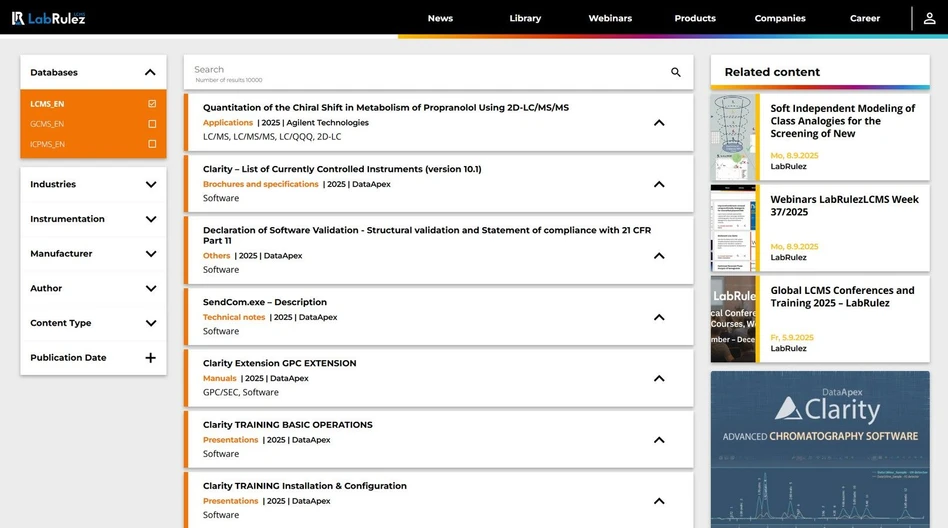
Our Library never stops expanding. What are the most recent contributions to LabRulezLCMS Library in the week of 8th September 2025? Check out new documents from the field of liquid phase, especially HPLC and LC/MS techniques!
👉 SEARCH THE LARGEST REPOSITORY OF DOCUMENTS ABOUT LCMS AND RELATED TECHNIQUES
👉 Need info about different analytical techniques? Peek into LabRulezGCMS or LabRulezICPMS libraries.
This week we bring you application notes by Agilent Technologies and Shimadzu and posters by Thermo Fisher Scientific / HPLC Symposium and Waters Corporation!
1. Agilent Technologies: Automated Solid Phase Extraction of PFAS from Aqueous Samples
- Application note
- Full PDF for download
In this study, three types of dual-phase SPE cartridges were evaluated based on the quality control requirements for aqueous matrices as specified in US EPA Method 1633 using automated SPE. The cartridges contained PFAS WAX and Carbon S for PFAS. In the first configuration, a 200 mg bed of PFAS WAX was layered on top of a 50 mg bed of Carbon S with the sorbents separated by a frit. In the second configuration, 200 mg of PFAS WAX was mixed with 50 mg of Carbon S before cartridge packing. In the third configuration, 200 mg of PFAS WAX and 10 mg of Carbon S were mixed before cartridge packing. All three configurations were evaluated under identical protocols using automated SPE and were compared to results obtained using the manual addition of carbon and separate WAX extraction. The blended sorbent containing 200 mg of PFAS WAX and 10 mg of Carbon S was selected for validation and further evaluation of several environmental matrices including groundwater from residential private wells, effluent from a wastewater storage lagoon, and a landfill monitoring well.
Experimental
Equipment and materials
The three Agilent dual-phase cartridges used in the study are listed in Table 1. As a performance benchmark, a single‑phase Bond Elut PFAS WAX sorbent cartridge (Agilent, part number 5610‑2151) was used with either Carbon S bulk (Agilent, part number 5610-2095) or Superclean ENVI-Carb (Millipore Sigma, part number 57210-U).
Samples were extracted using the PromoChrom eight‑channel automated SPE extractors with upside‑down shaker racks (part number SPE-03 with MOD004), anticlogging frits (part number CF-06), high-capacity inline filters (part number F-HC-30), and anticlogging tips (part number F-T-4). Sample analysis was performed using an Agilent 1290 Infinity II LC system consisting of an Agilent 1290 Infinity II high-speed pump (G7120A), an Agilent 1290 Infinity II multisampler (G7167B), and an Agilent 1290 Infinity II multicolumn thermostat (G7116B). The LC system was modified for PFAS analysis using the Agilent InfinityLab PFC‑free HPLC conversion kit (part number 5004-0006). The LC system was coupled to an Agilent 6495C triple quadrupole LC/MS equipped with an Agilent Jet Stream technology ion source. Agilent MassHunter Workstation software was used for data acquisition (version 10.1) and Quantitative Analysis for QQQ (version 12.1) was used for data analysis. Instrumental conditions were determined based on detailed multiparametric optimization experiments developed in‑house.
Conclusion
The adoption of automated solid phase extraction (SPE) for PFAS analysis in environmental matrices significantly enhances laboratory efficiency and reduces the potential for human error. Our evaluation of five extraction protocols revealed that the blended sorbent containing 200 mg of PFAS WAX and 10 mg of Carbon S provided the best performance in terms of recovery, matrix interference reduction, and fewer outliers. This configuration was successfully applied to various environmental samples, demonstrating its versatility and reliability. The findings support the use of automated SPE with optimized sorbent cartridges as a robust method for PFAS analysis, aligning with the quality control metrics of US EPA Method 1633. Future work should focus on further refining automated SPE techniques and exploring their application to other environmental matrices.
2. Shimadzu: Automated Preparation of Calibration Curves Using the Autosampler's Dilution Function
- Application note
- Full PDF for download
User Benefits
- The auto-dilution function equipped in the autosampler eliminates the need for manual dilution during calibration curve creation and sample preparation.
- Samples can be automatically diluted to create a calibration curve by specifying the desired dilution factor in the batch table.
- Because the same method file can be used across different dilution factors, only minor adjustments are needed when changing dilution conditions.
In LC quantification, the dilution ofstandard and sample solutions is typically performed manually using pipettes, which is a laborintensive and time-consuming process. Recent advancements have called for automation to reduce labor and improve efficiency. By automating the dilution process, workflows can be streamlined, leading to increased productivity. The Nexera series autosamplers are equipped with an automatic pretreatment function that enables automated dilution. Using the auto-dilution function, samples can be automatically prepared at any desired dilution factor and directly introduced into the analytical column. This article presents a method to automate the creation of calibration curves and subsequent quantification workflows using the autosampler’s auto-dilution function.
Automated Dilution Analysis of Organic Acid Standard Solution
Automated dilution analysis was conducted using a 1000 mg/L mixed standard solution of ten organic acids. The analytical conditions are shown in Table 2 (pretreatment program : Table 1). 1.0 mL polypropylene vials were used as mixing vials, and septum-sealed vials were used for the undiluted standard solution. Rinse solution (ultrapure water) was used as the diluent. Fig. 3 shows the chromatogram of the 100-fold diluted organic acid mixed standard solution (concentration after auto-dilution : 10 mg/L for each organic acid). The Nexera Organic Acid Analysis System (pH-buffered electric conductivity detection) was employed for this analysis.
Conclusion
By utilizing the auto-dilution function in the autosampler, the standard undiluted solution for calibration curve creation can be automatically diluted at any desired dilution ratio. This eliminates the need for manual sample dilution and streamlines the calibration curve creation workflow. Additionally, since the autodilution function can also be applied to sample solutions, only the preparation of undiluted standard and sample solutions is required, allowing for a fully automated process from calibration curve creation to quantitation. As a result, the reduction in pretreatment work contributes to improved work efficiency and productivity.
3. Thermo Fisher Scientific / HPLC Symposium: Wide-ranging polynucleotide separation capabilities using Reversed Phase particles with variable pore geometry
- Poster
- Full PDF for download
Polynucleotides such as DNA and RNA serve many uses in the areas of basic research, industrial manufacturing, therapeutics to up/down regulate cellular functions, and as therapeutic and vaccine intermediates (i.e., as an instructional template to produce proteins that 1) supplement/replace ineffective proteins or 2) function as antigens). CRISPR technology using guide RNA (gRNA, ~100mer) to directly modify cellular chromosomes was recently leveraged to create a customized treatment within 6-months for an infant with CPS1 deficiency1. This approach has provided long-term, life-saving enzyme production negating the need for daily treatments. Associated DNA and RNA such as gRNA and mRNA (1000+mer) require detailed characterization to ensure safety and efficacy (e.g., of sufficient quantity and fidelity in delivery vehicles such as lipid nanoparticles). Here, we present a RP particle with complex pore geometry and the effects of mobile phase and temperature for separating DNA/RNA with therapeutic benefits (siRNA-gRNA-mRNA:~ 20-100- 1000+mer). Semi-prep column separations, common for sample recovery for subsequent analyses or sample enrichment for in vitro or in vivo use, is also shown.
Materials and methods
Test method(s)
DNAPac RP columns packed with 4 µm DNAPac RP media include 2.1 × 50 mm (P/N 088924), 2.1 × 50 mm (P/N 088924), and 21.2 × 150 mm (P/N 080922- 1521232). For instruments, mobile phases, gradient conditions, and other chromatographic operating parameters (flow rate, temperature, injection volume, etc.), please reference the figures and associated text. For all analyses, samples were detected by UV absorbance at 260nm. For 21.2x150mm semi-prep separations, a conventional (U)HPLC chromatography system with a binary pump, autosampler and detector without column compartment (ambient temperature separations) was used for all analyses. Ion Pairing Agents (Cation Anion): TEAA – Triethylamine Acetate, HAA – Hexylamine Acetate, HFIP – Hexafluoroisopropanol.
Data analysis
The Thermo Scientific Chromeleon 7.2.10 or 7.3 Chromatography Data Systems (CDS) software was used for data acquisition and analysis.
Results
DNAPac RP particle characterization – chemistry and pore structure
Figure 1 summarizes the chemical and physical properties of the resin, which is based on polymeric divinylbenzene (top left). Unlike conventional silica particles, the polymeric resin is not susceptible to hydrolytic degradation at neither extreme pH (1-14) nor high temperature (90+oC). The aromatic groups also provide π- π bonding with aromatic nucleotides giving different selectivity from conventional alkyl phases incapable of such interactions. The SEM image visually shows the highly variated porous structure of the particles. Barrett-Joyner-Halenda (BJH) N2 adsorption analysis details the surface area contributions of the different pore sizes. From this analysis it is clear that a continuum of pores from 50Å to 2500Å (suitable for small molecules up to macromolecule adsorption, respectively) contributes to the overall surface area of the particle. Based on the complex geometry and resulting pore structure, we commonly refer to the media as a supermacroporous (SMP) particle.
Conclusions
- High resolution separation of nucleic acids varying in length from 10 to 10,000 nucleotides is achieved using an SMP particle with a variable pore structure.
- Polymeric SMP particles are compatible with different mobile phase IP compositions, high pH and high separation temperature, which are critical parameters for optimizing the separation of polynucleotides
- SMP particles provide high resolution separations in both analytical and semi-prep formats
4. Waters Corporation / ASMS: Detection and Characterization of PFAS Molecules Using Inclusion and Exclusion Features of Data Directed Analysis (DDA)
- Poster
- Full PDF for download
Polyfluorinated alkyl substances (PFAS) are bioaccumulative and suspected to contribute to increased cancer risk in humans. Monitoring PFAS in biofluids is possible, but their very low concentrations present analytical challenges.
Data-Directed Acquisition (DDA) isolates ions that meet defined criteria, fragments them at elevated collision energies, and generates product ion spectra. Because PFAS ions show a characteristic mass defect due to fluorine atoms, inclusion lists can enhance their detection. Conversely, exclusion lists derived from background matrix analyses help remove interferences, simplifying ion selection for fragmentation.
Preliminary tests with mixed small-molecule samples demonstrated the utility of these lists before applying them to PFAS, where inclusion lists contained hundreds of entries and exclusion lists thousands.
Methods
- Instrument: SELECT SERIES™ Cyclic™ Ion Mobility Mass Spectrometer
- Acquisition: ToF-ESI negative DDA mode, 100 ms survey/MSMS scan times, collision energy ramps optimized by PFAS class
- LC System: ACQUITY Premier with PFAS Kit and Atlantis Premier BEH C18 AX Isolator Column (2.1 × 50 mm, 5 µm)
- Analytical Column: ACQUITY UPLC HSS T3 C18 (100 × 2.1 mm, 1.8 µm) at 35 °C
- Flow Rate: 0.3 mL/min; Injection Volume: 5 µL; Autosampler Temp: 6 °C
- Mobile Phases:
- A: H₂O:MeOH (95:5) with 2 mM ammonium acetate
- B: MeOH with 2 mM ammonium acetate
- Samples: LCMS QC mixture, native PFAS mixture (PFAC30PAR, Wellington Labs), and human serum
- Software: MassLynx™ 4.2 for acquisition, waters_connect™ with PFAS library (130 entries) for processing, Tibco Spotfire® for visualization
Conclusion
- ToF-DDA mode on a cyclic ion mobility mass spectrometer is effective for PFAS analysis.
- Inclusion lists based on PFAS mass defect improve real-time detection and intelligent switching.
- Background-derived exclusion lists (up to 9000 entries) further reduce interferences and enhance specificity.