News from LabRulezLCMS Library - Week 50, 2025
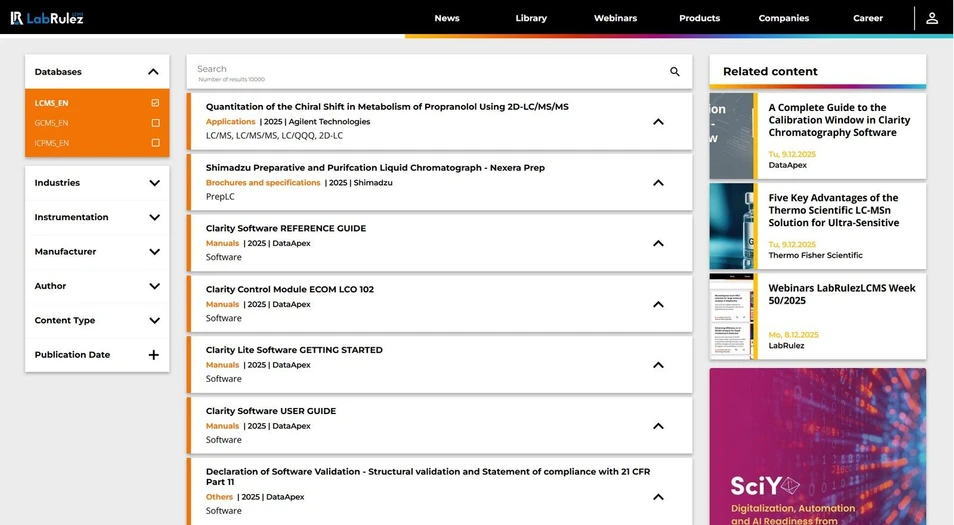
LabRulez: News from LabRulezLCMS Library - Week 50, 2025
Our Library never stops expanding. What are the most recent contributions to LabRulezLCMS Library in the week of 8th December 2025? Check out new documents from the field of liquid phase, especially HPLC and LC/MS techniques!
👉 SEARCH THE LARGEST REPOSITORY OF DOCUMENTS ABOUT LCMS AND RELATED TECHNIQUES
👉 Need info about different analytical techniques? Peek into LabRulezGCMS or LabRulezICPMS libraries.
This week we bring you application notes by Agilent Technologies and Waters Corporation, technical note by Shimadzu and poster by Thermo Fisher Scientific / ASMS!
1. Agilent Technologies: Robust and Reproducible Monitoring of PFAS in Treated Wastewater by Direct Injection on 6495D LC/MS
- Application note
- Full PDF for download
PFAS is a class of synthetic chemicals that are resistant to heat, water, grease, and oil. Exposure to this class of chemicals is widespread and their ability to move and persist in the environment makes them difficult to clean up. Found in everyday household and workplace products such as drinking water, food packaging, fish caught from compromised environments, and personal care products is an indication of how widespread the use of PFAS and its contamination in the environment.
Traditional techniques of analysis to enhance sensitivity incorporate the use of solid phase extraction, which allows enrichment of the sample before injection. Increased awareness of emerging contaminants has necessitated the need for higher throughput methods, some bypassing the sample preparation step, to decrease sample analysis time. Direct injection analysis can save time by removing the need to prepare samples but still providing robustness and reproducibility to justify its capabilities and improved efficiency.
Experimental
Instrumentation
Liquid chromatography system:
- Agilent 1290 Infinity II Bio-LC High‑Speed Pump (G7132A)
- Agilent 1290 Infinity II Bio-LC Multisampler (G7137B)
- Agilent 1290 Infinity II Multicolumn Thermostat (G7116B)
Mass spectrometry system:
- Agilent 6495D Triple Quadrupole LC/MS (G6495D)
- Agilent Jet Stream (AJS) Source A PFC free kit, together with a delay column, was also used.
Results and discussion
The sensitivity of the method was calculated with ten spikes of water at 1 ng/L resulting in the method detection limit. The calculated concentration was prior to dilution of methanol and demonstrates that all but three analytes were equal or less than 1 ng/L detection limits, the analytes with greater than 1 ng/L MDL were 3:3 FTCA and 8:2 FTSA (Table 6).
Conclusion
The increased awareness of PFAS globally has meant that regulations are constantly being adopted and larger amounts of samples at lower limits are required. By incorporating the direct injection technique on the Agilent 6495D LC/MS we get a combination of high sample throughput while providing excellent analytical sensitivity. Also, increasing throughput and reducing consumables cost creates increased value in the instrument. The method displays a clean baseline and sensitivity with the observation of 1 ng/L detection in spiked wastewater. Reproducibility and robustness were measured between the concentrations of 0.5 to 100 ng/L on the 6495D LC/MS. The system was able to detect 38 PFAS between 0.25 to 3.4 ng/L with RSD < 20% over 150 direct injections, providing confidence in the data for a complex matrix like wastewater.
2. Shimadzu: A sustainable analytical approach for detecting extra virgin olive oil adulteration using Nexera™ UC
- Technical note
- Full PDF for download
Knowledge of the composition of triacylglycerols (TAGs) in vegetable oils is important for dietary and nutritional reasons, due to the influence of the different properties of each fatty acid on the human organism. Specifically, extravirgin olive oil (EVOO) is a popular food ingredient worldwide, and for this reason, detecting economically motivated adulteration is important to protect consumers’ interest and health[1]. According to the latest report from the EU Food Fraud Network (European Union, 2021), olive oil (OO) tops the list of reported adulterated food products. The official methods to assess OO purity and detect the presence of extraneous vegetable oils include the analysis of fatty acids (FAs), triacylglycerols (TAGs) and sterols (Regulation (EU) No 2568/91 and its amendments) [2].
A variety of chromatographic techniques has been employed for TAGs analysis and separation. High-performance liquid chromatography (HPLC) methods, which use reversed-phase (RP) and silver-ion (Ag) columns for TAGs separation, have been employed either independently or in combination[3]. However, both these approaches have the drawback of relying on toxic organic solvents. The alternative separation technique employed in TAGs analysis is supercritical fluid chromatography (SFC) coupled with a UV detector at very low wavelengths, due to the weak UV absorption of the mobile phase. In this study, a fast, simple and green methodology was optimized to detect intentionally adulterated olive oil with cheaper seed oils at different levels by means of SFC with UV detection, followed by statistical analysis.
2. Experimental
2.2 SFC-PDA Nexera™ UC system
All experiments were performed on a Nexera™ UC system (Shimadzu Europa, Germany). The system was equipped with a CBM-20A communication bus module, a DGU-20A5R degasser, an LC-30ADSF CO2 pump, one LC-20ADXR dual plunger parallelflow pump, a Sil-30AC autosampler, a CTO-20AC column oven, a SPD-M20A photodiode array (PDA) detector, and a SFC-30A backpressure regulator (BPR). Chromatograms were recorded using Shimadzu LabSolution ver. 5.80 software. Four Ascentis Express C18 columns, provided by KGaA (Darmstadt, Germany), were connected in series for TAGs separation. The analytical conditions used are summarized in Table 1.
3. Results and discussion
Using four C18 columns packed with superficially porous particles, a highly efficient separation of TAGs with an isocratic elution mode was provided, allowed for complete sample TAG elution within 30 min with the conditions used in this method (Figure 1). Peak identification was carried out according to partition number (PN), the published composition of these common vegetable oils and the relative amount of major and minor peaks, and finally taking into account TAGs retention times. For compounds with identical PN, separation was achieved based on the number of unsaturations. The elution order of TAGs was primarily governed by the hydrophobicity of the solutes. As the PN increases, the non-polar character of TAGs becomes more dominant.
Conclusions
The Nexera™ UC system provided excellent results for assessing TAGs composition in ten different vegetable oils examined in this study employing an SFC-PDA analytical method using isocratic mode and UV detection at 205 nm. This approach does not require any sample preparation and enables analyses to be completed with less waste and less cost compared to traditional methods, making it feasible for routine analyses, while providing reliable quantitative values.
Quantification of adulterated EVOO was performed by establishing curves based on peak areas of LLL marker versus seed oils concentrations. Statistical analysis using PCA and one-way ANOVA also visually distinguished adulterated EVOO from pure EVOO, and the result was in accordance with the present quantitative method. This fast and environmental method exhibits a huge potential for quality control and authenticity evaluation of EVOO.
3. Thermo Fisher Scientific / ASMS: Uncovering biological differences at scale: high-throughput and in-depth plasma proteomics with the Seer Proteograph ONE workflow and Orbitrap Astral Zoom Mass Spectrometer
- Poster
- Full PDF for download
Plasma proteomics enables minimally invasive biomarker discovery by capturing disease-related molecular signatures. However, its effectiveness is limited by the wide dynamic range of protein concentrations. To address this, we combined the Seer Proteograph ONE workflow with the Orbitrap Astral Zoom mass spectrometer to enable a high-throughput, high-precision platform that delivers deep plasma profiling and actionable insights for large-scale clinical and translational research (Figure 1).
Methods:
The Seer Proteograph ONE workflow was used to prepare plasma samples from a small disease cohort with matched healthy controls to evaluate its performance and feasibility in detecting biologically meaningful differences. Samples were then separated and analyzed using the Thermo Scientific Vanquish Neo UHPLC system coupled to the Orbitrap Astral Zoom mass spectrometer, enabling deep and reproducible proteome coverage. Two analytical approaches—a high-throughput method and a Max-ID workflow—were tested to demonstrate the versatility and throughput for comprehensive biomarker discovery in clinical cohort studies.
Results:
The Seer Proteograph ONE workflow with Orbitrap Astral Zoom mass spectrometer demonstrated that both high-throughput and Max-ID workflow were able to detect differences in biology in diseased states from healthy controls. The high-throughput workflow enabled rapid, reproducible analysis, while the Max-ID approach delivered deeper proteome coverage. The synergy between the Seer Proteograph workflow and Orbitrap Astral Zoom mass spectrometer supports scalable, high-resolution biomarker discovery, making it suitable for large clinical studies and precision medicine applications.
Conclusions
- The Seer Proteograph ONE workflow combined with Orbitrap Astral Zoom mass spectrometer identified >10,800 protein groups using ultradeep profiling, compared to >8,200 with the high-throughput method—demonstrating scalable, reproducible plasma proteomics with clear detection of biological differences for biomarker discovery.
- The Protoeograph ONE workflow combined with the Orbitrap Astral Zoom Mass Spectrometer captures exceptional dynamic range of 7-8 orders of magnitude in plasma proteome
- >1,000 differentially abundant proteins detected with biologically relevant dysregulated pathways such as immune signaling or tissue remodeling underscores the complex biology of lung cancer
- Identification of FDA markers as differentially expressed showcases the workflow’s strength for capturing biologically relevant plasma proteins
4. Waters Corporation: Improving Throughput and Analytical Greenness in Pharmaceutical Discovery Using Ultrashort (2.1 x 10 mm) HPLC Columns
- Application note
- Full PDF for download
Benefits
- Up to 60% decrease in analysis time using the ultrashort (2.1 x 10 mm) column
- Lower AMGS metric values indicating improvements in analytical method greenness
Drug discovery is a fast-paced, high-throughput environment where chemists screen large numbers of samples to determine if a suitable compound has been created. Supporting these efforts from an analytical standpoint using liquid chromatography (LC) or liquid chromatography-mass spectrometry (LC-MS) can present challenges. For many discovery workflows, hundreds if not thousands of samples are analyzed for the determination of drug concentrations in biological matrices, for structural confirmation or for an assessment of purity. Analytically speaking, this means that the number of samples that may be analyzed per unit time, or throughput, is valued more highly than is achieving baseline separation of all components. To maximize throughput, rapid (“ballistic”) gradients can be employed along with short analytical columns.1 Ballistic gradients are designed to run at the highest flow rate possible while using the steepest gradient slope, in terms of percent solvent per column volume (%/VC).2 This allows for the fastest elution off the column possible. Shorter columns are used not only to limit the pressure generated by the column, thereby allowing faster flow rates, but also to reduce the analysis time.
In this application note, the use of a 2.1 x 10 mm 2.5 µm XSelect™ HSS T3 Column is examined compared to 2.1 x 30 mm and 2.1 x 50 mm columns packed with the same stationary phase. These three columns were used to analyze a full 96-well QuanRecovery™ Plate to simulate the output of a drug discovery environment where multiple samples need to be run as fast as possible. Prior to sample analysis, instrument methods were created to increase throughput by limiting the inter-injection delay. The inter-injection delay time was calculated and recorded. The total analysis time for each column configuration was determined and compared, along with the AMGS. While the loss of efficiency in using a 10 mm column was expected, the shorter column configuration achieved adequate results for a single component sample. Coupling this column with mass spectrometry for peak identification would be sufficient for high-throughput discovery screening where separation quality is not the most important attribute of the analysis, but rather speed is of the highest value.3
Experimental
Reversed Phase LC Conditions
- LC system: ACQUITY™ Premier Binary Solvent Manager with Column Manager, TUV Detector, and Xevo™ TQ Absolute Mass Spectrometer
- Columns:
- XSelect HSS T3, 2.1 x 50 mm, 2.5 µm (p/n: 186006149)
- XSelect HSS T3, 2.1 x 30 mm, 2.5 µm (p/n: 186006148)
- XSelect HSS T3, 2.1 x 10 mm, 2.5 µm (p/n: 186011466)
- Chromatography software: MassLynx™ V4.1 Software
Results and Discussion
Instrument Considerations
Prior to sample analysis, the system being used was considered. For Waters™ LC systems, there are a few parameters in the inlet method that can be adjusted to speed up the time between injections, or inter-injection delay. This delay comes from the sequence of steps that the system takes to draw the sample and inject it into the flow path of the LC. The parameters that need adjustment are all located in the sample manager panel of the instrument method or inlet method. Figure 1 shows screenshots of the sample manager panel and where the mentioned parameters are located.
Conclusion
The use of high-throughput LC separations in pharmaceutical discovery allows new lead compounds to be selected quickly and efficiently. This may be achieved using short columns with ballistic gradients. To support these activities 2.1 x 10 mm columns were developed and used to analyze a full 96-well plate of samples. Comparing the results obtained on the 10 mm column to those produced using 30 and 50 mm columns showed a 57–146% higher throughput. Additionally, the use of the 10 mm column was determined to be substantially “greener” as measured by the analytical method greenness scores, with decreases of 40 and 68% relative to 30 and 50 mm length columns.