Author
LabRulez
LabRulez
Everything from the world of analytical chemistry in one place. We connect people in solving their problems. At Labrulez you will find all the necessary information easily, quickly and clearly. Stop searching and start finding.
Tags
Scientific article
Science and research
LinkedIn Logo

Regarding Emitter Positioning for Nanoflow Electrospray Ionization with a High-Capacity Inlet Capillary
Mo, 4.5.2026
| Original article from: J. Am. Soc. Mass Spectrom. 2026, 37, 3, 754–759
This study shows nanoflow ESI-MS signal intensity is robust within 1–2 mm of optimal emitter position, improving proteomics workflow stability.
<p>J. Am. Soc. Mass Spectrom. 2026, 37, 3, 754–759: Graphical abstract</p>

J. Am. Soc. Mass Spectrom. 2026, 37, 3, 754–759: Graphical abstract

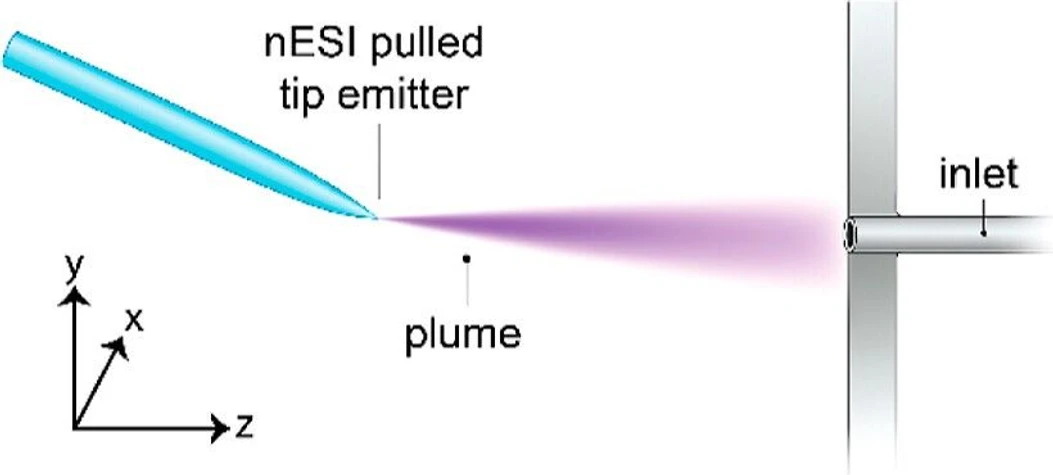
This study investigates the impact of emitter positioning on signal intensity in nanoflow electrospray ionization mass spectrometry. By systematically varying emitter position in three dimensions, the authors demonstrate that signal robustness improves at greater distances along the z-axis, with consistent performance maintained within 1–2 mm of the optimal position.

Signal behavior was consistent across the m/z range, indicating that precise repositioning for different analytes is unnecessary. These findings provide practical guidance for improving robustness and reproducibility in nanoflow LC–MS/MS proteomics workflows.

The original article

Regarding Emitter Positioning for Nanoflow Electrospray Ionization with a High-Capacity Inlet Capillary

Noah M. Lancaster, Scott T. Quarmby, Katherine A. Overmyer, and Joshua J. Coon*

J. Am. Soc. Mass Spectrom. 2026, 37, 3, 754–759

https://doi.org/10.1021/jasms.5c00441

licensed under CC-BY 4.0

Selected sections from the article follow. Formats and hyperlinks were adapted from the original.

Owing to its high sensitivity, nanoflow electrospray liquid chromatography coupled with tandem mass spectrometry (nESI-LC-MS/MS) is widely used for protein sequence analysis. (1,2) Whereas high-flow electrospray sources typically have relatively fixed emitter alignments and are more robust to changes in emitter positioning, nESI sources frequently require manual alignment in three dimensions. (3,4) Since the number of ions reaching the MS system can vary depending on the location of the nESI emitter, positioning is a critical aspect of achieving robust and reproducible results.

Multiple reports illustrate the relationship between emitter positioning and electrospray signal intensity; (2,4−10) however, these studies typically examine a single dimension or evaluate emitters and flow regimes not typical of shotgun proteomic workflows. To understand these relationships, we investigate here the effect of emitter positioning on signal intensity when using fused-silica capillaries with integrated emitters at a flow rate of 300 nL/min, a common choice across the field. (11−17) Experiments were conducted using an Orbitrap Ascend mass spectrometer, a notable example of instruments commonly used in proteome analysis, (18) which features a nanoflow source and asymmetric inlet capillary (high-capacity transfer tube, HCTT). This work represents, to our knowledge, the first report in the literature characterizing how emitter positioning impacts signal intensity for nanoflow electrospray ionization into an inlet capillary without radial symmetry.

Since most nESI emitters are manually positioned, understanding the precision in positioning that is required could assist in reducing batch-to-batch variation that is common in larger proteomic experiments. Further, recent efforts to improve the throughput of proteome analysis feature the use of multiple columns with multiple emitters aligned with the source at the same time. (19−23) By performing measurements in all three dimensions, this report provides insight for implementing such a multiemitter setup.

Experimental Section

Emitter positioning measurements were performed by infusing BSA peptides at 300 nL/min into an Orbitrap Ascend mass spectrometer (Thermo Scientific) using a fused silica capillary (360 μm O.D, 75 μm I.D.) with integrated emitter (∼10 μm opening). (24) The emitter was aligned to the inlet using the source camera and the x/y/z micrometer on a NanoSpray Flex source (Thermo Scientific). The origin of the coordinate system used here was defined as the center of the inlet capillary opening. In particular, the z = 0 plane is orthogonal to the opening of the inlet capillary, and the x = 0 and y = 0 planes are parallel to the inlet capillary axis. Top- and side-view images of the starting position are shown in Figure S2. Code used for data analysis is available at https://github.com/coongroup/EmitterPositioning. Raw data is available at MassIVE accession number MSV000100165. Additional experimental and data analysis details are described in the Supporting Information.

Results and Discussion

We characterized signal intensity dependence on emitter position for nanoflow electrospray by infusing a mixture of peptides generated via trypsin digestion of purified BSA in an Orbitrap-quadrupole linear ion trap hybrid mass spectrometer (Orbitrap Ascend Tribrid). To ensure LC–MS applicability, we used an emitter size (∼10 μm orifice) and flow rate (300 nL/min) identical to those typical of capillary LC–MS. (11−17) The resulting MS1 analysis produced numerous ions across the m/z range (Figure S3). We selected two of these ions, a doubly protonated species (LGEYGFQNALIVR at m/z 740.4) and a triply protonated species (RHPEYAVSVLLR at m/z 480.6), for their strong signal intensity and stability over the time range of the experiments here (Figures S4 and S5). With the above setup, we tracked those m/z peaks as a function of emitter position in three dimensions and recorded intensity distributions (Figure 1). Figure 1C presents the ion signal across x-positions, where the x = 0 plane is aligned to the central axis of the inlet capillary and the dashed lines depict the MS inlet opening width in this dimension (0.6 mm, Figure S6). (25,26) Strikingly, we observe that the signal is relatively stable and high across two millimeters of the x-dimension. Further, greater than 50% of the ion signal is retained at distances up to ∼five times the width of the inlet (i.e., full width half max (fwhm)). Figure 1D presents the same concept but in the y-dimension, where good signal stability is also observed across a similar length of two millimeters; however, the larger inlet opening in the y-dimension (1.6 mm) does not appear to proportionally impact the width of the intensity distribution. The ion plume is roughly symmetrical in both x- and y-dimensions; (8) therefore, it is expected that the smaller inlet width in the x-dimension would have a higher probability of being in the high density region of the plume than in the y-dimension. Proportional to inlet opening, the x position of the emitter would consequently have less of an effect on the intensity than the y position. We note the intensity distributions appear to be slightly off-center; however, we find the centroids of the distributions (−0.1 and 0.3 mm, x- and y-respectively, Figure S7) were within the tolerance of the micrometer. Figure 1E presents the ion intensities as a function of emitter position in the z-dimension. Impressively, signal continues to be observed up to ∼7 mm removed from the inlet at levels close to 50% of the highest. Not surprisingly, the highest signal is observed at the closest position, but, as noted above, that signal gradually declines with increasing distance. The relative intensities of these two peptide ions remain fairly constant at all observed z positions (Figure S8). Overall, identical trends were observed for both peptides over all dimensions. As these peptides are fairly high signal intensity, we wanted to confirm that the trends reported here were not biased by signal saturation, so we extracted signal intensities for low intensity features and compared the x, y, and z intensity distributions (Figure S9). This analysis confirms that these two peptides are representative of global trends for our tryptic peptide sample.
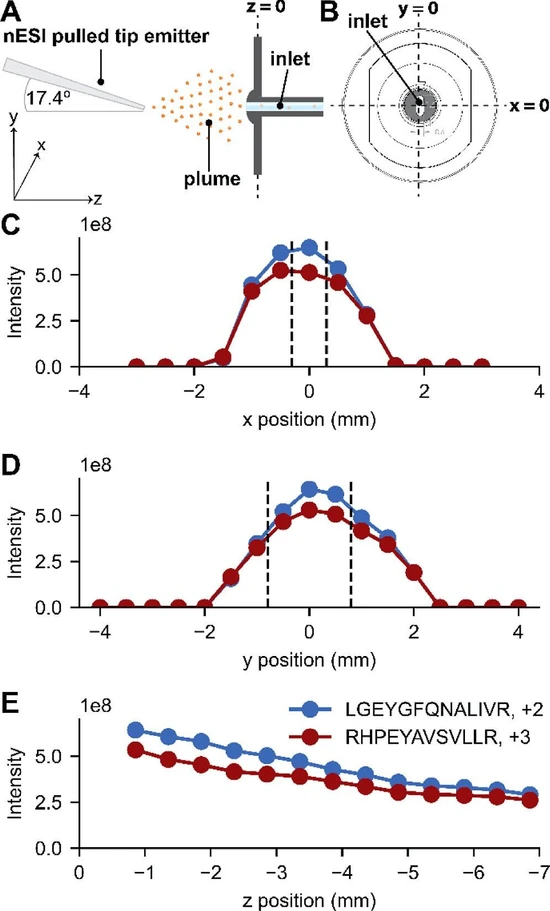
J. Am. Soc. Mass Spectrom. 2026, 37, 3, 754–759: Figure 1. 1D Positioning Experiments. (A) The x/y/z coordinate system used for this study. (B) An x/y perspective of the inlet with coordinate definitions. (C) Intensity dependence on x-position for two selected peptides (at y = 0 and z = −0.9). Dotted lines indicate the estimated position of the inlet capillary edges. (D) Intensity dependence on y-position for two selected peptides (at x = 0 and z = −0.9). Dotted lines indicate the estimated position of the inlet capillary edges. (E) Intensity dependence on z-position for two selected peptides (at x = 0 and y = 0).J. Am. Soc. Mass Spectrom. 2026, 37, 3, 754–759: Figure 1. 1D Positioning Experiments. (A) The x/y/z coordinate system used for this study. (B) An x/y perspective of the inlet with coordinate definitions. (C) Intensity dependence on x-position for two selected peptides (at y = 0 and z = −0.9). Dotted lines indicate the estimated position of the inlet capillary edges. (D) Intensity dependence on y-position for two selected peptides (at x = 0 and z = −0.9). Dotted lines indicate the estimated position of the inlet capillary edges. (E) Intensity dependence on z-position for two selected peptides (at x = 0 and y = 0).

Conclusions

We report the dependence of peptide signal intensity on emitter positioning for nanoflow electrospray. Specifically, within 1–2 mm in any dimension, one can achieve reasonably consistent and robust signal. Distinct intensity profiles we observed here for the x- and y-dimensions likely arise from the asymmetric shape of the ion capillary. We demonstrate improved robustness of signal intensity to x/y variation at increasing z distances, an observation that will be helpful for positioning multiple emitters, for example. (19−23)

We provide evidence that the effect of the emitter position on signal intensity does not strongly depend on the analyte for bottom-up proteomics analysis. This report provides insight into the role of emitter positioning on signal intensity for bottom-up proteomics and represents the first characterization of the effect of emitter position on electrospray signal intensity on an instrument with an inlet capillary lacking radial symmetry. Future areas of interest would be an examination of how trends vary across different flow rates or emitter types, as well as assessing how the exact intensity profiles vary across instruments with differences in their atmospheric interface.

LabRulez
LinkedIn Logo
 

Related content

UPLC™ Separation of Fifteen Bisphenols Using a Waters Acquity™ Biphenyl RP Column with MaxPeak™ Premier Technology and UV Detection

Applications
| 2026 | Waters
Instrumentation
Consumables, LC columns, HPLC
Manufacturer
Waters
Industries
Pharma & Biopharma

Achieving Low‑ppb Bisphenol Quantitation with the Agilent InfinityLab Pro iQ Mass Detector

Applications
| 2026 | Agilent Technologies
Instrumentation
LC/MS, LC/SQ
Manufacturer
Agilent Technologies
Industries
Materials Testing

ECL detection of fentanyl

Applications
| 2026 | Metrohm
Instrumentation
Electrochemistry
Manufacturer
Metrohm
Industries
Forensics

Early-stage drug metabolite quantitation without radiolabels

Applications
| 2026 | Thermo Fisher Scientific
Instrumentation
HPLC, LC/MS, LC/SQ
Manufacturer
Thermo Fisher Scientific
Industries
Pharma & Biopharma, Metabolomics

Oligonucleotide Analysis Using the Agilent InfinityLab Pro iQ and Altura Oligo HPH-C18 Column

Applications
| 2026 | Agilent Technologies
Instrumentation
LC/MS, LC/SQ, Consumables, LC columns
Manufacturer
Agilent Technologies
Industries
Pharma & Biopharma
 

Related articles

Coupling of Size Exclusion Chromatography to High Throughput Charge Detection Mass Spectrometry for the Analysis of Large Proteins and Virus-like Particles
Scientific article | Science and research

Coupling of Size Exclusion Chromatography to High Throughput Charge Detection Mass Spectrometry for the Analysis of Large Proteins and Virus-like Particles

This study enhances SEC-CD-MS for high-mass analysis by integrating high-throughput CD-MS and ultrawidepore SEC, enabling precise characterization of large biomolecules like VLPs and monoclonal antibodies.
LabRulez
tag
share
more
Hydrophilic Interaction Chromatography HRMS with Acrylamide Monolithic Columns: A Novel Approach for Intact Antibody Glycoform Characterization
Scientific article | Science and research

Hydrophilic Interaction Chromatography HRMS with Acrylamide Monolithic Columns: A Novel Approach for Intact Antibody Glycoform Characterization

This study introduces acrylamide monolith HILIC-MS for intact mAb glycoprofiling, offering high selectivity, baseline separation, and detection of low-abundance glycoforms missed by RPLC-MS.
LabRulez
tag
share
more
Implementation of Infrared-Activated Negative Electron Transfer Dissociation (IR-NETD) Using Xenon on a Quadrupole-Orbitrap-Quadrupole Linear Ion Trap Mass Spectrometer
Scientific article | Science and research

Implementation of Infrared-Activated Negative Electron Transfer Dissociation (IR-NETD) Using Xenon on a Quadrupole-Orbitrap-Quadrupole Linear Ion Trap Mass Spectrometer

This study reports the first implementation of IR-activated NETD with xenon on a quadrupole-Orbitrap MS, demonstrating improved RNA fragmentation and biopharmaceutical characterization.
LabRulez
tag
share
more
Imaging of Protein Assemblies up to 231 kDa in Tissues with Nano-DESI Mass Spectrometry
Scientific article | Science and research

Imaging of Protein Assemblies up to 231 kDa in Tissues with Nano-DESI Mass Spectrometry

This study extends nano-DESI mass spectrometry imaging to intact protein assemblies up to 231 kDa, enabling direct identification of large complexes in tissue.
LabRulez
tag
share
more
 

Related content

UPLC™ Separation of Fifteen Bisphenols Using a Waters Acquity™ Biphenyl RP Column with MaxPeak™ Premier Technology and UV Detection

Applications
| 2026 | Waters
Instrumentation
Consumables, LC columns, HPLC
Manufacturer
Waters
Industries
Pharma & Biopharma

Achieving Low‑ppb Bisphenol Quantitation with the Agilent InfinityLab Pro iQ Mass Detector

Applications
| 2026 | Agilent Technologies
Instrumentation
LC/MS, LC/SQ
Manufacturer
Agilent Technologies
Industries
Materials Testing

ECL detection of fentanyl

Applications
| 2026 | Metrohm
Instrumentation
Electrochemistry
Manufacturer
Metrohm
Industries
Forensics

Early-stage drug metabolite quantitation without radiolabels

Applications
| 2026 | Thermo Fisher Scientific
Instrumentation
HPLC, LC/MS, LC/SQ
Manufacturer
Thermo Fisher Scientific
Industries
Pharma & Biopharma, Metabolomics

Oligonucleotide Analysis Using the Agilent InfinityLab Pro iQ and Altura Oligo HPH-C18 Column

Applications
| 2026 | Agilent Technologies
Instrumentation
LC/MS, LC/SQ, Consumables, LC columns
Manufacturer
Agilent Technologies
Industries
Pharma & Biopharma
 

Related articles

Coupling of Size Exclusion Chromatography to High Throughput Charge Detection Mass Spectrometry for the Analysis of Large Proteins and Virus-like Particles
Scientific article | Science and research

Coupling of Size Exclusion Chromatography to High Throughput Charge Detection Mass Spectrometry for the Analysis of Large Proteins and Virus-like Particles

This study enhances SEC-CD-MS for high-mass analysis by integrating high-throughput CD-MS and ultrawidepore SEC, enabling precise characterization of large biomolecules like VLPs and monoclonal antibodies.
LabRulez
tag
share
more
Hydrophilic Interaction Chromatography HRMS with Acrylamide Monolithic Columns: A Novel Approach for Intact Antibody Glycoform Characterization
Scientific article | Science and research

Hydrophilic Interaction Chromatography HRMS with Acrylamide Monolithic Columns: A Novel Approach for Intact Antibody Glycoform Characterization

This study introduces acrylamide monolith HILIC-MS for intact mAb glycoprofiling, offering high selectivity, baseline separation, and detection of low-abundance glycoforms missed by RPLC-MS.
LabRulez
tag
share
more
Implementation of Infrared-Activated Negative Electron Transfer Dissociation (IR-NETD) Using Xenon on a Quadrupole-Orbitrap-Quadrupole Linear Ion Trap Mass Spectrometer
Scientific article | Science and research

Implementation of Infrared-Activated Negative Electron Transfer Dissociation (IR-NETD) Using Xenon on a Quadrupole-Orbitrap-Quadrupole Linear Ion Trap Mass Spectrometer

This study reports the first implementation of IR-activated NETD with xenon on a quadrupole-Orbitrap MS, demonstrating improved RNA fragmentation and biopharmaceutical characterization.
LabRulez
tag
share
more
Imaging of Protein Assemblies up to 231 kDa in Tissues with Nano-DESI Mass Spectrometry
Scientific article | Science and research

Imaging of Protein Assemblies up to 231 kDa in Tissues with Nano-DESI Mass Spectrometry

This study extends nano-DESI mass spectrometry imaging to intact protein assemblies up to 231 kDa, enabling direct identification of large complexes in tissue.
LabRulez
tag
share
more
 

Related content

UPLC™ Separation of Fifteen Bisphenols Using a Waters Acquity™ Biphenyl RP Column with MaxPeak™ Premier Technology and UV Detection

Applications
| 2026 | Waters
Instrumentation
Consumables, LC columns, HPLC
Manufacturer
Waters
Industries
Pharma & Biopharma

Achieving Low‑ppb Bisphenol Quantitation with the Agilent InfinityLab Pro iQ Mass Detector

Applications
| 2026 | Agilent Technologies
Instrumentation
LC/MS, LC/SQ
Manufacturer
Agilent Technologies
Industries
Materials Testing

ECL detection of fentanyl

Applications
| 2026 | Metrohm
Instrumentation
Electrochemistry
Manufacturer
Metrohm
Industries
Forensics

Early-stage drug metabolite quantitation without radiolabels

Applications
| 2026 | Thermo Fisher Scientific
Instrumentation
HPLC, LC/MS, LC/SQ
Manufacturer
Thermo Fisher Scientific
Industries
Pharma & Biopharma, Metabolomics

Oligonucleotide Analysis Using the Agilent InfinityLab Pro iQ and Altura Oligo HPH-C18 Column

Applications
| 2026 | Agilent Technologies
Instrumentation
LC/MS, LC/SQ, Consumables, LC columns
Manufacturer
Agilent Technologies
Industries
Pharma & Biopharma
 

Related articles

Coupling of Size Exclusion Chromatography to High Throughput Charge Detection Mass Spectrometry for the Analysis of Large Proteins and Virus-like Particles
Scientific article | Science and research

Coupling of Size Exclusion Chromatography to High Throughput Charge Detection Mass Spectrometry for the Analysis of Large Proteins and Virus-like Particles

This study enhances SEC-CD-MS for high-mass analysis by integrating high-throughput CD-MS and ultrawidepore SEC, enabling precise characterization of large biomolecules like VLPs and monoclonal antibodies.
LabRulez
tag
share
more
Hydrophilic Interaction Chromatography HRMS with Acrylamide Monolithic Columns: A Novel Approach for Intact Antibody Glycoform Characterization
Scientific article | Science and research

Hydrophilic Interaction Chromatography HRMS with Acrylamide Monolithic Columns: A Novel Approach for Intact Antibody Glycoform Characterization

This study introduces acrylamide monolith HILIC-MS for intact mAb glycoprofiling, offering high selectivity, baseline separation, and detection of low-abundance glycoforms missed by RPLC-MS.
LabRulez
tag
share
more
Implementation of Infrared-Activated Negative Electron Transfer Dissociation (IR-NETD) Using Xenon on a Quadrupole-Orbitrap-Quadrupole Linear Ion Trap Mass Spectrometer
Scientific article | Science and research

Implementation of Infrared-Activated Negative Electron Transfer Dissociation (IR-NETD) Using Xenon on a Quadrupole-Orbitrap-Quadrupole Linear Ion Trap Mass Spectrometer

This study reports the first implementation of IR-activated NETD with xenon on a quadrupole-Orbitrap MS, demonstrating improved RNA fragmentation and biopharmaceutical characterization.
LabRulez
tag
share
more
Imaging of Protein Assemblies up to 231 kDa in Tissues with Nano-DESI Mass Spectrometry
Scientific article | Science and research

Imaging of Protein Assemblies up to 231 kDa in Tissues with Nano-DESI Mass Spectrometry

This study extends nano-DESI mass spectrometry imaging to intact protein assemblies up to 231 kDa, enabling direct identification of large complexes in tissue.
LabRulez
tag
share
more
 

Related content

UPLC™ Separation of Fifteen Bisphenols Using a Waters Acquity™ Biphenyl RP Column with MaxPeak™ Premier Technology and UV Detection

Applications
| 2026 | Waters
Instrumentation
Consumables, LC columns, HPLC
Manufacturer
Waters
Industries
Pharma & Biopharma

Achieving Low‑ppb Bisphenol Quantitation with the Agilent InfinityLab Pro iQ Mass Detector

Applications
| 2026 | Agilent Technologies
Instrumentation
LC/MS, LC/SQ
Manufacturer
Agilent Technologies
Industries
Materials Testing

ECL detection of fentanyl

Applications
| 2026 | Metrohm
Instrumentation
Electrochemistry
Manufacturer
Metrohm
Industries
Forensics

Early-stage drug metabolite quantitation without radiolabels

Applications
| 2026 | Thermo Fisher Scientific
Instrumentation
HPLC, LC/MS, LC/SQ
Manufacturer
Thermo Fisher Scientific
Industries
Pharma & Biopharma, Metabolomics

Oligonucleotide Analysis Using the Agilent InfinityLab Pro iQ and Altura Oligo HPH-C18 Column

Applications
| 2026 | Agilent Technologies
Instrumentation
LC/MS, LC/SQ, Consumables, LC columns
Manufacturer
Agilent Technologies
Industries
Pharma & Biopharma
 

Related articles

Coupling of Size Exclusion Chromatography to High Throughput Charge Detection Mass Spectrometry for the Analysis of Large Proteins and Virus-like Particles
Scientific article | Science and research

Coupling of Size Exclusion Chromatography to High Throughput Charge Detection Mass Spectrometry for the Analysis of Large Proteins and Virus-like Particles

This study enhances SEC-CD-MS for high-mass analysis by integrating high-throughput CD-MS and ultrawidepore SEC, enabling precise characterization of large biomolecules like VLPs and monoclonal antibodies.
LabRulez
tag
share
more
Hydrophilic Interaction Chromatography HRMS with Acrylamide Monolithic Columns: A Novel Approach for Intact Antibody Glycoform Characterization
Scientific article | Science and research

Hydrophilic Interaction Chromatography HRMS with Acrylamide Monolithic Columns: A Novel Approach for Intact Antibody Glycoform Characterization

This study introduces acrylamide monolith HILIC-MS for intact mAb glycoprofiling, offering high selectivity, baseline separation, and detection of low-abundance glycoforms missed by RPLC-MS.
LabRulez
tag
share
more
Implementation of Infrared-Activated Negative Electron Transfer Dissociation (IR-NETD) Using Xenon on a Quadrupole-Orbitrap-Quadrupole Linear Ion Trap Mass Spectrometer
Scientific article | Science and research

Implementation of Infrared-Activated Negative Electron Transfer Dissociation (IR-NETD) Using Xenon on a Quadrupole-Orbitrap-Quadrupole Linear Ion Trap Mass Spectrometer

This study reports the first implementation of IR-activated NETD with xenon on a quadrupole-Orbitrap MS, demonstrating improved RNA fragmentation and biopharmaceutical characterization.
LabRulez
tag
share
more
Imaging of Protein Assemblies up to 231 kDa in Tissues with Nano-DESI Mass Spectrometry
Scientific article | Science and research

Imaging of Protein Assemblies up to 231 kDa in Tissues with Nano-DESI Mass Spectrometry

This study extends nano-DESI mass spectrometry imaging to intact protein assemblies up to 231 kDa, enabling direct identification of large complexes in tissue.
LabRulez
tag
share
more
Other projects
GCMS
ICPMS
Follow us
FacebookX (Twitter)LinkedInYouTube
More information
WebinarsAbout usContact usTerms of use
LabRulez s.r.o. All rights reserved. Content available under a CC BY-SA 4.0 Attribution-ShareAlike