Exploring Protein Purification Methods: Essential Techniques for Accurate Results

Phenomenex: Exploring Protein Purification Methods: Essential Techniques for Accurate Results
Purifying the target protein is crucial for investigating its specific properties and interactions with biomolecules like DNA, RNA, and other proteins. A range of purification strategies is available, and the optimal approach depends on factors such as the required scale, throughput, and downstream application. In many cases, the process must be fine-tuned through empirical optimization to achieve the desired purity and yield.
What is Protein Purification?
Protein purification is a critical process in biotechnology and life sciences, aimed at isolating a specific protein from complex biological mixtures such as cell lysates or tissue extracts. The goal is to obtain a highly purified protein sample, free from contaminants like other proteins, nucleic acids, and lipids, to enable accurate analysis of its structure, function, and interactions.
This process is especially vital in biotechnological areas inside immunology and microbiology. In immunology, it underpins the production of vaccines, therapeutic antibodies, and diagnostic assays by enabling the isolation of key immune proteins and antibodies. It also supports the investigation of cell signaling and immune response mechanisms. In microbiology, purified proteins are essential for studying pathogens, identifying disease-related antigens, and driving drug discovery efforts. Ultimately, protein purification is fundamental to the development of targeted vaccines, innovative diagnostics, and effective therapeutic strategies.
Types of Protein Purification Methods
There are several types of protein purification methods, each chosen based on the protein’s characteristics such as size, charge, solubility, and binding affinity. Below are some commonly used methods:
Non-Chromatographic Approaches
Non-chromatographic approaches use simpler physicochemical principles—such as solubility, molecular size, or diffusional properties—to separate and purify proteins. These techniques are often employed as initial purification or concentration steps before further refinement.
Precipitation Techniques
Protein precipitation is a widely used approach in purification workflows, typically relying on one of three main methods:
- Organic solvent precipitation involves adding solvents like ethanol or acetone to lower the solution's dielectric constant. This promotes protein–protein interactions, reducing solubility and leading to aggregation and precipitation.
- Isoelectric point precipitation exploits the pH at which a protein carries no net charge. At this point, solubility is minimized, causing the protein to precipitate from solution.
- Nonionic polymer precipitation uses polymers such as dextran, polyethylene glycol (PEG), or NPEP to alter the solution’s physical properties. These agents create crowding effects that promote protein aggregation without directly binding to the proteins.
Dialysis
Dialysis involves placing a protein solution inside a semi-permeable membrane that allows water and ions to pass while the protein remains inside, facilitating buffer exchange.This method is commonly used during protein expression and purification workflows for buffer exchange, desalting, and removal of unwanted small molecules such as imidazole, urea, or ammonium sulfate. The process helps maintain protein stability and activity by gradually equilibrating the sample with the desired buffer conditions.
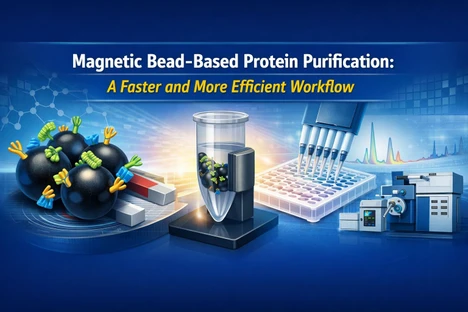
Immunocapture (Magnetic Bead-Based Purification
Immunocapture uses antibodies immobilized on solid supports like magnetic beads to selectively bind and isolate a target protein. This method is highly specific and particularly useful for low-abundance targets or small-scale prep, such as:
- Pulling down proteins from complex mixtures
- Capturing tagged recombinant proteins (e.g., FLAG, HA, or His tags)
- Enrichment before western blotting, MS, or ELISA
Magnetic beads offer speed, ease of use, and minimal sample loss, making them ideal for lab-scale workflows.
Biozen MagBeads provide a fast and efficient method for purifying, isolating, and cleaning up monoclonal antibodies (mAbs), proteins, and peptides. These paramagnetic beads feature a streptavidin-coated surface, enabling high-affinity binding in immuno-based workflows. Compared to traditional sample preparation techniques, magnetic bead-based immunocapture offers greater speed and consistency by delivering high binding capacity with uniform particle size, ensuring accurate and reproducible results in significantly less time.
Centrifugation
Centrifugation of crude protein mixtures is an essential step in the investigation of protein purification and aggregation. Outlined below are the various types of centrifugations employed in protein purification.
Preparative Ultracentrifugation
Ultracentrifugation is an effective method of purifying proteins from aggregates based on their size, shape and density. Centrifugation, widely recognized as a robust and versatile method, is commonly used to separate complex mixtures of cellular components. Ultracentrifuges separate small particles by spinning at high speeds, utilizing centrifugal force based on size and density.
Differential Centrifugation
Differential centrifugation operates by separating components based on differences in size and density, using varying speeds of centrifugation to achieve this. Its resolving power ranges from low to medium. A key advantage of this technique is its convenience for processing multiple samples simultaneously, making it effective for purifying crude samples. Additionally, it preserves cell viability and maintains the natural distribution of hematopoietic cell populations.
Rate-zonal Gradient Centrifugation
This technique separates components based on their sedimentation rate within a medium that contains a density gradient. It offers medium resolving power and is particularly effective for separating multiple components in complex mixtures with high precision. It is also considered a cost-effective and widely used technique in molecular biology and biochemistry.
Isopycnic Centrifugation (Equilibrium Centrifugation)
Isopycnic centrifugation is an advanced protein purification method that relies on the principle of separating particles according to their intrinsic buoyant density, irrespective of their size or morphology. During the process, proteins migrate through a density gradient until they equilibrate at a position where their density matches that of the surrounding medium, resulting in precise separation without further sedimentation.
Chromatographic Approaches
Chromatography is a common method of protein purification and is based on the separation of molecules in a mixture as they move through a stationary phase and a mobile phase. Outlined below are the various types of chromatography employed in protein purification.
Ion Exchange Chromatography
Ion exchange chromatography relies on the interaction between a charged stationary phase and oppositely charged analytes, with cation exchange chromatography attracting positively charged molecules to a negatively charged stationary phase. Successful application of this technique requires careful selection of the appropriate ion exchange column, buffer pH, and salt concentration. This approach is often used in the biopharmaceutical industries as mAb polishing steps, viral clearance and charge variant analyses as part of the product quality control.
Phenomenex offers a range of protein purification columns. Their ion exchange chromatography solutions include:
- Luna SCX for strong selectivity of positively charged compounds, such as peptides
- Biozen WCX for efficient separation of proteins such as monoclonal antibodies charged variants
- PhenoSphere SAX, a strong anion-exchanger with fully porous 80Å particles, particularly useful for small molecules such as nucleotides
Size Exclusion Chromatography
Size exclusion chromatography (SEC) separates molecules based on their size, with larger analytes eluting first due to their exclusion from the pores in the column packing material, while smaller molecules are able to enter the pores, facing a longer travelling path, and hence, eluting later. This method can be categorized into aqueous SEC (gel filtration chromatography, GFC) for analyzing biomolecules such as proteins and antibodies. This type of chromatography is widely used as an analytical tool for quality control in the biopharmaceutical industry and can also be an approach of choice for polishing steps.
Phenomenex offers a range of Biozen columns for SEC separations. In the case of mAbs, Biozen dSEC-2 and Biozen dSEC-7 columns are the top choices for monoclonal antibody (mAb) analysis, delivering high-resolution separation of monomers, aggregates, and fragments formed during mAb manufacturing, processing, or storage. The dSEC-7 column, featuring a larger pore size and optimized particle design, extends the dynamic range to accommodate larger biomolecules and complex biotherapeutics.
For more general applications, Biozen SEC-2 and Biozen SEC-3 phases cover different MW ranges for high-efficiency separation of biomolecules (e.g., proteins and antibodies). Additionally, the BioSep and Yarra lines become top choices when looking for preparative scale columns.
Reversed-Phase Chromatography
Reversed-phase chromatography, the most common mode in high-performance liquid chromatography/ ultra-high-performance liquid chromatography (HPLC/UHPLC), separates compounds based on hydrophobic and van der Waals interactions using alkyl (C18, C8, C4) stationary phases or other hydrophobic polymers. For large biomolecules such as proteins and peptides, wide-pore (typically 300 Å) C4, C8 and C18 columns are ideal, as the larger pore size allows better accessibility of the protein molecules to the stationary phase surface, improving mass transfer and peak shape during separation.
The Biozen line from Phenomenex offers a wide range of HPLC/UHPLC columns for the analysis of biomolecules.These include phases optimized for high-resolution analysis of intact proteins (Native-RP, Widepore C4, Intact XB-C8) and peptides (Peptide PS-C18, Peptide XB-C18 and Peptide Polar-C18). Kinetex could also be an option when looking for more selectivities for the analysis of peptides and small proteins. Additionally, when aiming to preparative scale processes, several of these media are also available in Phenomenex Axia formats to easily up-scale your separations.
Hydroxyapatite Chromatography
Hydroxyapatite chromatography (HAC) is a sophisticated mixed-mode chromatographic technique that exploits the unique properties of hydroxyapatite (Ca10(PO4)6(OH)2), utilizing both cation-exchange interactions via its phosphate groups and metal affinity through its calcium sites to achieve highly selective protein separations.
Renowned for its efficacy in resolving complex biomolecular separations, HAC excels in tasks like aggregate removal from monoclonal antibodies, surpassing the capabilities of traditional single-mode chromatographic methods such as ion-exchange or hydrophobic interaction chromatography.
Hydrophobic Interaction Chromatography
Hydrophobic interaction chromatography (HIC) is a method of protein purification that separates molecules based on their hydrophobicity, using high-salt buffers to promote protein-ligand interactions while maintaining the protein's biological activity. The process involves gradually reducing the salt concentration to elute proteins in order to increase hydrophobicity, making it effective for purifying target molecules and removing impurities or aggregates, making it a valuable approach for intermediate and polishing steps during purification processes.
Affinity Chromatography
Affinity chromatography is a powerful and highly selective technique used to purify biomolecules based on specific, reversible interactions between a target molecule and an immobilized ligand. In many cases, recombinant proteins are engineered with affinity tags—such as His-tags or GST-tags—that facilitate binding to complementary ligands on the chromatography matrix.
This method offers the advantage of achieving several thousand-fold purifications in a single step while preserving the biological activity of the protein. It is widely employed for purifying enzymes, antibodies, and antigens, using a variety of ligands including specific antibodies, enzymes, and multifunctional compounds like concanavalin A and triazine dyes.